
The Cognitive Cost of Clinical Interruptions: Why Unified Clinical Communication Matters for Patient Care?

During my years as a surgeon in the Air Force, I learned something that applies to every clinical environment I have worked in since: you cannot make precise decisions under constant noise. In the operating room, we protect against interruptions deliberately. The room quiets. Tasks are sequenced. The cognitive environment is guarded because the consequences […]
The Coordination Tax: What’s Really Eating Your Clinical Day
In this episode of The Connected Practice, Dr. Kevin Halow, surgeon, veteran, co-founder, and Chief Medical Officer of ClinicianCore, introduces the concept of the “coordination tax”—the invisible overhead created when physicians spend valuable clinical time navigating fragmented communication systems.
Drawing from his experience in surgical practice, Dr. Halow explores how disconnected phones, EHRs, portals, routing systems, and departmental workflows force physicians to become the communication hub for their practice. The episode examines the difference between documentation burden and coordination burden, the impact of fragmented communication on clinical efficiency and burnout, and why solving the problem requires infrastructure rather than another standalone messaging tool.
The episode also introduces HCO Practice HQ, ClinicianCore’s organizational communication module designed around intelligent, role-aware routing and secure intra-office communication
Intra-Office Communication Breakdown: How Fragmented Channels Create a Daily Tax on Physician Time
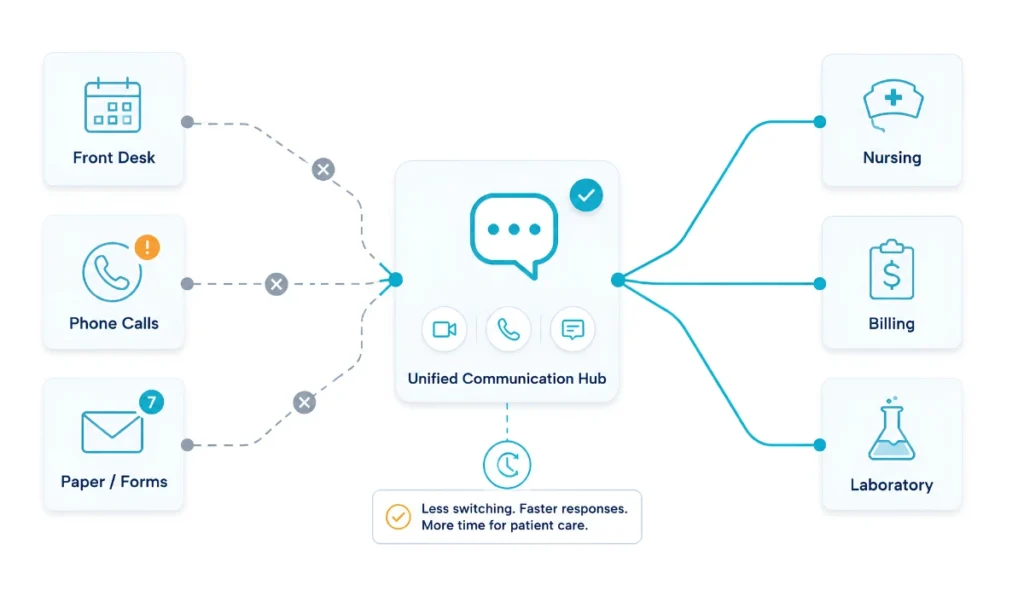
Every morning in an independent physician practice, the coordination work begins before the first exam room door opens. A routing slip sits at the front desk waiting for a response.
Asynchronous Communication in Medicine: How I Restructured My Workflow to Reduce Stress and Save Time

During my years in practice, first as an Air Force surgeon and later running an independent group, I operated under an unspoken rule: respond to everything immediately.
ClinicianCore Platform Walkthrough: A Demo with Dr. Kevin Halow, MD MBA
n this special platform walkthrough, Dr. Kevin Halow, MD MBA, Co-Founder and Chief Medical Officer of ClinicianCore, provides a screen-by-screen demonstration of the ClinicianCore platform and how it is designed around the way physicians actually communicate and work.
The episode walks through the Priority Box, HCO Practice HQ, HCC Consult Core, Physician Lounge, secure chat, encrypted audio and video calls, live CPT documentation, and the built-in AI assistant. Dr. Halow demonstrates how ClinicianCore brings clinical communication into one unified, HIPAA-compliant environment while helping physicians prioritize urgent information, document consultations, and reduce administrative friction.
The walkthrough ultimately positions ClinicianCore as more than a messaging application—a physician-centric unified communication network designed to streamline clinical workflows, support revenue capture, strengthen secure collaboration, and help physicians spend less time managing communication infrastructure and more time practicing medicine.
Care Transition Failures and Hospital Readmission Risk: What the Evidence Shows
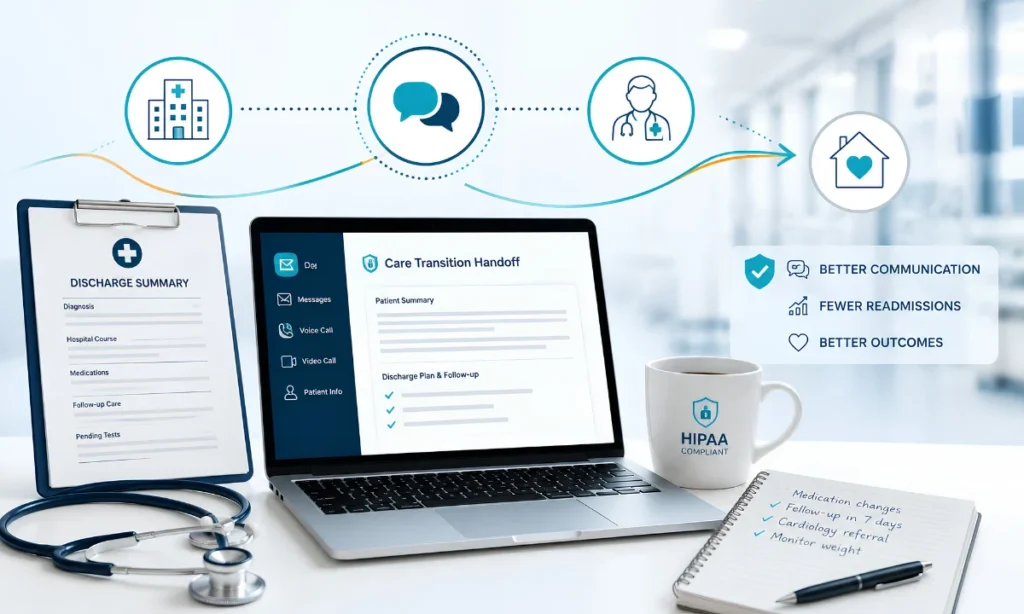
Every discharge is a transfer of trust. The hospital physician hands a patient to the community physician and assumes the clinical story travels with them. Too often, it does not.
Beyond Secure Chat: The Journey to an AI-Native Clinical Communication Platform
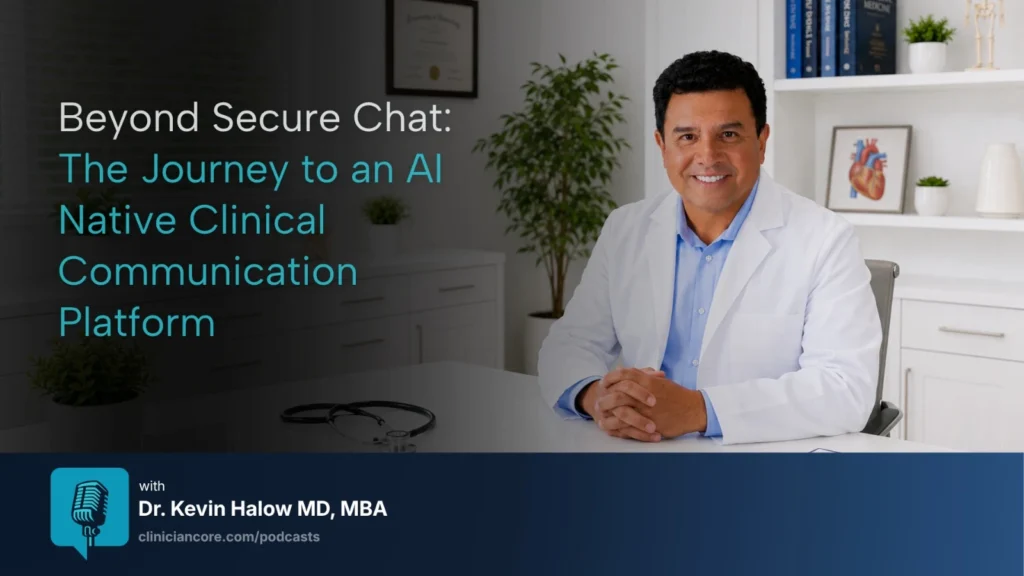
In this episode of The Connected Practice, Dr. Kevin Halow, Co-Founder and Chief Medical Officer of ClinicianCore, explores why healthcare needs to move beyond traditional secure messaging toward an AI-native clinical communication platform.
The episode examines how fragmented communication tools, constant alerts, administrative friction, and documentation demands contribute to physician burnout. Dr. Halow explains how an AI-native approach can address these challenges through smart alert routing, unified voice/video/text communication, ambient clinical intelligence, and physician-centric collaboration.
He also explores the four key pillars of the ClinicianCore ecosystem: HCO for unified organizational communication, HCC for healthcare collaboration and consultation workflows, HCX for professional and industry exchange, and the Physician Lounge for trusted physician-to-physician connection.
Ultimately, the episode looks at how intelligent communication orchestration can reduce cognitive overload, simplify documentation, strengthen clinical collaboration, and help restore the joy of practicing medicine
From a Scratchpad to ClinicianCore | Dr. Kevin Halow MD (Founder Story)

The idea that became ClinicianCore did not start in a venture capital boardroom or a Silicon Valley incubator. It started in a surgery committee meeting when I was the chief of surgery.
Joint Commission Patient Handoff Guide (2026)
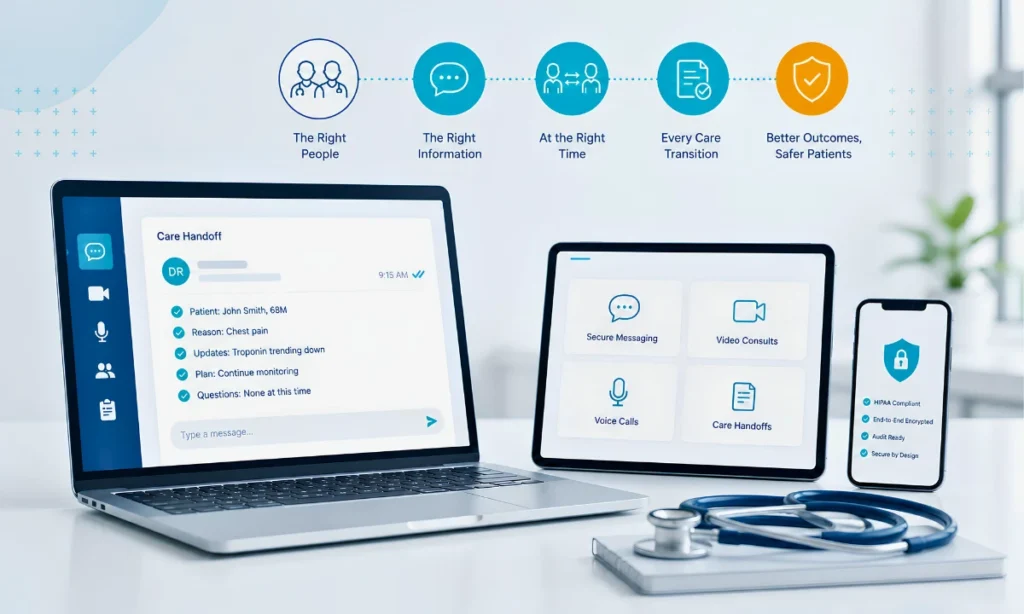
Care handoff documentation Joint Commission 2026 requirements are governed by NPSG.02.05.01, the National Patient Safety Goal requiring structured handoff communication at every care transition. Most physicians believe that thorough verbal summaries, supplemented by EHR notes, satisfy this standard. Under the current Comprehensive Accreditation Manual, they do not.
The $180,000 Conversation That Never Happened

In this episode of The Connected Practice, Dr. Kevin Halow, Co-Founder and Chief Medical Officer of ClinicianCore, explores why FHIR-native clinical communication is becoming an important operational requirement for healthcare organizations in 2026.
He explains how fragmented EHR systems and disconnected applications create interoperability challenges, administrative burden, and communication friction for physicians. The episode examines APIs, HL7 FHIR, SMART on FHIR, and CMS-0057-F, along with the changing requirements around prior authorization.
Dr. Halow also discusses how ClinicianCore is building an intelligent communication layer designed to connect clinical workflows with compliant healthcare systems. From HCC Consult Core and billable consultations to HCX communication and the Physician Lounge, the episode explores how interoperable infrastructure can support unified clinical communication, medical practice efficiency, HIPAA-compliant collaboration, and physician burnout reduction.