Care handoff documentation Joint Commission 2026 requirements are governed by NPSG.02.05.01, the National Patient Safety Goal requiring structured handoff communication at every care transition. Most physicians believe that thorough verbal summaries, supplemented by EHR notes, satisfy this standard. Under the current Comprehensive Accreditation Manual, they do not.
The Joint Commission’s Sentinel Event Alert data consistently identify handoff communication failures as among the most cited contributing factors in serious reportable events. A 2023 Joint Commission review found that communication breakdowns at care transitions contributed to adverse outcomes in over 70% of sentinel event cases examined. The documentation gap between what the standard requires and what most organizations actually produce is systematic, not incidental.
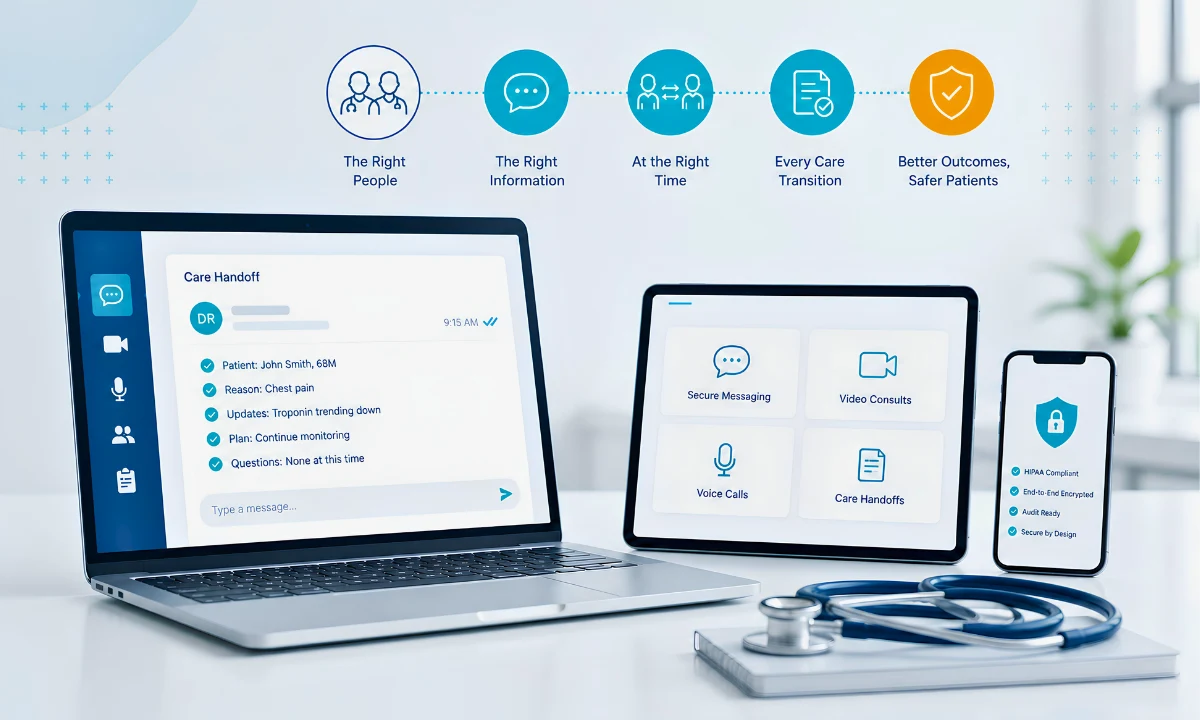
ClinicianCore is a secure, HIPAA-compliant unified clinical communication platform built exclusively for physicians. The ConsultCore directly supports your efforts by maintaining a persistent, timestamped, tamper-evident patient handoff thread at every care transition, helping you confidently meet NPSG. 02.05.01 without restructuring existing workflows.
This guide covers what NPSG.02.05.01 requires how surveyors assess compliance in 2026, where I-PASS fits, and why verbal-only handoffs consistently fail.
Key Takeaways
- NPSG.02.05.01 requires structured, interactive, and documented handoff communication at every care transition; verbal summaries alone are insufficient.
- According to the Joint Commission Sentinel Event Alert (2023), communication failures at care transitions contributed to adverse outcomes in over 70% of sentinel event cases reviewed.
- I-PASS is the most validated structured handoff protocol, but the Joint Commission does not mandate it. The standard is methodology-neutral and requires documented structured communication.
- According to AHRQ (2024), physicians implementing structured handoff protocols with documentation reduced handoffs with missing information by 23.7% compared to baseline.
- ClinicianCore, a secure, HIPAA-compliant unified clinical communication platform built exclusively for physicians, addresses NPSG.02.05.01 through HCC’s persistent shared patient thread, timestamped, tamper-evident, and auditable at every transition.
- For a complete HIPAA-compliant handoff infrastructure, see ClinicianCore’s HIPAA-compliant collaboration platform.
What Is NPSG.02.05.01 and Why Does It Exist?
NPSG.02.05.01 is the Joint Commission National Patient Safety Goal addressing handoff communication. It was established following the Joint Commission analysis identifying communication breakdowns at care transitions as a primary contributor to preventable patient harm. The standard applies to all Joint Commission-accredited physicians and healthcare organizations.
The requirement specifies four components that must be present in any compliant handoff:
- Handoff information must be standardized across the organization
- The handoff process must allow for interactive communication between the sending and receiving clinicians
- Information transferred must be limited to what is essential, reducing cognitive overload at transition
- The receiving clinician must have the opportunity to ask questions before assuming care
NPSG.02.05.01 does not prescribe a specific technology or named protocol. It mandates outcomes: structured, interactive, documented communication. The distinction between what the standard requires and what most physicians actually do is the compliance gap this post addresses.
According to the Agency for Healthcare Research and Quality (AHRQ) in their report in 2023, communication failures during care transitions contribute to approximately 30% of preventable adverse events in hospital settings. NPSG.02.05.01 exists to create an auditable, structured process that closes that gap systematically.
The standard’s emphasis on documentation is often misunderstood as a mere technicality. It is vital because it makes compliance verifiable and builds trust in your processes, a responsibility that most organizations need to strengthen.
What Joint Commission Handoff Compliance Actually Requires in 2026
The Joint Commission’s 2026 survey process for NPSG.02.05.01 focuses on three elements that many organizations still address incompletely.
Structured standardization. The organization must demonstrate that a consistent handoff process exists and is followed across departments, care settings, and shifts. Ad hoc verbal summaries, regardless of how thorough, do not satisfy this element without evidence of standardized application. Surveyors expect written policies, training documentation, and consistent implementation across surveys.
Interactive communication. NPSG.02.05.01 explicitly requires that the receiving clinician be able to ask questions and receive responses before assuming care. A one-way information transfer including a detailed EHR note, does not satisfy this element without evidence of bidirectional exchange.
The standard requires that handoff communication be documented in a retrievable, contemporaneous format, such as structured EHR entries or standardized templates, to ensure verifiability. A retrospective note entered after the transfer does not meet this requirement, so organizations should implement specific documentation methods like real-time structured notes or checklists to achieve compliance.
The CMS Conditions of Participation (2024) add a parallel regulatory layer: care transition documentation must be available to the receiving care team before care assumption. Combined with Joint Commission requirements, organizations face dual audit exposure when documentation is absent or retrospective.
For a broader view of how communication failures at transitions affect patient safety and organizational risk, see this analysis of clinical communication failures in healthcare.
How Is NPSG.02.05.01 Surveyed in 2026?
Joint Commission surveyors assessing NPSG.02.05.01 compliance use the Tracer methodology. Surveyors identify patients currently in a care transition from the emergency department to an inpatient unit, from the operating room to a floor, from inpatient to post-acute care and trace the communication record backward from the receiving team to the sending team.
What surveyors look for during a Tracer:
- A written policy defining the organization’s standardized handoff protocol
- Staff who can describe and demonstrate the protocol when asked
- Documentation confirming the handoff occurred concurrent with the transition
- Evidence that the receiving clinician had the opportunity for interactive exchange
- Confirmation that essential clinical information was transferred per the organization’s defined standard
The Joint Commission SAFER Matrix (2024) classifies handoff documentation failures as high-risk findings when they occur at multiple transition points or when the documentation gap is systematic. A single undocumented handoff may result in a Requirement for Improvement. A pattern of verbal-only handoffs across a department constitutes a more serious finding, particularly when a patient safety event can be traced to a transition.
Surveyors may also review EHR audit logs. An EHR note entered after a transfer is complete may be flagged as insufficient evidence of concurrent structured handoff communication. The timestamp matters.
The I-PASS Handoff Structure and Its Relationship to Joint Commission Requirements
I-PASS stands for Illness severity, Patient summary, Action list, Situation awareness and contingency planning, and Synthesis by receiver. It is the most rigorously validated structured handoff protocol in published clinical literature.
The NEJM (2023) multicenter study on handoff documentation and readmission demonstrated that structured handoff protocols with documented receiver synthesis reduced preventable readmission events by a statistically significant margin across participating hospital systems. The synthesis step, the receiving clinician’s written confirmation of understood handoff, is what distinguishes I-PASS from informal verbal handoffs in both clinical outcome research and audit compliance.
The Joint Commission does not mandate I-PASS specifically. NPSG.02.05.01 is methodology-neutral. An organization may use SBAR, I-PASS, a locally developed protocol, or any structured approach, provided the process is standardized, interactive, and documented. The AHRQ (2024) recommends I-PASS as a best-practice implementation of NPSG.02.05.01 because its structure produces exactly the audit evidence that surveyors require.
The practical limitation of I-PASS without a supporting platform: the synthesis step is the most commonly omitted element in real-world implementation. Without a system that captures receiver acknowledgment in the same record as the handoff summary, the documentation gap persists even when I-PASS is formally adopted as organizational policy. This creates a compliance gap that written policies alone cannot close. For context on how unified communication architecture reduces these documentation failures at scale, see this analysis of how unified clinical communication reduces medical errors.
Why Verbal-Only Handoff Communication Does Not Satisfy Joint Commission Requirements
Most clinical teams believe that a thorough verbal handoff, detailed, organized, and completed at bedside, satisfies NPSG.02.05.01. The 2024 Joint Commission Comprehensive Accreditation Manual does not support this belief.
The documentation requirement is not procedural. It exists because verbal-only handoffs produce no auditable record confirming that the handoff occurred, what information was transferred, whether the receiving clinician had the opportunity to ask questions, or whether critical alerts were communicated before care assumption.
According to the Joint Commission Sentinel Event Alert (2023), inadequate handoff communication contributed to adverse outcomes in over 70% of sentinel event cases reviewed. The events associated with handoff failures include wrong-patient procedures, medication administration errors at shift change, and missed critical values at transfer. These are not rare-edge outcomes. They represent the documented consequence of handoff communication that relies on verbal exchange without a structured, documented record.
Verbal handoffs fail compliance requirements for three structural reasons. First, they produce no documentation retrievable during a Joint Commission Tracer. Second, they cannot demonstrate that standardization was applied consistently across providers and shifts. Third, they cannot confirm that the receiving clinician had an opportunity to ask questions, because no record of the exchange exists.
The 2024 Comprehensive Accreditation Manual specifies that handoff documentation is required for a compliance finding. Organizations that rely on verbal handoffs supplemented by after-the-fact EHR notes are exposed to all three elements during the survey.
How ClinicianCore HCC Satisfies NPSG.02.05.01 Handoff Documentation Requirements
ClinicianCore, a secure, HIPAA-compliant unified clinical communication platform built exclusively for physicians, addresses NPSG.02.05.01 compliance through the ConsultCore’s persistent shared patient thread.
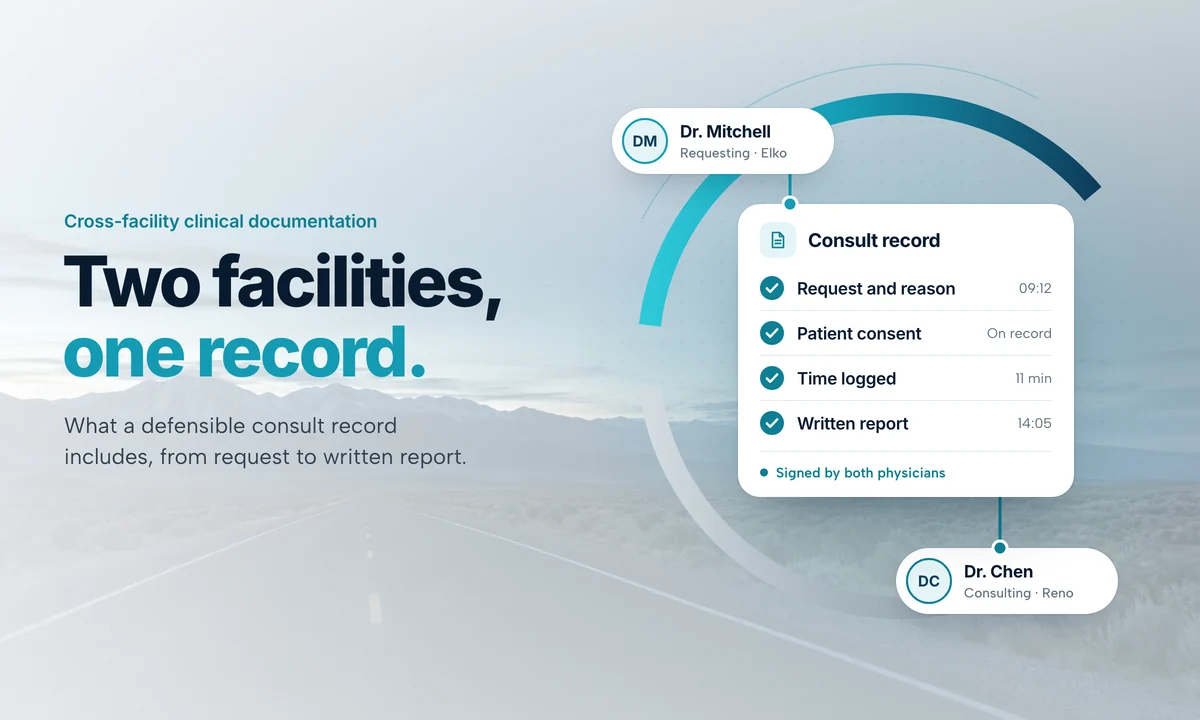
Every care transition documented within HCC produces a timestamped, tamper-evident record of the full clinical exchange. The sending physician’s handoff summary is captured. The receiving physician’s acknowledgment, including any questions raised and responses provided, is captured in the same thread. The record is concurrent with the transition, retrievable, and auditable.
This architecture satisfies all four NPSG.02.05.01 elements:
Standardization. HCC enforces a consistent handoff structure at every transition — the same documentation fields, the same workflow, regardless of department or shift. Organizational policy and platform execution are aligned by design.
Interactive communication. The persistent thread captures the bidirectional exchange between sending and receiving physicians. The question-and-response sequence is preserved in a single sequential record. Surveyors conducting a Tracer can review the interactive exchange without relying on staff recollection.
Documentation. Every handoff produces a timestamped record concurrent with the transition. The documentation is not a retrospective entry. It is a live record generated as the handoff occurs.
Essential information. The thread carries the full clinical context from the prior care episode, eliminating the information loss that characterizes EHR-note-only transitions where the receiving clinician inherits a summary without the conversation.
HCC integrates with existing EHR systems. Organizations do not choose between EHR documentation and NPSG-compliant handoff communication. Both exist. The HCC thread operates as the structured, auditable layer above the EHR that NPSG.02.05.01 compliance requires. For organizations currently relying on verbal-only handoffs or retrospective EHR notes, ClinicianCore provides a direct path to compliance. The ConsultCore module, part of ClinicianCore’s unified clinical communication platform, deploys above the existing EHR infrastructure without migration risk.
Frequently Asked Questions
What does Joint Commission NPSG.02.05.01 require for care handoffs?
NPSG.02.05.01 requires structured, interactive, and documented handoff communication at every care transition. According to the Joint Commission (2024), compliant handoffs must standardize information transfer, allow the receiving clinician to ask questions, and produce a retrievable documentation record. ClinicianCore HCC satisfies all three requirements through its persistent shared patient thread.
How is Joint Commission handoff compliance surveyed in 2026?
Joint Commission surveyors assess NPSG.02.05.01 compliance using the Tracer methodology, selecting patients currently in care transition and tracing the handoff record backward from receiving to sending team. The Joint Commission SAFER Matrix (2024) classifies systematic handoff documentation failures as high-risk findings. ClinicianCore HCC produces the timestamped, sequential handoff records surveyors require.
What is the I-PASS handoff structure, and does the Joint Commission require it?
I-PASS stands for Illness severity, Patient summary, Action list, Situation awareness, and Synthesis by receiver. The Joint Commission does not mandate I-PASS specifically. The standard is methodology-neutral. According to AHRQ (2024), I-PASS is recommended as a best-practice implementation because its documentation structure produces the audit evidence NPSG.02.05.01 requires.
Does verbal-only handoff communication satisfy Joint Commission requirements?
No. Verbal-only handoff communication does not satisfy NPSG.02.05.01. The Joint Commission Comprehensive Accreditation Manual (2024) requires documentation of the handoff: a retrievable record confirming the structured transfer occurred. According to the Joint Commission Sentinel Event Alert (2023), handoff failures contributed to adverse outcomes in over 70% of sentinel event cases reviewed.
How does ClinicianCore HCC satisfy NPSG.02.05.01 handoff documentation requirements?
ClinicianCore HCC satisfies NPSG.02.05.01 by maintaining a persistent, timestamped, tamper-evident patient handoff thread at every care transition. The thread captures the sending physician's summary, the receiving physician's acknowledgment, and any bidirectional exchange, concurrent with the transition and not retrospectively documented. According to the Joint Commission (2024), concurrent documented handoffs are the compliance standard.
References
1. Joint Commission. (2024). National Patient Safety Goals: NPSG.02.05.01 Handoff Communication. Retrieved from https://www.jointcommission.org/standards/national-patient-safety-goals/
2. Joint Commission. (2023). Sentinel Event Alert Issue 58: Inadequate Handoff Communication. Retrieved from https://www.jointcommission.org/resources/sentinel-event/sentinel-event-alert-newsletters/
3. Joint Commission. (2024). Comprehensive Accreditation Manual for Physicians. Retrieved from https://www.jointcommission.org/
4. Joint Commission. (2024). SAFER Matrix for Survey Compliance. Retrieved from https://www.jointcommission.org/
5. CMS. (2024). Conditions of Participation: Care Transitions Requirements. Retrieved from https://www.cms.gov/
6. AHRQ. (2024). I-PASS Handoff Communication Program. Retrieved from https://www.ahrq.gov/
7. AHRQ. (2023). Communication Failures and Preventable Adverse Events During Care Transitions. Retrieved from https://www.ahrq.gov/
8. NEJM. (2023). Readmission Rates and Handoff Documentation Gaps: Multicenter Analysis. Retrieved from https://www.nejm.org/
9. HHS OCR. (2025). HIPAA Compliance Requirements for Clinical Communication Documentation. Retrieved from https://www.hhs.gov/hipaa/