Every discharge is a transfer of trust. The hospital physician hands a patient to the community physician and assumes the clinical story travels with them. Too often, it does not. A phone call is missed. A discharge summary arrives two days late, stripped of the clinical context that shaped every decision made during the hospitalization. The receiving physician sees a diagnosis and a medication list. The reasoning that drove those decisions, the concerns raised on morning rounds, the specialist’s recommendation that changed the management plan, none of that survives the fax.
The consequence of that communication gap is not abstract. The Joint Commission has estimated that miscommunication during patient handoffs is associated with up to 80% of serious medical errors. A systematic review published in JAMA Network Open found that structured communication interventions at discharge reduced 30-day readmission rates from 13.5% to 9.1%. CMS penalizes approximately 2,400 hospitals annually under the Hospital Readmissions Reduction Program for readmission rates that exceed their peer benchmarks, with reductions of up to 3% applied to every qualifying Medicare payment for an entire fiscal year.
This post examines what the current evidence actually says about the relationship between care transition communication and readmission risk, where the documentation gap most often appears, and what physician-driven communication infrastructure can close it. I write this not as a health systems administrator, but as a physician who has seen clinical context evaporate at discharge and watched a patient return through the emergency department three weeks later with a problem that was fully documented in a summary no one had read.
Key Takeaways
- The Joint Commission estimates miscommunication during patient handoffs is associated with up to 80% of serious medical errors.
- A JAMA Network Open systematic review found discharge communication interventions reduced 30-day readmission rates from 13.5% to 9.1%.
- CMS HRRP FY2026 penalizes approximately 2,400 hospitals, with payment reductions of up to 3% on every qualifying Medicare inpatient claim.
- Fewer than 50% of patients see their primary care physician within two weeks of hospital discharge.
- Direct physician-to-physician communication between inpatient and outpatient providers occurs in only 23 to 38% of transitions.
- Structured handoff programs, including I-PASS studied in NEJM, reduced preventable adverse events by 23 to 30%.
“The doctor receiving a discharged patient is not getting a handoff. They are piecing together a clinical story from a document, not hearing it directly from the physician who was there.”

What the Evidence Shows: Communication and Readmission Risk
The relationship between care transition communication and hospital readmission is among the most studied problems in healthcare delivery. The evidence is consistent and specific.
A systematic review and meta-analysis published in JAMA Network Open examined 19 randomized clinical trials involving nearly 4,000 patients and found that communication interventions at hospital discharge were significantly associated with lower 30-day readmission rates. In intervention groups, the readmission rate was 9.1% compared to 13.5% in control groups, a relative risk ratio of 0.69. The same interventions were associated with higher medication adherence (86.1% vs. 79.0%) and higher patient satisfaction. The conclusion from that body of evidence is direct: improving communication at discharge changes clinical outcomes.
The New England Journal of Medicine provides a parallel data point from within the hospital itself. A multicenter study by Starmer, Landrigan, and colleagues evaluated the I-PASS handoff communication bundle across nine academic pediatric hospitals and found a 23% relative reduction in preventable adverse events following implementation. A subsequent, more generalized implementation of I-PASS in adult hospital settings found a 47% reduction in adverse events. These findings establish that structured communication, applied consistently at moments of care transfer, reduces patient harm at a measurable scale.
The mechanism is not complicated. Miscommunication at handoffs creates information gaps. Those gaps produce incomplete clinical pictures. Incomplete clinical pictures lead to decisions, or more precisely to non-decisions, that would not have been made with full information. The patient returns to the hospital not because their disease worsened unpredictably, but because a management decision was delayed or reversed by a physician who was working with an incomplete record.
The CMS HRRP Framework: When Communication Failures Become Financial Penalties
The Hospital Readmissions Reduction Program (HRRP) is the mechanism through which federal policy attaches direct financial consequences to hospital readmission rates. Under HRRP, CMS reduces Medicare payments to hospitals with higher-than-expected 30-day readmission rates for specific conditions and procedures. The payment reduction is applied to every qualifying Medicare inpatient claim for an entire fiscal year, not just to readmission cases, and is capped at 3% of base operating payments.
For fiscal year 2026, the performance period spans July 2021 through June 2024. CMS uses that three-year window to smooth statistical variation and identify hospitals with persistently elevated readmission rates. Approximately 2,400 hospitals face some level of HRRP penalty in FY2026, with roughly 8% of those facing reductions of 1% or more. The payment reduction applies from October 1, 2025, through September 30, 2026. For a hospital with substantial Medicare volume, even a 1% reduction across all inpatient DRG payments represents a material financial exposure over twelve months.
CMS explicitly frames HRRP as an incentive to improve, in its words, “communication and care coordination to better engage patients and caregivers in discharge plans and, in turn, reduce avoidable readmissions.” The program is not designed to penalize hospitals for clinical complexity or high-risk populations; the excess readmission ratio is peer-adjusted, comparing each hospital to hospitals with similar patient characteristics. What the program measures is the residual readmission rate that remains after case mix is accounted for, which reflects, at least in part, the quality of care coordination and discharge communication.
For physicians in group practices and outpatient settings, the HRRP penalty is the hospital’s financial problem, but the care transition failure is theirs. The community cardiologist who receives a three-day-old fax and places a patient in a two-week appointment slot that does not align with the clinical urgency in the discharge summary has participated in a transition failure that will show up in the hospital’s readmission denominator. The incentives are asymmetric. The accountability is shared. The communication infrastructure, in most practices, is not.
Where Clinical Context Is Lost at Discharge
A discharge summary is not a handoff. It is a document. The distinction matters because clinical context, the reasoning behind decisions, the concerns that were considered and set aside, the timing sensitivities that govern post-discharge management, do not survive well in document form, particularly when that document is produced under time pressure, transmitted through a fax, and received by a physician who has no prior relationship with the patient.
The evidence on what happens at discharge is specific and sobering. According to the American Nurse Journal, fewer than 50% of patients see their primary care provider within two weeks of hospital discharge. A 2024 qualitative study published in the Journal of General Internal Medicine by Chatterton and colleagues found that direct communication between inpatient and outpatient physicians occurs in only 23 to 38% of care transitions. In the majority of cases, the discharge summary is the sole channel through which the receiving physician learns what happened during hospitalization.
The discharge summary, when it functions as designed, conveys diagnosis, key decisions, medication changes, and follow-up instructions. What it cannot reliably convey is urgency, nuance, or the clinical reasoning that made a particular follow-up instruction important rather than routine. A physician reading a discharge summary for a patient they have never seen is performing interpretation, not handoff. They are reconstructing a clinical story from a structured document rather than receiving it directly from a colleague.
A 2023 AHRQ case study found that providers did not flag a critical echocardiogram result populated in a patient’s EHR after discharge from the hospital to a skilled nursing facility, resulting in missed care and readmission. The information existed in the record. It was not communicated. That distinction, between information being present and information being received and understood, is where care transitions most frequently fail.
The AHRQ PSNet 2024 review on communication during transitions of care identified that 70% of observed hospital-to-home health transitions included at least one safety issue, with the most frequent being medication errors, incomplete information transfer, and inadequate documentation of follow-up needs. These are not rare edge cases. They are the baseline state of care transition communication in the current environment for a substantial proportion of US patients.
The Physician-to-Physician Gap: Why Discharge Summaries Are Not Enough
I want to be direct about something that tends to get softened in policy language. The current standard of care transition communication, discharge summary by fax or EHR message, is not adequate for the complexity of the patients being discharged from US hospitals in 2025. It was not designed for that complexity. It was designed for a care delivery environment where the hospital physician and the community physician shared geographic proximity, often practiced in the same building, and communicated by phone as a matter of routine. That environment no longer exists in most US markets.
The physician receiving a patient after discharge from a tertiary hospital may be in a different health system, using a different EHR, and seeing the discharge summary as a PDF attachment to an HL7 message that arrived asynchronously during a full clinic schedule. The expectation that this physician will extract the clinically relevant urgency signals from that document, prioritize appropriately, and schedule follow-up in a window that matches the biological timelines of the patient’s condition is not a reasonable one in the absence of direct communication.
Direct physician-to-physician communication is what the I-PASS literature studied and what the JAMA Network Open meta-analysis measured when it found readmission reductions. The interventions that worked were not improvements to discharge documentation. They were improvements to the communication process itself, real-time or structured near-real-time exchange of information between the physician sending the patient and the physician receiving them.
The American College of Physicians’ 2023 position paper “Beyond the Discharge: Principles of Effective Care Transitions Between Settings” explicitly calls for improving communication between inpatient and outpatient physicians as a prerequisite for safer transitions. The ACP identifies role ambiguity, inadequate structured communication, and Health Information Exchange limitations as contributing factors to transition failures. The paper recommends federally supported implementation of updated health information exchange infrastructure alongside direct provider-to-provider communication standards.
The 80% figure from the Joint Commission, the 0.69 relative risk from JAMA Network Open, and the 23% error reduction from NEJM all point in the same direction. The tool that reduces readmission risk is not a better form. It is a better conversation.
What Structured Communication Infrastructure Changes
The evidence on what specifically improves care transitions converges on several elements. These are not proprietary conclusions. They are the findings from the systematic review literature, the I-PASS studies, and the ACP position paper.
Structured, persistent documentation of the clinical handoff.
When the reasoning behind a discharge decision is captured in a format that the receiving physician can access at the moment they need it, not through a fax queue three days later, the information gap narrows. The key word is persistent: the thread must remain available as the patient moves through the post-discharge period, not disappear at the moment the patient leaves the unit.
Direct physician-to-physician communication before or at discharge.
The JAMA Network Open meta-analysis found the most effective interventions were those that included direct communication, not just documentation. This means an actual exchange between the discharging and receiving physician, not a note placed in a queue. The I-PASS studies implemented verbal standardized handoffs alongside written documentation and found the combination produced better outcomes than either alone.
Timing alignment between clinical urgency and follow-up scheduling.
A patient discharged with heart failure who is scheduled for a two-week follow-up appointment, when the clinical window for identifying decompensation is five to seven days, has experienced a transition failure before they leave the building. Reducing this misalignment requires the receiving physician to understand the urgency embedded in the handoff, which requires communication, not documentation.
Cross-entity thread continuity.
When a patient moves from hospital to skilled nursing facility to home health to outpatient physician, each transition involves a new set of providers who may have no access to what was communicated in prior transitions. Reducing this fragmentation requires a communication infrastructure that does not terminate at discharge but persists across the care continuum.
A 2024 study on transitional care teams published in LWW found that facilities implementing specialized care transition teams reduced readmission rates from an average of 15.9% to 13.4%. These were structured communication interventions, not clinical interventions. The disease did not change. The communication did.
How ClinicianCore HCC Consult Core Supports Care Transition Communication
ClinicianCore is a secure, AI-powered platform that enables seamless communication among providers across hospitals, clinics, and networks. The HCC Consult Core module is built to reflect real clinical thinking, supporting structured and dynamic consults with embedded documentation that captures context, reasoning, and decision trails. This directly addresses the cross-entity communication problem that care transitions create.
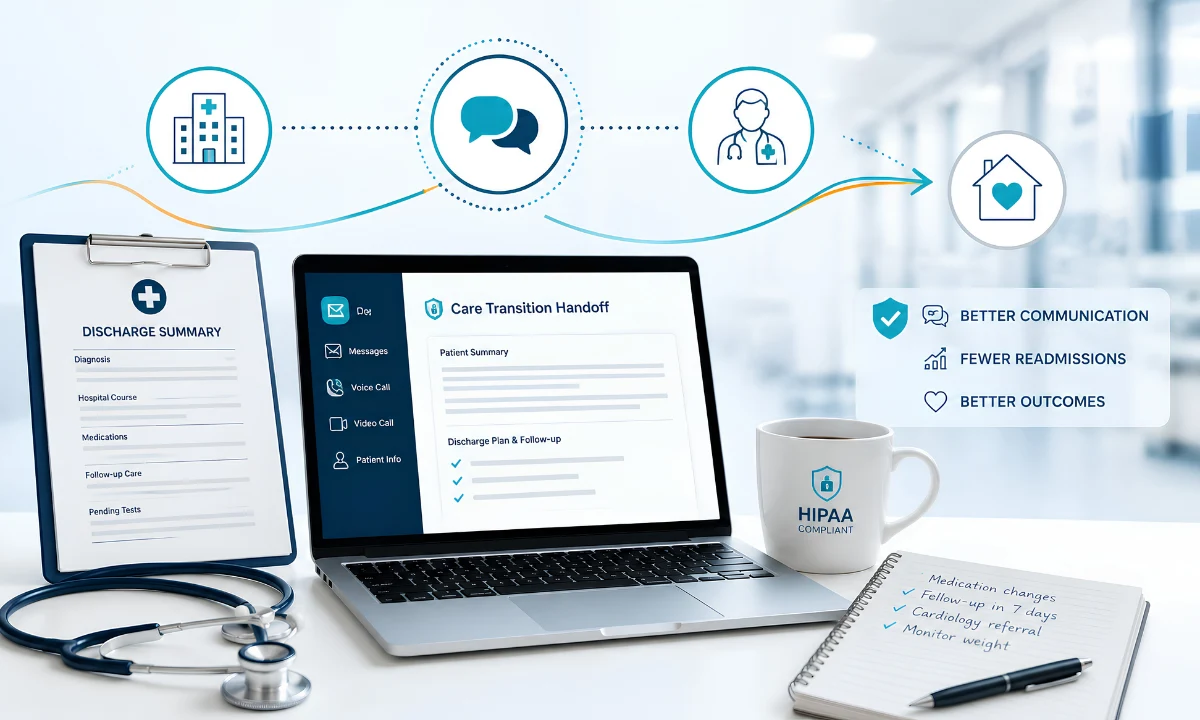
HCC Consult Core maintains a persistent clinical communication thread for each patient across the discharge boundary. The discharging physician initiates the thread. The community physician receives it at the moment of discharge, not three days later by fax. The thread carries the clinical reasoning, the urgency context, and the specific follow-up instructions that would otherwise survive only in the memory of the discharging physician and the shorthand of a discharge summary.
What this means practically is that the community cardiologist who receives a patient after a heart failure admission sees not just a diagnosis and a medication list but the complete conversation that shaped the discharge plan. The concern was raised by the overnight resident. The echocardiogram result changed the medication decision. The specific seven-day follow-up window that reflects clinical, not administrative, timing.
No phone call. No fax. No gap between what was communicated inside the hospital and what the physician receiving the patient actually knows.
As a secure, AI-powered platform built to reflect real clinical thinking, ClinicianCore HCC Consult Core applies the communication standard that the evidence supports: real-time, persistent, cross-entity physician-to-physician communication at the moment of care transition. It eliminates the friction of establishing interdisciplinary conversations across health systems and lends clarity to those communications without disrupting patient flow.
For group practices managing post-discharge patients, this is not a marginal improvement. The JAMA Network Open data suggests it can reduce 30-day readmission rates by more than 30% relative to standard discharge documentation. For practices with substantial Medicare populations, reduced readmissions reduce CMS HRRP exposure for the hospitals where their patients are admitted and reduce the clinical burden of managing patients who return through the emergency department with preventable decompensations. It is how we recreate physician-centric communication and tackle physician burnout.
ClinicianCore is a secure, HIPAA-compliant unified clinical communication platform tailored for medical practices. Learn how the HealthCare Collaboration platform supports care coordination across the full discharge cycle.
ClinicianCore is a secure, HIPAA-compliant unified clinical communication platform built exclusively for physicians. Learn how the unified clinical communication platform supports care coordination across the full discharge cycle.
Frequently Asked Questions
What percentage of serious medical errors are linked to communication failures during patient handoffs?
The Joint Commission estimates that miscommunication during patient handoffs is associated with up to 80% of serious medical errors. This figure derives from the Joint Commission Center for Transforming Healthcare’s 2010 handoff communication research and has been reaffirmed in multiple subsequent analyses, including Sentinel Event Alert Issue 58. ClinicianCore HCC- Consult Core addresses this with persistent cross-entity physician communication at discharge.
What does the CMS Hospital Readmissions Reduction Program data show about readmission and care transitions?
The CMS Hospital Readmissions Reduction Program (HRRP) penalizes hospitals with higher-than-expected 30-day readmission rates by reducing Medicare payments by up to 3%. For FY2026, approximately 2,400 US hospitals face some level of penalty, with performance measured over the July 2021 to June 2024 window. CMS explicitly cites communication and care coordination as the primary mechanism for reducing avoidable readmissions.
What communication failures most commonly occur at hospital discharge?
Fewer than 50% of patients see their primary care provider within two weeks of hospital discharge. Direct communication between inpatient and outpatient physicians occurs in only 23 to 38% of transitions, with the discharge summary serving as the sole communication channel in the majority of cases. A 2024 AHRQ review found 70% of hospital-to-home health transitions included at least one safety issue related to information transfer.
How does structured care transition communication reduce 30-day readmission risk?
A systematic review and meta-analysis in JAMA Network Open of 19 randomized trials found that communication interventions at hospital discharge reduced 30-day readmission rates from 13.5% to 9.1% (relative risk 0.69, 95% CI 0.56 to 0.84). A 2024 LWW study found care transition teams reduced readmissions from 15.9% to 13.4%. ClinicianCore HCC Consult Core provides the persistent cross-entity communication thread that these interventions demonstrated.
Does better care transition communication reduce physician burnout?
Unresolved care transitions create cognitive burden for both discharging and receiving physicians. The discharging physician carries unresolved uncertainty about whether the clinical context was received. The receiving physician manages patients whose history they have partially reconstructed. Structured communication that closes this loop reduces the cognitive overhead of managing post-discharge patient status and is consistent with the administrative burden reduction that ClinicianCore’s physician burnout reduction platform addresses.
References
1. Centers for Medicare and Medicaid Services. (2025). Hospital Readmissions Reduction Program (HRRP). CMS.gov. https://www.cms.gov/medicare/payment/prospective-payment-systems/acute-inpatient-pps/hospital-readmissions-reduction-program-hrrp
2. Centers for Medicare and Medicaid Services. (2025). Hospital Readmissions Reduction Program. CMS.gov. https://www.cms.gov/medicare/quality/value-based-programs/hospital-readmissions
3. Becker, C., Zumbrunn, S., Beck, K., et al. (2021). Interventions to Improve Communication at Hospital Discharge and Rates of Readmission: A Systematic Review and Meta-analysis. JAMA Network Open. https://jamanetwork.com/journals/jamanetworkopen/fullarticle/2783547
4. Starmer, A.J., Spector, N.D., Srivastava, R., et al. (2014). Changes in Medical Errors after Implementation of a Handoff Program. New England Journal of Medicine, 371(19), 1803-1812. https://www.nejm.org/doi/full/10.1056/NEJMsa1405556
5. The Joint Commission. (2017). Sentinel Event Alert Issue 58: Inadequate Hand-off Communication. https://www.jointcommission.org/en-us/knowledge-library/newsletters/sentinel-event-alert/issue-58
6. The Joint Commission Center for Transforming Healthcare. (2010). Tackkling Miscommunication Among Caregivers. As reported by Fierce Healthcare, October 21, 2010. https://www.fiercehealthcare.com/healthcare/joint-commission-center-for-transforming-healthcare-tackles-miscommunication-among
7. Chatterton, B., Chen, J., Schwarz, E., et al. (2024). Primary Care Physicians’ Perspectives on High-Quality Discharge Summaries. Journal of General Internal Medicine, 39, 1438-1443. https://link.springer.com/article/10.1007/s11606-023-08541-5
8. Agency for Healthcare Research and Quality. (2024). Communication During Transitions of Care. PSNet. https://psnet.ahrq.gov/perspective/communication-during-transitions-care
9. American Nurse Journal. (2023). Transitional Care Can Reduce Hospital Readmissions. American Nurse Journal. https://www.myamericannurse.com/transitional-care-can-reduce-hospital-readmissions/
10. American College of Physicians. (2023). Beyond the Discharge: Principles of Effective Care Transitions Between Settings. Position Paper. https://www.acponline.org/sites/default/files/acp-policy-library/policies/beyond_the_discharge_principles_of_effective_care_transitions_between_settings_2023.pdf
11. QualityNet/CMS. (2025). FY2026 Hospital Readmissions Reduction Program Performance Period Information. https://qualitynet.cms.gov/inpatient/hrrp
12. Rammohan, R., et al. (2023). The Path to Sustainable Healthcare: Implementing Care Transition Teams to Mitigate Hospital Readmissions and Improve Patient Outcomes. PMC. https://pmc.ncbi.nlm.nih.gov/articles/PMC10265694/13. StatPearls / NCBI. (2024, June 7). Reducing Hospital Readmissions. NCBI Bookshelf. https://www.ncbi.nlm.nih.gov/books/NBK606114/