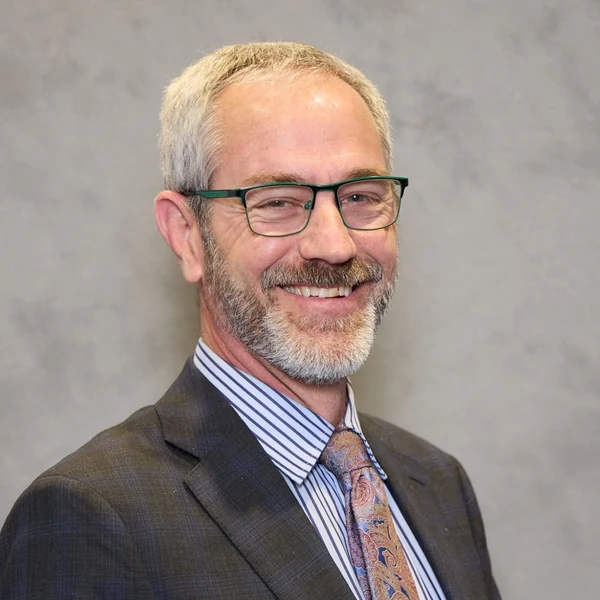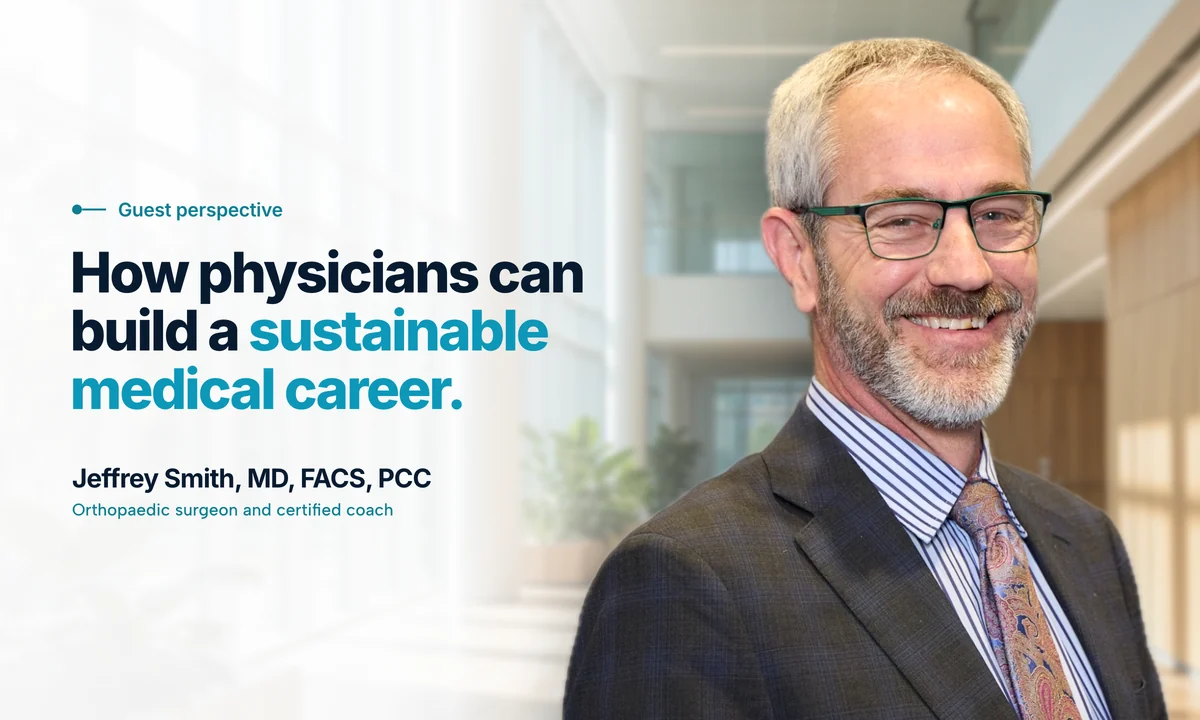
A sustainable medical career is one in which a physician can keep performing at a high level while still finding meaning in the work, keeping the relationships that matter and having energy left for life outside medicine. For orthopaedic traumatologist and Professional Certified Coach Jeffrey Smith, MD, FACS, PCC, that is a much higher bar than simply avoiding burnout.
Dr. Smith has more than 20 years of experience in academic and private healthcare systems, more than 1,000 hours of one-on-one coaching with surgeons, and his own experience of burnout in a demanding surgical career. In this guest perspective, he answers 12 questions we put to him: what wears physicians down, why they stay in work that exhausts them, the early signs that a career is no longer sustainable, how to set boundaries without short-changing patients, what organizations owe their physicians, and the one piece of advice he gives early-career physicians. His answers follow in his own words.
Key takeaways
- Avoiding burnout sets the bar too low. A sustainable medical career keeps performance, meaning, relationships and energy for life outside medicine over decades.
- The strengths medicine rewards, such as hard work, responsibility, high standards and availability, can turn into overcommitment, perfectionism and no boundaries when used without limits.
- Early warning signs come before formal burnout: slower recovery, a different feeling on Sunday evening, rising cynicism and irritation, and work using up sleep, exercise and relationships.
- Career design is a repeating cycle of reflection, goal setting, intentional adjustment and reassessment. Small changes, such as a schedule, one responsibility or a protected day, often matter more than leaving medicine.
- Good boundaries protect patient care: ask what truly needs your expertise, what can be delegated, what can wait, and what should never have become your responsibility.
- Organizations and physicians share the work. In 2025, 41.9% of physicians reported at least one symptom of burnout (AMA, 2026), and in 2024 more than one in five intended to reduce clinical hours (JAMA Network Open, 2026).
- Colleagues matter: 41.1% of academic surgical faculty in one 2026 survey were seriously considering leaving, and relationships with colleagues were among the top reasons faculty stayed (JAMA Surgery, 2026).
What does a sustainable medical career mean beyond avoiding burnout?
I think we set the bar far too low if our goal is simply to avoid burnout.
A sustainable medical career is one in which we can continue to perform at a high level while also finding meaning, fulfillment, and even joy in the work. It allows us to grow as physicians and as human beings, maintain important relationships, and have enough energy left for the other things that matter in our lives.
For much of my career, I equated success with working harder. I loved being a surgeon, took great care of patients, and achieved many of the things that we traditionally associate with professional success. I paid much less attention to the sustainability of that success. Working harder and harder just to keep up isn’t a good long-term strategy.
So I think the better question is not simply, “How do we prevent physicians from burning out?” It is, “How do we create careers that physicians can continue to find meaningful, challenging, rewarding, and sustainable over decades?”
What stops physicians from building careers they can sustain and enjoy?
One challenge is that medicine selects for—and then reinforces—behaviors that can make us extraordinarily successful in the short term but may not be sustainable over an entire career.
We work hard. We delay gratification. We accept responsibility. We tolerate discomfort. We put patients first. Those can all be tremendous strengths. But almost any strength can become a liability when used without limits. Commitment can become overcommitment. Responsibility can become believing that everything is our responsibility. High standards can become perfectionism. Availability can become the absence of boundaries.
Then we add administrative burden, inefficient workflows, EHR demands, staffing challenges, loss of autonomy, increasing communication demands, and sometimes work environments that conflict with our professional values.
Sustainability requires us to recognize both sides of that equation: the individual practices that allow us to perform and recover, and the systems in which physicians are being asked to work.
Why do physicians stay in work that leaves them exhausted or unfulfilled?
Physicians are remarkably good at adapting. That is one of our strengths, but it can also keep us in situations long after they have stopped working for us. We tell ourselves, “This is just medicine.” Or, “Everyone is busy.” Or, “It will get better after this next thing.”
We also invest heavily in our professional identities. We spend years becoming physicians, surgeons, specialists, and leaders. Changing direction can feel like walking away from something we worked very hard to achieve.
Sometimes we simply don’t create the space to ask whether what we are doing still fits. One of the great values of reflection—whether that occurs with a coach, mentor, colleague, spouse, or simply through deliberate time alone—is creating enough distance to ask: Is the way I am practicing medicine still consistent with the physician and person I want to be?
That is a very different question from, “Can I keep doing this?” Physicians can endure an extraordinary amount. Endurance alone shouldn’t be our measure of career success.
What are the early signs that a medical career is no longer sustainable?
Often the signs are subtle before they become dramatic. You may notice that recovery takes longer. Sunday evening starts feeling different. Things that once felt meaningful begin to feel like obligations. Irritation becomes more common. You become more cynical. You have less patience with colleagues, staff, or the people you love.
Another important sign is when work begins consuming the resources that previously allowed you to recover from work—sleep, exercise, relationships, hobbies, reflection, and time away.
I also pay attention when physicians say some version of, “I don’t feel like myself anymore.”
We shouldn’t have to wait for someone to meet a formal definition of burnout before asking whether something needs to change. Small adjustments made early are generally much easier than trying to rebuild a career after years of sacrifice and exhaustion.
How can physicians build a career around their strengths, values and priorities?
I like to think about professional development as a cycle: reflection, goal setting, intentional adjustment, and reassessment.
First, understand where you are. What parts of your work give you energy? What consistently drains it? What are you particularly good at? What matters enough that you are unwilling to compromise it? And what may have mattered a few years ago that doesn’t matter nearly as much today?
Then ask where you want to go. The adjustment doesn’t necessarily have to be dramatic. Physicians sometimes imagine that career change means leaving medicine, changing specialties, or quitting a job. Often the most powerful changes are smaller—changing a schedule, reducing a responsibility, developing a new professional interest, teaching more, operating differently, protecting a day, or saying no to something that no longer deserves a yes or serves you.
Then reassess.
Careers are dynamic. The career that was ideal at 35 may not be the career you want at 45, 55, or 65. Intentional careers require repeated adjustment rather than a single career decision made at the end of training.
What practical steps help physicians who already feel dissatisfied or burned out?
Start by resisting the urge to solve everything at once. That alone can create more overwhelm.
Create enough space to understand the problem before prescribing the solution. I might ask three questions: What do I want more of? What do I want less of? What do I want to protect?
Then get very specific.
Instead of saying, “My job is overwhelming,” identify what is actually overwhelming. Is it call expectations? Inbox volume? Documentation? Lack of autonomy? A particular administrative responsibility? Difficult relationships? Financial pressure? A schedule that leaves no recovery time?
Once the problem becomes specific, possibilities for change become much easier to see. Then make an intentional adjustment and reassess. Some changes will work; others won’t. This is much more like performance improvement than failure. We gather information, make an adjustment, see what happens, and continue learning.
How can physicians set healthier boundaries and still provide quality patient care?
One of the traps in medicine is equating unlimited availability with commitment to our patients.
Those are not the same thing.
Good boundaries actually help preserve our ability to provide excellent care over time. The question is not, “How little can I do?” It is, “What does excellent patient care genuinely require, and what have we simply allowed to accumulate around it?”
I encourage physicians to clarify their non-negotiables. What truly requires your expertise? What can be delegated? What can wait? What should never have become your responsibility in the first place?
Boundaries also become much more effective when expectations are communicated clearly. Ambiguity creates enormous amounts of unnecessary work.
The goal isn’t withdrawal from responsibility. It is aligning responsibility with what actually matters.
What role do mentorship, peer support and professional communities play?
An enormous role.
Medicine can become surprisingly isolating, particularly as physicians become more senior or take on leadership responsibilities. We are surrounded by people all day and can still have very few places where we can speak openly.
Trusted colleagues help normalize the difficult parts of medicine. They provide perspective when we have complications, make mistakes, struggle with decisions, or begin questioning our careers.
They also help us see our strengths when we aren’t particularly good at seeing them ourselves.
I believe strongly in creating cultures where asking for perspective or support is viewed as a professional strength rather than a sign that someone isn’t coping.
None of us performs at our best completely alone.
What role should healthcare organizations and leaders play in physician wellbeing?
A substantial one.
We cannot ask individual physicians to meditate, exercise, become more resilient, or manage their time better while ignoring dysfunctional systems or excessive expectations.
Organizations need to look carefully at workload, staffing, autonomy, administrative burden, communication expectations, scheduling, psychological safety, and whether physicians actually have the resources necessary to do the work being asked of them.
At the same time, I don’t think this needs to become an either-or argument between individual responsibility and organizational responsibility. Both matter.
Organizations should create environments in which physicians can succeed, and physicians should develop the skills and practices that allow them to navigate demanding careers effectively. Sustainable medicine requires attention to both the person and the system.
How does reducing administrative and communication burden support physician wellbeing?
One of the most frustrating experiences for physicians is spending large amounts of time doing work that feels disconnected from why they became physicians.
Documentation, prior authorization, inbox management, redundant communication, unnecessary or ineffective meetings, repeated credentialing, and poorly designed workflows don’t just consume time. They consume attention.
Attention is a limited professional resource. Every unnecessary click, message, form, or interruption competes with something else—talking with a patient, thinking through a difficult problem, teaching a trainee, collaborating with a colleague, or simply getting home on time.
Reducing administrative burden isn’t about making physicians’ jobs easier for the sake of making them easier. It is about allowing highly trained professionals to spend more of their time doing work that actually provides value to patients and the organization.
How can technology and better-designed workflows make physician careers more sustainable?
Technology has tremendous potential, but only if we ask the right question. Too often the question is, “What can this technology do?”
I think the better question is, “What problem are we trying to solve for patients and clinicians?”
Technology should reduce friction, eliminate unnecessary work, improve communication, make information easier to find, and return time and attention to physicians.
If a new technology creates three new tasks for every task it eliminates, we haven’t necessarily made progress. AI and other emerging technologies offer extraordinary opportunities to reduce documentation and administrative work. But the measure of success shouldn’t simply be adoption. It should be whether the technology gives clinicians more capacity to do meaningful clinical work and creates a better experience for patients and healthcare professionals.
What is one piece of advice for an early-career physician?
Don’t build a career that you have to recover from. Build one that can evolve with you.
Early in our careers, there is enormous pressure to prove ourselves—to work harder, say yes, build expertise, establish a reputation, and take advantage of opportunities. Some of that is necessary.
But periodically ask yourself: What am I trying to become successful at, and is that success creating the life and career I actually want?
Pay attention to what gives you energy. Invest in relationships. Find people you trust. Protect the parts of yourself that exist outside medicine. Continue learning. And give yourself permission to change the way you practice as your life changes.
A successful medical career shouldn’t simply be one that lasts a long time. It should be one that, when you look back, was worth sustaining.
Frequently asked questions
What is a sustainable medical career?
A sustainable medical career lets a physician keep performing at a high level while still finding meaning, keeping close relationships and having energy for life outside medicine. Dr. Jeffrey Smith sets that bar above simply avoiding burnout, which 41.9% of physicians still reported in 2025, according to AMA data (AMA, 2026).
What are the early signs that a medical career is no longer sustainable?
Early signs are often subtle: recovery takes longer, Sunday evenings feel different, meaningful work starts to feel like an obligation, and cynicism rises. Work also starts using up sleep, exercise and relationships. Among US surgeons, close social relationships scored lowest of all flourishing domains (Journal of the American College of Surgeons, 2026).
Does professional coaching help physicians with burnout?
Professional coaching probably reduces burnout among physicians, especially when it continues for more than four weeks, according to a 2026 meta-analysis of randomized trials (Annals of Internal Medicine, 2026). In one trial, burnout scores fell 21.6% among coached physicians while they rose 2.5% in the control group (JAMA Network Open, 2024).
How does peer support affect physician burnout?
Physicians who feel they belong at work report much less burnout. In a 2026 study of 14,051 US physicians, a strong sense of belonging was linked to about one-fifth the odds of burnout (JAMA Network Open, 2026). Dr. Smith sees trusted colleagues as the people who normalize the difficult parts of medicine.
What can healthcare organizations do to support physician wellbeing?
Organizations can review workload, staffing, autonomy, administrative burden, communication expectations and scheduling instead of offering only individual resilience programs. Poor control over specific parts of work is linked to burnout and to plans to reduce clinical effort or leave (Annals of Internal Medicine, 2025). Dr. Smith argues that both the person and the system matter.
How much time do physicians spend in the EHR outside clinic hours?
A national study of 200,081 physicians found they spent 5.8 hours in the electronic health record for every 8 hours of scheduled patient time, including 1.2 hours outside clinic hours and 1.3 hours on unscheduled days (Journal of General Internal Medicine, 2024). Dr. Smith calls attention a limited professional resource.
References
- In 2025, 41.9% of physicians reported at least one symptom of burnout, down from 43.2% in 2024 and 48.2% in 2023, in responses from nearly 19,000 physicians. Source: American Medical Association, AMA: Physician burnout rates are falling, specialty gaps remain, 2026
- In 2024, 22.5% of 14,540 physicians reported intent to reduce clinical hours and 15.1% of 15,935 reported intent to leave their organization. Source: JAMA Network Open, Rotenstein L, et al., Physician Intent to Reduce Hours and Intent to Leave Organizations, 2026
- 41.1% of surgical faculty reported seriously considering leaving; relationships with colleagues were among the most cited reasons for staying. Source: JAMA Surgery, Sarkissyan M, et al., Factors Associated With Surgical Faculty’s Desire to Leave or Stay at Their Jobs, 2026
- Surgeons scored highest on meaning and purpose (8.50) and lowest on close social relationships (7.41); 88% view surgery as a calling. Source: Journal of the American College of Surgeons, Ig-Izevbekhai KI, et al., Self-Reported Flourishing Among US Surgeons: A National Physician Survey, 2026
- Professional coaching probably reduces burnout among physicians, particularly when sustained for more than 4 weeks (systematic review and meta-analysis of randomized trials). Source: Annals of Internal Medicine, Collett G, et al., Efficacy of Individual-Level Interventions to Mitigate the Risk for Burnout Among Health Care Professionals, 2026
- Coached physicians had a 21.6% reduction in mean burnout score compared with a 2.5% increase in the control group. Source: JAMA Network Open, Kiser SB, et al., Physician Coaching by Professionally Trained Peers for Burnout and Well-Being: A Randomized Clinical Trial, 2024
- Among 14,051 physicians, a strong sense of belonging was associated with lower odds of burnout (odds ratio 0.22), of intent to reduce hours and of intent to leave. Source: JAMA Network Open, Carlasare LE, et al., Sense of Belonging, Burnout, and Work Intentions Among US Physicians, 2026
- Poor control over specific aspects of work was associated with burnout and with intentions to reduce clinical effort or leave the organization. Source: Annals of Internal Medicine, Sinsky CA, et al., Association of Work Control With Burnout and Career Intentions Among U.S. Physicians, 2025
- 200,081 physicians spent a mean of 5.8 hours in the EHR per 8 scheduled patient hours, including 1.2 hours outside clinic hours on clinic days and 1.3 hours on unscheduled days. Source: Journal of General Internal Medicine (NIH PubMed Central), Holmgren AJ, et al., National Comparison of Ambulatory Physician Electronic Health Record Use Across Specialties, 2024
Guest perspectives reflect the author’s own views and experience. They are not clinical advice.