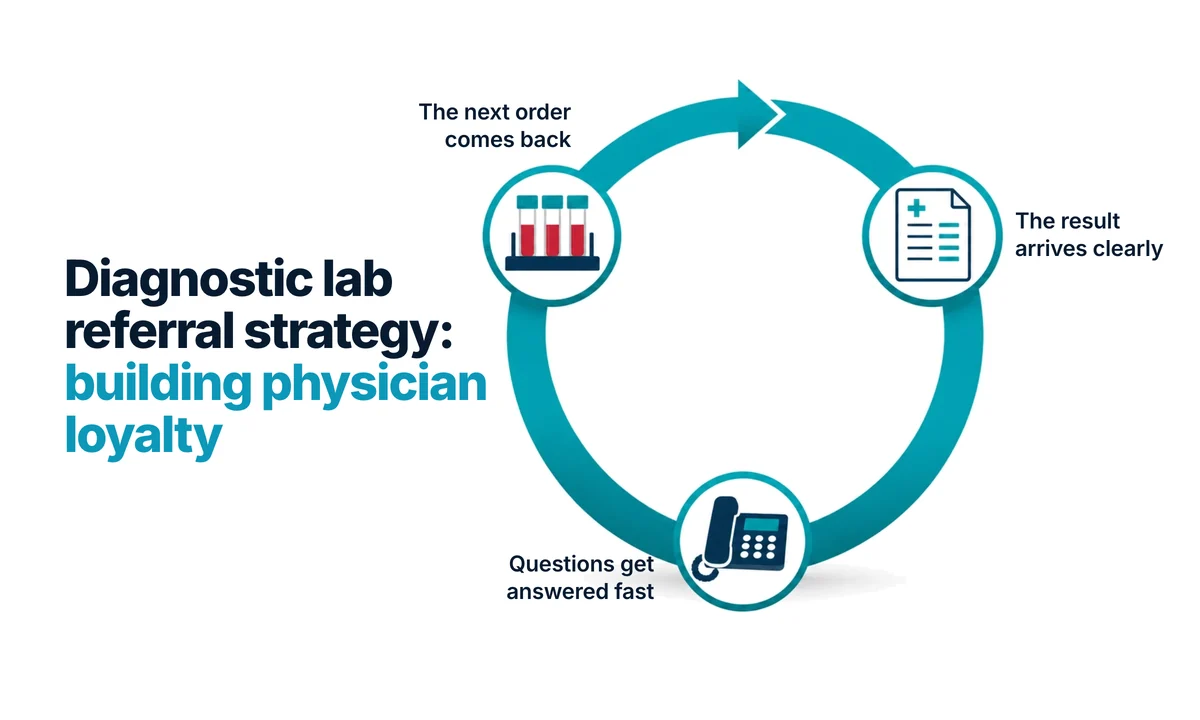
A diagnostic lab referral strategy works when the lab is the easiest organization for a practice to reach. Ask a primary care physician why the practice sends bloodwork to one lab instead of another, and the answer is rarely price. It sounds more like this: when a result is critical, they reach me. When my nurse has a question, someone answers. For clinical laboratories, imaging centers and pathology groups, that daily experience is the referral relationship.
The opportunity is wide open. In a 2025 national study of 8,122 family physicians, only 8% reported an ideal experience receiving test results from outside hospitals or health systems (JAMA Network Open). In a 2025 industry survey, 88% of healthcare practitioners said fax-related delays hurt patient care.
This article explains how communication gaps quietly move test volume to competitors, what ordering physicians reward, where the compliance line sits, and how ClinicianCore, a secure, HIPAA-compliant unified clinical communication platform built exclusively for physicians, helps a diagnostic organization become the easiest group in a practice’s network to work with.
Key takeaways
- Ordering physicians reward the diagnostic provider that is easiest to reach. Communication quality is a commercial asset, not a cost center.
- Outside test results still rarely arrive well. Only 8% of family physicians reported an ideal experience with test results from outside hospitals or health systems (JAMA Network Open, 2025).
- Every critical result is both a CLIA obligation and a loyalty test. Fast, documented, acknowledged delivery wins the next order.
- Routing clarifications to clinical staff instead of the front desk removes the phone tag that pushes practices toward competitors.
- Labs should compete on service, never on free goods or payments to referring physicians. Federal safe harbors that let some organizations donate EHR software exclude laboratory companies.
- ClinicianCore connects diagnostic organizations to ordering practices through the Trusted Entity network, alongside the EHR, with a full record of every exchange.
““Physicians don’t experience a lab through its analyzers. They experience it through the phone call that gets answered, the result that reaches them, and the question that gets a quick reply.””

Why do physicians choose one lab over another?
Physicians do not experience a laboratory through its analyzers. They experience it through what happens after the order leaves the office: how fast results arrive, whether a critical value reaches the right person, and how hard it is to ask a simple question.
Test menus have converged. Most regional labs run comparable assays, accept the same major payers and promise similar turnaround times. When the clinical product looks the same, the service around it decides where orders go, and communication is the part of that service a practice feels every day.
That is the premise behind ClinicianCore’s work with care delivery partners: physicians prefer referring to centers where communication is easy. Referral habits form around convenience. A practice that has to fax a request, call a main number, wait on hold and leave a message will tolerate it until a competitor makes life easier. Then it moves its orders, usually without saying a word.
How do laboratories lose referrals?
Referral leakage for a diagnostic organization is simple to define: tests that a loyal or affiliated practice could have sent to you went somewhere else. The reasons are rarely clinical. They are operational, and most of them trace back to communication.
The data on result exchange shows how stubborn the problem is. In the 2025 JAMA Network Open study of family physicians, ideal interoperability experiences ranged from 19% for encounter documents down to 8% for test results from outside hospitals or health systems. The authors note that this held despite public policies designed to support standards-based exchange.
The channels have not changed much either. According to Documo’s 2025 Healthcare Fax and Workflow Survey, reported by Medical Economics, 88% of healthcare practitioners say fax-related delays negatively affect patient care.
For a lab, that friction shows up in familiar places:
- A specimen is rejected, and the redraw request sits in a fax tray for two days.
- A nurse calls to ask whether a test can be added to an existing sample and spends 20 minutes in a phone tree.
- A pathologist needs clinical history to finalize a report and cannot reach the ordering physician.
- A critical value call lands on the front desk voicemail after hours.
None of these events triggers a complaint. Each one makes the next order slightly more likely to go to someone else. Reducing referral leakage starts with removing them.
Why are critical results a retention moment?
A critical result is the single most important message a lab sends, and it carries both a legal duty and a relationship test.
Under CLIA, 42 CFR 493.1291(g) requires a laboratory to “immediately alert the individual or entity requesting the test” and, when applicable, the person responsible for using the results, whenever a result indicates an imminently life-threatening condition or panic or alert values. The Joint Commission’s 2026 National Patient Safety Goals for the Laboratory Program keep NPSG.02.03.01, which requires written procedures defining critical results, who reports them to whom, and the acceptable time to report, with timeliness evaluated.
Delivery alone is not enough. In an eight-hospital system studied in 2025, 25% of critical value calls in one hospital needed escalation because the first call did not reach the right person, until a dedicated phone in each area brought that to between 9% and 14% (Guarner et al., 2025). A 2026 review adds that quality indicators should measure “not only the timeliness of notification but also the timeliness of the clinical response” (Truijens et al., 2026). Clear ownership matters as much as speed.
For a commercial leader, the lesson is direct. When a lab reaches the responsible clinician quickly, gets an acknowledgment and documents it, the physician remembers. When the call bounces between voicemail boxes, the physician remembers that too.
A diagnostic lab referral strategy built on five communication habits
The strongest diagnostic lab referral strategy treats every contact with the ordering practice as part of the product. Five habits matter most.
1. Send critical and urgent results to the responsible clinician
A faxed result lands in a pile. A secure message marked urgent lands on the device the clinician already carries. Pair delivery with an acknowledgment so the lab knows the message was seen, and escalate to a named backup when it is not.
2. Route clarifications to clinical staff, not the main line
Most questions between a lab and a practice are small: a missing diagnosis code, a fasting status, a request to add a test. A secure message sent straight to the right team member resolves them in minutes. It also spares physicians the interruptions that add to their day. In a 2024 survey, 35% of clinicians said critical result calls distracted them from patient care, and 82% said they would consider a new notification system (ADLM Clinical Laboratory News, 2024).
3. Make the pathologist and radiologist reachable
A confusing addendum invites a phone call that may never connect. A direct, documented conversation lets a radiologist point to the exact finding, or a pathologist walk a surgeon through a margin. That conversation is where diagnostic expertise becomes visible to the referring physician.
4. Keep every exchange in one documented thread
Phone calls leave no record. A written thread captures who said what and when, which supports CLIA documentation, protects both clinicians and makes audits far less painful.
5. Treat responsiveness as a service metric
If a lab measures turnaround time for specimens but not for questions, it is measuring half of the experience. Track how fast clarifications are answered and critical results are acknowledged, then report those numbers to your outreach team. Physician referral retention follows the numbers you watch.
How ClinicianCore connects the ordering practice and the diagnostic provider
ClinicianCore is a secure, HIPAA-compliant unified clinical communication platform built exclusively for physicians, connecting each practice’s own team and the outside organizations it works with. Three parts of the platform carry the lab relationship.
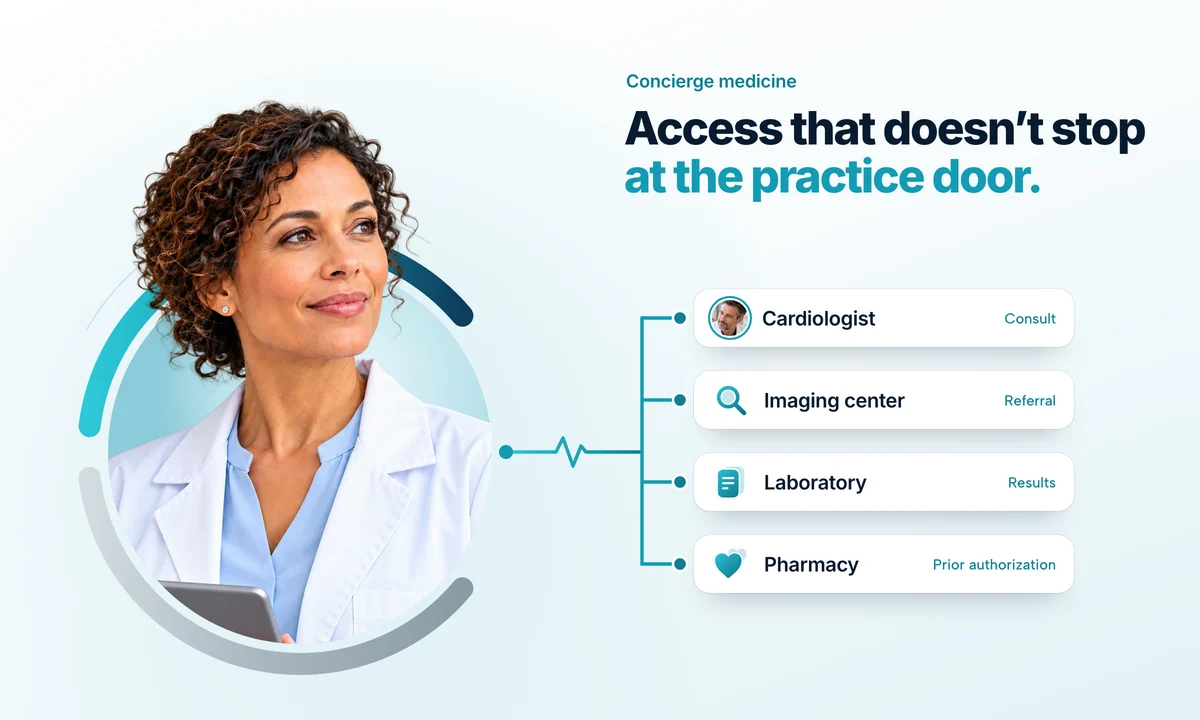
- Trusted Entity is the network that connects a practice to the organizations it works with outside its walls, including clinical laboratories, imaging centers and pharmacies. Every connection is verified and covered by signed agreements. Work runs in queues with one thread per request, each marked Normal, Urgent or STAT, and the people who hold the collaborator role on each side join the thread automatically. Each organization decides who on its side takes part. Our article on the Trusted Entity network for outside organizations explains how connections are set up.
- Practice HQ is the ordering practice’s own secure workspace, where physicians, nurses, medical assistants and office staff coordinate the work that follows a result.
- ConsultCore supports documented physician-to-physician conversations, such as a pathologist or radiologist discussing a finding with the ordering physician.
ClinicianCore works alongside the EHR rather than inside it, so a lab can start working with a practice without waiting for an interface build. The platform is not patient facing. It is secure communication infrastructure with encryption, role-based access and audit trails, and clinical and billing decisions stay with licensed professionals. For a broader view of the model, see our overview of unified clinical communication.
Compete on service, not inducements
A communication strategy only builds lasting loyalty if it stays on the right side of fraud and abuse law. The HHS Office of Inspector General explains in its 2023 General Compliance Program Guidance that the federal anti-kickback statute “has been interpreted to cover any arrangement where one purpose of the remuneration is to induce referrals” for services paid by a federal health care program. OIG has warned clinical laboratories about payments to referring physicians for decades.
Software is a specific trap. The federal safe harbor that protects donated EHR items and services covers donors “other than a laboratory company” (42 CFR 1001.952(y)). Labs cannot rely on it to give software to the practices that send them tests.
The practical line for a lab is clear:
- Improve your own responsiveness. Faster answers, documented critical results and reachable specialists are legitimate competition on quality.
- Do not pay for a referring practice’s software, subscriptions or staff time. Each organization should hold and fund its own access.
- Have healthcare counsel review outreach programs, especially anything that transfers value to a practice.
This is not legal advice, and arrangements vary. The principle is simple: win orders by being better to work with, not by subsidizing the people who send them. ClinicianCore, a secure, HIPAA-compliant unified clinical communication platform built exclusively for physicians, supports this approach because each organization holds its own access, and every exchange is encrypted and logged, which supports HIPAA-compliant collaboration across organizations.
How can lab leaders measure physician loyalty?
Physician loyalty can be measured before it turns into lost volume. These metrics give a chief commercial officer an early warning system.
| Metric | What it reveals | How to track it |
|---|---|---|
| Active ordering practice retention | Whether practices that ordered last quarter still order this quarter | Compare ordering client lists by quarter |
| Volume trend per practice | Silent defection that never becomes a complaint | Flag practices with sustained month over month declines |
| Critical result time to acknowledgment | Whether urgent results reach a responsible clinician | Timestamp delivery and acknowledgment for each critical value |
| Clarification response time | How easy the lab is to work with day to day | Measure time from question to answer by channel |
| Share of traffic by fax and phone | How much of the relationship still runs on analog channels | Count inbound and outbound messages by channel |
| Outreach team escalations | Where friction concentrates by practice or test line | Log and categorize issues raised in client visits |
Review these numbers with the outreach team monthly. A practice whose response times are slipping and whose volume is flattening is a conversation to have this week, not next quarter.
Become the easiest lab to work with
Diagnostic organizations spend heavily on couriers, client service teams and outreach visits to win physician loyalty. Those investments still matter. But the daily experience of reaching the lab, getting an answer and receiving a critical result without chasing it is what keeps a practice from drifting to a competitor.
Joining ClinicianCore as a Trusted Entity puts a lab inside the communication workflow its ordering practices already use. Results reach the right clinician, questions reach the right staff member, and every exchange is documented. That lowers friction for the practice, supports medical practice efficiency, and makes your organization the obvious choice for the next order.
The Trusted Entity network grows stronger with every organization that joins. To see how ClinicianCore, a secure, HIPAA-compliant unified clinical communication platform built exclusively for physicians, can connect your lab with the practices you serve, Request a Live Demo.
Frequently asked questions
How do diagnostic labs keep referring physicians loyal?
Diagnostic labs keep referring physicians loyal by being the easiest organization to work with: fast, acknowledged critical results, quick answers and reachable pathologists. Only 8% of family physicians report an ideal experience receiving outside test results (JAMA Network Open, 2025). ClinicianCore connects labs and practices in one documented channel.
Why do physicians switch labs?
Physicians usually switch labs because of accumulated friction rather than one failure. Rejected specimens in fax trays, critical calls that reach voicemail and long holds all add up; 88% of practitioners say fax delays hurt patient care (Documo survey, 2025). ClinicianCore replaces fax and phone tag with secure, recorded threads.
What is referral leakage for a laboratory?
Referral leakage for a laboratory is test volume that a loyal or affiliated practice sends to a competing lab instead. It is usually driven by operational friction, not clinical quality. In one 2024 survey, 82% of clinicians would consider a better notification system (ADLM). ClinicianCore helps labs remove that friction.
How should labs report critical results?
Under CLIA, labs must immediately alert the person or entity that ordered the test when a result signals an imminent threat to life. Best practice adds a named recipient, acknowledgment, escalation and documentation; up to 25% of calls in one hospital needed escalation (AJCP, 2025). ClinicianCore keeps that exchange on record.
Can a lab give free communication software to referring physicians?
A lab should not give free software or pay subscriptions for referring physicians. The federal EHR donation safe harbor excludes laboratory companies as donors (42 CFR 1001.952, 2026). Each organization should fund its own access, and counsel should review outreach programs. ClinicianCore gives each organization its own account.
How does ClinicianCore help labs grow physician referrals?
ClinicianCore helps labs grow referrals by connecting them directly to ordering practices through its Trusted Entity network. Labs can send urgent results, route questions to practice staff and keep a documented record. In a 2024 survey, 35% of clinicians said critical result calls distracted them from patient care (ADLM).
Does ClinicianCore replace a lab information system or the practice EHR?
No. ClinicianCore does not replace a laboratory information system or a practice EHR; it runs alongside them as a secure communication layer between organizations. Only 8% of family physicians report ideal outside test result exchange (JAMA Network Open, 2025). ClinicianCore handles the conversations those systems were not designed for.
References
[1] Everson J, Adler-Milstein J, Phillips RL, Bazemore AW, Patel V. EHR Interoperability Experiences Reported by Family Physicians. JAMA Network Open, 2025;8(11):e2542460. https://pubmed.ncbi.nlm.nih.gov/41231471/
[2] Health care’s fax problem is still hurting patients (reporting Documo’s 2025 Healthcare Fax and Workflow Survey). Medical Economics, 2025. https://www.medicaleconomics.com/view/health-care-s-fax-problem-is-still-hurting-patients
[3] 42 CFR 493.1291, Standard: Test report. Electronic Code of Federal Regulations, Office of the Federal Register, current as of 2026. https://www.ecfr.gov/current/title-42/section-493.1291
[4] National Patient Safety Goals Effective January 2026 for the Laboratory Program. The Joint Commission, 2025. https://digitalassets.jointcommission.org/api/public/content/3c7a110c215943bc80d9ce87e9d9ee9d
[5] Guarner J, Osoria Z, Barker D, Stigaard LC. Escalation process of critical values when these cannot be communicated on first attempt: a hospital-wide process improvement project. American Journal of Clinical Pathology, 2025;163(1):97-101. https://pubmed.ncbi.nlm.nih.gov/39177003/
[6] Truijens K, Kalaria T, De Guire V, von Meyer A, Vermeersch P. Critical result thresholds and notification practices in clinical laboratories. Critical Reviews in Clinical Laboratory Sciences, 2026. https://pubmed.ncbi.nlm.nih.gov/42667162/
[7] Kavuri SB, Clark C, Olalekan O, Okorodudu AO. Critical result notification preferences. ADLM Clinical Laboratory News, 2024. https://myadlm.org/cln/Articles/2024/SeptemberOctober/Critical-result-notification-preferences
[8] General Compliance Program Guidance. HHS Office of Inspector General, 2023. https://oig.hhs.gov/documents/compliance-guidance/1135/HHS-OIG-GCPG-2023.pdf
[9] 42 CFR 1001.952, Exceptions (safe harbors), paragraph (y) electronic health records items and services. Electronic Code of Federal Regulations, Office of the Federal Register, current as of 2026. https://www.ecfr.gov/current/title-42/chapter-V/subchapter-B/part-1001/subpart-C/section-1001.952
Statistics are reported as published by each source. This article is general information, not legal advice.