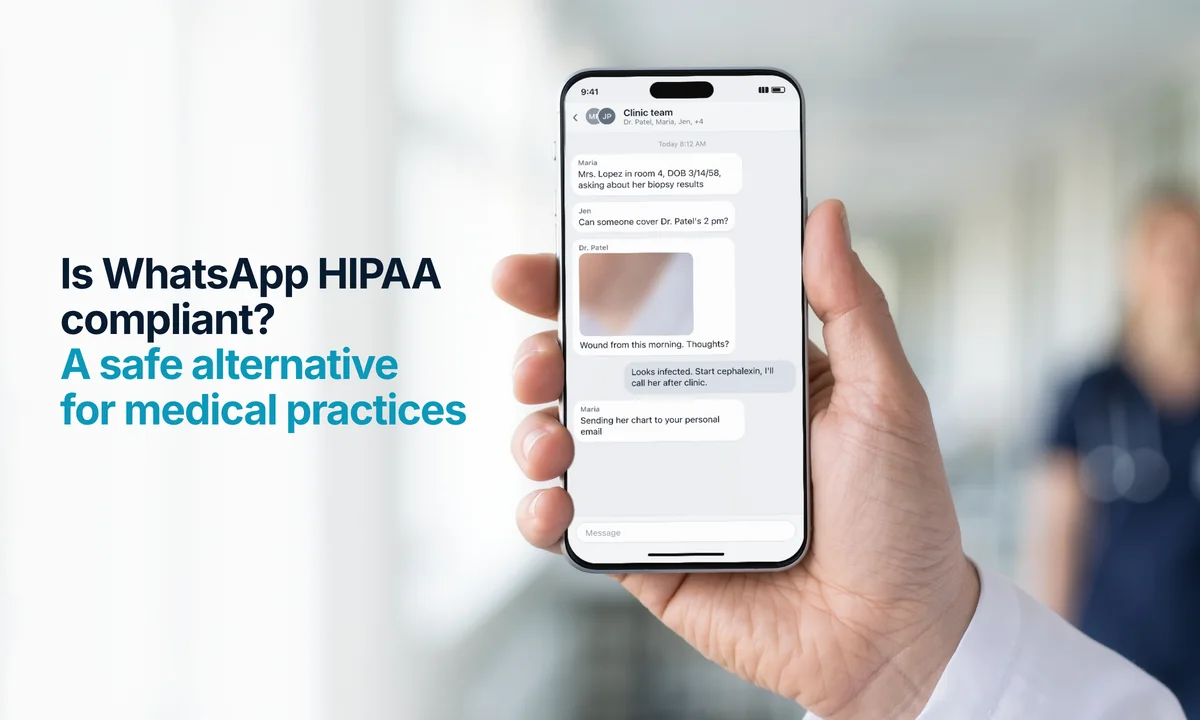
Is WhatsApp HIPAA compliant? No. Meta’s own terms for its business platform state that Meta is not a HIPAA business associate and that the platform is not HIPAA compliant (Meta, 2026), so a practice cannot get the Business Associate Agreement (BAA) that HIPAA requires. The right alternative is a clinical messaging platform that signs a BAA, ties every message to one identified person, keeps an audit record and lets the practice remove access when someone leaves.
Yet consumer texting still runs much of the day in many independent practices: on-call swaps in a group chat, a wound photo sent to a colleague, a schedule change texted to the front desk. This guide explains what HIPAA, CMS and The Joint Commission require, how the main types of secure messaging platforms differ, and how to move a practice off WhatsApp and standard SMS in four steps. It also shows how ClinicianCore, a secure, HIPAA-compliant unified clinical communication platform built exclusively for physicians, covers internal team messaging, physician-to-physician consults and work with outside organizations.
Key takeaways
- Meta’s terms for the WhatsApp Business Platform state that Meta is not a HIPAA business associate, so no BAA is available for WhatsApp use with patient information.
- Encryption alone does not make an app HIPAA-compliant. Practices also need a signed BAA, unique user access, audit records and the ability to revoke access.
- CMS (QSO-24-05, 2024) and The Joint Commission (2024) permit texting patient information and orders only through a HIPAA-compliant secure texting platform, with CPOE still preferred.
- HHS OCR received reports of 663 large breaches affecting about 242.9 million people in 2024, and email was the main location of PHI in 25% of those reports.
- Front-desk patient texting tools, hospital paging systems and clinician collaboration platforms solve different problems. Choose by the workflow you need to replace.
“Practices don’t pick WhatsApp because they ignore compliance. They pick it because it is fast and already on every phone. A replacement only works if it is just as easy for the whole team on day one.”

Is WhatsApp HIPAA compliant for medical practices?
No version of WhatsApp is set up to carry protected health information (PHI) for a U.S. practice. Under HIPAA, any vendor that creates, receives, maintains or transmits PHI on a practice’s behalf is a business associate and must sign a BAA. Meta’s terms for the WhatsApp Business Platform, updated in 2026, state that Meta is not a business associate or subcontractor under HIPAA and that the platform is not HIPAA compliant (Meta, 2026). A vendor that says it is not a business associate will not sign a BAA.
Encryption in transit does not change that answer. The HIPAA Security Rule also expects administrative and technical safeguards that a consumer app leaves to each person’s phone:
- Unique user access: every message tied to one identified person, not a phone number.
- Audit records: a reviewable log of who sent, read or forwarded a message, and when.
- Access removal: when a medical assistant or associate physician leaves, the practice can end their access to its conversations.
- Practice control of storage: chats and photos backed up to personal cloud accounts sit outside the practice’s risk analysis.
The same gaps apply to standard carrier SMS and to other consumer chat apps. For the enforcement side, read our analysis of why consumer apps create HIPAA liability, and use the checklist of what every physician practice must verify before deploying any communication tool.
What do CMS and The Joint Commission allow for texting patient information?
On February 8, 2024, CMS issued memorandum QSO-24-05-Hospital/CAH. It states that texting patient information and patient orders among members of the health care team is permissible when done through a HIPAA-compliant secure texting platform and in line with the Conditions of Participation. Computerized provider order entry (CPOE) remains the preferred method of order entry (CMS, 2024).
The Joint Commission followed on June 5, 2024. Accredited organizations may text patient information and orders through a secure texting platform that is encrypted, confirms who wrote each message and transfers orders into the electronic health record (EHR), where they must be dated, timed and authenticated (The Joint Commission, 2024). Its FAQs cover ambulatory care and office-based surgery as well as hospitals.
The AMA’s 2026 guidance adds a practical caution for physicians. Texted orders should be kept for urgent situations, sent only through a secure platform and promptly documented in the EHR. The AMA also notes that the free versions of tools many physicians use are not HIPAA-compliant for texting, even when an enterprise version is (AMA, 2026).
None of these rules opens the door to WhatsApp or standard SMS. What they allow is secure team messaging under clear policies. Practices should keep orders in the EHR and use a compliant platform for the conversation around the patient.
Why does consumer texting carry more risk for independent practices now?
Independent practices deliver a large share of U.S. care, and many have no dedicated compliance staff. In 2024, 42.2% of physicians worked in private practices, down from 60.1% in 2012 (AMA, 2025). A practice of that size often runs on one office manager, a few personal phones and habits that started before anyone wrote a policy.
The enforcement record is getting harder to ignore. HHS OCR received reports of 663 breaches affecting 500 or more people that occurred in 2024, affecting about 242.9 million individuals, and email was the main location of PHI in 25% of those reports (HHS OCR, 2024 data). OCR named risk analysis, audit controls, information system activity review and person authentication as key areas needing improvement.
In December 2024, HHS proposed updates to the Security Rule that would require encryption of electronic PHI at rest and in transit, multi-factor authentication and a written technology asset inventory, each with limited exceptions (HHS OCR, 2024). The proposal is not final and the current rule remains in effect. Still, an unmanaged WhatsApp group would be hard to place on any asset inventory or risk analysis.
What types of HIPAA-compliant messaging platforms are there?
Once the answer to “is WhatsApp HIPAA compliant” is clear, the next question is what to use instead. Vendors offering a HIPAA-compliant WhatsApp alternative use similar language for very different products. Before comparing platforms, decide which communication problem you need to replace. Most products fall into one of three categories, next to the consumer apps practices are leaving.
| Category | Built for | Typical use | Fit for clinician-to-clinician work |
|---|---|---|---|
| Consumer messaging apps and standard SMS | Personal communication | Group chats, photos and quick texts on personal phones | Not suitable for PHI: no BAA, no practice-controlled audit or access removal |
| Front-desk patient texting platforms | Front office staff and patients | Appointment reminders, two-way patient texts, intake forms, shared inbox | Designed for patient outreach, not for physician consults or cross-practice work |
| Hospital paging and inpatient messaging systems | Hospitals and health systems | Pager replacement, on-call routing, alarms, EHR alerts | Sized for inpatient settings and hospital procurement |
| Clinician and care team collaboration platforms | Physicians, nurses and practice teams | Internal team messaging, structured consults, work with outside organizations | Built for the clinical side of an independent practice |
Many practices end up with two tools: a patient-facing texting tool at the front desk and a clinician platform for the care team. That split also makes policy simpler, because patient reminders and clinical discussions follow different rules.
How does ClinicianCore replace WhatsApp for clinical teams?
As a WhatsApp alternative for medical practices, ClinicianCore is a secure, HIPAA-compliant unified clinical communication platform built exclusively for physicians. It sits in the fourth category above and carries the conversations that consumer apps carry today, inside the practice and across organizations, under a BAA. It works alongside the practice’s EHR and front-desk tools rather than replacing them.
Practice HQ: internal communication for the whole practice
In a busy clinic, physicians, nurses and medical assistants need quick answers about rooming, a lab question or an on-call change. Practice HQ gives the team secure messaging, voice and video in one workspace, with role-based access so each person sees what their role requires. Conversations stay in the practice’s workspace instead of personal chat threads, and access ends when a team member leaves.
ConsultCore: structured physician-to-physician consults
A curbside question texted to a specialist is fast, but it leaves no structured record. ConsultCore supports interprofessional consultations between physicians at different practices, with a structured record of the clinical question, the reasoning and the decision. When payer requirements are met, that record can support interprofessional consultation coding. Our guide to billing interprofessional consults under the 2026 CPT rules covers the details.
Trusted Entity: secure work with outside organizations
Much of a practice’s daily traffic goes to organizations outside its walls: specialist practices, labs, imaging centers, pharmacies and billing partners. Through the Trusted Entity network, practices connect with verified outside organizations and work in topic threads with the right people, with audit-ready records. A referral packet or an imaging question moves with the conversation instead of a fax and a callback. The same thread supports closing the referral loop.
Physician Lounge: a confidential space for physicians
Physicians also use consumer group chats to talk with peers, which leaves screenshots and lasting records on personal phones. The Physician Lounge is a confidential space only for credentialed physicians, built on zero data retention. Peer connection matters: 43.2% of physicians reported at least one symptom of burnout in 2024 (AMA, 2025).
Together, these parts form one unified clinical communication workspace for the practice and the organizations it works with. Practices comparing options can see how ClinicianCore approaches HIPAA-compliant collaboration in more detail.
How can a practice switch from WhatsApp and SMS to a secure platform?
Knowing the answer to “is WhatsApp HIPAA compliant” is only half the job, because software alone does not change habits. A clean switch pairs a clear policy with a tool that is as easy as the app it replaces.
- Find every informal channel. List the group chats, SMS threads, personal phone photos and on-call messages in use today, and who is in each one. Add them to the practice’s HIPAA risk analysis.
- Write a short acceptable use policy. State that PHI, patient photos and schedule details stay off WhatsApp, standard SMS and personal email, and name the approved platform as the channel for clinical and operational messages.
- Move everyone at once, with role-based access. Give each physician and staff member a unique login on a secure, HIPAA-compliant unified clinical communication platform built exclusively for physicians, set role-based permissions and confirm that access can be removed the day someone leaves.
- Keep patient reminders and clinical work separate. Use the EHR or a front-desk tool for minimum-necessary patient reminders, and route team discussions, consults and outside coordination through the BAA-covered clinical platform. Close the old group chats on a set date.
See how a practice-wide switch would work for your team. Request a Live Demo.
About this comparison: WhatsApp is a trademark of Meta Platforms, Inc. ClinicianCore is not affiliated with or endorsed by Meta. Statements about WhatsApp in this article describe Meta’s own published terms as of November 2026.
Frequently asked questions
Is WhatsApp HIPAA compliant for medical practices?
No. Meta’s 2026 terms for the WhatsApp Business Platform state that Meta is not a HIPAA business associate, so no BAA is available. With 663 large breaches reported to HHS OCR for 2024 (HHS OCR, 2024), practices should move patient information to a BAA-covered platform such as ClinicianCore.
Can physicians text patient orders under current CMS rules?
Yes, through a HIPAA-compliant secure texting platform. CMS memorandum QSO-24-05 (CMS, 2024) permits texting patient information and orders among care team members, with CPOE still preferred. The Joint Commission lists four requirements (The Joint Commission, 2024). ClinicianCore supports secure team messaging, while orders stay documented in the EHR.
What should a medical practice look for in a WhatsApp alternative?
Look for a signed BAA, unique logins, role-based access, audit records and same-day access removal. HHS OCR named audit controls among five key improvement areas in its 2024 breach findings (HHS OCR, 2024). ClinicianCore, a secure, HIPAA-compliant unified clinical communication platform built exclusively for physicians, includes these controls.
How is clinical team messaging different from front-desk patient texting?
Front-desk tools handle patient reminders, intake forms and two-way patient texts. Clinical team platforms handle conversations among physicians, nurses, staff and outside organizations. With 42.2% of physicians in private practice in 2024 (AMA, 2025), many independent practices use both. ClinicianCore covers the clinical side and is not patient-facing.
Does the proposed HIPAA Security Rule update affect practice messaging?
It could. The December 2024 HHS proposal would require encryption of electronic PHI, multi-factor authentication and an asset inventory reviewed at least every 12 months (HHS OCR, 2024). It is not final yet. Practices using ClinicianCore keep team messaging on one managed platform instead of personal chat apps.
References
- Meta states it is not a HIPAA business associate and that the WhatsApp Business Platform is not HIPAA compliant (section 4.2, terms effective 23 Sep 2026). Source: Meta, Meta Terms for WhatsApp Business Platform, 2026
- Texting patient information and orders is permissible through a HIPAA-compliant secure texting platform; CPOE remains preferred. Source: CMS, QSO-24-05-Hospital/CAH: Texting of Patient Information and Orders for Hospitals and CAHs, 2024
- Accredited organizations may text information and orders through an encrypted secure texting platform that captures orders in the EHR. Source: The Joint Commission, Use of secure text messaging for patient information and orders, 2024
- Texted orders should be urgent-only, sent through a secure platform and documented in the EHR; free tool versions are not HIPAA-compliant for texting. Source: AMA, Debunking regulatory myths: texting patient orders, 2026
- 42.2% of physicians worked in private practices in 2024, down from 60.1% in 2012. Source: AMA, Physician Practice Benchmark Survey, 2024 data (published 2025)
- 663 large breaches in 2024 affected about 242,908,056 individuals; email was the location in 25% of reports; key improvement areas named. Source: HHS OCR, Annual Report to Congress on Breaches of Unsecured PHI, Calendar Year 2024
- Proposed Security Rule changes: encryption at rest and in transit, MFA, asset inventory at least every 12 months; current rule remains in effect. Source: HHS OCR, HIPAA Security Rule NPRM Fact Sheet, 2024
- 43.2% of physicians reported at least one symptom of burnout in 2024. Source: AMA, U.S. physician burnout hits lowest rate since COVID-19, 2025