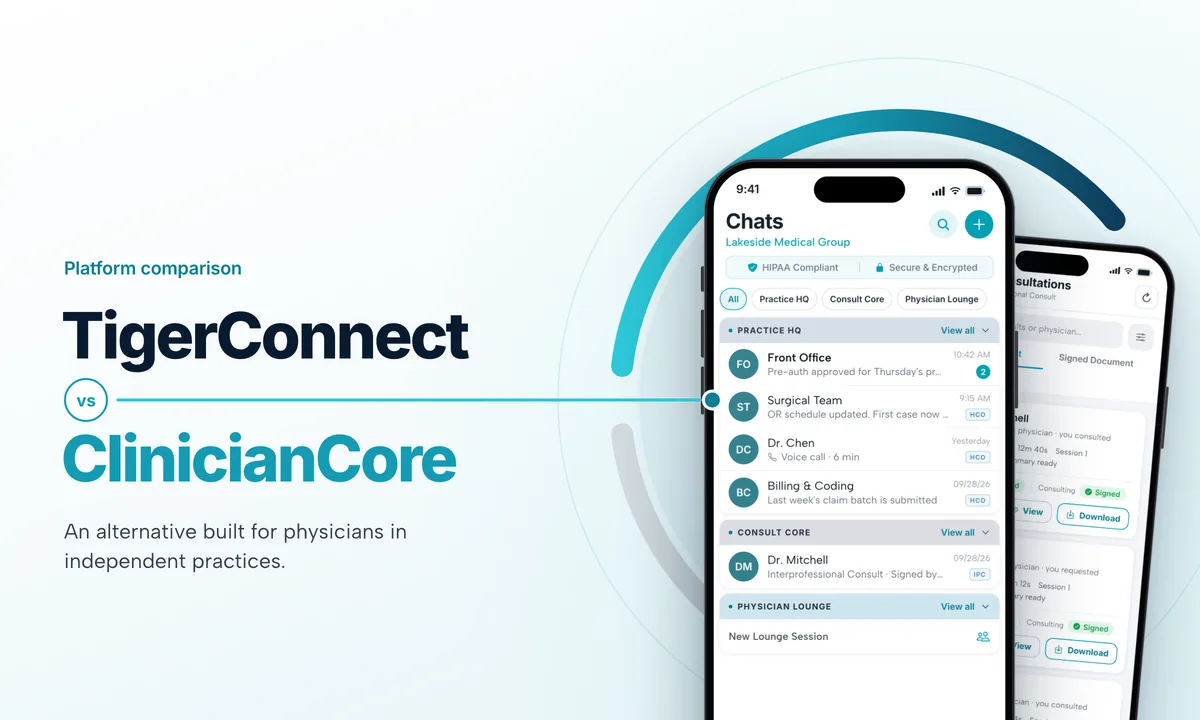
TigerConnect vs ClinicianCore at a glance
If you are looking for a TigerConnect alternative for an independent physician practice, start here.
| Platform | How it describes itself | Organizations it names | Products or modules |
|---|---|---|---|
| ClinicianCoreBuilt for physicians | Clinical communication built exclusively for physicians | Independent physician group practices and their outside partners | Practice HQ, ConsultCore, Trusted Entity, Physician Lounge |
| TigerConnectIn its own words | Clinical communication software for hospitals | Health systems, hospitals, ambulatory surgery centers, behavioral health, home health and hospice, physician groups, skilled nursing | Clinical Collaboration, Scheduling, Alarm Management, Nurse Call, Smart Room, Patient Engagement, Pre-Hospital, Transfer, Operator Console, CareConduit |
The TigerConnect row uses TigerConnect’s own wording and product names from tigerconnect.com, checked on 13 October 2026. Products change, so check with TigerConnect for current details. Learn more about ClinicianCore at cliniciancore.com/platform.
What is TigerConnect?
TigerConnect describes its product as clinical communication software for hospitals and says it has worked in healthcare communications since 2010. Its website lists a product family that includes secure messaging (Clinical Collaboration), scheduling, alarm management, nurse call, smart room, patient engagement, pre-hospital and transfer tools, an operator console and an AI orchestration engine called CareConduit. The organizations it names include health systems, hospitals, ambulatory surgery centers, behavioral health, home health and hospice, physician groups and skilled nursing facilities.
This page does not assess TigerConnect beyond that description. For pricing, current features or contract terms, ask TigerConnect.
What should a practice look for in a TigerConnect alternative?
Start with your own practice, not with a feature list.
A communication platform for a practice should take work off that pile, not add to it. Five things matter most for an independent group:
- Built around physicians: the physician’s day, consults and judgment sit at the center of the design.
- Consults that leave a record: a specialist’s advice is captured in a structured record that the practice can find, use and, where the rules allow, bill.
- A verified outside network: referral partners, labs and billing services are verified before they connect, and every exchange is logged.
- Setup sized to a practice: onboarding fits a physician group without a hospital-scale integration program.
- HIPAA safeguards and a signed BAA: encryption, access controls and an audit trail, in writing.
ClinicianCore, module by module
ClinicianCore is designed for independent physician group practices and the people they work with every day, inside the practice and outside it. Video, voice and text sit in one place, in real time or asynchronously, so a physician can answer when the clinical day allows.

Practice HQYour practice team
Practice HQ keeps the practice’s internal communication in one place, so the right person sees an urgent result and everyone else is not interrupted by it.
Key features
- Routing: messages routed by urgency, clinical role, on-call schedule and provider availability.
- One system for the whole team: front desk, billing, nursing staff, physicians and laboratory services.
- Every kind of message: real-time video, store-and-forward video, voice and text.
- Protected: encrypted in transit and at rest, with role-based access controls.

ConsultCorePhysician to physician
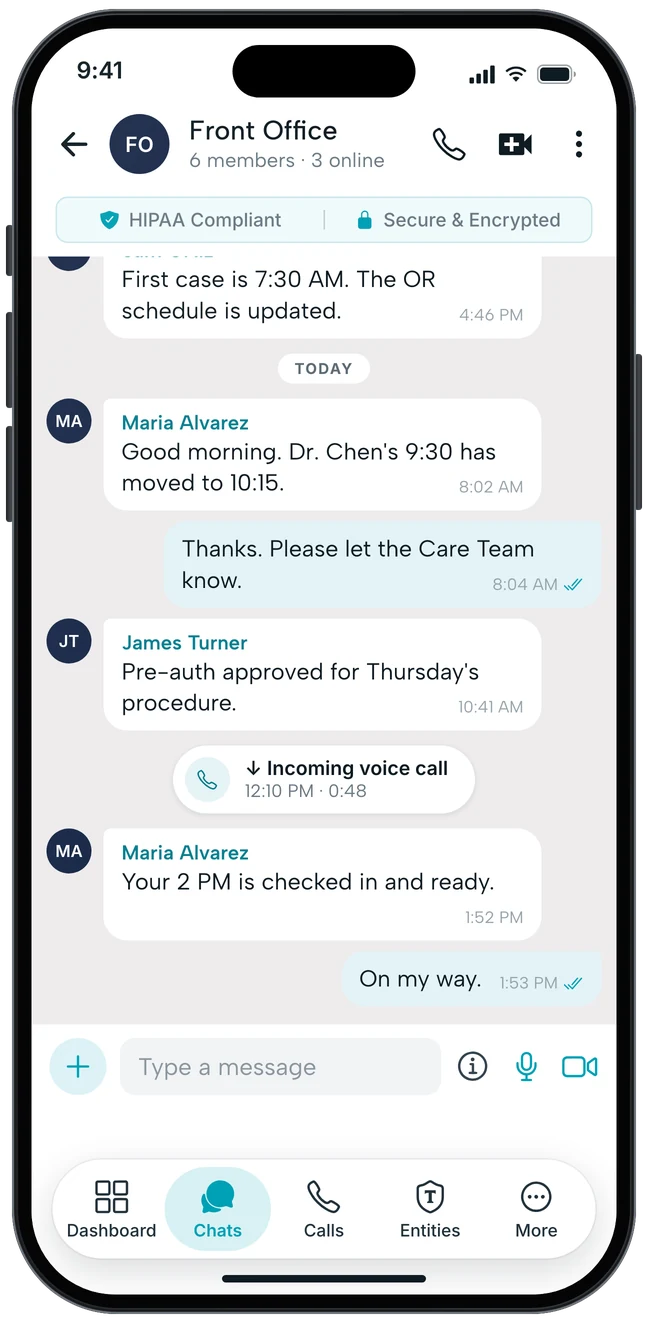
Most consults between physicians happen in a hallway, by text or over the phone, and leave no record. ConsultCore captures each interprofessional consult as a structured record: the question, the files shared, the advice given and each acknowledgment, in order.
Key features
- Request: the requesting physician starts a consult, now or scheduled, with images and lab results attached.
- Consult: video, voice or written, with a transcript and a summary for physician review.
- Sign and keep: requesting and consulting physicians both sign; the record is saved and can be downloaded.
Medicare pays for interprofessional consultation CPT codes used by practitioners who can bill E/M visits:
- 99446 to 99449The consulting physician’s assessment, with a verbal and written report, set by time spent
- 99451The consulting physician’s assessment with a written report only
- 99452The requesting physician’s time preparing for and arranging the consult
A 2024 systematic review in JAMA Network Open of 72 studies found e-consults avoided 24.0 to 55.0 percent of referrals in post-consult surveys. The review rated the evidence as low to very low, so treat the figures as a range, not a promise.
Before you bill. Interprofessional consultation codes carry conditions, including time thresholds, documented patient consent and limits when a face-to-face visit is close by. Payer rules differ. ClinicianCore provides the communication and documentation tools; coding, billing and reimbursement decisions stay with the practice and its coders.

Trusted EntityOutside organizations
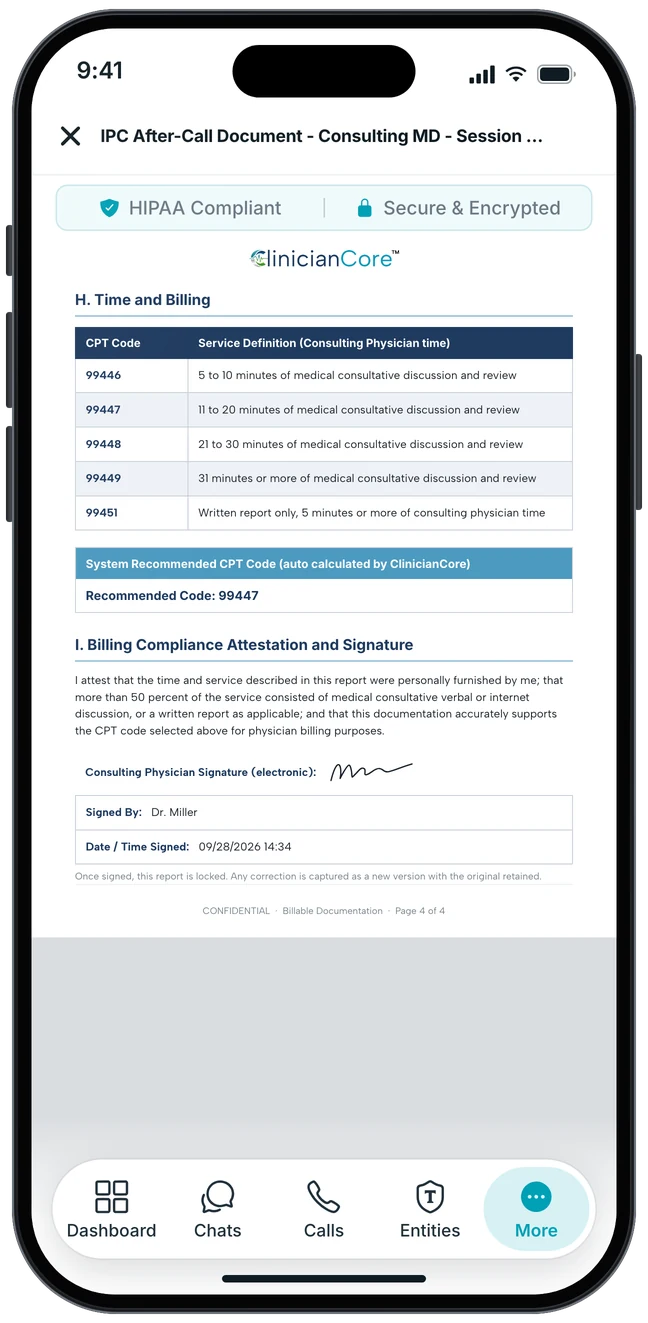
A practice depends on organizations it does not run: specialists, labs, imaging centers and billing services. Trusted Entity gives each of them a verified, direct connection, in place of fax-and-phone loops.
Key features
- Verified before connecting: ClinicianCore checks identity, licensing and professional credentials.
- Shared queues: billing resolution, referral coordination, prior authorization and general, one thread per topic.
- One record both sides can see: messages, files and consult records move through one secure channel.
- Audit trail: every exchange is logged.

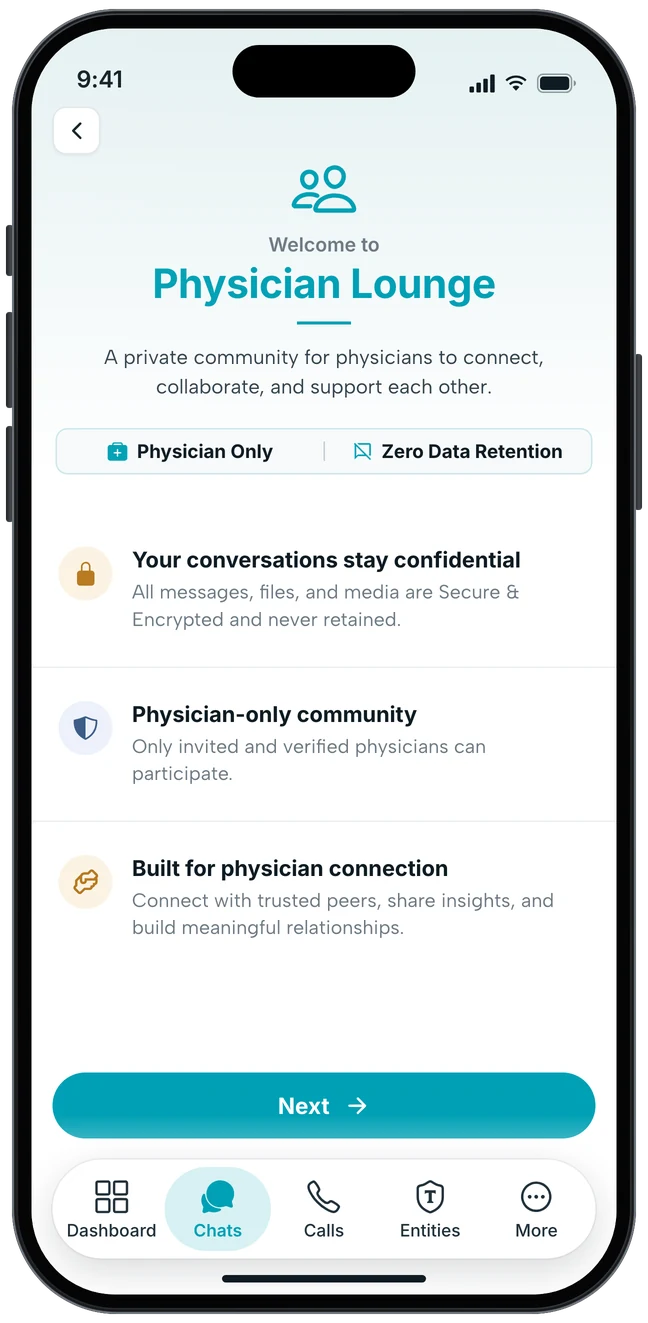
Physician LoungeThe physician community
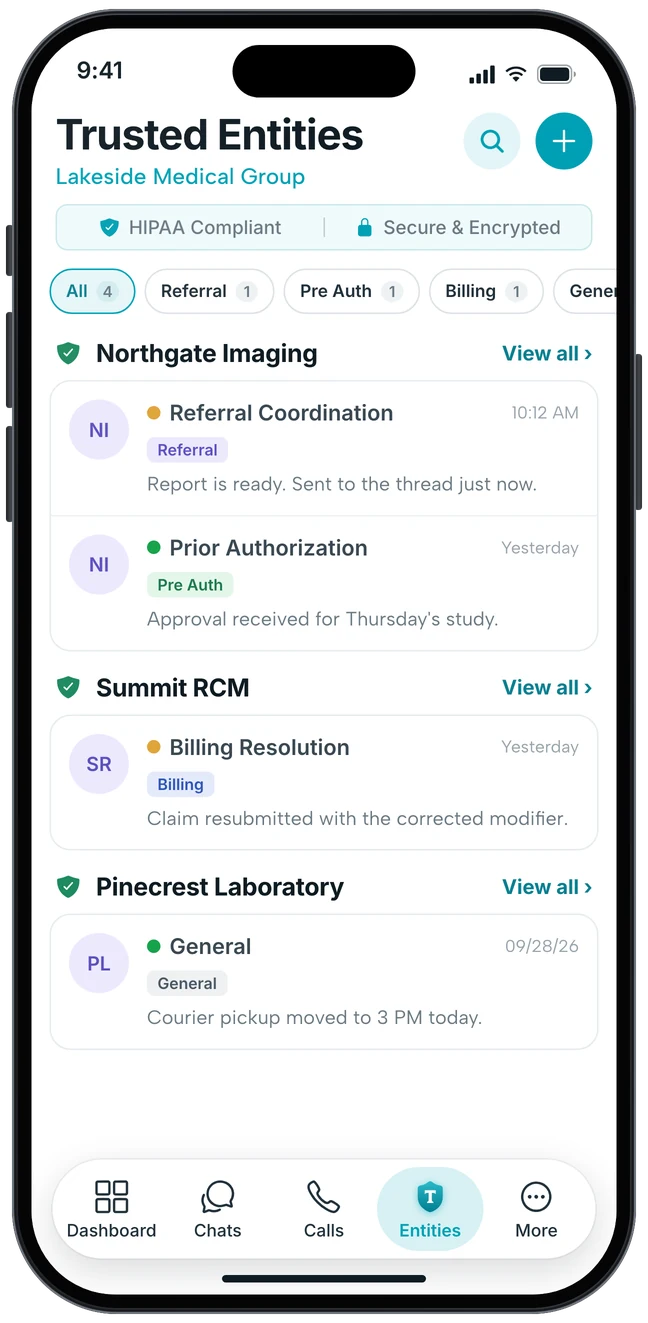
A private, physician-only space for conversation with colleagues outside your own practice or institution.
Key features
- Verified physicians only: every member goes through credential and licensure verification before joining.
- No outside parties: patients, insurance representatives and other outside parties are not part of it.
- Not stored: conversations are not stored, saved or archived.
See it with your own consult.
Bring one real consult or referral from your practice, and we will walk it through ConsultCore and Trusted Entity on a 30-minute call.
How is ClinicianCore secured?
- Encryption in transit and at rest
- Role-based access controls, so each person sees what their role needs
- Multi-factor authentication support
- An audit trail for consults and partner exchanges
- A Business Associate Agreement where ClinicianCore acts as a business associate
In December 2024, HHS proposed changes to the HIPAA Security Rule that would require encryption of electronic protected health information at rest and in transit, and multi-factor authentication, with limited exceptions. Whatever platform you choose, ask for these safeguards in writing. See the HIPAA-compliant collaboration platform page and our guide to the Business Associate Agreement for clinical communication.
Is ClinicianCore the right fit?
It depends on your organization. ClinicianCore is built exclusively for physicians, so it fits some teams well and others less well.
ClinicianCore fits when
- You run or work in an independent physician group practice, and physician communication is the priority.
- You want consults recorded as structured, potentially billable records rather than lost in calls and texts.
- You need a verified connection to referral partners, labs, imaging centers and billing services, with one audit trail.
- You want onboarding sized to a practice.
Another platform may suit you better when
- You need hospital-floor systems such as nurse call, alarm management or an operator console. ClinicianCore does not offer them.
- You need one platform for every role across a multi-hospital system.
- Your main need is texting with patients. ClinicianCore is built for communication between clinicians and the organizations they work with.
How do you evaluate a TigerConnect alternative?
Put the same six questions to every vendor on your list, TigerConnect and ClinicianCore included:
- Who is the product built for: hospitals, practices, or both?
- What happens to a consult after the conversation ends? Is there a structured record?
- Who can you connect with outside the practice, and how are they verified?
- What does setup look like for a practice of your size, and how long does it take?
- Will the vendor sign a BAA, and which safeguards are in writing?
- Does it fit your physicians’ day: video, voice and text, in real time and asynchronously?
You can also read how we compare with another vendor in PerfectServe vs ClinicianCore.
Frequently asked questions
What is a good TigerConnect alternative for an independent physician practice?
ClinicianCore is a TigerConnect alternative built exclusively for physicians in independent group practices. It brings internal messaging, recorded consults, verified outside partners and a physician-only community into one platform. In 2024, 42.2 percent of US physicians worked in private practice (AMA, 2025), the setting ClinicianCore is designed for.
What is the difference between TigerConnect and ClinicianCore?
TigerConnect describes itself as clinical communication software for hospitals. ClinicianCore is built exclusively for physicians in independent group practices, with recorded consults and a verified partner network. In 2024, 47.4 percent of US physicians worked in practices with 10 or fewer physicians (AMA, 2025). Confirm current TigerConnect details with TigerConnect directly.
Can ClinicianCore document interprofessional consults for billing?
Yes. ClinicianCore ConsultCore captures physician-to-physician consults as structured records that can support interprofessional consultation codes 99446 to 99449, 99451 and 99452. A review of 72 studies found e-consults avoided 24 to 55 percent of referrals in post-consult surveys (JAMA Network Open, 2024). Coding decisions stay with the practice.
Is ClinicianCore HIPAA compliant?
Yes. ClinicianCore is built for HIPAA compliance, with encryption in transit and at rest, role-based access controls and audit trails for consults and partner exchanges. In December 2024, HHS proposed requiring encryption of electronic health information at rest and in transit, with limited exceptions (HHS, 2024). Ask any vendor for a signed BAA.
Does ClinicianCore replace hospital systems such as nurse call or alarm management?
No. ClinicianCore is built for physician communication in independent practices and does not offer hospital-floor systems such as nurse call, alarm management or an operator console. It focuses on the work around the physician: physicians averaged 7.3 hours a week on administrative tasks in 2024 (AMA, 2025).
About this comparison. TigerConnect is a trademark of its owner. ClinicianCore is not affiliated with, endorsed by or sponsored by TigerConnect. Information about TigerConnect comes from its public website as of 13 October 2026 and may change; check with TigerConnect for current details. ClinicianCore provides communication and documentation tools. It does not provide medical care, medical advice, coding or billing services.
Sources (8)
- TigerConnect, home page, checked 13 October 2026
- American Medical Association, Smaller share of doctors in private practice than ever before, 2025
- JAMA Network Open, Family physician to hospital specialist electronic consultation: a systematic review, 2024
- American Medical Association, Doctors work fewer hours, but the EHR still follows them home, 2025
- American Medical Association, Physician burnout rate continues to decline, 2026
- CMS, CY 2025 Medicare Physician Fee Schedule final rule fact sheet, 2024
- CMS, MLN Matters MM13887, 2024
- HHS, HIPAA Security Rule proposed rule fact sheet, 2024