Independent medical practices face an operational paradox every day. Physicians chart complex clinical encounters inside the Electronic Health Record, yet the moment a patient requires external coordination, that digital workflow comes to an abrupt halt. The clinical team prints the record, walks to a machine or a digital print driver, and hits send on a fax.
Across the United States, an estimated 70% to 90% of all healthcare communications and roughly 56% of patient referrals still travel via analog telephone lines or unindexed electronic faxes. Every year, the healthcare system exchanges over nine billion fax pages. The cost of this reliance is staggering: studies demonstrate that 46% to 50% of faxed referrals never result in a scheduled appointment, leaving patients stranded in administrative limbo and primary care providers completely in the dark.
To eliminate this manual breakdown without burdening independent practices with expensive, complex interfaces, the ClinicianCore platform introduces the Trusted Entity Network.
ClinicianCore bridges independent practices and their external partners by pairing sovereign practice management with inter-organizational clinical collaboration.
Key Takeaways
- 70% to 90% of healthcare communications and roughly 56% of referrals still move by fax or phone, and 46% to 50% of faxed referrals never convert into a scheduled visit.
- ClinicianCore’s Trusted Entity Network replaces the fax number with a secure, identity-verified gateway connecting a practice to specialists, labs, imaging centers, and billing partners.
- Every cross-organization exchange runs through an Initiate → Authenticate → Authorize → Connect → Communicate → Monitor & Audit sequence that completes in seconds rather than days.
- A dual-thread structure keeps administrative tasks, such as authorizations and scheduling, separate from clinical conversation, such as triage and medication adjustments, on the same patient referral.
- HCC Consult Core turns informal curbside consults into documented, billable interprofessional consultations under applicable CPT codes.
- The architecture is built on a HIPAA Business Associate framework, giving independent practices integrated-network-level collaboration without giving up their own EHR or autonomy.
“The medical fax machine has survived for decades not because it is superior, but because no alternative has combined its universal reach with the operational tools clinics actually need.”

The Reality of Referral Breakdowns and Administrative Drift
The persistence of the fax machine is not due to a lack of newer software; it is the predictable outcome of EHR workflow. A Primary Care practice cannot natively connect with an external cardiology or orthopedic group that documents in an EHR without incurring steep vendor interface fees, navigating complex data translation layers, and undergoing multi-month IT rollouts.
Because of this interoperability divide, practices default to the universal lowest common denominator: the fax number. This creates systemic failures that threaten practice solvency and patient outcomes:
- The Referral Black Hole: Nearly half of all faxed referrals fail to convert into visits because pages arrive illegible, insurance cards are faint, or documents languish in digital fax worklists without staff triage.
- The Telephone Tag Cycle: When a specialist’s front desk receives a referral missing a prior authorization or recent lab summary, they cannot click reply. Staff must dial the referring office, navigate complex phone trees, leave voicemails, and await return faxes.
- Open Legal and Malpractice Exposure: In ambulatory care, the referring clinician often carries ongoing medical liability for tracking high-risk referrals. When an unconfirmed specialist referral results in an unaddressed diagnostic finding or a missed oncology consult, the absence of an immutable care handoff creates a severe malpractice risk.
- Operational Expense: Healthcare organizations report that roughly 30% of diagnostic tests must be reordered simply because original results were lost, never received, or buried in fax backlogs.
Understanding the Trusted Entity Architecture
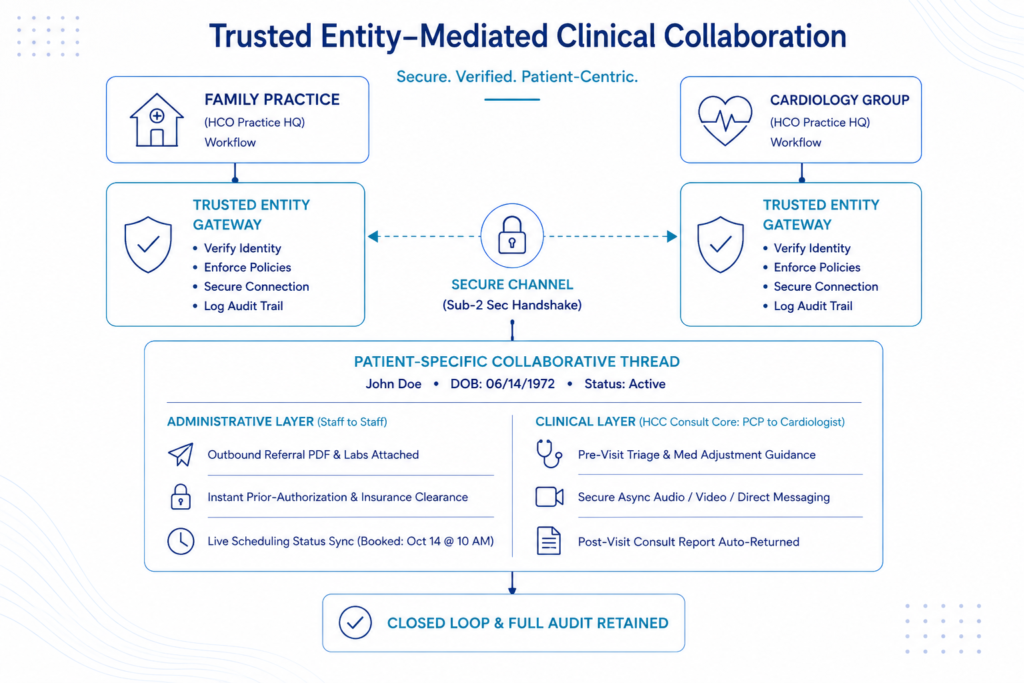
A Trusted Entity is ClinicianCore’s secure identity and policy enforcement gateway. Rather than requiring open-ended, vulnerable point-to-point connections, every external partner connects to your practice through an intelligent boundary that enforces mutual rules, roles, and compliance.
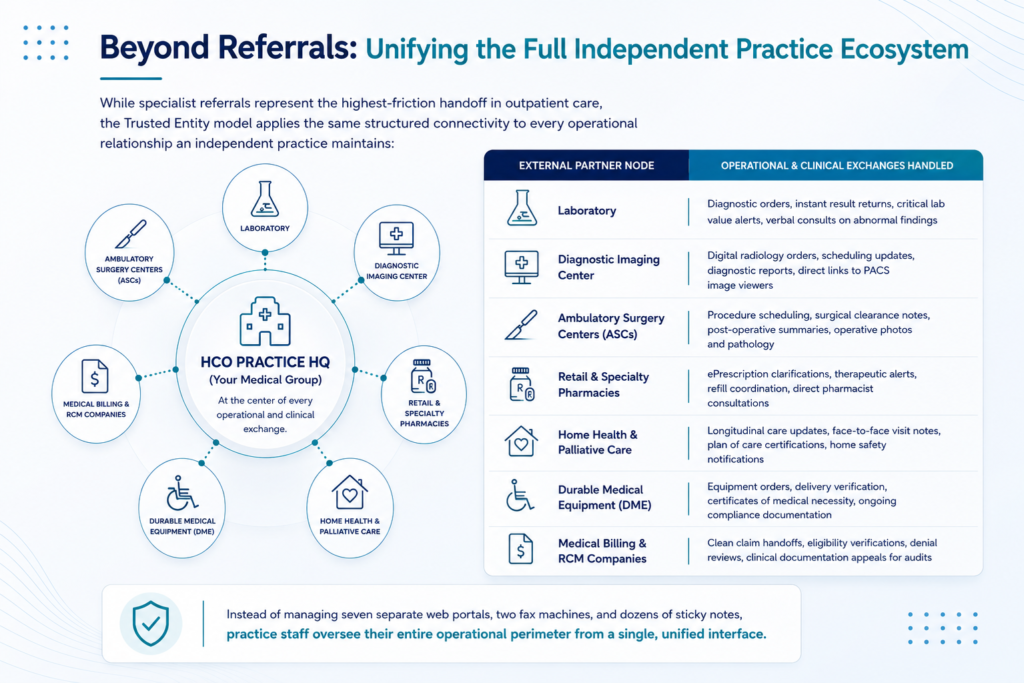
The central medical practice, operating through HCO Practice HQ, controls who can connect, what data they can access, and which transactions they can initiate. Each external node—whether an imaging center, a specialty practice, a billing service, or a laboratory—communicates through its own dedicated Trusted Entity gateway.
When an interaction begins across this network, the platform executes a rapid sequence to secure the handoff:
- Initiate: The sending organization triggers the request.
- Authenticate: The gateway verifies the receiving partner’s identity, licensing, and professional credentials against a verified registry.
- Authorize: The gateway applies the sending practice’s granular sharing policies and access permissions.
- Connect: The system establishes an isolated, end-to-end encrypted channel.
- Communicate: Teams conduct real-time clinical and operational exchanges through live video, text, voice, or structured data payloads.
- Monitor & Audit: The platform continuously logs, indexes, and retains immutable audit trails of the entire exchange.
The total handshake requires seconds, replacing days of manual phone tag and unconfirmed fax transmissions.
Transforming the Referral Lifecycle: The PDF-Anchored Patient Thread
ClinicianCore does not require practices to wait for EHRs to build bidirectional APIs. Instead, it transforms familiar daily behaviors into stateful, collaborative digital channels.
1. Ingestion Without IT Friction
During a patient encounter, the primary care physician documents the need for a cardiology evaluation. Rather than printing a paper stack to a physical fax tray, staff export or “print to PDF” the encounter summary, facesheet, and recent diagnostic labs as a single file.
Staff opens ClinicianCore, selects the verified specialty practice from their Trusted Entity directory, and drops the PDF into the new referral queue. The gateway authenticates both nodes, checks permissions, and creates a dedicated, patient-specific thread in seconds.
2. Clear Operational Queues
The referral avoids generic office email inboxes or unmonitored fax queues. Both practices manage the handoff using synchronized, role-based dashboards:
- Primary Care Practice Outbound View: Shows exactly where each outbound patient sits: Delivered, Triaged, Action Required, Scheduled, or Completed.
- Specialty Practice Inbound View: Intake staff receive the referral in a unified worklist. Using an integrated side-by-side viewer, staff review the attached PDF notes alongside structured demographic fields, eliminating the need to decipher blurry fax pages.
3. The Dual-Thread Communication Architecture
To prevent administrative hurdles from interrupting clinical focus, ClinicianCore anchors each patient referral with two distinct, linked workspaces:
If the specialist’s front desk discovers that an insurance plan requires an authorization approval code, staff do not need to call the primary care practice or send a fax rejection letter. They flag the item as Action Required and post a note in the administrative thread. The Primary Care practice staff receives an alert, attaches the approval document directly to the chat, and the specialist books the encounter.
Meanwhile, if the cardiologist reviews the attached clinical history and recommends an immediate medication titration before the visit, they reach out directly via the clinical thread. Both physicians can exchange asynchronous text, voice notes, or rapid video consults without leaving their respective workspaces.
4. Automated Loop Closure
When the patient completes their specialist visit, the cardiologist exports the consultation report from the EHR and uploads the PDF directly back to the original patient thread.
The referral status automatically updates to Completed / Consult Returned across both practice dashboards. The Primary Care practice team downloads the clean document, attaches it to the patient’s chart within the EHR, and routes it to the PCP for sign-off. The referral loop closes completely, creating a transparent audit trail that protects the patient and eliminates the risk of malpractice.
How Trusted Entities Extend Beyond Referrals
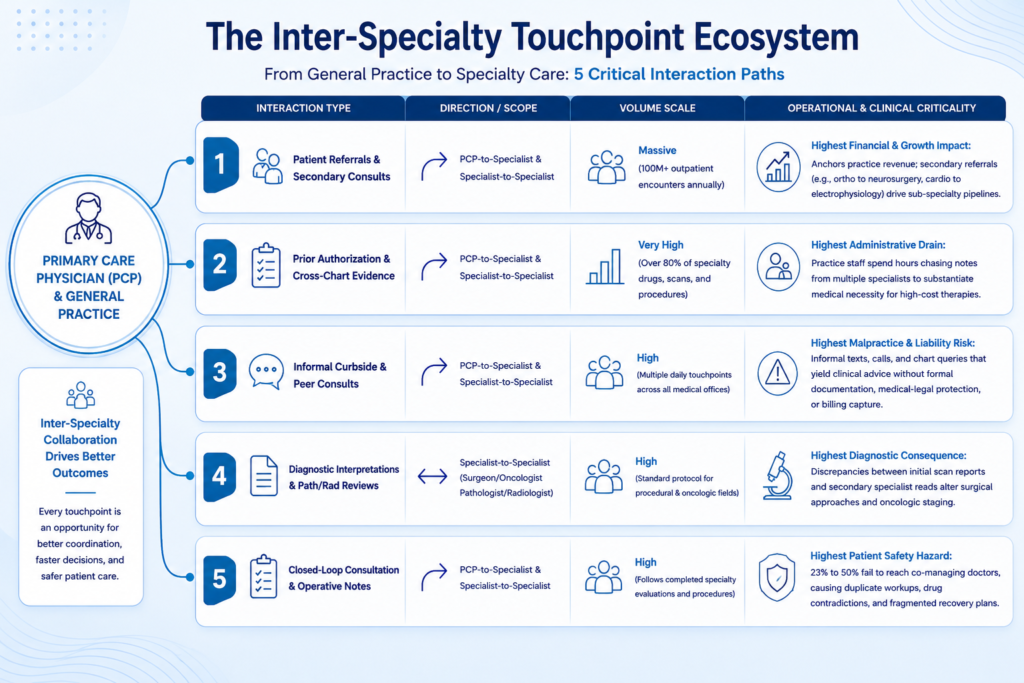
A Trusted Entity provides a structured, secure, and identity-based connection between a medical practice and the physicians, specialists, and organizations it works with. The same trusted connectivity can support the full range of inter-specialty interactions:
- Patient Referrals & Secondary Consults: Routes referrals directly to the intended specialist while preserving clinical context, establishing a traceable handoff, and providing visibility into referral status.
- Prior Authorization & Cross-Chart Evidence: Enables practices to securely request and exchange clinical documentation required to establish medical necessity, reducing repeated phone calls, fax requests, and administrative follow-up.
- Informal Curbside & Peer Consults: Give physicians a direct pathway to communicate with verified colleagues while preserving relevant clinical context and creating an appropriate documentation trail when a conversation becomes clinically significant.
- Diagnostic Interpretations & Path/Rad Reviews: Creates direct physician-to-physician pathways for sharing reports, clinical questions, and second-review requests, helping reduce interpretation gaps and delays.
- Closed-Loop Consultations & Operative Notes: Ensure completed evaluations, recommendations, and procedural documentation return to the appropriate care team, closing the communication loop instead of leaving the referring physician uncertain about what happens next.
Across all five interactions, the Trusted Entity becomes the connective layer between organizations, establishing who can communicate, where information should go, what was exchanged, and whether the clinical handoff was completed.
The Economic and Strategic Advantage for Independent Medicine
The independent practice remains the clinical bedrock of high-value, patient-centered care. Yet independent practices are routinely disadvantaged by health system monopolies that use monolithic EHRs to steer referrals and control local markets.
ClinicianCore provides independent practices with the collaborative infrastructure of an integrated health network without forcing them to sacrifice their autonomy, change their EHR, or surrender operational control:
- Elimination of Administrative Waste: By replacing manual fax dialing, unreadable transmissions, and constant phone tag with automated status queues and real-time administrative messaging, clinics save dozens of front-desk hours every week.
- Closing Care Gaps and Protecting Revenue: Bringing referral completion rates from the national average of 50% up toward industry targets of 85% or higher ensures patients receive necessary specialist care while protecting the downstream revenue of clinical partners.
- Compliant Monetization of Clinical Insights: Through HCC Consult Core, informal provider curbsides transform into structured, compliant interprofessional consults that can be properly documented, verified, and billed under applicable CPT codes.
- Absolute Compliance by Design: Built strictly around a HIPAA Business Associate framework, ClinicianCore ensures that every transmission, file exchange, and messaging session adheres to rigorous encryption and audit standards, completely avoiding the privacy vulnerabilities of commercial email and manual fax lines.
Moving Outpatient Care Forward
The medical fax machine has survived for decades not because it is superior, but because no alternative has combined its universal reach with the operational tools clinics actually need.
By replacing unmonitored transmissions with verified identity gateways, shared operational queues, and patient-specific collaborative threads, the ClinicianCore Trusted Entity network finally gives independent medical practices a path forward. It eliminates administrative friction, protects patients from falling through the cracks in clinical care, and connects the healthcare community securely, privately, and intelligently.
Frequently Asked Questions
What is a Trusted Entity in the ClinicianCore platform?
A Trusted Entity is ClinicianCore’s secure identity and policy enforcement gateway that connects an independent practice to external partners such as specialists, labs, imaging centers, and billing services, replacing vulnerable point-to-point connections with an intelligent boundary that enforces mutual rules, roles, and compliance.
How does the Trusted Entity Network reduce reliance on fax referrals?
The Trusted Entity Network replaces fax transmissions with a verified digital handoff. Staff export a referral as a PDF, drop it into a Trusted Entity directory, and the gateway authenticates both practices, checks permissions, and opens a dedicated patient-specific thread within seconds.
What happens during a Trusted Entity connection handshake?
Every Trusted Entity interaction runs through six steps: Initiate, Authenticate, Authorize, Connect, Communicate, and Monitor & Audit. The gateway verifies identity and licensing, applies sharing policies, and opens an encrypted channel, all within seconds rather than days of phone tag.
How does HCC Consult Core make curbside consults billable?
Through HCC Consult Core, informal provider curbside conversations become structured, compliant interprofessional consults that are properly documented, verified, and billed under applicable CPT codes, instead of disappearing as an undocumented hallway conversation that neither practice can track or reference later.
Is the ClinicianCore Trusted Entity Network HIPAA compliant?
Yes. The Trusted Entity Network is built strictly around a HIPAA Business Associate framework, so every transmission, file exchange, and messaging session between practices adheres to rigorous encryption and audit standards, avoiding the privacy vulnerabilities of commercial email and manual fax lines.
References
- U.S. Department of Health and Human Services, Office for Civil Rights. “Covered Entities and Business Associates.” HHS.gov, HIPAA for Professionals.
- U.S. Department of Health and Human Services, ASTP/Office of the National Coordinator for Health IT. “Interoperable Exchange of Patient Health Information Among U.S. Hospitals.” ONC Data Brief No. 71, May 2024. — general interoperability/background context.
- U.S. Department of Health and Human Services, Office of the National Coordinator for Health IT. “Use of Certified Health IT and Methods to Enable Interoperability by U.S. Non-Federal Acute Care Hospitals, 2019.” ONC Data Brief No. 54, February 2021.
- Zhong A, Amat MJ, Anderson TS, et al. “Completion of Recommended Tests and Referrals in Telehealth vs In-Person Visits.” JAMA Network Open. 2023;6(11):e2343417. Also indexed by AHRQ Patient Safety Network, December 2023.
- Annals of Family Medicine. “Specialty Referral Completion Among Primary Care Patients: Results From the ASPN Referral Study.” 2007;5(4):361–368.
- Fax Sip It. “Fax Usage Statistics, Data & Trends in 2026.” faxsipit.com.
- GetCodesHealth. “21 Fax Usage in Medical Settings Statistics: Critical Facts for Legal and Healthcare Professionals in 2026.” getcodeshealth.com.
- ReferralMD. “Why Clinics Lose Referrals and How to Fix It.” referralmd.com.
- Linear Health. “Referral Management Best Practices: KPIs & Benchmarks.” linear.health.
- XenFax. “Fax Usage Statistics (2026): Who Still Faxes, and Why.” xenfax.com.