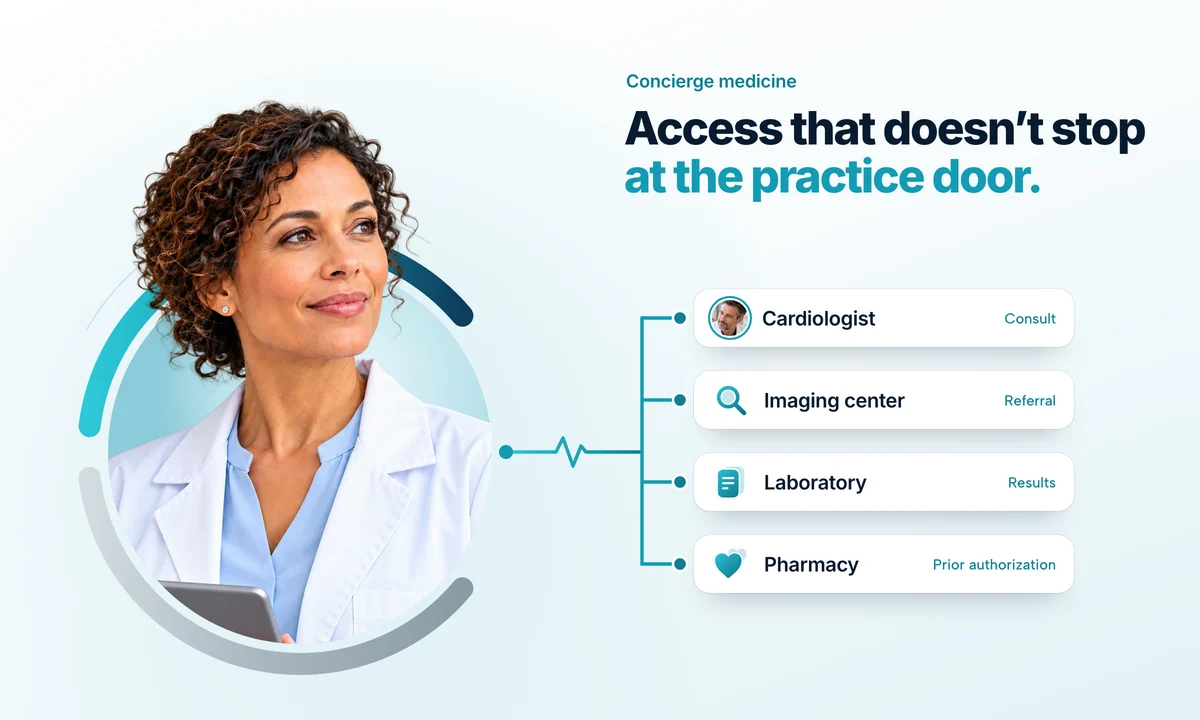
Concierge medical practice communication is the secure exchange of clinical information between a concierge physician and the specialists, imaging centers, laboratories, pharmacies, and other organizations involved in a member’s care. It matters because it determines whether the access concierge patients pay for extends beyond the practice.
Patients join a concierge, hybrid concierge, or direct primary care practice expecting their physician to respond quickly, know them well, and coordinate whatever comes next. Inside the practice, a smaller panel makes that promise achievable. Outside the practice, it becomes much harder to keep. The moment a patient needs a cardiologist, an MRI, a specialty medication, or a procedure that requires payer approval, the quality of care depends on how well the concierge physician communicates with people who work somewhere else. Much of that communication still runs through fax, phone calls, voicemail, and portals that do not talk to each other.
This article explains how ClinicianCore helps concierge physicians build trusted relationships with specialists, coordinate referrals, and obtain documented specialist advice through interprofessional consultation (IPC). Through Trusted Entity, practices can establish structured communication with participating specialists and other healthcare organizations. Through Consult Core, physicians can request and provide clinical input when appropriate, supporting better-informed decisions and more coordinated patient care. ClinicianCore complements the existing EHR by connecting the physicians and organizations involved in a patient’s care.
Key Takeaways
- Build a trusted specialist network for your patients. ClinicianCore’s Trusted Entity workflows help concierge physicians establish secure, structured communication with participating specialists and outside healthcare organizations, making it easier to coordinate referrals and develop dependable referral relationships.
- Connect your patients with the right specialists. When a patient needs specialty care, ClinicianCore helps physicians coordinate with specialists and track communication across organizational boundaries, supporting a more connected referral experience.
- Obtain specialist advice through interprofessional consultation (IPC). When clinically appropriate, a concierge physician can request documented input from a consulting physician to help inform diagnosis, treatment planning, or the need for an in-person specialist visit.
- Improve continuity of care through physician-to-physician collaboration. IPC gives requesting and consulting physicians a structured way to exchange clinical information and document their contributions, helping keep patient care coordinated beyond the initial encounter.
- Close the loop with specialists and external organizations. ClinicianCore provides a shared, auditable communication channel that helps physicians follow up on referrals, coordinate next steps, and reduce the risk of important information being lost across disconnected communication channels.
- Extend your practice’s capabilities without replacing your EHR. ClinicianCore complements existing clinical systems by connecting the physicians and organizations involved in patient care, supporting concierge practices as they coordinate increasingly broad networks of trusted specialists and services.
- Keep clinical and billing responsibilities clear. IPC reimbursement depends on applicable payer and coding requirements. Referrals, consultation requests, and communication alone do not guarantee reimbursement or require a referral in
“My patients judge me by what happens after they leave my office, not only by how quickly I answer the phone. Closing the loop with every specialist is part of the promise.”

Why Does Concierge Medicine Depend On Communication Beyond The Practice?

Concierge practices are not all alike. Some charge a membership fee and still bill insurance for covered services. Many direct primary care practices do not bill insurance at all, and some physicians formally opt out of Medicare, which requires a private contract with each Medicare beneficiary they treat [1]. The AMA Code of Medical Ethics accepts retainer arrangements but requires physicians to separate amenity fees clearly from insured medical services [2]. The number of concierge and direct primary care practices in the US grew 83.1 percent between 2018 and 2023, from 1,658 to 3,036 sites, according to a national study in Health Affairs [3].
What these models share is a set of patient expectations: physician accessibility, responsiveness, personalized care, trusted specialist relationships, and a physician who closes the loop. A concierge internist usually carries a much smaller panel than a traditional primary care physician. The network around that panel is often large: dozens of trusted specialists, several imaging centers and laboratories, an ambulatory surgery center, pharmacies, and outside billing support. For concierge physicians, the value of that network depends on more than knowing which specialists to call. It depends on having reliable ways to communicate with them, coordinate referrals, exchange clinical information, and obtain advice when a patient’s needs require specialist expertise. Strong professional relationships can support a more connected patient experience and may create opportunities for appropriate, reciprocal referrals over time. ClinicianCore is designed to support these relationships through structured external communication and documented physician-to-physician consultation.
A smaller panel gives the physician time. It does not give the physician visibility into what happens after the patient leaves the office. That is where concierge physician referrals and outside coordination decide whether the membership promise holds.
Where Does Concierge Medical Practice Communication Break Down?
Communication gaps in outpatient referrals are well documented. In research cited by CMS in its Closing the Referral Loop quality measure, 68% of specialists reported receiving no information from the primary care physician before referral visits. A quarter of primary care physicians still had no information from the specialist four weeks after the visit [4].
The same measure cites a study of 963 referrals in which pediatricians scheduled the specialist appointment for only 39% of referrals and sent patient information to the specialist for only 51% [4]. AHRQ defines care coordination as the deliberate organization of care activities among everyone involved, carried largely by the exchange of information [5]. When that exchange depends on fax machines and voicemail, coordination depends on persistence rather than design.
For a concierge practice, the friction points are familiar:
- Referrals faxed with no confirmation they arrived
- Phone calls and voicemail that consume physician and staff time
- Separate portals for each specialist, hospital, and imaging center
- Missing clinical information that delays the specialist’s evaluation
- Unclear ownership of who acts next
- Little visibility into what happened after the referral
None of these problems is unique to concierge medicine. They matter more there because the concierge physician has explicitly promised patients to manage them.
Where Does ClinicianCore Fit Alongside The EHR?
ClinicianCore is not an EHR, a referral management system, a patient portal, a billing system, or a prior authorization clearinghouse. Patients do not use it. It is a secure, HIPAA-compliant unified clinical communication platform built exclusively for physicians, used with their teams and the organizations they work with. It runs beside whatever EHR the practice already uses and requires no change to charting.
| The practice EHR | ClinicianCore | |
|---|---|---|
| Holds | The patient record, orders, referral entries, billing data | The conversations between physicians and organizations |
| Used by | The practice | The practice, its specialists, its trusted organizations |
| Answers | What was ordered and documented | Who asked what, who answered, and what happens next |
Day to day, Practice HQ is where the practice communicates and coordinates. Trusted Entity connects the practice with outside organizations, Consult Core structures formal consultations, and Physician Lounge gives physicians a private space with peers. Together they support four activities: communicate, collaborate, consult, and connect.For concierge practices, two capabilities are especially important. Trusted Entity helps establish structured communication with participating specialists and outside healthcare organizations, supporting referral coordination and follow-up. Interprofessional consultation through Consult Core allows physicians to request and document specialist advice when clinically appropriate, helping the treating physician make informed decisions about diagnosis, treatment, and whether an in-person specialist visit is needed. Together, these workflows help concierge physicians stay involved in their patients’ care beyond the practice’s own walls.
How Does Interprofessional Consultation Bring Specialist Input Before An Appointment?
An interprofessional consultation (IPC) is a physician-to-physician consultation in which a treating physician asks a specialist for advice about a specific patient, without the specialist seeing that patient.
What Medicare recognizes
Medicare began paying separately for these services on January 1, 2019. CMS recognized CPT codes 99446 through 99449 and 99451 for the consulting physician, and 99452 for the treating or requesting physician [6]. CMS requires documented patient consent and applies patient cost sharing [6], and expects the consultation to benefit the specific patient rather than serve as education or professional courtesy [7]. In 2023, CMS confirmed that coverage and payment of these services is permissible for state Medicaid and CHIP programs; states that choose to pay must submit a state plan amendment [8].
How the workflow runs in ClinicianCore
A concierge internist reviews an abnormal ECG for a patient in her sixties. She wants a cardiologist’s view before deciding whether the patient needs an office visit with cardiology.
- The concierge physician frames a specific clinical question.
- She starts or schedules the consult in Consult Core with the question and relevant history, and can invite the cardiologist even if he is not yet on ClinicianCore.
- The cardiologist reviews the information and asks additional questions during the consult if needed.
- The cardiologist returns a recommendation.
- Consult Core records the consultation with a transcription and summary, and suggests a CPT code for physician review. The requesting and consulting physicians both sign, and the record can be downloaded.
- The concierge physician decides the next step: manage in practice, order testing, or schedule a specialist visit.
Where reimbursement fits
When an interprofessional consultation independently satisfies applicable payer and coding requirements, the consulting physician may be able to bill for the qualifying professional service, and the suggested code can map to that service when payer requirements are met. Not every IPC qualifies. Payer policies vary, and some plans do not pay these codes separately. Consent, documentation, time, and timing rules all apply, and CPT guidance generally excludes reporting when the consultation leads directly to a transfer of care or a visit with the consultant. Our article on billing interprofessional consults: 2026 CPT rules explains what CPT requires.
Concierge models add another variable. A physician who has opted out of Medicare cannot bill Medicare for the requesting code. The specialist’s billing depends on the specialist’s own enrollment and the patient’s coverage. Members should also know that cost sharing may apply.
Any payment is for consultative work actually performed. It is never compensation for sending or receiving a referral, and ClinicianCore does not guarantee reimbursement.
For a concierge physician, IPC creates a structured way to seek specialist expertise without automatically making an office visit the first step. When clinically appropriate, the consulting physician’s advice can help inform the next step in the patient’s care, including whether an in-person evaluation is needed. The requesting physician remains responsible for the patient’s ongoing care, while the consulting physician contributes specialized expertise. Consult Core supports this collaboration with a documented consultation workflow. Any reimbursement depends on applicable payer, coding, consent, and documentation requirements; payment is for qualifying clinical work, never for a referral.
How Do You Close The Loop On Concierge Physician Referrals?
ClinicianCore does not replace the referral function in the EHR. The order, the referral record, and the clinical documentation stay where they are. ClinicianCore manages the conversation around the referral, which is where most referrals stall.
A typical sequence for concierge primary care referrals looks like this:
- The concierge physician initiates the referral in the EHR.
- A secure ClinicianCore thread opens between the two practices.
- The specialist’s team confirms receipt and asks for any missing information.
- The specialist evaluates the patient.
- Recommendations come back in the same thread.
- The concierge physician follows up with the patient and adjusts the plan.
The difference is visibility. Both physicians and their authorized staff can see what was sent, whether it arrived, which questions are open, and when the recommendation came back. CMS treats closing the referral loop as a quality measure in its own right [4]. A single channel that keeps the specialist’s response tied to the original request makes that loop easier to close, and it keeps healthcare referral communication out of the fax queue. We described how practices make that shift in transforming fax referrals into real-time clinical collaboration.
How Does Trusted Entity Connect A Practice With Organizations Beyond It?
Concierge practices communicate constantly with organizations outside their walls: imaging centers, laboratories, ambulatory surgery centers, pharmacies, billing organizations, specialty practices, and other healthcare organizations. In ClinicianCore, each of these can become a trusted organization through Trusted Entity, a formal connection between two organizations with verified identity, defined access, shared policies, and an audit trail. The practice invites an organization already on ClinicianCore or refers a new one, the ClinicianCore team reviews compliance, and setup can take up to 48 hours.
Conversations with a trusted organization happen in topic threads inside queues organized by purpose, with key details pinned at the top:
- Referral Coordination for scheduling, records, clinical questions, and results
- Prior Authorization for documentation and status
- Billing Resolution for coverage, claim, and payment questions
- General for everything else
Consider a concierge physician who orders a lumbar MRI at an outside imaging center. The request goes to the center in the Referral Coordination queue. The center’s scheduler asks about prior imaging in the same thread. An authorization question moves to the Prior Authorization queue and reaches the right staff. When the study is read, the notification returns to the practice without a phone call.
The HIPAA Security Rule requires regulated entities to maintain administrative, physical, and technical safeguards, including access controls and audit controls, for electronic protected health information [9]. Trusted Entity is designed around those principles for HIPAA-compliant collaboration across organizations. Each practice remains responsible for its own compliance program.
For concierge physicians, Trusted Entity can help turn individual contacts into more structured working relationships with participating specialists and outside healthcare organizations. When a referral is needed, the practice has a channel for communicating about receipt, missing information, scheduling questions, and follow-up. Over time, dependable communication can support stronger professional relationships and create opportunities for appropriate two-way referrals. ClinicianCore does not guarantee referrals or specialist participation; its role is to make communication and coordination between connected organizations more structured, visible, and auditable.
How Can A Practice Coordinate The Conversation Around A Prior Authorization Decision?
Prior authorization reaches concierge practices too. Even a practice that bills no insurer still has patients whose plans must approve advanced imaging, specialty medications, procedures, diagnostic tests, or specialty treatment.
What the data shows
In the AMA’s 2025 prior authorization survey of 1,000 physicians, respondents reported completing an average of 40 prior authorizations per week, consuming about 13 hours of physician and staff time. In that survey, 94% said prior authorization contributes to physician burnout [10]
Federal rules are changing part of the picture. Under the CMS Interoperability and Prior Authorization Final Rule (CMS-0057-F), Medicare Advantage plans and Medicaid and CHIP fee-for-service programs and managed care plans must decide expedited requests within 72 hours and standard requests within 7 calendar days starting in 2026. Qualified health plan issuers on the federally facilitated exchanges are excluded from those timeframes. Impacted payers must also give a specific reason for denials, with electronic prior authorization interfaces due in 2027. The rule does not apply to prior authorization decisions for drugs [11].
Where ClinicianCore helps
ClinicianCore does not submit authorizations to payers or make coverage decisions. It coordinates the people around the decision: the concierge physician, the specialist, the imaging center or pharmacy, and any authorized organization helping with the request. Within one prior authorization workflow, the practice can see who is gathering documentation, what the payer requested, which questions remain open, and where the request stands.
The goal is fewer repeated phone calls, less faxing, fewer missing documents, clearer status, and shorter communication delays. That is medical practice efficiency in concrete terms.
One Patient, Four Workflows, One Thread
These workflows rarely happen in isolation. A single patient can move through all four:
- The concierge physician identifies a possible need for cardiology.
- A referral is initiated in the EHR.
- The cardiologist requests additional information.
- The concierge physician answers through ClinicianCore.
- The cardiologist provides an interprofessional consultation when clinically appropriate.
- The patient proceeds to a specialist evaluation.
- Additional testing requires authorization.
- ClinicianCore carries that communication to the Prior Authorization queue of the right trusted organization.
- The cardiologist sends recommendations back to the concierge physician.
- The concierge physician continues managing the patient’s care.
Today, a journey like this can involve faxes, portal messages, emails, phone calls, and voicemail. In ClinicianCore, it stays in one connected record of communication that both physicians can follow from first question to final recommendation.
How Do Concierge Physicians Build A Specialist Network?
A concierge physician’s value often rests on relationships built over years with specialists the physician trusts. ClinicianCore can become the communication infrastructure for those relationships:
- Concierge physician and cardiologist
- Concierge physician and gastroenterologist
- Concierge physician and neurologist
- Concierge physician and orthopedist
- Concierge physician and dermatologist
- Concierge physician and imaging center
- Concierge physician and ambulatory surgery center
For concierge physicians, a connected specialist network can serve two complementary purposes. First, it can help the practice coordinate referrals to specialists and maintain communication as patients move through evaluation and treatment. Second, it can support direct physician-to-physician consultation when the concierge physician needs specialist advice about a specific clinical question. Through Trusted Entity, ClinicianCore supports structured communication with participating organizations; through Consult Core, it supports documented interprofessional consultation between physicians. Together, these workflows can help concierge physicians connect patients with appropriate specialty care while remaining involved in clinical decisions and follow-up.
This is a clinical network, not a financial one. No one is paid for joining, sending, or receiving referrals. The value is in the relationships, the communication, and the consultations themselves.
How Does Cliniciancore Differ From Other Concierge Medicine Technology?
| Tool | What it does well | What it leaves out |
|---|---|---|
| EHR | Records the patient, orders, and referrals | Communication with physicians in other organizations |
| Patient portal | Connects the practice with patients | Physician and organization communication |
| Ordinary secure messaging | Sends protected messages | Structured consultation, organizational trust, purpose-based queues |
| Referral management software | Tracks referral orders and status | The clinical conversation between physicians |
| Standalone eConsult platform | Supports consultations | Referrals, trusted organizations, and daily coordination |
| Fax, email, telephone | Universally available | Security, visibility, and an audit trail |
ClinicianCore’s difference is the combination. As a secure, HIPAA-compliant unified clinical communication platform built exclusively for physicians, it lets a concierge practice communicate, collaborate, consult, and connect without switching tools at every step of the patient’s care.
What Compliance And Reimbursement Considerations Apply?
The federal Anti-Kickback Statute applies to physicians, and HHS OIG notes that physicians are attractive targets for kickback schemes because they are a source of referrals [12]. The AMA likewise treats payment solely for referring a patient as unethical fee splitting [13]. Practices using any consultation workflow should keep these principles in view:
- Reimbursement is for clinical work actually performed, never for generating or receiving referrals.
- Not every interprofessional consultation is billable. Payer, coding, consent, and documentation rules decide.
- ClinicianCore does not guarantee reimbursement and does not pay anyone for referrals.
- ClinicianCore does not replace payer authorization systems or the EHR.
- Concierge, hybrid, and direct primary care practices should review billing with qualified counsel and coding professionals, especially when Medicare opt-out status is involved.
Conclusion
Concierge medicine promises personalized attention and a physician who stays involved in a patient’s care. Fulfilling that promise often requires trusted relationships with specialists and other healthcare organizations beyond the practice itself. It also requires ways to obtain specialist expertise, coordinate referrals, and ensure recommendations reach the physician responsible for ongoing care.
ClinicianCore supports these needs through two complementary workflows. Trusted Entity helps concierge practices establish structured communication with participating specialists and outside healthcare organizations to coordinate referrals and follow-up. Consult Core supports interprofessional consultation, allowing physicians to request and document specialist advice when clinically appropriate. Together, these workflows help concierge physicians connect their patients with specialty care while maintaining continuity and visibility across the care journey. ClinicianCore complements the EHR by connecting the physicians and organizations involved in patient care.
To see how ClinicianCore can help your practice communicate, collaborate, consult, and connect across the healthcare network, Request a Live Demo.
Frequently Asked Questions
What is concierge medical practice communication?
Concierge medical practice communication is the secure exchange of clinical information between a concierge physician and the specialists, imaging centers, laboratories, pharmacies, and other organizations involved in a member’s care. Concierge and direct primary care practices grew 83.1% from 2018 to 2023 (Health Affairs, 2025). ClinicianCore gives these practices one secure channel for it.
Does ClinicianCore replace our EHR or referral system?
No. ClinicianCore runs beside your existing EHR, which keeps the patient record, orders, and referral entries. ClinicianCore manages the communication between physicians and outside organizations, where gaps are common: 68% of specialists received no information from the primary care physician before referral visits, in research cited by CMS (CMS, 2026).
What is interprofessional consultation (IPC) in healthcare?
An interprofessional consultation is a physician-to-physician consultation in which a treating physician asks a specialist for advice about a specific patient without the specialist seeing the patient. Medicare has paid separately for six CPT codes for these services since 2019 (CMS, 2024). ClinicianCore Consult Core gives physicians a structured, signed record of each consult.
Can a specialist bill for an interprofessional consultation?
Sometimes. When an interprofessional consultation independently satisfies applicable payer and coding requirements, the consulting physician may be able to bill for the qualifying service. Since 2023, coverage and payment are also permissible for state Medicaid and CHIP programs (CMS, 2023). Payment is for clinical work performed, never for referrals, and ClinicianCore does not guarantee reimbursement.
How does ClinicianCore help close the loop on concierge physician referrals?
ClinicianCore keeps each referral’s conversation in one secure thread shared by both practices. Specialists can confirm receipt and ask for missing information, and their recommendations return to the same thread. That matters because 25% of primary care physicians still had no specialist information four weeks after referral visits, in research cited by CMS (CMS, 2026).
Does ClinicianCore submit or approve prior authorizations?
No. Payers and their utilization management organizations make authorization decisions. ClinicianCore provides the communication layer around the prior authorization workflow, where physicians report completing an average of 40 requests each week (AMA, 2026). Physicians, specialists, pharmacies, and imaging centers track documentation and open questions in one auditable place.
What is Trusted Entity in ClinicianCore?
Trusted Entity is how a ClinicianCore practice formally connects with outside organizations, such as imaging centers, laboratories, surgery centers, pharmacies, and billing partners. Each connection carries verified identity, defined access, and an audit trail. In research cited by CMS, physicians sent patient information to the specialist for only 51% of referrals (CMS, 2026).
Is ClinicianCore suitable for HIPAA-compliant physician communication?
Yes. ClinicianCore is built for HIPAA-compliant physician communication, with verified physicians and practice staff, access controls, and auditable records for clinical conversations. The HIPAA Security Rule requires three kinds of safeguards, administrative, physical, and technical, for electronic health information (HHS, 2026). Each practice still maintains its own compliance program and business associate agreements.
Do doctors get paid for referrals to specialists?
No. Payment solely for referring a patient is fee splitting, which the AMA Code of Medical Ethics treats as unethical, and federal anti-kickback law also applies. Physicians can be paid for consultative work actually performed, which Medicare has covered for interprofessional consultations since 2019 (CMS, 2024). ClinicianCore pays no one for referrals.
References
[1] Manage Your Enrollment (opting out of Medicare). Centers for Medicare & Medicaid Services, 2026. https://www.cms.gov/medicare/enrollment-renewal/providers-suppliers/chain-ownership-system-pecos/manage-your-enrollment
[2] Code of Medical Ethics Opinion 11.2.5: Retainer Practices. American Medical Association, current opinion (undated). https://code-medical-ethics.ama-assn.org/ethics-opinions/retainer-practices
[3] Zhu JM, Marsh T, Polsky D, Huntington A, Song Z. Growth in Number of Practices and Clinicians Participating in Concierge and Direct Primary Care, 2018–23. Health Affairs, 2025. https://pmc.ncbi.nlm.nih.gov/articles/PMC12965179/
[4] CMS50v14: Closing the Referral Loop: Receipt of Specialist Report (2026 performance period). Centers for Medicare & Medicaid Services, eCQI Resource Center, 2026. https://ecqi.healthit.gov/ecqm/ec/2026/cms0050v14
[5] Care Coordination. Agency for Healthcare Research and Quality, 2024. https://www.ahrq.gov/ncepcr/care/coordination.html
[6] Medicare and Medicaid Programs; CY 2025 Payment Policies Under the Physician Fee Schedule and Other Changes to Part B Payment and Coverage Policies (89 FR 97710). Centers for Medicare & Medicaid Services, Federal Register, 2024. https://www.govinfo.gov/content/pkg/FR-2024-12-09/html/2024-25382.htm
[7] Medicare Program; Revisions to Payment Policies Under the Physician Fee Schedule and Other Revisions to Part B for CY 2019 (83 FR 59452). Centers for Medicare & Medicaid Services, Federal Register, 2018. https://www.govinfo.gov/content/pkg/FR-2018-11-23/html/2018-24170.htm
[8] State Health Official Letter SHO #23-001: Medicaid and CHIP Coverage and Payment of Interprofessional Consultation. Centers for Medicare & Medicaid Services, 2023. https://www.medicaid.gov/federal-policy-guidance/downloads/sho23001.pdf
[9] Summary of the HIPAA Security Rule. U.S. Department of Health and Human Services, Office for Civil Rights, 2026. https://www.hhs.gov/hipaa/for-professionals/security/laws-regulations/index.html
[10] Only 1 in 3 doctors trusts insurers’ prior authorization promises (2025 AMA Prior Authorization Physician Survey). American Medical Association, 2026. https://www.ama-assn.org/practice-management/prior-authorization/only-1-3-doctors-trusts-insurers-prior-authorization
[11] CMS Interoperability and Prior Authorization Final Rule (CMS-0057-F) fact sheet. Centers for Medicare & Medicaid Services, 2024. https://www.cms.gov/newsroom/fact-sheets/cms-interoperability-prior-authorization-final-rule-cms-0057-f
[12] Fraud & Abuse Laws (Physician Education). U.S. Department of Health and Human Services, Office of Inspector General, 2021. https://oig.hhs.gov/compliance/physician-education/fraud-abuse-laws/
[13] Code of Medical Ethics Opinion 11.3.4: Fee Splitting. American Medical Association, current opinion (undated). https://code-medical-ethics.ama-assn.org/ethics-opinions/fee-splitting
Statistics are reported as published by each source. CPT codes and payer rules change; confirm current requirements before billing. CPT is a registered trademark of the American Medical Association.