For more than two decades evaluating healthcare software architecture, revenue operations, and the daily mechanics of medical groups, I’ve seen a paradox that never goes away. Medicine is inherently interdependent. A single patient journey does not unfold within the confines of a single clinic, specialty, or corporate entity. An individual patient regularly navigates primary care clinics, independent diagnostic imaging centers, ambulatory surgical facilities, specialized testing laboratories, and regional specialty practices. Each point of care requires nuanced cognitive collaboration among independent medical professionals.
Yet the digital communication infrastructure supporting modern healthcare was architected on a fundamentally flawed premise. Ever since the arrival of federal data privacy legislation in the mid-1990s, healthcare technology has operated under the assumption that clinical communication is strictly an intraorganizational challenge. Over three decades of electronic health record adoption have seen billions of dollars invested in building walled digital gardens designed to preserve institutional billing data and protect the enterprise perimeter. Large hospital systems purchased monolithic software platforms engineered to retain patient encounters within their own facilities, while independent clinics adopted point solutions designed solely to connect internal staff within a single office suite.
This architectural assumption has created a profound structural misalignment. The most dangerous point of clinical failure, the most pervasive source of administrative burnout, and the largest uncompensated economic drain on physician practices does not occur inside the clinic walls. It occurs at the perimeter. The future of clinical communication is not simply better communication within healthcare organizations. It is better communication between healthcare organizations. Healthcare itself is interconnected. Our communication architecture must finally reflect that reality.
Key Takeaways
- Healthcare communication architecture has focused on intraorganizational tools for three decades, leaving the space between independent practices largely unaddressed.
- HCO Practice HQ establishes the internal foundation: unified video, voice, and messaging inside a single practice.
- HCC Consult Core’s Cross-Entity framework turns informal, unbilled curbside consults into documented, CPT-compliant interprofessional consultations.
- The Physician Lounge restores the collegial peer space that has largely disappeared from modern clinical practice.
- ClinicianCore is a secure, HIPAA-compliant unified clinical communication platform built exclusively for physicians, uniting these three layers, internal, interorganizational, and human, inside one application.
- Independent practices in rural and community settings gain the most from cross-entity connectivity, since it shortens the distance between primary care and specialty expertise.
“Independent physicians have always talked to each other. What they’ve never had is a platform built to document, secure, and pay for that conversation.”

Solving the Internal Baseline: The Practice Perimeter
To understand why communication between organizations has broken down so completely, one must first examine the operational baseline within the practice perimeter. In standard outpatient clinics, internal communication remains fractured across multiple consumer-grade digital tools, unrecorded telephone interruptions, paper message slips, and disjointed software windows. Front office administrative staff struggle to triage patient flow, nursing staff waste valuable hours chasing routine scheduling verifications, and practice administrators manage redundant software subscriptions that fail to communicate with one another.
This internal friction was the initial problem we set out to resolve with the architecture of the HealthCare Organization, or HCO Practice HQ. Before a medical practice can interact effectively with external peers, it must establish order within its own walls. A medical practice requires a unified, secure digital foundation where linear, real-time video conferencing, asynchronous, nonlinear video check-ins, secure voice calling, and protected group messaging all live in a single environment.
When internal communications occur within an encrypted clinical workspace, the clinic’s operational velocity transforms. A surgeon or general physician can leave asynchronous video instructions for medical assistants between examinations, preserving rich clinical nuance without interrupting the exam cadence. Front desk coordinators and triage teams coordinate patient appointments and prior authorizations with immediate precision. However, addressing intra-office workflow friction is merely the baseline for modern practice management. It addresses the internal perimeter, yet leaves the broader clinical ecosystem untouched.
The Operational Void Between Independent Organizations
Once a medical group achieves internal coordination, it immediately collides with the structural wall separating it from the rest of the healthcare community. Consider what transpires every day across outpatient medicine. An independent primary care physician evaluates a complex patient with multiple escalating comorbidities. The clinician needs expert input from an independent cardiologist, an endocrinologist, and a regional diagnostic imaging center.
What communication rails exist to support this interdisciplinary exchange? None. The electronic health record systems deployed by separate medical practices cannot communicate with one another in any meaningful, interactive, conversational manner. As a result, clinical dialogue drops instantly to the lowest common technological denominator: unrecorded curbside telephone calls, unencrypted consumer mobile text messages, and paper facsimile transmissions.
This operational void introduces severe systemic consequences. First, patient care is delayed by days or weeks while medical assistants play phone tag across clinic switchboards. Second, clinical context is degraded as complex medical assessments are reduced to truncated scribbles on fax cover sheets. Third, and perhaps most critically for the clinician, an immense volume of intellectual labor is completely erased from the economic ledger.
Independent specialists routinely spend countless hours each week answering external curbside inquiries, reviewing outside laboratory reports, and providing diagnostic guidance to community colleagues. Because these conversations occur informally outside any structured digital framework, they produce no auditable documentation and generate zero clinical reimbursement. In an era of tightening payer fee schedules and escalating overhead, expecting independent specialty groups to provide uncompensated cognitive labor across broken communication channels is economically untenable.
Arriving at Cross Entity: The Definitive Architectural Necessity
When you examine this breakdown from an architectural perspective, the conclusion becomes unavoidable. What healthcare requires is not another internal messaging app, nor another bloated institutional portal. Healthcare requires a shared interorganizational collaborative rail.
This necessity gave rise to HealthCare Collaboration, or HCC Consult Core. At the very center of HCC lies its definitive capability: Cross-Entity communication.
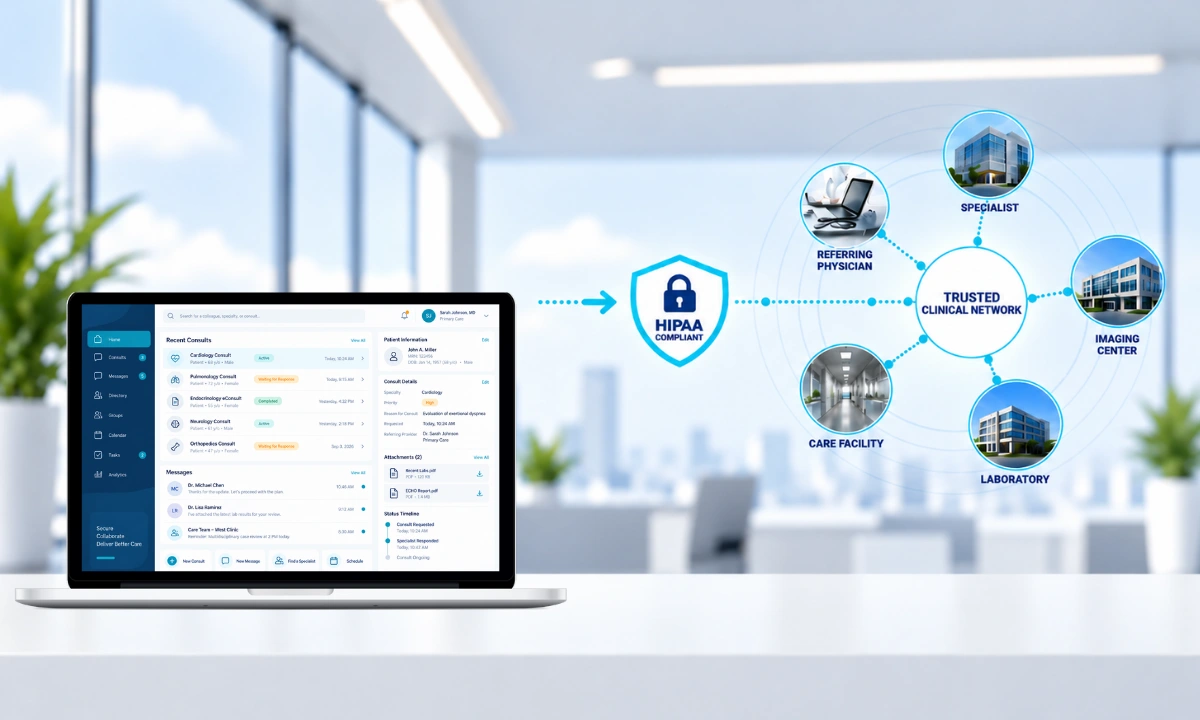
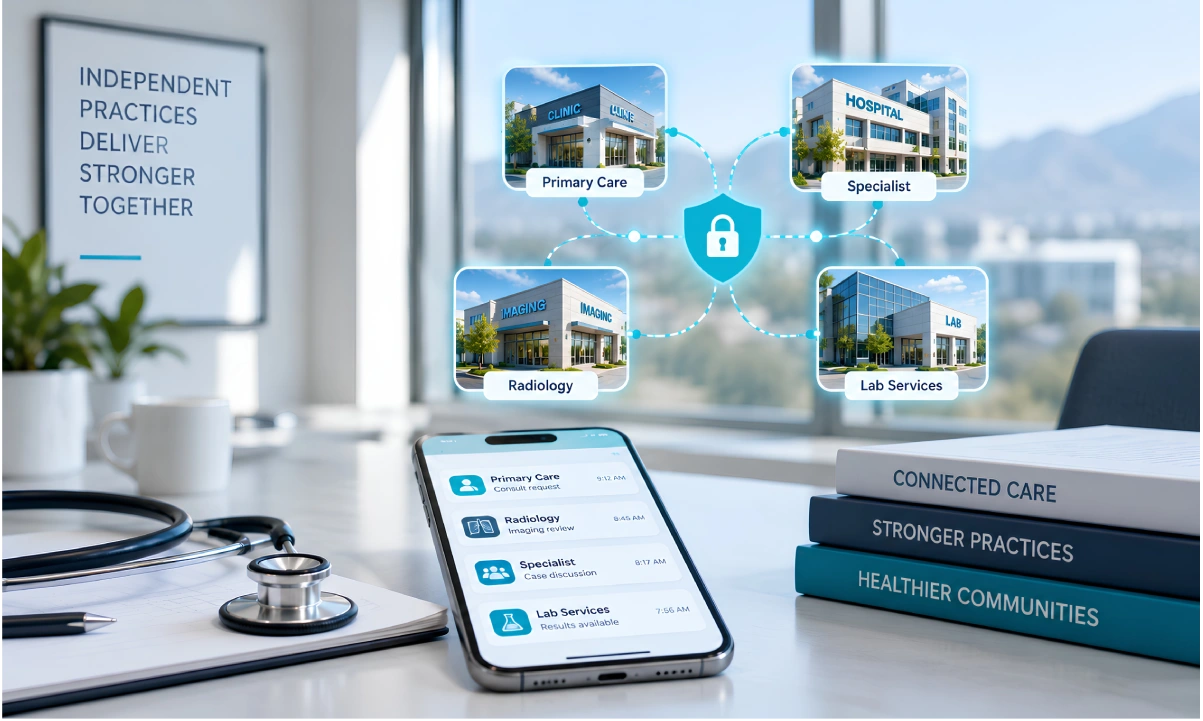
Cross-entity collaboration is not merely a technical feature; it is an entirely new operational paradigm. Under conventional arrangements, an independent medical clinic is an isolated digital island. To collaborate with an outside specialist, clinicians must either navigate cumbersome institutional health system portals or risk noncompliant informal messaging. Cross-entity connectivity breaks this impasse by establishing an authenticated, secure bridge that spans distinct legal entities, distinct medical groups, and distinct administrative boundaries.
Through Cross Entity architecture, an independent family practice and an independent neurology group can interact as fluidly as if they occupied adjacent offices in the same facility. A requesting physician initiates a formal, structured clinical inquiry across the Cross Entity bridge. The receiving specialist receives rich clinical history, relevant diagnostic parameters, and clear diagnostic questions within an encrypted, structured workflow.
Crucially, Cross Entity communication captures the consultative encounter as it occurs. The platform tracks review time, preserves the clinical decision trail, and generates an auditable clinical record that integrates directly into practice management billing systems. This structured documentation directly satisfies the statutory requirements for interprofessional consultation Current Procedural Terminology codes.
Practices can compliantly bill CPT codes 99446, 99447, 99448, and 99449 for extensive consultative evaluations based on review time, code 99451 for written interprofessional assessments, and code 99452 for requesting physicians. What was once uncompensated curbside banter is transformed into an auditable, billable encounter that fairly compensates independent physicians for their specialized knowledge.
Cross-entity collaboration creates a compounding network dynamic. With every independent specialty group, diagnostic imaging clinic, or outpatient practice that connects to the platform, the entire regional healthcare collective gains speed, coordination, and clinical autonomy. Independent practices no longer need to surrender their identity to hospital conglomerates simply to achieve interdisciplinary coordination.
The Human Professional Layer: Reviving the Physician Lounge
While administrative coordination and interorganizational consultation address operational workflows, healthcare architecture remains fundamentally incomplete if it ignores the human professional layer. Clinical practice is not merely an algorithmic series of tasks; it is a demanding intellectual and human calling. Yet over the past two decades, professional isolation among physicians has reached unprecedented heights.
The industrialization of modern medicine has systematically dismantled the traditional collegial spaces where doctors once found mutual support and shared knowledge. The physical hospital physician lounge, which historically functioned as an organic environment for peer mentorship, difficult case discussions, and informal camaraderie, has virtually disappeared. Physicians find themselves isolated within their individual clinics, bound to documentation quotas and administrative demands.
To address this human reality, ClinicianCore introduces the Physician Lounge. Designed as an exclusive, verified space reserved solely for credentialed physicians, the Physician Lounge operates free from administrative observation, corporate surveillance, or outside commercial presence. It provides doctors with a private venue to decompress, share nuanced clinical perspectives, and reconnect with respected peers.
Within this environment, physicians can participate in specialty-specific clinical discussions, debate emerging clinical trials, or seek discrete guidance on perplexing diagnostic dilemmas. Encrypted private rooms facilitate confidential one-on-one clinical dialogue, allowing clinicians to review intricate cases with utmost discretion. By restoring the organic collegiality of medicine, the platform directly confronts clinician burnout and reestablishes the professional community essential for lifelong medical practice.
The Single Application Architecture: Unifying the Layers of Care
When you assemble these essential dimensions, the comprehensive power of a single application architecture becomes strikingly evident. Healthcare delivery does not suffer from a scarcity of individual software applications; it suffers from excessive fragmentation. Medical practices are burdened by tool fatigue, managing disparate logins, separate vendor agreements, and competing user directories.
The genuine breakthrough of the ClinicianCore platform lies in the architectural synthesis of these three distinct layers into a single, cohesive digital home.
First, HCO Practice HQ resolves the internal operational layer, aligning staff, medical assistants, and physicians within the practice perimeter. Second, HCC Consult Core and its Cross Entity framework resolve the interorganizational collaborative layer, linking independent medical groups into a unified regional clinical network and monetizing consultative cognitive expertise. Third, the Physician Lounge addresses the human-professional layer, nurturing clinician well-being and restoring collegiate culture.
These three layers do not function as disconnected silos. They exist within a single unified application where clinical context travels seamlessly. A physician can coordinate daily clinic schedules with staff in the morning, review a complex Cross Entity consultative inquiry from a regional colleague midday, and engage in high-level specialty case analysis in the Physician Lounge during the evening, all without switching applications, maintaining multiple credentials, or compromising regulatory compliance.
The Geographic Divide: A Universal Mandate for Independent Medicine
This architectural reimagining is urgently relevant across modern healthcare. Throughout the nation, healthcare delivery presents an extraordinary geographic and operational divide. Expanding metropolitan medical centers operate alongside suburban and rural communities that face severe shortages of specialty providers.
Across every region, the barrier to exceptional patient care is rarely a lack of clinical skill; it is the friction of distance and disconnected communication. When an independent family physician in a community practice encounters a patient with an ambiguous cardiac arrhythmia or complex surgical presentation, the traditional referral process frequently stalls. The patient waits weeks or months for an appointment, often traveling long distances to major medical hubs for an evaluation that could have been resolved through structured interprofessional collaboration.
Through a unified single application powered by Cross Entity connectivity, these structural barriers dissolve. An independent specialty practice can maintain optimal internal operations while serving as an accessible consultative resource for primary care clinics across an entire region. Specialists review diagnostic tracings asynchronously, formulate documented guidance, bill compliant consultation codes, and determine whether an in-person appointment is truly necessary. Primary clinicians receive rapid expert guidance, patients receive timely care in their local communities, and independent medical groups build enduring collaborative alliances that sustain the viability of private practice on a national scale.
Uncompromising Data Integrity and the Horizon of Independence
Throughout this architectural transformation, data governance and regulatory compliance must remain inviolable. Independent medical practices cannot afford the civil liabilities or reputational damage of security breaches resulting from informal communication channels. Every component of our unified platform is built from the ground up to ensure rigorous HIPAA compliance, with post-quantum cryptographic protections, granular role-based permissions, and comprehensive administrative audit logging.
Independent practices represent the heartbeat of community healthcare. They deliver personalized care, preserve clinical integrity, and provide patients with dedicated advocacy free from corporate bureaucracy. Yet preserving that independence in the modern economic landscape requires private practices to have software infrastructure that matches their clinical dedication.
The future of clinical communication will not be won by building higher walls around individual medical facilities. It will be achieved by building secure, intelligent bridges between healthcare organizations. By unifying internal workflows, pioneering cross-entity collaboration, and restoring the professional physician community, we are equipping independent medical practices with the operational engine needed to thrive.
ClinicianCore was built on the premise that clinical communication should reflect how healthcare is actually delivered. For independent practices everywhere, that means creating secure connections not only within the organization, but across the organizations that collectively care for the patient.
Learn more about the ClinicianCore platform at ClinicianCore.com.
Frequently Asked Questions
What is interorganizational clinical communication?
Interorganizational clinical communication is the structured exchange of clinical information between independent healthcare practices, rather than within a single organization. ClinicianCore’s HCC Consult Core supports this exchange through CPT-compliant consultation workflows recognized under the CMS 2026 Physician Fee Schedule (CMS, 2026).
Why don’t curbside consults get billed under most clinical communication systems?
Curbside consults go unbilled because they happen outside any structured, documented workflow, so they don’t meet CPT reporting requirements. CMS recognizes and pays six interprofessional consultation codes, 99446 through 99449 and 99451 through 99452, under the CY 2026 Physician Fee Schedule (CMS, 2026). ClinicianCore’s HCC Consult Core documents these exchanges to meet that standard.
How does the Physician Lounge address physician professional isolation?
Physician professional isolation has intensified as informal peer spaces inside clinical practices have disappeared: 46% of physicians reported withdrawing from family, friends, or colleagues in the past year (Physicians Foundation, 2025). ClinicianCore’s Physician Lounge is a verified, physician-only space for peer discussion, free from administrative or commercial presence.
Why is specialty care access limited for patients in rural and community-based practices?
As of December 2025, 63% of the nation’s 8,467 designated primary care Health Professional Shortage Areas were rural, leaving many patients far from specialty care (HRSA, 2026). ClinicianCore’s Cross-Entity framework lets community physicians reach independent specialists remotely for documented, billable guidance instead of a long referral.
Does ClinicianCore’s cross-entity consultation billing use active CPT codes?
Yes. ClinicianCore’s HCC Consult Core documents interprofessional consultations using the six CPT codes CMS currently recognizes and pays: 99446 through 99449 for telephonic review time and 99451 through 99452 for written or internet consultations, per the CY 2026 Medicare Physician Fee Schedule (CMS, 2026).