It was 7:15 on a Tuesday morning in Reno. The operating room lights were already on. My team had scrubbed in. Anesthesia had run the checklist twice. On the other side of a curtain in pre-op, a man who had not eaten in fourteen hours lay waiting, doing the quiet arithmetic every surgical patient does in that hour. His wife was in the waiting room, checking her phone. He had told his employer he would be out for two weeks. He had not slept well in days, the way people do not sleep well the night before someone puts them under.
In our last conversation before the case, he mentioned, almost in passing, that his cardiologist had recently adjusted his anticoagulation regimen and ordered a new echocardiogram. He assumed it had already reached us. It was a reasonable assumption, and it was wrong. We had a cardiac clearance note. We did not have the echocardiogram, and we did not have the medication details we needed to know his blood would behave the way we needed it to once we opened him up.
Forty five minutes of phone calls later, we still did not have what we needed. I walked back to pre-op and told him we were postponing. I watched something in his face fall. He would call his employer again. His wife would unpack the bag she had packed for the waiting room. He would go home still carrying whatever it was we were supposed to fix, and start the whole bracing process over. I felt something too, standing in that hallway. Not the clean frustration of an unsolved problem, but the slower kind, the frustration of having done everything right and still failed a patient because a piece of information sitting three miles away never found its way into the workflow of the person who needed it.
Here is what I want to be precise about, because it is the argument of this piece. Nobody in that chain was missing a communication tool. The cardiologist’s office had a fully functioning EHR with messaging built in. The imaging center had a portal. My practice had secure text, a patient communication platform, and a fax line we still, for reasons nobody can fully explain, sometimes depend on. In 2026, outpatient care is not short on ways to send information. It is short on ways to make sure information lands inside the moment someone needs to use it.
Key Takeaways
- Outpatient practices in 2026 already own multiple communication tools. The gap is a workflow that connects those tools to the moment a clinician has to act.
- ONC’s updated Clinician Communication SAFER Guide treats reliable electronic communication for care transitions and referrals as a direct patient safety issue, not a convenience feature.
- Peer reviewed workflow research finds that between a third and half of specialist referral loops close incompletely, leaving the referring physician without the consultant’s findings.
- The Joint Commission has repeatedly identified communication failure among the leading root causes of serious reportable patient safety events.
- HCC Consult Core and HCO Practice HQ are built to move clinical information inside the workflow that acts on it, instead of into one more inbox competing for attention.
“The patient should never have to be the workflow.”

The Anatomy of an Empty Chair
That Tuesday morning stayed with me longer than most cancelled cases do, because nothing about it was anyone’s failure in the ordinary sense. The cardiologist did his job. The imaging center did its job. My team did its job. My patient did everything asked of him, right down to fasting on schedule. Everyone performed. And a man who had spent days bracing himself for surgery went home carrying the same condition he arrived with, because the connective tissue between four competent clinical teams did not hold for one Tuesday morning.
For him, it was not an operational delay. It was a canceled surgery, a second round of unpaid leave, a wife re-packing a bag, and the particular exhaustion of having to steel himself for the same fear twice. For me, it was the harder kind of frustration a physician carries: not anger at any one person, but the discomfort of knowing that skill and readiness were never the limiting factor. A piece of information on a server three miles away was.
This Is Not a Tools Problem, It Is a Workflow Problem
Sit down with almost any independent practice and ask how many ways it can communicate with another clinician, and the list runs long. EHR messaging, secure text, patient portals, fax, phone, email, and increasingly a referral platform that has to be logged into separately from everything else the practice uses.
None of that is the problem. The problem is that each channel lives in its own silo, disconnected from the clinical workflow that is supposed to act on what comes through it. A referral note arrives in a portal nobody checks until end of day. A discharge summary lands in a fax queue reviewed once every few hours. A cardiologist’s medication change is documented cleanly in his own EHR and never crosses into the surgeon’s. Every one of those systems performed exactly as designed, and the information still did not reach the person who needed to act on it, at the moment they needed to act on it.
This is why outpatient care in 2026 does not have a communication problem in the old sense. It has a fragmentation problem: many tools, little coordination between them, and communication that too often sits outside the clinical workflow instead of inside it. If the problem were a lack of tools, the answer would be to add another one. We have been adding tools for a decade, and mornings like that Tuesday in Reno have not gone away. Making the message and the workflow the same thing, instead of two things reconciled by a person standing in a hallway on the phone, is what closes the gap.
What the 2026 Clinician Communication SAFER Guide Recognizes
This is not only a clinician’s frustration anymore. It is a formally recognized patient safety issue. ONC’s updated SAFER Guides, streamlined for 2025 and refreshed again in early 2026, organize eight guides around the risks most likely to actually harm patients. Among them is the Clinician Communication guide, which sets recommended safety practices for how clinicians, care teams, and patients communicate, with a specific focus on making electronic communication through EHR based messaging, secure text, and similar channels reliable enough to safely carry care transitions such as discharges and referrals (ONC, 2026).
Communication itself, not just data exchange in the abstract, is treated as a direct patient safety and workflow issue. For years the health IT conversation in this country centered on interoperability, on whether one system can talk to another. That was necessary, but it was never sufficient. Two systems can be perfectly capable of exchanging data and still produce a communication failure, because the exchange happened outside the workflow of the person who needed the information at 7:15 on a Tuesday morning.
The data behind this should worry every practice leader. Research analyzing cross-institutional specialty referrals has found that breakdowns in workflow and information flow routinely prevent referring clinicians from receiving the consultant’s visit notes, and separate analysis of the referral process has found that between a third and half of referral loops are never fully closed (PMC referral loop research, 2024). Reviewing 1,441 sentinel events reported in 2022, the Joint Commission found that failures in communication, teamwork, and consistently following policy were primary drivers behind incidents in which a fifth were associated with patient death and nearly half with severe temporary harm (Joint Commission, 2022 data).
Nevada Makes the Gap Impossible to Ignore
Nevada is a hard place to treat this problem as theoretical. We have fast growing metro areas with sophisticated hospital systems, and we have rural and frontier communities where distance turns a routine clinical question into a genuine logistical problem. Here, a fragmented communication tool is not just an inconvenience. It can be the reason a patient drives three hours for a consult that could have happened over a secure message, or the reason a rural physician makes a treatment decision without specialist input that was technically one inbox away and functionally unreachable.
Picture an independent physician in a smaller Nevada community who needs a specialist’s read on a complicated case. She has tools to reach that specialist. What she often does not have is a workflow where that outreach lands inside the specialist’s actual clinical day, gets answered with the urgency the case deserves, and comes back structured enough to act on. The tool exists, and the patient still gets in the car.
Building Communication Into the Workflow, Not Beside It
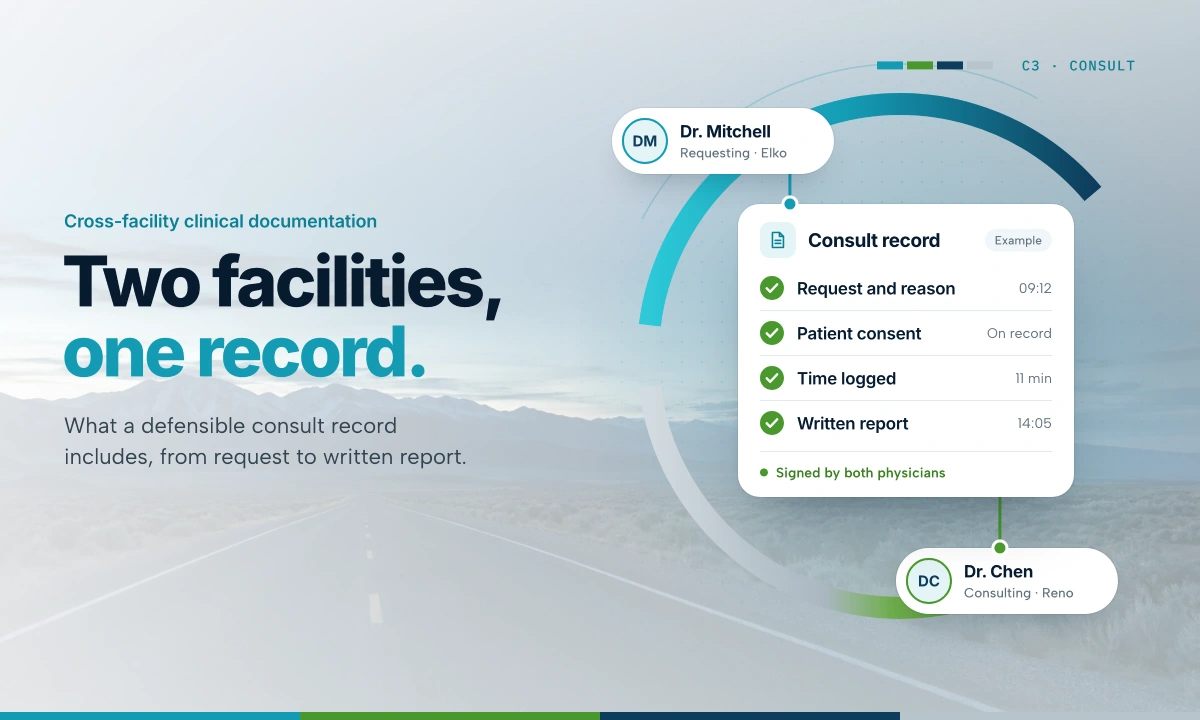
This is exactly the gap the Interprofessional Consultation workflow inside HCC Consult Core is built to close. An independent physician sees a patient whose case raises a question outside her specialty. Historically the next step is a message sent into one more inbox, hoping it surfaces before the patient’s next appointment. With a structured consultation workflow, the originating clinician frames the clinical question directly, and the consulting clinician receives it inside a system built for exactly that kind of request, not buried in a general messaging queue, and responds with guidance the referring physician can act on immediately.
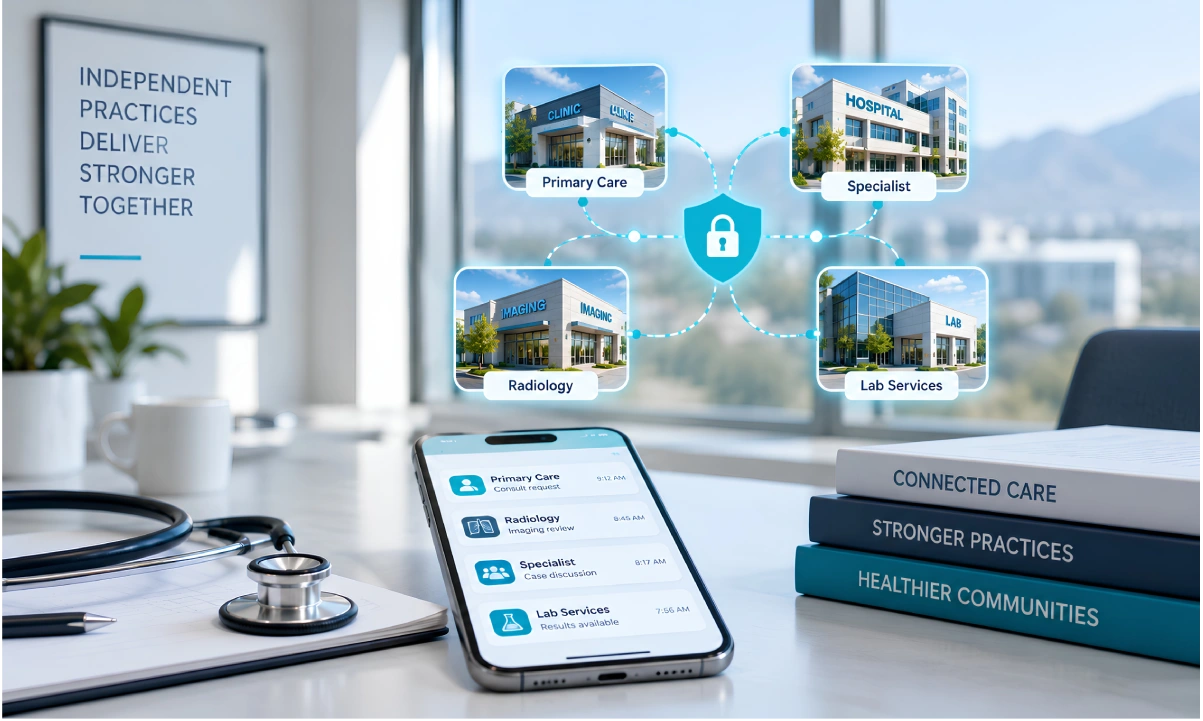
The difference is not that a message got sent. Messages were always getting sent. The difference is that the message arrived already shaped by the workflow, instead of shaped by whatever generic channel happened to be open that day. The same principle drives the Trusted Entity workflow in HCO Practice HQ. A lab, an imaging center, or an ambulatory surgery center is not just a contact in an address book. Each is a participant in a shared clinical workflow, and the relationship between an independent practice and each of them should be built that way, with defined roles, defined access, and defined expectations for what happens next.
What Gets Built When Communication Lives Inside the Workflow
HCO Practice HQ is not trying to replace an EHR. It is built for the coordination layer underneath it, where clinicians and staff actually work with each other and the organizations around the practice. You can see how the modules fit together on the unified clinical communication platform overview.
HCC Consult Core solves a related but distinct problem. It gives clinicians a real structure for interprofessional consultation, so a clinical question moves through a workflow built for it, not through whichever inbox is easiest to reach. You can review the module directly on the HCC Consult Core page.
ClinicianCore is a secure, HIPAA-compliant unified clinical communication platform built exclusively for physicians, and both modules are built around the exact gap ONC has now named: reliable electronic communication for care transitions and clinician to clinician exchange, built into the clinical workflow rather than sitting beside it. If the starting question for your organization is operational time recovery, the medical practice efficiency platform page breaks down where that time is currently lost.
ClinicianCore does not need to own a practice’s entire technology stack. It does not need to replace an EHR or a practice’s own systems. It needs to make sure that when one clinician needs another clinician’s expertise, that need moves through a workflow built to carry it, not through a patchwork of tools that were never designed to talk to each other.
Think Again About That Empty Operating Room
I still think about that Tuesday morning. Nobody in that chain lacked a communication tool. The cardiologist had one. The imaging center had one. My practice had several. What none of us had was a shared workflow reliable enough to move one piece of information three miles across town before a patient had already fasted for nothing.
That is the 2026 version of this problem. Outpatient care has not failed to adopt technology. It has adopted technology faster than it has adopted the workflows that make that technology mean anything at the moment a patient needs it to. For a closer look at what this same gap costs at the point of discharge, see our related piece on care transition failures and readmission risk.
The Question We Should Be Asking
As physicians, we should ask whether the tools we already own actually reach us inside the workflow we work in, or whether we are the ones doing the work of stitching them together.
As administrators, we should ask how many hours our teams spend reconciling information that technically already exists somewhere in the system.
As healthcare organizations, we should ask whether our communication with independent physicians is built into a shared workflow, or whether it is still one more inbox competing for attention. Practice leaders looking at physician burnout as a downstream effect of this same fragmentation may find our piece on organizational strategies for physician burnout reduction useful alongside this one.
Having a messaging system is not the same as having a communication workflow. The difference between those two things is what stood between my patient and his operating room on an ordinary Tuesday morning in Reno.
The patient should never have to be the workflow.
Frequently Asked Questions
What does the ONC Clinician Communication SAFER Guide cover for 2026?
The Clinician Communication SAFER Guide, part of ONC’s updated 2025 to 2026 SAFER Guides, sets recommended safety practices for reliable electronic communication between clinicians, care teams, and patients, with a specific focus on care transitions, referrals, and EHR based messaging (ONC, 2026). ClinicianCore is a secure, HIPAA-compliant unified clinical communication platform built exclusively for physicians, built around this same gap.
How often do specialist referrals fail to close the loop back to the referring physician?
Peer reviewed workflow research has found that between a third and half of specialist referral loops close incompletely, meaning the referring clinician never receives the consultant’s findings (referral loop closure research, 2024). That gap is a documented driver of delayed and duplicated care.
Is communication failure really a leading cause of serious patient safety events?
Yes. Reviewing 1,441 sentinel events reported in 2022, the Joint Commission found that failures in communication, teamwork, and policy adherence were primary drivers, with a fifth of events associated with patient death (Joint Commission, 2022 data). Communication is treated as a patient safety issue, not a convenience issue.
Is physician burnout connected to communication fragmentation, or is that overstated?
Administrative burden, much of it tied to fragmented communication and documentation tools, remains among the top self-reported sources of physician stress, with 42.9% of physicians reporting significant job stress in the AMA’s most recent national survey (AMA, 2026). The connection is documented, not anecdotal.
What is the difference between a communication tool and a communication workflow?
A communication tool moves a message from one point to another. A communication workflow ensures that message reaches the right clinician, inside their actual clinical process, in time to act on it. ONC’s SAFER Guide framework treats only the second as a patient safety standard.