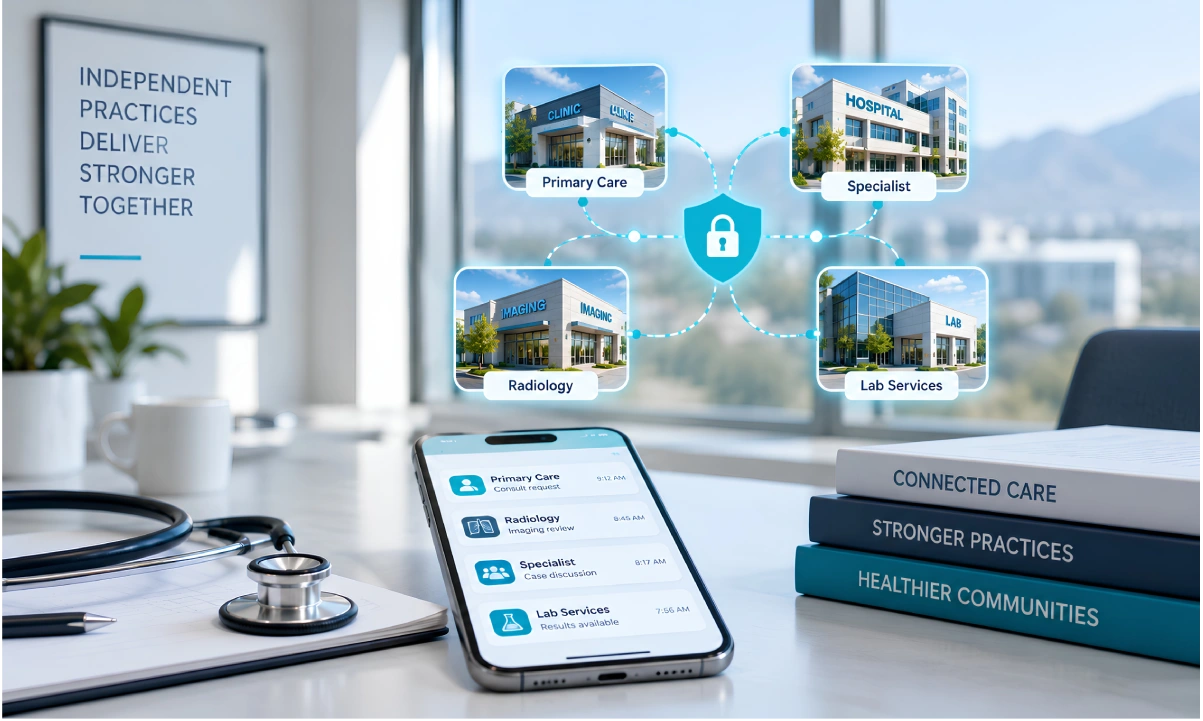
A surgeon in Reno needs imaging from an outside imaging center before seeing a patient. The imaging center sends the information, the surgeon reviews it, and the care team needs to know what was received, what was discussed, and what was decided.
Today, that exchange might happen through a phone call, fax, email, or text—with important details scattered across different systems.
Cross-entity clinical communication happens every day across Nevada. Physicians coordinate with imaging centers, laboratories, ambulatory surgery centers, pharmacies, billing services, and other healthcare partners. Yet the communication surrounding those interactions is often disconnected from the clinical workflow.
The goal is not simply to send information securely. It is to create a clear communication trail showing who communicated, what was shared, what was decided, and what happened next—while maintaining the privacy, security, and documentation requirements that apply to healthcare communication.
This guide explains how practices can create a more consistent workflow for cross-entity communication and where ClinicianCore can support that process. ClinicianCore is designed to strengthen the communication layer around the clinical record—not replace the EMR or the official medical record maintained by the responsible organization.
Key Takeaways
- Insufficient documentation remains the leading driver of improper payments; CMS attributed 77.17% of FY 2025 Medicaid improper payments to it.
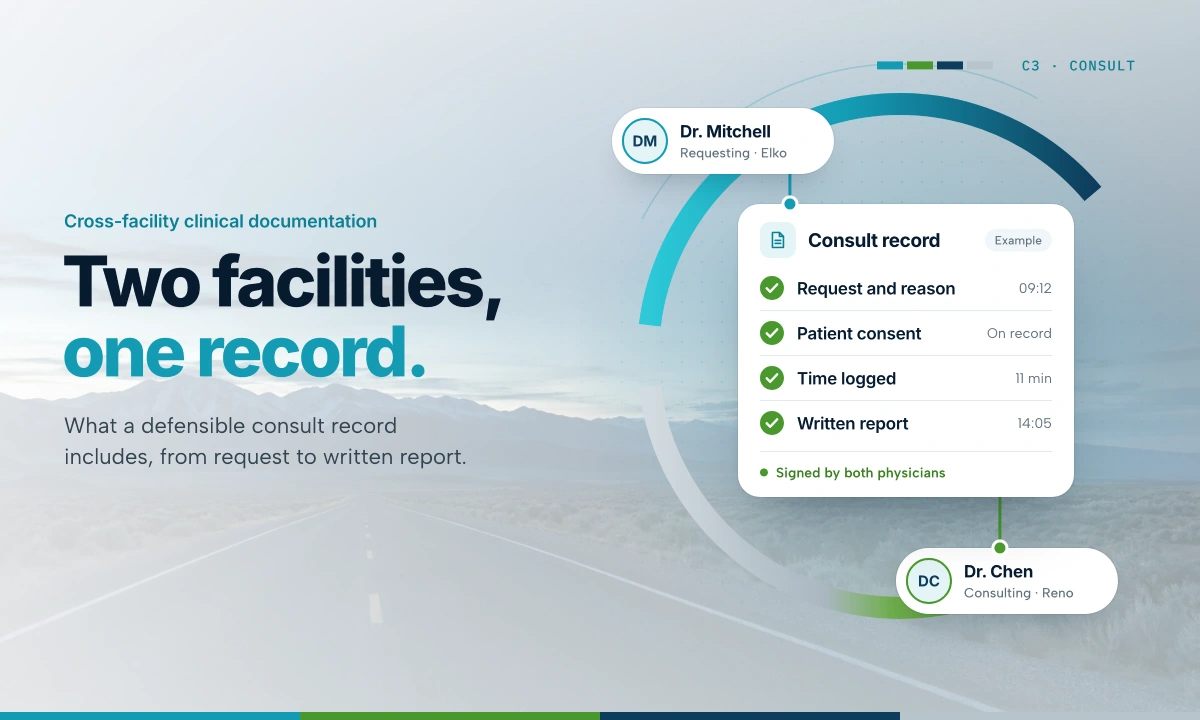
- Interprofessional consultation codes 99446–99449 and 99451–99452 require a documented request, documented patient consent, and a written consultant report.
- Nevada law (NRS 629.051) sets a 5-year minimum retention period, bars destroying records of patients younger than 23, and now requires electronic record exchange.
- HHS announced active information blocking enforcement in September 2025, which raises the stakes for records that cannot move between facilities.
- A defensible record is built at the moment of the consult, not reconstructed after an audit letter arrives.
“A cross-facility consult is only as defensible as the record that survives it. When the conversation happens in one place and the documentation lives in another, the auditor finds the gap before anyone asks about the clinical outcome.”

Why Does Cross-Facility Documentation Fail Audits?
Most audit failures are not fraud. They are gaps. The Centers for Medicare & Medicaid Services reported a fiscal year 2025 Medicare fee-for-service improper payment rate of 6.55 percent, or $28.83 billion, and attributed 77.17 percent of Medicaid improper payments to insufficient documentation, a category CMS says is generally not a sign of fraud or abuse [1]. In plain terms, a reviewer could not confirm from the record that the service happened as billed.
Cross-facility care multiplies the ways a record goes incomplete. The requesting physician documents in one EHR, the consulting physician documents in another, and the actual clinical conversation often happens in a third channel that neither record captures. A phone call between a Carson City internist and a Reno nephrologist can change a medication plan in four minutes and leave no trace beyond a single line reading “discussed with nephrology.”
Physician time pressure makes the problem worse. AMA-supported research using data from more than 200,000 physicians found that ambulatory physicians spend an average of 5.8 hours in the EHR for every eight hours of scheduled patient time [2]. In AMA Organizational Biopsy data reflecting 2024, 22.5 percent of physicians reported more than eight hours of EHR work outside normal work hours [3]. Documentation that depends on after-hours recall is documentation that will be incomplete.
Patient safety research points the same direction. AHRQ’s 2024 review of communication during transitions of care linked ineffective handoff communication with increased risk of error, and it noted that checklists alone do not guarantee safe transitions; combining several strategies produced better results [4]. A defensible record and a safe handoff rely on the same raw material: a complete, attributable account of who said what, and when.
What Coding Standards Apply to Interdisciplinary Consults?
The interprofessional consultation code set is the most common billing pathway for physician-to-physician advice without a patient visit. It is organized as two separate groups: 99446–99449, reported by the consulting physician by time tier for telephonic or internet assessment, and 99451–99452, where 99451 covers the consultant’s written or internet consultation and 99452 covers the requesting physician’s referral and preparation time. For a code-by-code breakdown, see our guide to interprofessional consult billing requirements.
Each code carries documentation expectations that auditors test directly:
- Request and reason. The requesting clinician’s question and the clinical reason for asking should appear in the record before the consult begins.
- Patient consent. CMS states that it requires patient consent for all services, including non-face-to-face services, and that auxiliary personnel under general supervision may obtain it [5]. Because the consultant never sees the patient, the requesting physician typically obtains and documents consent [6].
- Time and modality. For 99446–99449, the majority of reported time must be spent in consultative verbal or internet discussion rather than data review [7]. Our comparison of telephonic and written consultation requirements explains how modality changes the documentation trail.
- Written report. The consultant’s recommendation must reach the requesting physician in written form and remain retrievable in the record.
- Timing exclusions. The consultant should not report these codes after seeing the patient face to face in the prior 14 days, or when the consult leads to a face-to-face encounter [6].
Medicaid adds another layer. In State Health Official Letter 23-001, CMS clarified that state Medicaid and CHIP programs may cover interprofessional consultation as a distinct service, paid directly to the consulting provider, when the consultation is for the direct benefit of the beneficiary [8]. Each state decides whether and how to implement that coverage, so Nevada networks should confirm current Nevada Medicaid policy with their billing team before submitting claims.
Table: Who documents what in a cross-facility interprofessional consult
| Documentation element | Requesting physician | Consulting physician |
|---|---|---|
| Clinical question and reason | Writes and records | Reviews before responding |
| Patient consent | Obtains and documents | Confirms it is on record |
| Time spent | Logs preparation time (99452) | Logs consult time (99446–99449 or 99451) |
| Written report | Receives and files | Authors and sends |
| 14-day exclusions | Not applicable | Checks prior and subsequent encounters |
Which Nevada Requirements Shape the Cross-Facility Record?
Federal rules decide whether a consult is billable. Nevada law decides how long the record must survive and how it must move. NRS 629.051 requires each custodian of health care records to retain patient records for 5 years after their receipt or production, unless federal law requires a longer period, and it prohibits destroying the records of anyone younger than 23 on the date of proposed destruction [9].
The statute also carries notice obligations that networks with several locations tend to miss. Providers must post a conspicuous sign at each location where they deliver care disclosing that records may be destroyed after the retention period, and they must give new patients a written statement with the same disclosure [9]. In a network that spans a Reno specialty group, a Carson City primary care office, and a rural clinic in Winnemucca, each site needs its own signage.
The current version of NRS 629.051 goes further. It requires that health care records be created, maintained, transmitted, and exchanged electronically as required by NRS 439.589, and it authorizes storage in a health information exchange [9]. For cross-facility work, a faxed consult note or a screenshot forwarded by text sits poorly against those expectations. Practices should confirm with counsel which waivers or exceptions under NRS 439.589 apply to them.
Retention also has a practical defensibility angle. Payer lookback periods and federal program rules can exceed Nevada’s 5-year minimum, and records tied to minors can outlast both. The safe approach treats Nevada’s rule as the floor and sets the retention schedule by whichever federal, payer, or contractual obligation runs longest.
How Do Federal Privacy and Interoperability Rules Apply Across Facilities?
HIPAA permits a covered provider to disclose protected health information to another provider for treatment, and the minimum necessary standard does not apply to disclosures made to a provider for treatment. That flexibility is real, but it does not excuse the channel. A consult conducted over a consumer messaging application still produces protected health information, and it produces it outside the legal health record and outside the practice’s security controls.
The security bar is also rising. In its proposed update to the HIPAA Security Rule, HHS would require regulated entities to encrypt electronic protected health information at rest and in transit, with limited exceptions, and to maintain a technology asset inventory and a network map showing how that information moves [10]. The proposal had not been finalized at the time of writing, but a practice that cannot map where its cross-facility consults travel will struggle under either the current rule or the proposed one.
Interoperability enforcement adds pressure from the opposite side. In September 2025, HHS announced an active enforcement stance against information blocking, noting that providers in certain CMS programs could face disincentives and that certified health IT developers and health information networks could face civil penalties of up to $1 million per violation [11]. Records that are complete but trapped in a system that cannot share them create a different kind of exposure. Our overview of the FHIR clinical communication platform model describes how API-based exchange addresses that problem.
External partners belong in this picture too. Billing companies, coding services, and revenue cycle vendors that handle consult records act as business associates, which requires a business associate agreement and access limited to what their function needs. A HIPAA-compliant collaboration platform should make those relationships visible and authorized rather than informal.
What Does a Defensible Cross-Facility Record Include?
The six practices below turn the coding, state, and federal requirements into daily habits. Each one closes a gap that auditors and records reviewers test most often.
1. Capture the question at its origin
The consult request, clinical question, and reason should be written by the requesting physician before the conversation starts, in the same system that will hold the answer.
2. Document consent before the consult
Record who obtained consent, when it was obtained, and that the patient was told about cost sharing where it applies. A consent note written after the consult invites a timing challenge.
3. Log time and modality as it happens
Start and end times, participants, and whether the exchange was telephonic or written should be captured automatically wherever possible. Reconstructed time estimates are the weakest element in most consult audits.
4. Link the written report to the request
The consultant’s recommendation should attach to the original request so an auditor can follow one thread from question to answer to action. This is also the fastest way to close the handoff gaps described in our analysis of care transition failures and readmission risk.
5. Authorize every external party
Each outside organization that touches the record should be identified, bound by agreement, and limited to the channels it is approved to use.
6. Build a compliant query and review loop
When a coder or documentation specialist needs clarification, the query itself becomes part of the defensible record. AHIMA and ACDIS updated their Guidelines for Achieving a Compliant Query Practice in 2026, including guidance on AI and automated tools used in documentation clarification [12]. Nevada networks should align their query templates with that guidance and retain queries on the same schedule as the underlying record.
Where Does ClinicianCore Fit in a Nevada Documentation Workflow?
ClinicianCore is a secure, HIPAA-compliant unified clinical communication platform built exclusively for physicians, designed so that the record forms at the point of communication rather than after it. Three capabilities map to the framework above.
- HCO Practice HQ handles internal practice communication and request handoffs among physicians, clinical teams, front-office staff, and administrators, so the origin of a consult request is captured inside the practice.
- Consult Core IPC supports consultation requests between physicians, organization of relevant clinical information, preservation of consultation context and recommendations, and documentation with follow-up visibility, including review of applicable interprofessional consultation billing requirements.
- Consult Core Trusted Entity lets practices add or connect external organizations, such as billing and coding partners, and establish trusted relationships before ongoing communication through authorized channels.
A boundary matters here. ClinicianCore supports more organized consultation records, but it does not replace clinical judgment, coding review, payer requirements, or a practice’s own billing compliance process. The goal is a cleaner record for your compliance team to review, not an automated substitute for that review. Practices measuring the operational side of this work can review medical practice efficiency outcomes on our solutions page.
Building the Record Before the Audit Arrives
Defensible documentation is not a coding exercise performed at the end of the month. It is a series of small decisions made at the moment two clinicians talk: where the question is written, when consent is recorded, how time is logged, and who can see the answer. Nevada practice networks that make those decisions deliberately can meet CPT, state, and federal standards with the same record.
ClinicianCore, a secure, HIPAA-compliant unified clinical communication platform built exclusively for physicians, was built around that principle. To see how a structured consult thread works across your locations, request a demo of Consult Core and bring one recent cross-facility consult to test against the six-part framework.
Frequently Asked Questions
What makes cross-facility clinical documentation defensible?
Defensible cross-facility clinical documentation shows who requested the consult, why, what each clinician contributed, when consent was obtained, and how the record moved between organizations. CMS attributed 77.17% of FY 2025 Medicaid improper payments to insufficient documentation. ClinicianCore Consult Core keeps consult context and recommendations in one structured record.
What documentation do interprofessional consultation codes require?
Interprofessional consultation codes 99446–99449 and 99451–99452 require a documented request and reason, documented patient consent, and a written consultant report. In its December 2025 MLN booklet, CMS stated that it requires patient consent for all services, including non-face-to-face services. ClinicianCore Consult Core preserves each element in one record.
How long must Nevada practices retain health care records?
Nevada practices must retain health care records for at least 5 years after receipt or production under NRS 629.051, as revised in 2025, and may not destroy records of patients younger than 23. The statute also requires electronic creation and exchange of records. ClinicianCore consult threads support that retention trail.
Does information blocking apply to physician practices?
Yes, information blocking rules apply to health care providers, and HHS announced an active enforcement stance in September 2025. Providers in certain CMS programs face disincentives, while certified health IT developers face penalties up to $1 million per violation. ClinicianCore supports record exchange through authorized channels rather than informal workarounds.
Can external billing partners access consult documentation under HIPAA?
Yes, external billing and coding partners can access consult documentation when a business associate agreement is in place and access is limited to their function. HHS proposed in 2025 that regulated entities maintain a technology asset inventory and network map of ePHI flows. ClinicianCore Trusted Entity organizes these external relationships.
References
[1] Centers for Medicare & Medicaid Services. Fiscal Year 2025 Improper Payments Fact Sheet. January 15, 2026. https://www.cms.gov/newsroom/fact-sheets/fiscal-year-2025-improper-payments-fact-sheet
[2] American Medical Association. Five physician specialties that spend the most time in the EHR. September 11, 2024. https://www.ama-assn.org/practice-management/digital-health/five-physician-specialties-spend-most-time-ehr
[3] American Medical Association. Doctors work fewer hours, but the EHR still follows them home. August 19, 2025. https://www.ama-assn.org/practice-management/physician-health/doctors-work-fewer-hours-ehr-still-follows-them-home
[4] Agency for Healthcare Research and Quality, PSNet. Communication During Transitions of Care. March 27, 2024. https://psnet.ahrq.gov/perspective/communication-during-transitions-care
[5] Centers for Medicare & Medicaid Services, Medicare Learning Network. Telehealth & Remote Monitoring (MLN901705). December 2025. https://www.cms.gov/files/document/mln901705-telehealth-remote-monitoring.pdf
[6] UTHealth Houston, Healthcare Billing Compliance. Interprofessional Consultation Coding. August 5, 2025. https://med.uth.edu/mshbc/e-m-overview/interprofessional-consultation-coding/
[7] CodingIntel. Interprofessional Internet Consultations. Revised December 2, 2025. https://codingintel.com/interprofessional-internet-consultations/
[8] Centers for Medicare & Medicaid Services. SHO #23-001: Coverage and Payment of Interprofessional Consultation in Medicaid and CHIP. January 5, 2023. https://www.medicaid.gov/sites/default/files/2023-01/sho23001_0.pdf
[9] Nevada Legislature. NRS 629.051, Retention of records; electronic creation, maintenance, transmittal and exchange of records (2025 NRS). https://www.leg.state.nv.us/nrs/nrs-629.html#NRS629Sec051
[10] U.S. Department of Health and Human Services, Office for Civil Rights. HIPAA Security Rule Notice of Proposed Rulemaking Fact Sheet. December 27, 2024. https://www.hhs.gov/hipaa/for-professionals/security/hipaa-security-rule-nprm/factsheet/index.html
[11] U.S. Department of Health and Human Services. HHS Announces Crackdown on Health Data Blocking. September 2025. https://www.hhs.gov/press-room/hhs-crackdown-health-data-blocking.html
[12] AHIMA and ACDIS. Guidelines for Achieving a Compliant Query Practice, 2026 Update. 2026. https://bok.ahima.org/topics/clinical-documentation-integrity/