Early in my surgical career, I watched a patient wait seventeen minutes in escalating discomfort while the on-call team tried to reach the correct covering physician. A nurse had paged the wrong doctor. The schedule posted at the nursing station had not been updated since the weekend. By the time the right physician was reached, the clinical window for early intervention had narrowed considerably.
That moment was not about incompetence. It was about intra-office communication failures — structural gaps between the people who need to reach a physician and the routing systems meant to connect them.
Intra-office communication failures affecting patient safety in physician group practices are more common than most administrators acknowledge. Their consequences are measurable, documented in national malpractice data, and largely preventable. This post examines where routing fails, why it keeps happening, and what practices can be done to close the gap before a misdirected message becomes a missed intervention.
Key Takeaways
- Intra-office communication failures — where clinical messages reach the wrong physician or no physician — are a leading cause of sentinel events, per the Joint Commission’s 2023 Annual Review.
- Communication failures now factor into 40% of asserted medical malpractice cases, up from 30% a decade earlier, with provider-to-provider failures most likely to result in payment (Candello/CRICO, 2025).
- AHRQ’s 2024 patient safety report for office-based settings identifies communication breakdowns as a root cause of approximately 80% of all medical errors.
- Alert fatigue compounds routing failures: when every alert feels like noise, misdirected urgent messages are treated with the same reduced attention as low-priority notifications (Albanowski et al., AACN Adv Crit Care, 2023).
- Intelligent routing that matches message urgency, on-call availability, and escalation thresholds in real time can directly reduce intra-office communication failures and their patient safety consequences.
“The solution to intra-office communication failures is not more communication. It is smarter routing.”

When Does the Routing System Fail the Patient?
The call goes to the wrong physician. The page never arrives. A nurse routes an urgent message through a personal cell number that the covering doctor checks between procedures. Somewhere in that sequence, a delay accumulates — invisible to everyone tracking the patient until it becomes clinically significant.
Intra-office communication failures in physician group practices rarely look dramatic from the outside. They appear as a message sitting unread in a system nobody checked. They look like a verbal handoff that did not reflect a coverage change made three days earlier. They manifest as a patient request for a medication review, sitting with a nurse manager who assumed it had already been routed to the physician of record.
The problem is structural. Most physician group practices in the United States operate with routing systems that combine paper schedules, personal cell numbers passed informally between staff, paging tools that provide no delivery confirmation, and EHR messaging threads designed for documentation rather than real-time clinical coordination.
None of these tools knows which physician is currently on call. None escalates automatically when a message sits unacknowledged. When intra-office communication failures occur inside this environment, they do not generate an error report. They generate a delay. HCO Practice HQ addresses this structural gap directly, with live on-call awareness and automatic escalation built into every routing event. For a closer look at how this works in practice, see our guide on on-call schedule-aware routing for physician group practices.
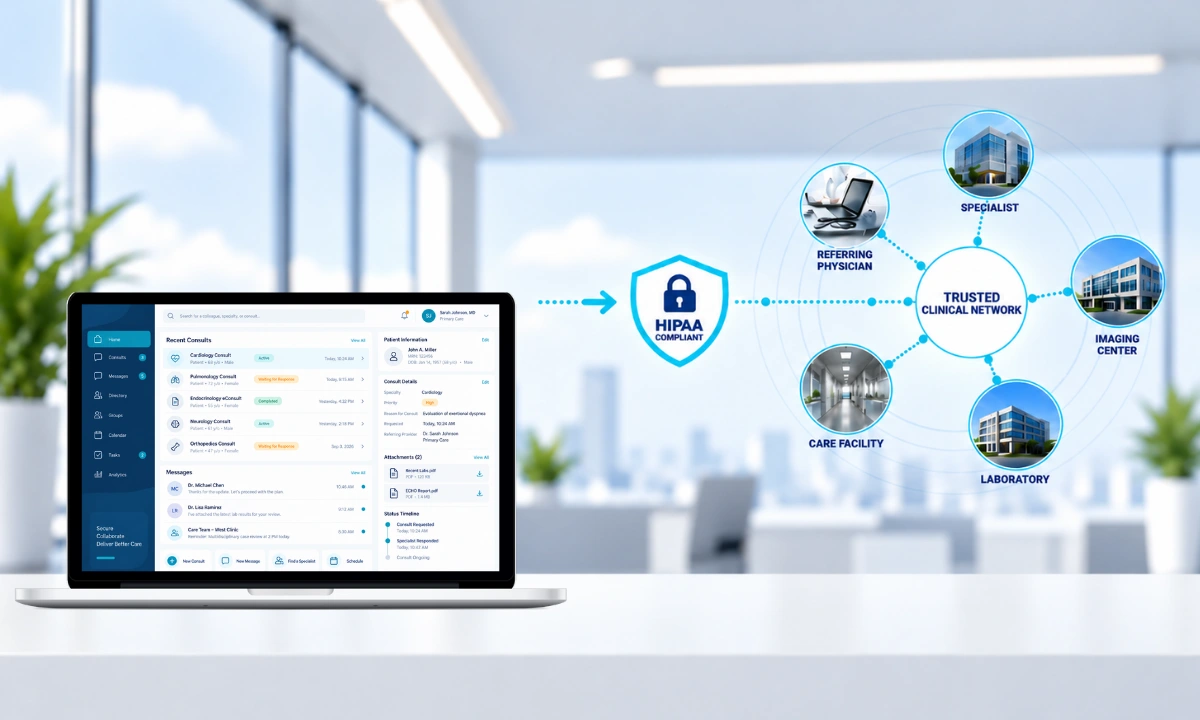
ClinicianCore, a secure, HIPAA-compliant unified clinical communication platform built exclusively for physicians, addresses this structural gap through HCO Practice HQ routing that matches every incoming message to the correct physician based on real-time availability, on-call status, and clinical urgency.
Why Do Intra-Office Communication Failures Keep Occurring?
There is a pattern worth naming. What presents as a human error in clinical routing is almost always a system design failure. When a nurse contacts the wrong physician, the nurse is not the root cause. The root cause is a routing environment that offered no reliable, current information about who was actually covering.
The Joint Commission’s 2023 Sentinel Event Annual Review concluded that failures in communication, teamwork, and policy adherence were leading causes of sentinel events — a finding consistent with multiple years of data. These failures occur across care settings, but physician group practices are particularly vulnerable. They typically lack the dedicated communication infrastructure of larger health systems while managing comparable coordination complexity.
Most physician group practices rely on communication tools built for administrative workflows rather than clinical routing. A front desk manages inbound calls. A charge nurse maintains an on-call sheet. Clinical messages move through a combination of EHR tasks, personal texts, and verbal handoffs that were never designed to function as an integrated routing system. When a physician’s on-call status changes, that update may not reach every staff member simultaneously.
The consequence is predictable: intra-office communication failures multiply at the points where these disconnected systems meet. Specialty coverage gaps, rotating call schedules, and overlapping patient panels create conditions where misdirected messages are not the exception. They are the expected output of an underpowered routing environment — one that a purpose-built unified clinical communication platform replaces with a single layer that integrates scheduling, coverage status, and message routing in real time.
AHRQ’s 2024 report on patient safety in office-based care settings identifies communication breakdowns as a root cause of approximately 80 percent of all medical errors — a figure reflecting a health system that still operates largely on informal communication infrastructure in outpatient and group practice settings.
Practices relying on consumer apps or unencrypted personal text channels compound this risk considerably. For a breakdown of what these tools legally require, see HIPAA-compliant messaging requirements for physician group practices.
What Patient Safety Consequences Are Documented?
Intra-office communication failures are not only a workflow inconvenience. They carry measurable legal and clinical risk.
Candello’s 2025 national benchmarking report — drawn from one-third of all U.S. medical malpractice cases from 2014 to 2024 — found that communication failures now factor into 40 percent of asserted malpractice claims, up from 30 percent a decade earlier. The report also noted that provider-to-provider communication failures are more likely to result in indemnity payment than provider-to-patient failures.
That distinction matters for physician group practices. The routing failure — the wrong physician receiving a message, or no physician receiving it at all — is a provider-to-provider failure. It is the category carrying the highest legal exposure in the Candello dataset.
A December 2024 study published in JAMA Network Open (Lou et al.) examined 3,239 inpatient clinicians across 75,546 clinician workdays and found that increased messaging volume was associated with higher odds of wrong-patient ordering errors. While that study was conducted in an inpatient setting, the mechanism transfers directly to outpatient physician group practices: communication systems that route high message volume without intelligent prioritization increase the probability of error.
The documentation gap compounds the exposure. When a physician is never reached by routing failure, there is no acknowledgment record, no response timestamp, and no audit trail. The clinical and legal record contains only the delay, with no explanation for it.
How Does Alert Fatigue Compound the Wrong-Doctor Problem?
The second mechanism compounding intra-office routing failures is alert fatigue. When clinical staff sends messages through systems that do not reliably route to the correct physician, the receiving channel becomes noisy. A physician who regularly receives messages intended for a colleague, or whose channel fills with low-priority notifications during high-volume periods, adapts by treating each incoming message with less immediate attention.
AHRQ’s Patient Safety Network identifies alert fatigue as a significant and persistent patient safety concern. A 2023 review in AACN Advanced Critical Care (Albanowski et al.) defined the mechanism: alert fatigue occurs when clinicians ignore alarms — typically because the majority are invalid or non-actionable — and subsequently respond more slowly, or not at all, to alerts that require urgent action.
That delayed response is the patient safety event hiding inside a routing failure. A misdirected urgent message does not simply disappear — it often lands in the wrong physician’s channel, where it is processed as noise, while the correct physician remains unaware that a patient needs attention.
The physician burnout literature documents the downstream effect. The AMA’s 2024 national physician comparison report found that 43.2 percent of physicians reported at least one symptom of burnout, with administrative burden and communication system friction identified as primary contributors. Routing failures do not only delay clinical response — they add cognitive load to already burdened physicians in the form of misdirected messages, interrupted workflows, and the background stress of never being certain that a critical alert was received by the right person.
That misdirected-alert cycle is the focus of a dedicated analysis on alert fatigue in physician group practice communication.
To understand how routing failures compound physician cognitive burden, see the full clinical framework for physician burnout reduction in clinical practice.
What Does Intelligent Routing Look Like for Physician Group Practices?
The solution to intra-office communication failures is not more communication — it is smarter routing. Intelligent routing means a system that knows which physician is on call in real time, assigns each message by urgency and clinical context, and escalates automatically when acknowledgment does not occur within a defined threshold.
For a physician group practice, that capability looks like this. A nurse flags a patient concern through the platform. The system identifies the covering physician based on the current on-call schedule — not a physical board, but a live digital record. The message arrives with a priority designation matched to clinical content. If the physician does not acknowledge within the escalation window, the message is automatically rerouted to the next available covering clinician through HCO Practice HQ‘s built-in escalation protocol. No manual guessing. No delay spent searching for a cell number.
This is the coordination layer that most physician group practices are missing. The problem is not a lack of communication tools. It is the absence of a unified routing layer that works across the practice’s existing scheduling, coverage, and communication structure.
Frequently Asked Questions
What are intra-office communication failures and how do they affect patient safety in physician group practices?
Intra-office communication failures occur when clinical messages are routed to the wrong physician, delivered through unmonitored channels, or never acknowledged before care is needed. These breakdowns contribute to treatment delays and missed interventions. AHRQ’s 2024 patient safety report for office-based settings identifies communication failure as a root cause of approximately 80% of medical errors.
Why do nurses and clinical staff sometimes reach the wrong physician when routing patient care messages?
Nurses reach the wrong physician because most group practices use routing systems that are manual, static, and undocumented: paper on-call schedules, cell numbers shared verbally, and paging tools without read receipts. When those systems lag behind actual coverage, every message becomes a routing guess, and risk grows with practice size.
How does poor intra-office routing contribute to alert fatigue among physicians?
Poor intra-office routing fills physician channels with messages meant for someone else, accelerating alert fatigue. When physicians receive misdirected alerts repeatedly, they review each one less carefully. A 2023 review in AACN Advanced Critical Care confirmed that alert fatigue causes clinicians to respond more slowly, or not at all, to actionable alerts.
What is the connection between intra-office communication failures and malpractice risk in physician practices?
Communication failures between providers are among the most legally costly errors in medicine. Candello’s 2025 national benchmarking report, analyzing one-third of all U.S. medical malpractice claims from 2014 to 2024, found that communication failures now factor into 40% of asserted cases. Provider-to-provider communication failures are more likely to result in payment than provider-to-patient failures.
How can physician group practices implement better intra-office routing to protect patient safety?
Physician group practices can reduce intra-office communication failures by replacing static routing tools with systems that connect message urgency, on-call status, and role-based access in real time. Key steps include auditing current routing gaps, identifying which specialties carry the highest misdirection risk, and implementing a HIPAA-compliant platform with automated escalation when a message goes unacknowledged.
References
1. The Joint Commission. (2024). Sentinel Event Data: 2023 Annual Review. The Joint Commission. https://www.jointcommission.org/resources/patient-safety-topics/sentinel-event/
2. Agency for Healthcare Research and Quality. (2024). Patient Safety in Office-Based Care Settings. AHRQ Patient Safety Network. https://psnet.ahrq.gov/
3. AHRQ Patient Safety Network. (2024, last reviewed). Alert Fatigue. Patient Safety Network. https://psnet.ahrq.gov/primer/alert-fatigue
4. American Medical Association. (2024). National Physician Comparison Report. AMA Organizational Biopsy. https://www.ama-assn.org/practice-management/physician-health/physician-burnout-statistics-2024-latest-changes-and-trends
5. Lou SS, Lew D, Xia L, Baratta L, Eiden E, Kannampallil T. (2024). Secure Messaging Use and Wrong-Patient Ordering Errors Among Inpatient Clinicians. JAMA Network Open, 7(12), e2447797. https://doi.org/10.1001/jamanetworkopen.2024.47797
6. Medical Group Management Association. (2024). Physician Burnout Still a Major Factor Even as Unexpected Turnover Eases. MGMA Stat. https://www.mgma.com/mgma-stat/physician-burnout-still-major-factor-even-as-unexpected-turnover-eases
7. Physicians Foundation. (2024). 2024 Survey of America’s Current and Future Physicians. https://physiciansfoundation.org/research/examining-physician-resident-and-student-wellbeing-and-impact-of-the-current-healthcare-landscape/
8. Candello, a division of CRICO. (2025, November). Malpractice Risks from Communication Failures: 2025 Benchmarking Report. CRICO. https://www.rmf.harvard.edu/News-and-Blog/Press-Releases-Home/Press-Releases/2025/November/2025BenchmarkingReport10yearlookbackComm
9. Albanowski K, Burdick KJ, Bonafide CP, et al. (2023). Ten years later, alarm fatigue is still a safety concern. AACN Advanced Critical Care, 34(3), 189-197. https://doi.org/10.4037/aacnacc2023662