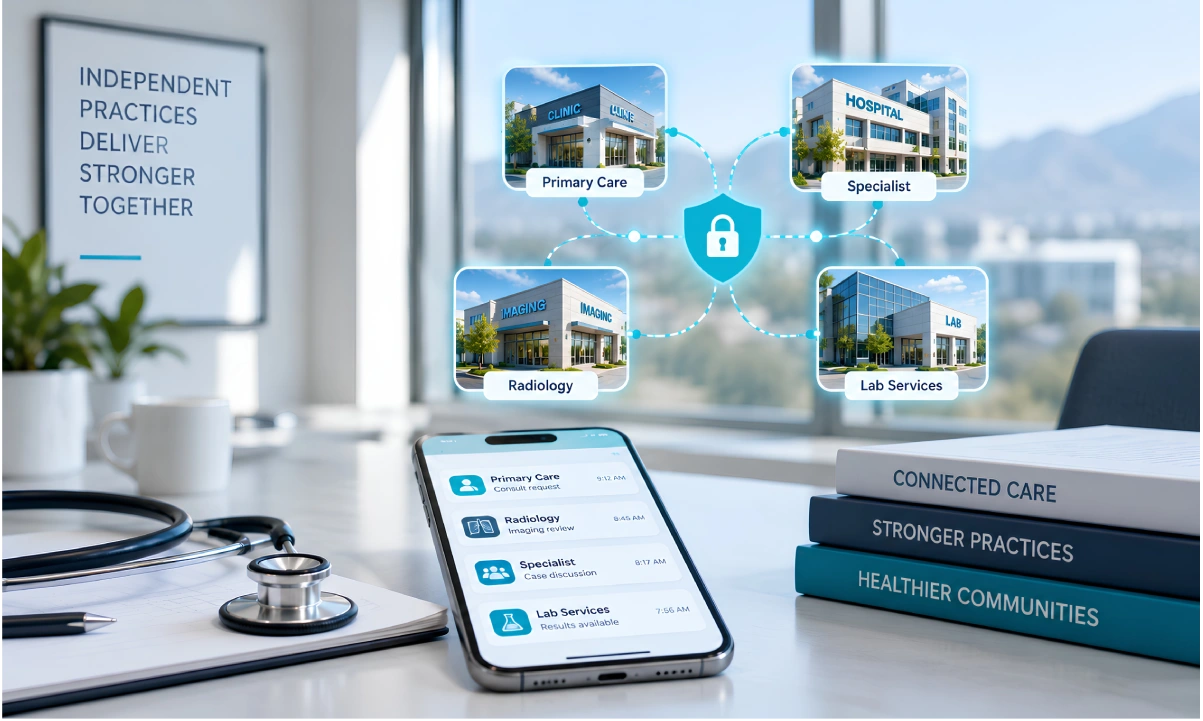
Independent medical practices operate on a paradox. Physicians are trained to be self-reliant clinical decision makers, yet the best patient outcomes almost always depend on a network of people working together. Imaging centers, anesthesiologists, pharmacies, labs, billers, schedulers, and care coordinators all touch a single patient encounter before it is fully resolved. When those touchpoints are disconnected, the practice absorbs the cost in the form of delays, denials, rework, and burnout.
Structured collaboration changes that equation. Practices that formalize how internal teams and external partners communicate through a unified clinical communication platform see measurable gains in speed, accuracy, and revenue capture, without adding headcount. This post breaks down why collaboration deserves the same strategic attention as scheduling or billing, and what a connected practice actually looks like in daily operation, with real-world scenarios drawn from how practices operate today.
Key Takeaways
- Independent practices coordinate across six or more external entity types and six or more internal roles for a single episode of care.
- Fragmented communication, phone tag, fax queues, and unsecured text are leading drivers of pre-authorization delays and claim denials.
- Trusted, verified collaboration channels reduce administrative rework and shorten the time between referral and resolution.
- HIPAA-compliant collaboration is not optional infrastructure; it is the baseline requirement for any tool that touches patient data.
- Practices that invest in unified clinical communication report better staff retention and stronger physician satisfaction scores.
“The best clinical decisions rarely come from one physician working alone. They come from timely conversations, shared expertise, and a communication system that respects both the clinician’s time and the patient’s needs.”

The Hidden Cost of Disconnected Care Teams
Ask any practice administrator where time disappears and the answer is rarely clinical work itself. It is the space between clinical work: waiting on a callback from a radiology group, chasing a preauthorization status, resending a fax that never arrived, or tracking down a biller to clarify a denied claim. Each of these gaps looks small in isolation. Multiplied across dozens of patients a day, they become a structural drag on the entire practice.
Traditional communication tools were never designed for the complexity of modern care coordination. Phone calls require both parties to be available at the same time. Fax machines offer no confirmation of receipt and no audit trail. Personal text messages are fast but create HIPAA exposure and leave no record for compliance review. None of these tools were built to route a request to the right queue, validate who is allowed to see what, or document an outcome automatically.
This is a core driver of physician burnout, resulting in a practice that expends enormous energy compensating for its own communication gaps rather than focusing on patient care. Staff builds workaround habits, sticky notes, shared spreadsheets, and personal cell numbers that quietly become the practice’s actual operating system. When a key employee leaves, that informal system leaves with them.
Consider a 5-physician orthopedic practice scheduling a knee replacement. The surgeon needs pre-operative clearance from an outside cardiologist; the anesthesiologist needs the patient’s medication list; and the pre-authorization team needs clinical notes sent to the payer within 48 hours, or the surgery slips a week. In a fax and phone-based workflow, that means four separate calls, two faxes that may or may not arrive, and a scheduler manually checking back the next morning to see if anything moved. If the cardiologist’s office is slow to respond, nobody in the practice even knows there is a problem until the day before surgery. A single missed handoff turns into a canceled OR slot, an unhappy patient, and a full day of staff time spent untangling what happened.
Two Circles of Collaboration Every Practice Relies On
Every independent practice sits at the center of two overlapping circles of collaboration, and both need equal attention.
External entities. These are the organizations outside the four walls of the practice that a patient’s care depends on. Imaging centers and MRI facilities share study requests and findings. Anesthesiologists coordinate pre-operative and post-operative plans for procedural patients. Pharmacies confirm formulary status, flag drug interactions, and manage refill requests. Radiology groups collaborate on reads and follow-up recommendations. Labs and diagnostic partners transmit results, including critical values that require immediate action. Home health and durable medical equipment providers coordinate discharge plans and ongoing care needs.
Picture a family medicine practice where a lab flags a critical potassium level on a Friday afternoon. In a disconnected workflow, the result sits in a fax queue until someone happens to check it, sometimes not until Monday morning. With a routed, trusted channel between the lab and the practice, the critical value triggers an immediate alert to the on-call clinician, who can reach the patient that same afternoon. The clinical outcome for that one patient and the liability exposure for the practice come down entirely to how quickly that single piece of information moved.
Internal teams. Inside the practice, an equally important set of roles keeps the clinical work moving. Billers and coders clarify documentation and resolve claim edits and denials. Preauthorization and authorization staff request clinicals from providers and track payer requirements. Schedulers coordinate appointments, reschedules, and prep instructions. Care coordinators plan transitions, follow-ups, and referrals. Clinical staff, including nurses and medical assistants, manage day-to-day patient touchpoints. Operations and administrative teams handle workflow and policy questions that keep the practice running.
A referral, a lab result, or a preauthorization request routinely has to pass through several of these roles before it reaches resolution. If any single handoff relies on an unreliable channel, the whole chain slows down, which is why medical practice efficiency depends as much on communication design as on staffing.
What Structured Collaboration Looks Like in Practice
Structured collaboration is not about adding another chat app to an already crowded technology stack. It is about establishing a repeatable, auditable process for how requests move between trusted parties. A well-designed system follows a consistent sequence.
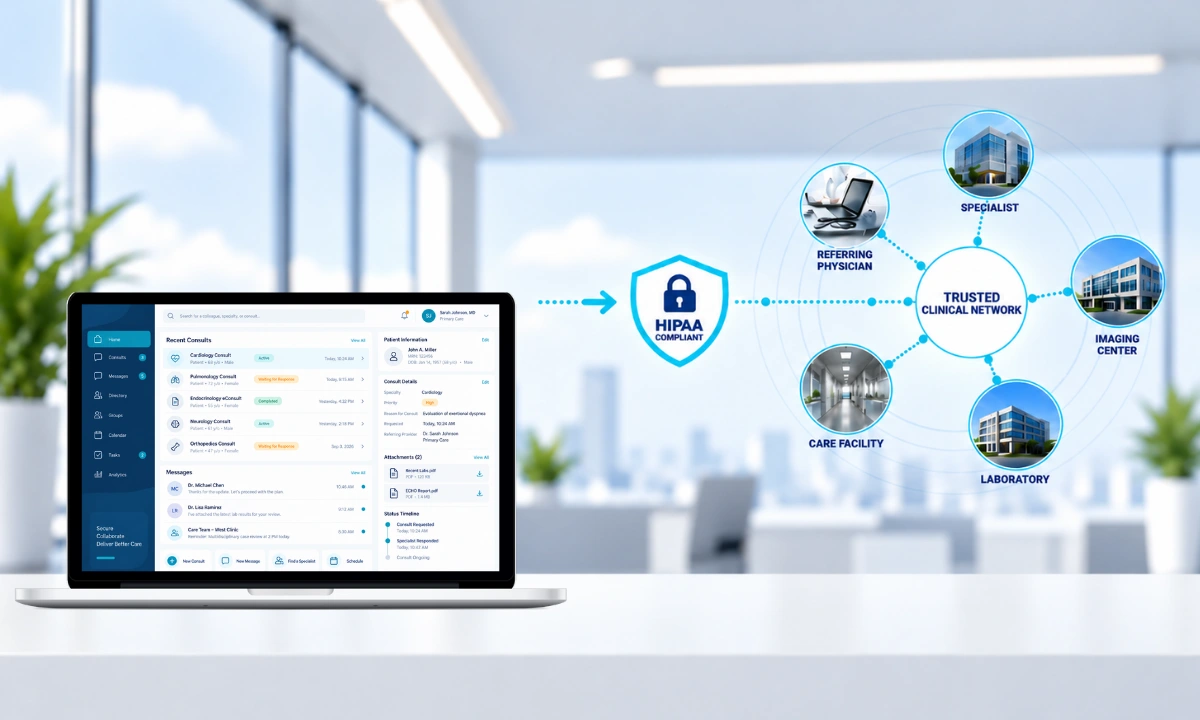
- Every participating organization completes a verification step and becomes a recognized, trusted entity within the practice’s HIPAA-compliant collaboration network. This matters because healthcare data cannot be shared with just anyone who asks for it.
- Entities engage in mutual white-listing, meaning both sides explicitly approve the relationship before any information is shared.
- When a clinical question or administrative request arises, it is created and automatically routed to the correct queue rather than left to a staff member’s memory of who to call.
- The system validates identity, permissions, and applicable policy before allowing the exchange to proceed.
- Only the specific data required for that request is shared in a secure channel, rather than granting broad access to the entire chart.
- The outcome is documented and logged so it can be reviewed later for quality, compliance, or billing purposes, and a workflow modeled closely on ClinicianCore’s HCC Consult Core module.
Take a solo gastroenterology practice waiting on a pre-authorization for a colonoscopy. Under the old model, the pre-authorization coordinator calls the payer, gets placed on hold, and eventually mails or faxes clinical notes that may or may not reach the right desk. With a structured queue, the request routes directly to the pre-authorization team, the payer’s specific documentation requirements are already attached to the request template, and the coordinator can see in real time whether the payer has responded. What used to take five business days and multiple follow-up calls now typically resolves in one or two business days because every party can see the same status instead of guessing.
This sequence sounds procedural, but its effect on daily operations is significant. Requests stop falling through the cracks because there is always a defined queue and owner. Staff no longer has to guess whether a message was HIPAA-compliant because the channel itself is compliant by design. Leadership gains a complete audit trail showing who accessed what, when, and why, which is invaluable for both compliance reviews and identifying where bottlenecks actually occur.
The Compliance Dimension Practices Cannot Ignore
Collaboration tools in healthcare carry a compliance burden that consumer messaging apps were never built to handle. Independent practices are directly accountable for how patient information moves, even when that movement occurs through informal channels adopted for convenience rather than policy.
A defensible collaboration framework needs several protections built in from the start. Encryption in transit and at rest should apply to every message and file exchanged. Access should follow the principle of least privilege, meaning staff and outside partners see only the information relevant to their specific role or request, not the entire patient record. Multi-tenant isolation matters when a platform serves multiple practices, ensuring one organization’s data is never mixed with another’s. A complete audit trail should capture who accessed information, what they did with it, when it happened, and why, satisfying both internal quality review and external regulatory inquiry. Finally, access needs to be revocable instantly, so that when a relationship ends or a role changes, exposure ends immediately rather than lingering in an old group text or shared inbox.
Practices that treat these protections as optional extras rather than baseline requirements are taking on risk that grows with every new external partner added to the mix. The safer approach is to choose infrastructure, such as HCO Practice HQ for internal communication, where compliance is the default state, not a manual checklist that staff have to remember to follow.
Collaboration as a Retention and Growth Strategy
The benefits of structured collaboration extend well beyond operational efficiency. Physician burnout is closely tied to administrative friction, and much of that friction originates in exactly the communication gaps described above. When a physician can send a consult request and trust that it reaches the right specialist, gets tracked, and returns a documented answer, that physician spends less mental energy on logistics and more on patients.
The same logic applies to non-clinical staff. Billers who can resolve a denial through a clear, documented channel instead of a chain of phone calls are less likely to feel overwhelmed by their workload. Schedulers who can coordinate directly with care coordinators avoid the frustration of double-booked or miscommunicated appointments. Over time, this translates into measurable retention gains, since administrative burnout is one of the most cited reasons staff leave independent practices for larger health systems with more resources, a trend explored further on the physician burnout reduction page.
Collaboration also has a direct revenue dimension. Faster pre-authorization turnaround means fewer delayed procedures. Cleaner documentation trails mean fewer claims denied and fewer costly appeals. Stronger coordination with external labs and imaging centers means fewer duplicate orders and faster diagnosis timelines, both of which improve patient satisfaction and referral volume.
A cardiology practice that used to lose roughly one in eight interprofessional consult claims due to documentation errors found that once consult requests, responses, and timestamps were captured automatically in a shared record, the billing team had everything needed to submit a clean claim on the first pass. Fewer appeals meant faster reimbursement, and the physicians spent less time being pulled into billing disputes months after they had already moved on to other patients. In a competitive market, the practices that make collaboration effortless, supported by Healthcare AI and Innovation where appropriate, innovation tools, tend to be the ones patients and referring providers choose to work with again.
Building the Case for a Unified Communication Platform
Independent practices do not need to accept fragmented communication as the cost of doing business. A unified clinical communication platform designed specifically for interprofessional consultation and internal coordination replaces the patchwork of phone calls, faxes, and unsecured texts with a single trusted network. HCC Consult Core, ClinicianCore’s dedicated module for interprofessional consultation billing and collaboration, was built around exactly this problem: give practices one governed, HIPAA-compliant environment where external entities and internal teams can request, route, validate, and resolve clinical and administrative questions without losing the audit trail along the way.
The practices that adopt this kind of infrastructure early, including verified community tools like Physician Lounge for physician networking, are positioning themselves for the next decade of healthcare delivery, in which coordination across a growing network of specialists, diagnostic partners, and support staff is no longer a nice-to-have. It is the operational backbone of good patient care. ClinicianCore exists to make that backbone dependable, secure, and built for the realities of independent practice.
Frequently Asked Questions
What does collaboration mean for an independent medical practice?
It means structured, secure communication between internal teams and external partners, such as labs, pharmacies, and imaging centers, so referrals, results, and requests move without delay. This reduces administrative rework and speeds up patient care decisions across the practice.
Why do independent practices struggle with communication more than large health systems?
Independent practices often rely on phone calls, faxes, or personal text messages instead of a unified system. Without a shared, HIPAA-compliant platform, requests get lost between the six or more roles typically involved in a single patient episode.
How does HIPAA-compliant collaboration differ from regular messaging apps?
HIPAA-compliant collaboration requires encryption, least privilege access, audit trails, and instant revocation of access. Standard consumer messaging apps do not offer these protections, exposing practices to compliance risk with every message sent.
Can better collaboration actually reduce claim denials?
Yes. Clear documentation and defined communication channels among billers, preauthorization staff, and clinical teams reduce missing information and delayed responses that commonly trigger denials, thereby significantly shortening the appeals cycle.
What role does collaboration play in reducing physician burnout?
Physicians spend less time chasing referrals or waiting on callbacks when requests are routed automatically and tracked to resolution. This administrative relief is consistently linked to higher physician satisfaction and lower burnout rates.
How does HCC Consult Core support interprofessional consultation?
HCC Consult Core routes consult requests to the correct specialist queue, validates identity and permissions, and documents the outcome automatically, giving practices a defensible audit trail for both clinical quality and billing purposes.
References
- American Medical Association, Physician Burnout Research
- Centers for Medicare and Medicaid Services, CPT Interprofessional Consultation Codes 99446-99452
- HHS Office for Civil Rights, HIPAA Security Rule Summary
- Journal of the American Medical Informatics Association, Care Coordination Studies
- Medical Group Management Association, Practice Operations Reports
- National Committee for Quality Assurance, Care Coordination Standards
- Healthcare Information and Management Systems Society, Interoperability Research
- American Academy of Family Physicians, Administrative Burden Studies