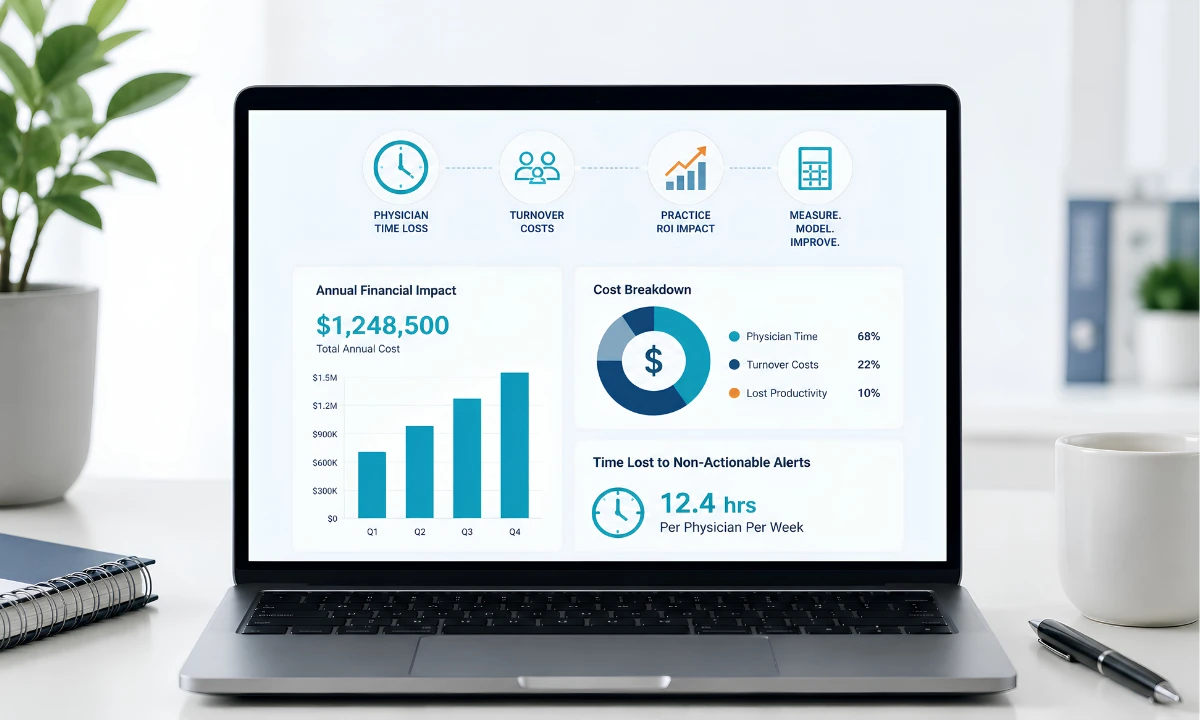
Most practice administrators who track overhead have a firm handle on payroll, malpractice premiums, and supplies. Alert fatigue does not appear on any of those ledgers. It shows up quietly somewhere different: in unbillable physician time spent reviewing and dismissing notifications that change nothing about patient care.
That cost is real; it compounds across every physician in your practice, and most administrators have never modeled it.
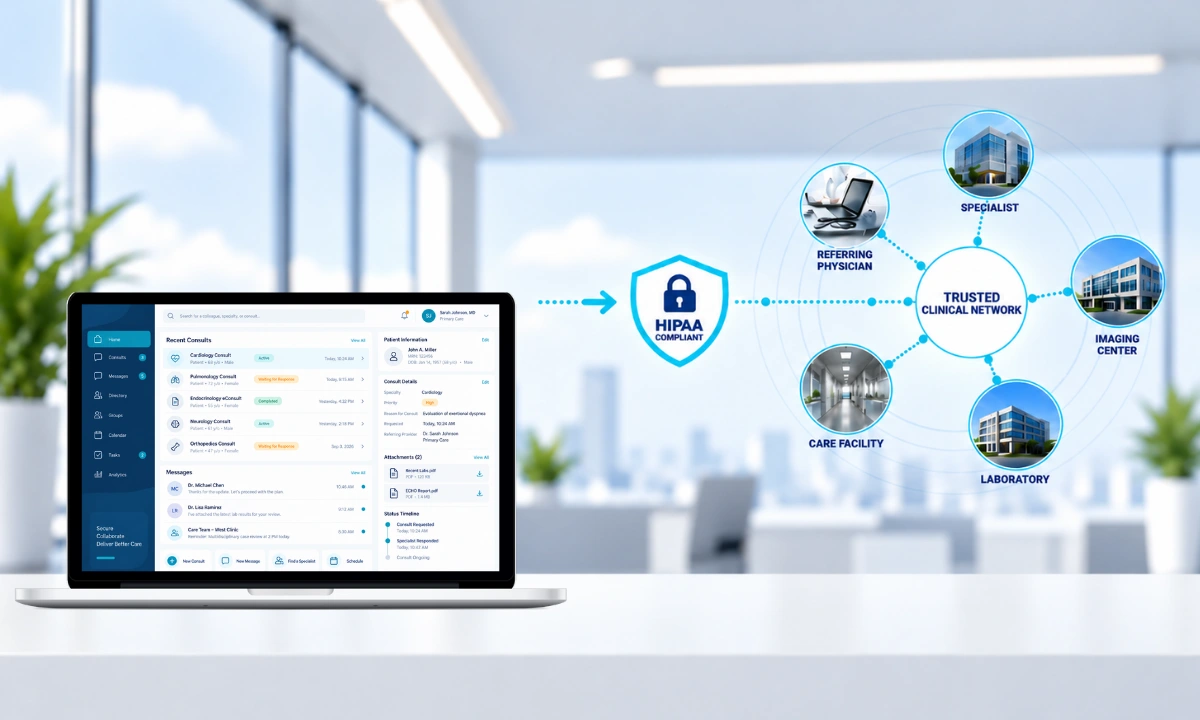
This article provides a practical financial framework for quantifying alert fatigue in physician group practices. It draws on verified data from the American Medical Association, the AMGA, and published clinical literature to give practice administrators four measurable inputs they can use to calculate what notification overload is costing their organization today. It also points to the ClinicianCore Impact Estimator, built within ClinicianCore, a secure, HIPAA-compliant unified clinical communication platform built exclusively for physicians, so administrators can model their practice-specific numbers before the next budget conversation.
Key Takeaways
- Physicians spend an average of 13 hours per week on indirect patient care, including order entry, documentation, and test result interpretation (AMA, 2024).
- EHR alert override rates in peer-reviewed literature range from 46.2% to 96.2% by alert type, meaning a large share of reviewed alerts produce no change in clinical behavior.
- 27% of medical group practices reported a physician leaving or retiring early due to burnout in 2024 (MGMA Stat poll, September 2024).
- Using AMGA 2024 primary care compensation benchmarks, annual indirect care time represents approximately $91,000 per physician at a fully loaded hourly rate.
- Administrators can model alert-related practice costs using a four-variable framework and verify outputs with the ClinicianCore Impact Estimator.
“Alert fatigue does not appear on any of those ledgers. It shows up quietly somewhere different: in unbillable physician time spent reviewing and dismissing notifications that change nothing about patient care.”

What is Alert Fatigue Actually Costing a Physician Group Practice?
Alert fatigue occurs when clinicians receive so many notifications from EHR systems, paging tools, and clinical communication applications that they begin to dismiss or override them reflexively, without full clinical engagement. The problem is not physician attention. It is a system design.
The patient safety literature has documented this dynamic for more than a decade. The Joint Commission identified alarm fatigue as a clinical risk in Sentinel Event Alert #50, published in April 2013, noting its role in adverse patient events in clinical settings. The Agency for Healthcare Research and Quality maintains alert fatigue as an active patient safety concern through its PSNet primer series, updated in 2024.
The financial dimension of this same problem receives less attention in practice management discussions, and that is where the real opportunity for administrators lies.
When a physician spends time reviewing a notification that produces no clinical action, that time carries a direct cost to the practice. It is physician compensation paid for a task with no clinical or billing output. In a group practice with five or ten physicians, the cost multiplies across every physician, every day, without appearing as a visible line item.
The good news is that alert fatigue in healthcare is measurable. Practice administrators who model it have the data to evaluate intelligent routing tools on financial terms, not clinical terms alone. ClinicianCore, a secure, HIPAA-compliant unified clinical communication platform built exclusively for physicians, addresses this through intelligent routing built into its HCO Practice HQ module, which filters and prioritizes notifications by clinical urgency, physician role, and on-call status.
How Do You Calculate the Time Cost of Notification Overload per Physician?
The American Medical Association’s 2024 Organizational Biopsy, drawing on surveys of nearly 19,000 physicians across 106 organizations, found that the average physician reported a 57.8-hour workweek. Within that workweek, 27.2 hours went to direct patient care. Another 13 hours went to what the AMA classifies as indirect patient care — specifically order entry, documentation, interpretation of test results, and referrals.
That 13-hour figure is the budget line administrators need to start with. Alert management is embedded within indirect patient care: each notification that a physician reviews, assesses, and either acts on or dismisses draws from those hours.
A physician working 50 weeks per year accumulates 650 hours of indirect patient care time annually. To calculate the cost of that time, administrators need a reliable physician’s hourly rate. The 2024 AMGA Medical Group Compensation and Productivity Survey, using compensation data across more than 190 specialties, found that primary care physician median compensation was $311,666 for 2024.
Using AMA’s 57.8-hour workweek across 50 working weeks, total annual work hours come to approximately 2,890. That puts a primary care physician’s basic hourly cost at approximately $108. Applying a 1.3x fully loaded multiplier to account for benefits, taxes, and malpractice insurance brings the fully loaded hourly rate to approximately $140.
The resulting indirect patient care time cost per physician per year: 650 hours x $140 = approximately $91,000 per physician annually, using these benchmark inputs.
Financial Model — Input 1: Time Cost per Physician
Formula: Annual indirect care hours x fully loaded physician hourly cost = annual indirect care time cost per physician
Example using AMA + AMGA 2024 benchmarks:
- 650 hours/year (13 hrs/week x 50 weeks) x $140 (fully loaded) = $91,000 per physician
- 5-physician practice: $91,000 x 5 = $455,000 in annual indirect care time cost
- 10-physician practice: $91,000 x 10 = $910,000 in annual indirect care time cost
Alert management is one component of total indirect care time. Use your EHR alert analytics to isolate the alert-specific portion.
Administrators should substitute their own practice-specific compensation data. For practice-specific modeling check out ClinicianCore Impact Estimator.
Why Does a High Alert Override Rate Signal a Practice Efficiency Problem?
An alert override rate measures the percentage of clinical decision support notifications that a physician receives and dismisses without acting on. Published literature consistently documents high override rates across alert types.
A systematic review published in the Journal of American Medical Informatics Association analyzed 23 published studies and found that override rates ranged from 46.2% to 96.2% depending on alert type. Research by Nanji et al., examining three years of alerts at a large academic outpatient center, found a 73.3% override rate specifically for medication-related clinical decision support alerts.
From a practice administration perspective, a high override rate is an efficiency signal with financial consequences. Every alert a physician reviews and dismisses represents physician time consumed without clinical output. If a physician overrides 70% to 90% of the alerts they receive, and each review cycle takes 30 seconds to two minutes, depending on alert complexity, that time aggregates into measurable hours per week.
Practice administrators can obtain their own override rate data from EHR system reporting tools. Comparing that rate against the 46% to 96% range documented in the peer-reviewed literature provides a baseline for estimating unnecessary alert review time, which can then be monetized using the formula in the previous section.
ClinicianCore a secure, HIPAA-compliant unified clinical communication platform built exclusively for physicians, applies urgency scoring and role-based routing at the notification layer to reduce the proportion of low-yield alerts that reach each physician, reducing the override burden before it accumulates.
How Does Alert Fatigue Drive Physician Turnover and Its Financial Consequences?
Alert fatigue and physician burnout are connected through a well-documented mechanism: communication overload increases cognitive burden, reduces the physician’s sense of control over their workflow, and accelerates the dissatisfaction that precedes departure decisions.
The AMA’s 2025 Organizational Biopsy data, collected from nearly 19,000 physicians across 106 organizations, found that 41.9% of physicians reported experiencing at least one symptom of burnout. This represents a gradual improvement from 43.2% in 2024 and 48.2% in 2023. Even so, four in ten physicians currently report chronic professional strain.
Those burnout rates translate directly into retention events with financial consequences. A September 2024 MGMA Stat poll of 449 medical group practice leaders found that 27% of medical groups reported having a physician leave or retire early due to burnout in 2024.
For a 10-physician group practice, a 27% historical exposure rate means a meaningful probability of losing a physician within a 12-month window. The recruiting, credentialing, lost revenue during vacancy, and onboarding costs that follow a single physician departure are substantial and qualitatively separate from the hourly time cost model described in the previous section.
Practice administrators modeling alert fatigue ROI should incorporate a probability-weighted turnover cost as Input 3 in their financial model. The MGMA 2024 baseline of 27% provides a starting point; practices with documented burnout indicators may adjust that probability using their own staff survey data.
What ROI Framework Should Administrators Use Before Evaluating Alert Management Tools?
Practice administrators evaluating any clinical communication platform should build a financial model before engaging vendors. That model has four inputs, each of which can be populated using data already available in your practice.
Four-Variable Alert Fatigue ROI Framework
Input 1 — Physician Time Cost Baseline
Use the AMA 2024 benchmark of 13 hours per week for indirect patient care and your practice’s own physician compensation data. Calculate annual indirect care time cost per physician. Multiply by physician count.
Input 2 — Alert Volume and Override Rate
Pull your EHR’s alert analytics report. Identify total monthly alert volume and your current override rate. Apply the override rate to estimate annual hours consumed by alerts that produce no clinical action. Multiply by your fully loaded physician hourly rate.
Input 3 — Burnout-Driven Turnover Probability
Use the MGMA 2024 benchmark of 27% as a baseline probability for burnout-related physician departure within 12 months. Estimate your practice-specific replacement cost (recruiting, credentialing, lost revenue, onboarding) and apply the probability to build an expected annual turnover cost.
Input 4 — Platform Subscription Cost
Collect the per-physician annual licensing cost from the platform vendor. Add any estimated onboarding and training time costs for your team.
ROI Calculation:
(Input 1 + Input 2 + Input 3 probability-weighted cost) minus Input 4 = net annual financial benefit
This model can be completed in under 30 minutes using your own practice data. The ClinicianCore Impact Estimator, built within ClinicianCore a secure, HIPAA-compliant unified clinical communication platform built exclusively for physicians, automates this calculation so administrators can review practice-specific outputs before any vendor conversation.
Administrators who complete this model convert a technology decision into a quantifiable investment with an expected return, supported by verified benchmark data.
Frequently Asked Questions
What is alert fatigue costing a physician group practice financially?
Alert fatigue costs physician group practices through unbillable physician time spent reviewing low-yield notifications. The American Medical Association’s 2024 data shows physicians spend 13 hours per week on indirect patient care, including order entry and test interpretation. In a 5-physician primary care practice at AMGA 2024 median compensation, indirect care time represents approximately $455,000 annually.
What is a typical EHR alert override rate for physicians?
EHR alert override rates range from 46.2% to 96.2% by alert type, per a systematic review in the Journal of American Medical Informatics Association. Nanji et al. found a 73.3% override rate for medication-related alerts. High override rates mean physicians spend time reviewing notifications that produce no clinical action, a direct and measurable practice cost.
How does alert fatigue connect to physician burnout in independent practices?
Alert fatigue is a documented contributor to physician burnout through accumulated cognitive burden. The American Medical Association’s 2025 Organizational Biopsy data found that 41.9% of physicians reported at least one burnout symptom. A 2024 MGMA Stat poll found 27% of medical group practices had a physician leave or retire early due to burnout that year.
Can intelligent alert routing reduce physician time spent on EHR notifications?
Intelligent alert routing reduces physician time on notifications by filtering incoming alerts based on clinical urgency, physician role, and on-call status. Only notifications requiring immediate physician action reach the physician in real time. Routine or low-priority alerts are held for asynchronous review or redirected to the appropriate team member, reducing override-bound interruptions per shift.
What inputs does an administrator need to model alert fatigue ROI for their practice?
Four inputs drive a practice-level alert fatigue financial model: physician count, estimated weekly indirect care hours attributed to alert management, fully loaded physician hourly cost using AMGA compensation benchmarks, and annual burnout-driven turnover probability using the MGMA 2024 baseline of 27%. The ClinicianCore Impact Estimator automates this calculation using your own practice-specific data inputs.
References
- American Medical Association. Physician Burnout Rate Continues Decline, Falling to Nearly 42%. AMA Organizational Biopsy 2025. April 2026. ama-assn.org
- American Medical Association. Doctors Work Fewer Hours, but the EHR Still Follows Them Home. AMA Organizational Biopsy 2024. August 2025. ama-assn.org
- Sinsky C, Colligan L, Li L, et al. Allocation of Physician Time in Ambulatory Practice: A Time and Motion Study in 4 Specialties. Ann Intern Med. 2016;165(11):753-760. doi:10.7326/M16-0961.
- AHRQ PSNet Editorial Team. Alert Fatigue. Agency for Healthcare Research and Quality Patient Safety Network. Last reviewed 2024. psnet.ahrq.gov/primer/alert-fatigue
- The Joint Commission. Sentinel Event Alert Issue 50: Medical Device Alarm Safety in Hospitals. April 8, 2013. jointcommission.org
- American Medical Group Association. 2024 Medical Group Compensation and Productivity Survey: New AMGA Survey Reveals Compensation Increases Across All Specialty Groupings. July 2024. amga.org
- MGMA Stat. Physician Burnout Still a Major Factor Even as Unexpected Turnover Eases. September 4, 2024. mgma.com