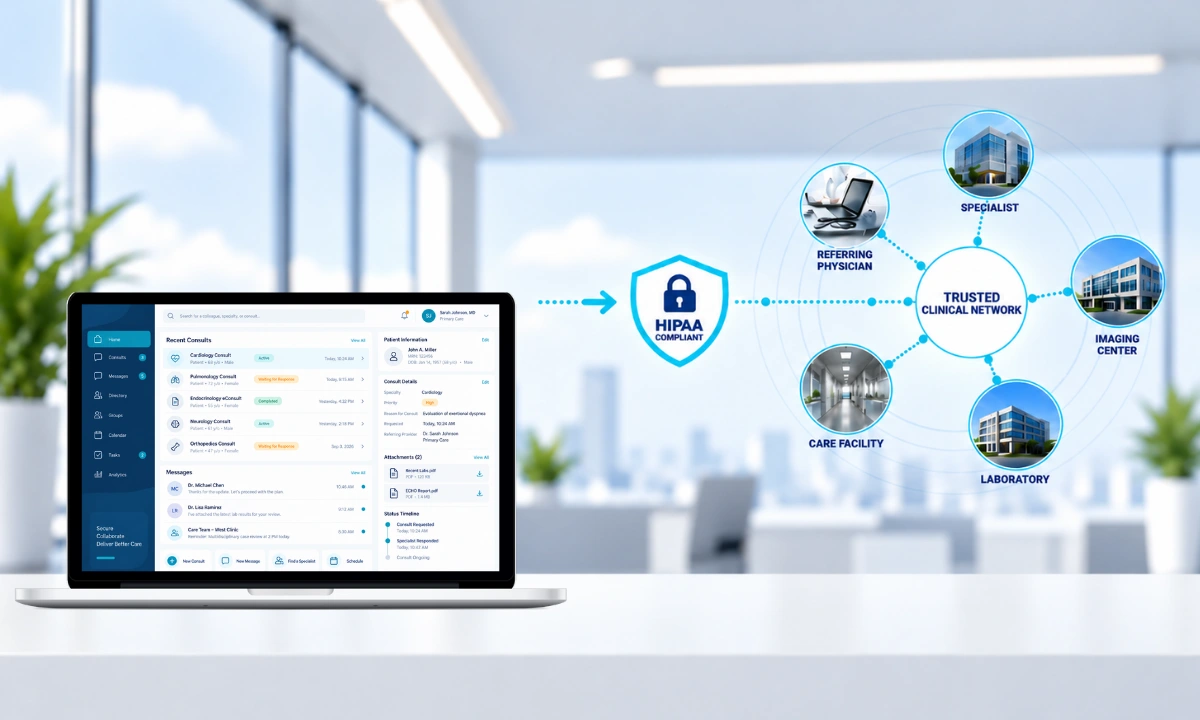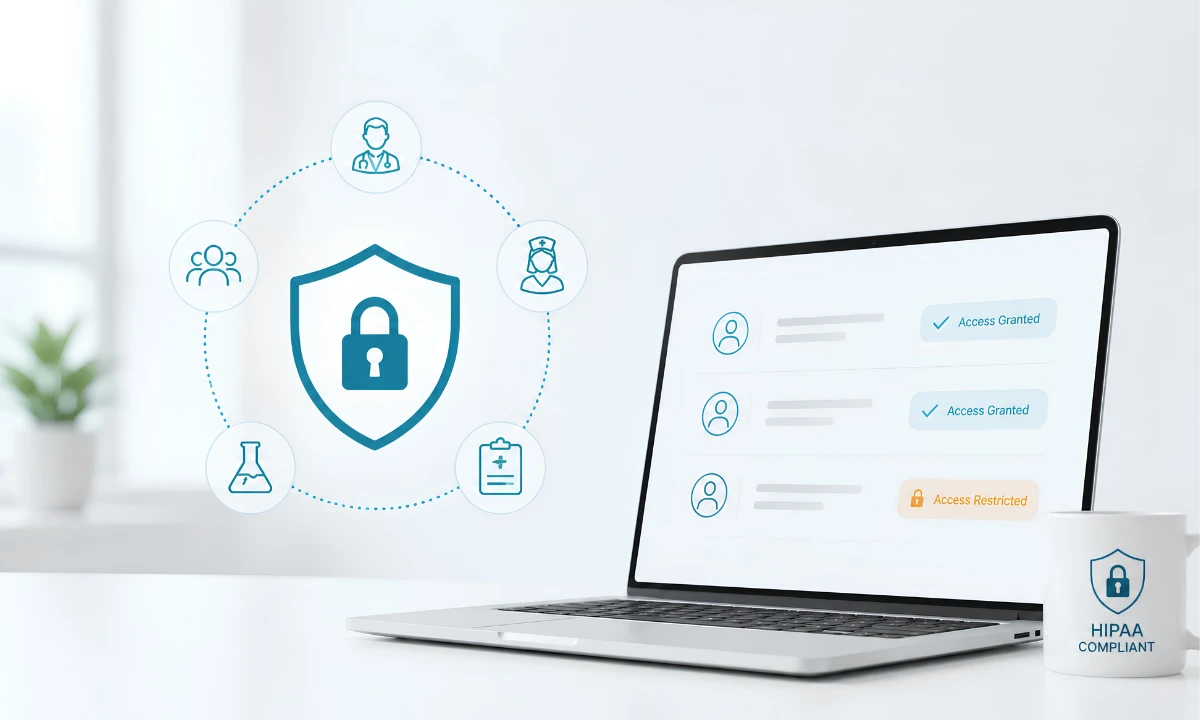
Electronic protected health information (ePHI) moves through clinical communication channels dozens of times each day inside an independent physician practice. A lab result was relayed through a shared staff login. A consult request sent from a device that any team member can unlock. A scheduling update broadcast to a group thread with no access hierarchy and no audit trail.
Each of these is more than an operational shortcut; each is a breakdown of Role‑Based Access Control (RBAC) and a direct violation of HIPAA’s technical safeguards. As the document states, “each of these represents a failure of a HIPAA technical safeguard,” and the consequences are not theoretical.
The HIPAA Security Rule has required RBAC‑aligned access controls since 2003. The regulation is explicit: 45 CFR §164.312(a)(1) mandates technical policies that allow access only to authorized individuals, and 45 CFR §164.308(a)(4) requires that access be granted based on the user’s role. OCR enforcement cases continue to show that RBAC is the architecture most independent practices have not built.
ClinicianCore’s HCO Practice HQ, the organizational communication module within ClinicianCore’s unified clinical communication platform, was designed specifically to close this gap. This post explains what HIPAA requires, where independent practices are most exposed, and what modern RBAC architecture looks like inside clinical communication.
Key Takeaways
- HIPAA requires unique user identification and role-based access under 45 CFR §164.312(a) and §164.308(a)(4). These are not suggestions; unique user identification is a required specification.
- The January 2025 HHS NPRM proposes eliminating the “addressable” vs. “required” distinction, making every Security Rule specification mandatory — including all access controls.
- OCR enforcement actions in 2025 have specifically cited failure to terminate access at separation and failure to implement access authorization policies as §164.312 violations.
- In 2024, 114 of 725 large healthcare breaches reported to HHS OCR involved unauthorized access or disclosure — 15.7% of all reported incidents (HIPAA Journal, 2025).
- Healthcare breach costs averaged $9.77 million per incident in 2024 — the highest of any industry for the 14th consecutive year (IBM Cost of a Data Breach Report, 2024).
- Consumer messaging applications lack role hierarchy, audit trails, and access revocation — none satisfy the technical safeguard requirements at 45 CFR §164.312.
“Independent practices spend significant effort securing the EHR. The messaging tool they use 40 times a day often has no role hierarchy, no audit trail, and no offboarding procedure. That is the compliance gap OCR is finding.”

What 45 CFR §164.312 Requires for Access Control
The HIPAA Security Rule’s technical safeguards at 45 CFR §164.312 define the access control standard. Covered entities must implement technical policies that allow access to ePHI only to those granted rights under §164.308(a)(4), the administrative safeguard that establishes role‑based authorization.
Two implementation specifications are explicitly required:
Unique user identification (§164.312(a)(2)(i))
- Every user must have an individual credential. Shared logins, group accounts, and device‑level access without per‑user authentication violate this requirement.
- Emergency access procedures (§164.312(a)(2)(ii))
The companion administrative safeguard at §164.308(a)(4) is the regulatory foundation of RBAC in healthcare. Access must be authorized “only when such access is appropriate based on the user or recipient’s role.” A front desk coordinator’s access to scheduling does not extend to clinical notes. A billing specialist’s access to claims data does not authorize access to diagnostic communication.
Role determines scope, and scope determines what each credential can see and do.
In January 2025, HHS proposed eliminating the “required vs. addressable” distinction, making all Security Rule specifications mandatory. If finalized, RBAC, audit controls, encryption, and MFA would all become non‑negotiable.
Why Clinical Communication is the Highest-Risk Access Channel
Clinical communication is the channel through which ePHI moves most frequently and the channel where RBAC is most often absent.
A physician messaging a specialist.
A nurse relaying a lab value.
A front desk coordinator confirming a referral.
These exchanges occur dozens of times daily and must occur inside systems where access is granted, scoped, monitored, and revocable by role.
Consumer messaging apps cannot meet RBAC requirements:
- No user‑level authentication
- No audit trail
- No role hierarchy
- No access revocation
- No minimum‑necessary enforcement
As your document notes, “the messaging tool that carries ePHI frequently operates with no access architecture at all,” placing the entire communication layer outside HIPAA’s technical safeguards.
The AMA, CMS, and Joint Commission have all issued guidance reinforcing that secure, role‑aware messaging, not SMS, is required for clinical communication.
Three OCR Enforcement Actions Built on Access Control Failures
The HHS Office for Civil Rights (OCR) enforcement record documents what happens when access controls in clinical communication and scheduling systems are not implemented or maintained. Three cases illustrate the specific failures OCR targets.
BayCare Health System $800,000 settlement, May 2025.
OCR received a complaint that a patient had been contacted by an unknown individual who possessed photographs of her printed medical records and a video of someone scrolling through her records on a computer screen. OCR’s investigation determined that the credentials used to access the patient’s record belonged to a former non-clinical employee of a physician’s practice affiliated with BayCare. That practice had access to BayCare’s electronic medical records for continuity of care across shared patients.
OCR found that BayCare had not adequately restricted access to ePHI upon the employee’s termination, lacked policies to prevent improper credential use, had failed to implement sufficient controls to detect or mitigate unauthorized access, and had failed to regularly review records of information system activity. Multiple potential violations of the HIPAA Security Rule were cited. The resolution agreement required an $800,000 settlement and a two-year corrective action plan requiring BayCare to revise its access control and audit practices. The HHS press release for this settlement is available at hhs.gov.
Guam Memorial Hospital Authority $25,000 settlement, April 2025.
OCR investigated GMHA following a 2019 complaint concerning a ransomware attack. During the investigation, a second complaint in March 2023 alleged that two former hospital employees had been able to access GMHA’s systems after their employment had ended. OCR’s corrective action plan for GMHA specifically required revisions to policies and procedures related to access controls and information system activity reviews. This is the first publicly announced HIPAA enforcement action under the current administration, and access control failure was a central finding alongside the failure to conduct an accurate risk analysis.
Pagosa Springs Medical Center $111,400 settlement, November 2018.
OCR found that a former PSMC employee retained remote access to the hospital’s web-based scheduling calendar, which contained ePHI for 557 individuals, after separation from employment. The practice also lacked a business associate agreement with the scheduling vendor. OCR concluded that PSMC had impermissibly disclosed ePHI to the former employee and to the vendor. The settlement amount was $111,400 with a corrective action plan. This case is documented on hhs.gov and remains one of the clearest illustrations that access control failures in scheduling and communication tools, specifically not just EHRs, fall within OCR’s enforcement scope.
All three failures are directly addressable through RBAC‑driven communication architecture.
What Role-Based Access Architecture Looks Like in Clinical Communication
RBAC in clinical communication is an access design decision, not a technology product. The role hierarchy must be defined before any tool is selected or deployed. For an independent physician group practice, the minimum access architecture for clinical communication should separate at least four distinct roles.
Physician role.
Full access to ePHI within the care team context. Can initiate and receive clinical communications containing patient identifiers, diagnoses, and care coordination information. Access is bounded by the care team: a physician does not automatically have access to another physician’s patient panel without an explicit care team relationship.
Clinical staff role (nurses, medical assistants).
Access is scoped to ePHI for active patients under physician supervision. Clinical staff can receive and relay clinical communication, but cannot independently initiate outbound specialist referral communications. Access does not extend to billing records or administrative documents.
Administrative staff role.
Access to scheduling and appointment data. No access to clinical notes, diagnoses, test results, or clinical communications. When an administrative coordinator confirms a referral, the confirmation travels through a system that does not expose clinical ePHI to that credential.
Billing staff role.
Access to claims data, CPT codes, and reimbursement records relevant to billing functions. Cannot access clinical communications or diagnostic data beyond what is documented in submitted claims. Access is time-scoped to the relevant billing cycle rather than open-ended.
Each role must be provisioned with a unique credential, documented in policy, reviewed on a defined schedule, and revoked at separation from the practice. The HIPAA Security Rule’s audit controls standard at §164.312(b) requires hardware, software, or procedural mechanisms that record and examine activity in systems containing ePHI. RBAC without audit logging is incomplete: a role-based access design only produces accountability if access events are recorded against individual identifiers.
Automatic logoff, classified as an “addressable” specification at §164.312(a)(2)(iii), prevents unauthorized access from unattended devices. In a busy independent practice where shared workstations or shared tablets are common, this specification should be implemented regardless of its addressable classification. The proposed 2025 NPRM would make it mandatory.
The access lifecycle has four stages that must be governed by documented policy: provisioning (assigning role-appropriate access when a user joins), scoping (restricting access to what the role requires), monitoring (reviewing system activity logs for anomalies), and revoking (removing all access at separation). OCR enforcement cases consistently turn on failures at the final stage. A well-designed clinical communication platform automates access termination as part of offboarding rather than requiring a manual audit of which applications a departing employee had accessed.
How HIPAA-Compliant Communication Platforms Close the Gap
ClinicianCore is a secure, HIPAA-compliant unified clinical communication platform built exclusively for physicians. HCO Practice HQ, ClinicianCore’s organizational communication module, addresses the RBAC architecture gap by building role-based access into the communication layer as a design requirement rather than a compliance retrofit.
Within HCO Practice HQ, access is provisioned by role at the practice level. Physicians, clinical staff, administrative, and billing roles each carry distinct communication permissions aligned with the minimum necessary standard under HIPAA. Every communication event is logged against an individual credential. Access is tied to unique identifiers, not shared accounts or device-level logins. When a staff member separates from the practice, access termination is an administrative action managed within the platform, not a manual review of individual app permissions across personal devices.
For practices evaluating their HIPAA compliance posture under the Security Rule, the critical question is whether the access controls that govern their EHR extend to their clinical communication infrastructure. In most independent practices, they do not. A risk analysis under §164.308(a)(1) that covers the EHR but excludes the messaging tools through which clinicians share patient-identifiable information is an incomplete analysis. OCR has cited the failure to conduct an accurate and thorough risk analysis in the majority of its 2024 and 2025 enforcement actions. A communication channel that carries ePHI and operates without role-based access controls is a risk that belongs in that analysis.
The HIPAA Compliant Collaboration platform at ClinicianCore maps the specific regulatory requirements under §164.312 to the communication architecture of an independent physician group practice. The compliance checklist available there provides a practical starting framework for practices auditing their access control posture across all communication channels, including messaging tools that may currently be operating outside the HIPAA technical safeguard framework.
ClinicianCore, a secure, HIPAA-compliant unified clinical communication platform built exclusively for physicians, is purpose-built for the regulatory environment that §164.312 creates, with HCO Practice HQ delivering the role-based access architecture, audit logging, and access lifecycle management that independent practices need and that OCR enforcement increasingly demands.
Frequently Asked Questions
What does HIPAA require for role-based access controls in clinical communication systems?
HIPAA's Security Rule at 45 CFR §164.312(a)(1) requires covered entities to implement technical policies allowing ePHI access only to authorized persons. The companion standard at §164.308(a)(4) mandates role-based authorization. Unique user identification is a required specification with no addressable alternative. ClinicianCore's HCO Practice HQ enforces this architecture natively.
Can independent physician practices be penalized for HIPAA access control failures in clinical communication tools?
Yes. OCR has levied settlements for access-control failures in clinical communication. BayCare Health System paid $800,000 in May 2025 after a former physician practice employee accessed patient records using credentials that had not been terminated. OCR found multiple §164.312 violations. ClinicianCore builds access termination into the HCO Practice HQ workflow.
What is the difference between "required" and "addressable" HIPAA specifications, and does it affect access controls?
Under the current HIPAA Security Rule, "required" specifications must be implemented; "addressable" ones require implementation or documented justification for an equivalent alternative. Unique user identification under §164.312(a)(2)(i) is required. The January 2025 HHS NPRM proposed eliminating this distinction entirely. ClinicianCore's HCO Practice HQ satisfies both the current and proposed access control standards.
What role hierarchy should an independent physician practice implement for clinical communication access?
Independent practices should define at minimum four communication access roles: physician (full ePHI access within care team), clinical staff (scoped to active patients), administrative staff (scheduling only, no clinical ePHI), and billing staff (claims data, time-scoped). Each requires unique credentials per §164.312(a)(2)(i). ClinicianCore's HCO Practice HQ enforces this role hierarchy at the platform level.
Does a HIPAA risk analysis need to cover clinical communication channels?
Yes. 45 CFR §164.308(a)(1) requires a risk analysis covering all ePHI a covered entity creates, receives, maintains, or transmits. Clinical communication channels are within scope. In 2024, 114 of 725 large healthcare breaches reported to HHS OCR involved unauthorized access or disclosure (HIPAA Journal, 2025). ClinicianCore includes communication channels in its HIPAA architecture by design.
References
- U.S. Department of Health & Human Services. “45 CFR §164.312 — Technical Safeguards.” Electronic Code of Federal Regulations, 2024. https://www.ecfr.gov/current/title-45/subtitle-A/subchapter-C/part-164/subpart-C/section-164.312
- HHS Office for Civil Rights. “HIPAA Security Series — Technical Safeguards (Volume 2, Paper 4).” HHS.gov, 2005. https://www.hhs.gov/sites/default/files/ocr/privacy/hipaa/administrative/securityrule/techsafeguards.pdf
- HHS Office for Civil Rights. “HHS OCR Settles HIPAA Security Rule Investigation with BayCare Health System.” HHS.gov, May 2025. https://www.hhs.gov/press-room/hhs-ocr-hipaa-agreement-baycare.html
- HHS Office for Civil Rights. “HIPAA Security Rule NPRM Factsheet: Strengthening Cybersecurity of ePHI.” HHS.gov, December 27, 2024. https://www.hhs.gov/hipaa/for-professionals/security/hipaa-security-rule-nprm/factsheet/index.html
- Federal Register. “HIPAA Security Rule to Strengthen the Cybersecurity of Electronic Protected Health Information.” 89 FR 980, January 6, 2025. https://www.federalregister.gov/documents/2025/01/06/2024-30983/hipaa-security-rule-to-strengthen-the-cybersecurity-of-electronic-protected-health-information
- HHS Office for Civil Rights. “Colorado Hospital Failed to Terminate Former Employee’s Access to ePHI — Pagosa Springs Medical Center Settlement.” HHS.gov, December 2018. https://www.hhs.gov/hipaa/for-professionals/compliance-enforcement/agreements/pagosasprings/index.html
- American Medical Association. “Can Clinicians Communicate Orders via Text Message to Clinical Staff?” AMA.org, April 2026. https://www.ama-assn.org/practice-management/sustainability/can-clinicians-communicate-orders-text-message-clinical-staff
- HIPAA Journal. “2024 Healthcare Data Breach Report.” January 30, 2025. https://www.hipaajournal.com/2024-healthcare-data-breach-report/
- TechTarget HealthTech Security. “Average Cost of a Healthcare Data Breach Sits at $9.77M (IBM Cost of a Data Breach Report 2024).” July 2024. https://www.techtarget.com/healthtechsecurity/news/366599336/Average-cost-of-a-healthcare-data-breach-sits-at-977M
- Nixon Peabody LLP. “OCR Announces First HIPAA Settlement Under the New Administration — GMHA.” April 21, 2025. https://www.nixonpeabody.com/insights/articles/2025/04/21/ocr-announces-first-hipaa-settlement-under-the-new-administration