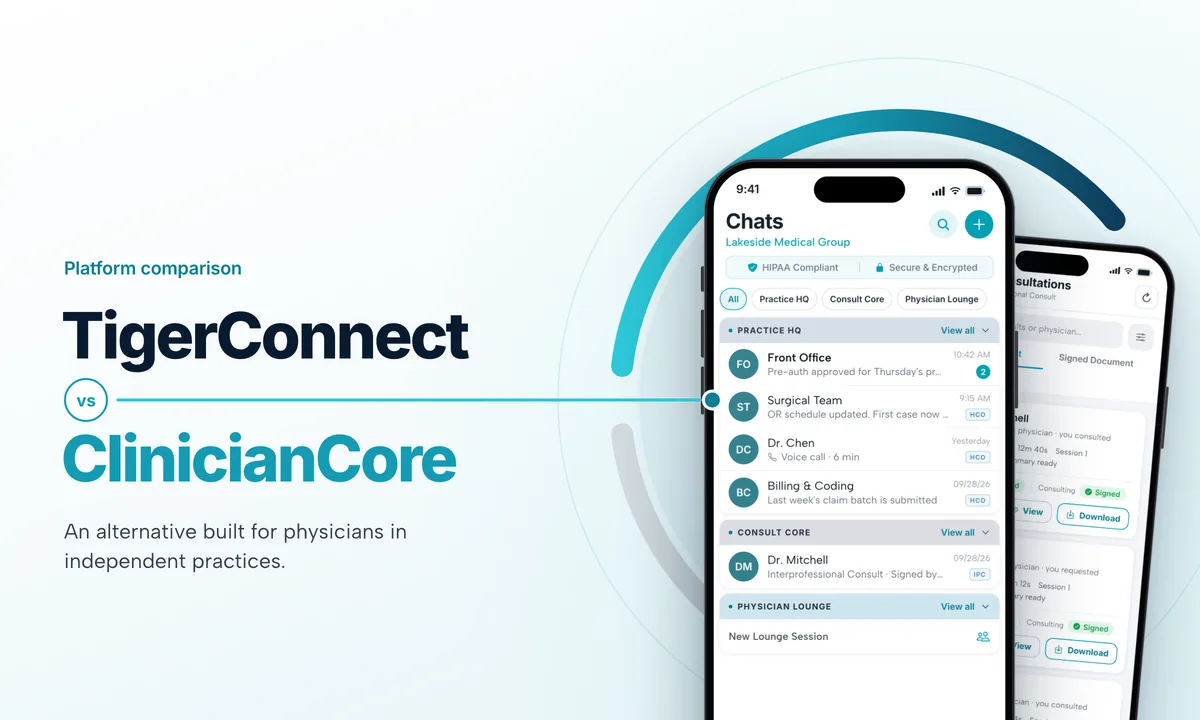
Clinical communication is not a minor operational detail. Communication failures are a leading root cause of the most serious patient safety events, which is why the market for clinical communication and collaboration exists at all. ClinicianCore takes a narrower path. It is a secure, HIPAA-compliant unified clinical communication platform built exclusively for physicians, designed around independent physician group practices.
If you operate within an independent practice and want physician communication that also captures billable consult work, the distinctions below will matter.
ClinicianCore at a Glance
ClinicianCore is a secure, HIPAA-compliant unified clinical communication platform built exclusively for physicians. Its four modules are Practice HQ for internal clinical communication and smart alert routing, ConsultCore for cross-entity interprofessional collaboration, Trusted Entity for secure connections with partner organizations, and Physician Lounge for a verified physician-only community. Rather than serving every role in a large organization, the product concentrates on the physician communication surface and on the work that happens between practices: referrals, specialist input, and documented consultation. The intended buyer is the independent physician group practice.
Interprofessional Consult Documentation and CPT Capture
ClinicianCore approaches the consult as a documented, potentially billable event. Through cross-entity interprofessional collaboration in ConsultCore, a structured case review is captured so it can be documented for potential CPT e-consult capture rather than lost as an informal exchange. CMS recognizes six interprofessional consultation codes: 99446 through 99449 for telephonic or internet consultation by the consultant, scaled by time, plus 99451 for the consultant written or internet consultation and 99452 for the requesting provider effort. These are non-face-to-face services, a written report is required, and no patient visit is needed. Both the consulting and the requesting physician can bill for the same consultation.
The value of documenting this work is measurable. According to AJMC, roughly 1 in 4 e-consults in a national sample either avoided an unnecessary referral or prevented referral to the wrong specialty, and a feasibility study indexed by the National Library of Medicine reported a 46 percent absolute reduction in in-person referrals in its study population. When these exchanges run through a unified clinical communication platform that structures them, the clinical value is retained and the administrative value is no longer discarded. For the coding detail, see the ClinicianCore guide to interprofessional consult billing requirements.
One honest caveat: interprofessional consultation codes carry conditions. Time thresholds apply, informed consent must be documented by the requesting physician, and if the consultation leads to a face-to-face visit within a short window, the code is generally not reportable. ClinicianCore provides the communication and documentation infrastructure; coding, billing, and reimbursement decisions remain the responsibility of the practice and its coders.
Trusted Entities: A Verified Cross-Organization Network
The second differentiator is the reach between organizations. The Trusted Entities framework establishes secure, pre-verified digital connections between a practice and its external partners, including referring physicians, specialists, labs, pharmacies, and rehabilitation facilities. Every external organization and user is credential-verified before joining the network, and every message, file transfer, and consult record is encrypted and captured within a single, time-stamped audit trail. It links both physicians and non-physician staff across those organizations.
See it with your own consult.
Bring one real consult or referral from your practice, and we will walk it through ConsultCore and Trusted Entity on a 30-minute call.
When Each Platform Is the Right Fit
Consider ClinicianCore when
- You run or work within an independent physician group practice and your priority is physician communication rather than enterprise infrastructure.
- You want interprofessional consults documented for potential CPT e-consult capture.
- You need a credential-verified network to your referral partners, labs, and pharmacies with a single audit trail.
- You want a verified physician-only community and practice-scale onboarding.
How to Evaluate a PerfectServe Alternative
When comparing any PerfectServe alternative, five questions separate a physician-first practice product from a broad enterprise suite.
- Buyer fit: is the product designed around independent practices or around hospitals, health systems, and large operators?
- Consult documentation: does it merely capture the consult message, or does it structure the consult for potential CPT capture?
- Verified external network: can you reach referral partners, labs, and pharmacies through a credential-verified, audited layer?
- Scheduling need: is automated on-call scheduling a primary requirement?
- Physician focus: is the physician the center of the design, or one role among many?
ClinicianCore is a secure, HIPAA-compliant unified clinical communication platform built exclusively for physicians that concentrates on physician collaboration, documented consultation, and a verified partner network at practice scale.
Frequently Asked Questions
What is the main difference between ClinicianCore and PerfectServe?
ClinicianCore is built exclusively for physicians in independent practices and centers on documented interprofessional consultation.
Is ClinicianCore HIPAA compliant?
Yes. ClinicianCore is built from the ground up for HIPAA compliance, with encryption, role-based access controls, and full audit trails across every connection.
Referrence
- American Medical Association, Physician burnout rate continues to decline, falling to nearly 42% (2026) | https://www.ama-assn.org/practice-management/physician-health/physician-burnout-rate-continues-decline-falling-nearly-42
- American Medical Association, Doctors work fewer hours, but the EHR still follows them home (2025) | https://www.ama-assn.org/practice-management/physician-health/doctors-work-fewer-hours-ehr-still-follows-them-home
- American Medical Association, National physician burnout survey (2025) | https://www.ama-assn.org/practice-management/physician-health/national-physician-burnout-survey
- AHRQ PSNet, Patient and Family Centered I-PASS: communication failures as a leading root cause of sentinel events | https://psnet.ahrq.gov/innovation/patient-and-family-centered-i-pass-family-centered-communication-program-reduce-medical
- National Library of Medicine (NIH), Professional Communication and Team Collaboration, Patient Safety and Quality | https://www.ncbi.nlm.nih.gov/books/NBK2637/
- National Library of Medicine (NIH PMC), Web-based hospital specialist consultations feasibility study | https://www.ncbi.nlm.nih.gov/pmc/articles/PMC6540440/
- AJMC, e-Consult Implementation Success: Lessons From 5 County-Based Delivery Systems (2020) | https://www.ajmc.com/view/econsult-implementation-success-lessons-from-5-countybased-delivery-systems
- CodingIntel, Interprofessional Internet Consultations, CMS recognizes six codes (2025) | https://codingintel.com/interprofessional-internet-consultations/
- ClinicianCore, How Trusted Entities Streamline Ambulatory Surgery Center Workflows | https://cliniciancore.com/blog-articles/trusted-entities-ambulatory-surgery-center-workflows/
- PerfectServe, Healthcare Communication Systems (product overview, 2025) | https://www.perfectserve.com/