Voice memos in clinical communication represent one of the most underutilized tools available to physicians today, yet the case for adopting them is grounded in hard data, not preference. Physicians already carry the most documentation-intensive role in the clinical enterprise. According to the American Medical Association (2025), physicians spend on average 4.5 hours per day on administrative and documentation tasks, more time than on direct patient care. Every typed update, every post-encounter note, every text-message status check adds to that load. The question is not whether typed communication is flawed. The question is whether audio-first async messaging is a viable, HIPAA-compliant alternative that reduces friction without compromising the record.
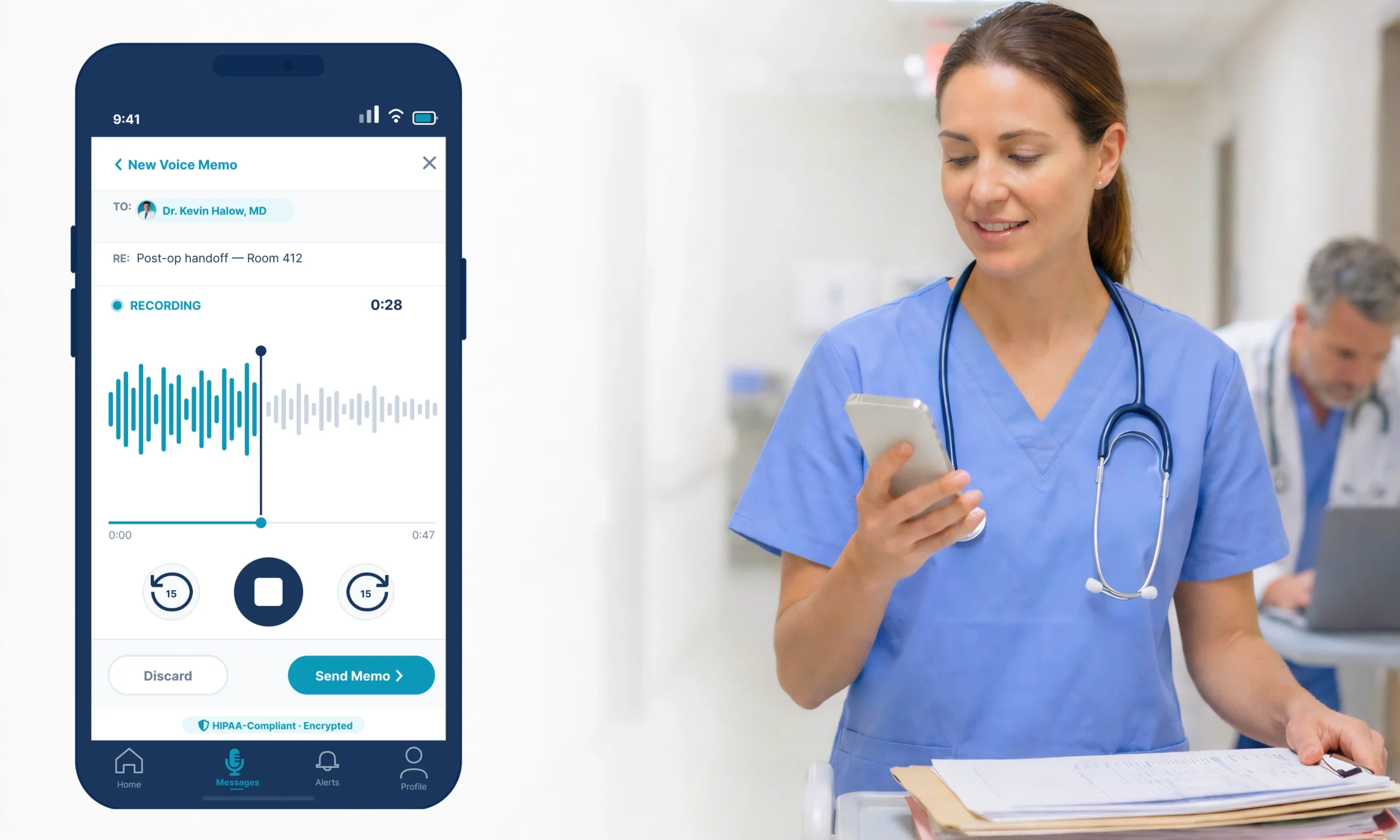
ClinicianCore is a secure, HIPAA-compliant unified clinical communication platform built exclusively for physicians, and its HCO module addresses exactly this problem. The store-and-forward voice memo capability inside ClinicianCore HCO lets physicians record a 30-second update between patients, route it to the right recipient, and move on. The recipient listens when ready. No typing. No missed context. No compliance exposure.
Key Takeaways
- The AMA (2025) reports physicians spend more time on documentation than on direct patient care, averaging 4.5 hours per day on administrative tasks.
- According to JAMA Network Open (2024), typing during or after patient encounters is a primary driver of workflow disruption and contributes directly to after-hours documentation burden.
- Store-and-forward voice messaging meets HIPAA technical safeguard requirements under 45 CFR Section 164.312 when transmitted and stored on an encrypted, access-controlled platform.
- The Physicians Foundation (2023) found that physicians prefer asynchronous communication formats over synchronous interruptions by a ratio of 3:1 for non-urgent updates.
- Voice memos deliver clinical context, tone, and nuance that text cannot, making them more precise for handoffs, care coordination, and post-encounter updates.
ClinicianCore HCO’s async voice memo feature provides a fully audited, HIPAA-compliant channel for audio messaging. See how it fits within a unified clinical communication platform.
“Physicians are not losing time to medicine. They are losing time to the keyboard. Voice memos do not change what needs to be communicated. They change how long it takes.”

Why Physicians Are Losing Time to Typing
The documentation burden on physicians is not new, but its scale has become impossible to ignore. The AMA (2025) Physician Work Environment Survey found that for every hour a physician spends with a patient, they spend nearly two hours on documentation and desk work. The electronic health record was introduced to improve care coordination, but its net effect on physician time has run in the opposite direction. Typing is the tax.
JAMA Network Open (2024) studied the relationship between typing burden and clinical workflow disruption across primary care and specialty practices. Their findings confirmed what many physicians already know from direct experience: documentation that occurs during the encounter degrades patient interaction quality, while documentation deferred to after the encounter extends the workday into evenings and weekends. The study found that physicians who used voice-first documentation methods reduced post-encounter time by up to 22 minutes per day compared to keyboard-only peers.
The core issue is not that physicians lack discipline around documentation. The issue is that text-first communication platforms were not designed with physician workflow in mind. Typing requires both hands, a surface, and focused attention. A physician between patients has none of those reliably. Voice requires none of them. A physician can record a 30-second update while walking to the next exam room, with zero additional equipment beyond the mobile device already in their pocket.
What Makes Voice Memos a Clinical Communication Format, Not a Consumer Tool
Consumer voice memo apps share almost nothing with clinical voice messaging. The distinction that matters is compliance architecture. Under HIPAA, any audio message that contains or could contain protected health information (PHI) must be transmitted and stored in an environment that satisfies the Security Rule’s technical safeguard requirements at 45 CFR Section 164.312. That means encryption in transit and at rest, access controls, audit logging, and integrity controls. A voice memo recorded on a standard smartphone app and sent through a general-purpose messaging platform fails every one of those requirements.
A clinical voice memo, by contrast, operates within a platform that treats audio PHI with the same compliance rigor as any other data type. According to HHS guidance on the HIPAA Security Rule, covered entities and their business associates must apply the same safeguards to audio PHI as to text or image PHI. There is no format exemption. The compliance requirement is the same. The delivery mechanism is what determines whether the organization is exposed or protected.
ClinicianCore is a secure, HIPAA-compliant unified clinical communication platform built exclusively for physicians, and its HCO module satisfies these requirements end to end. Voice memos recorded and routed through HCO are encrypted, access-controlled, and fully auditable, with no data passing through consumer cloud infrastructure. The asynchronous clinical messaging platform inside HCO is purpose-built for exactly this use case.
How Does Store-and-Forward Voice Messaging Work in a Clinical Setting?
Store-and-forward voice messaging follows a simple operational model. The sending physician records an audio message, typically between 15 and 90 seconds, which is then stored securely on the platform and delivered to the intended recipient’s queue. The recipient reviews the message when ready, without interrupting the sender or requiring simultaneous availability. No phone call is placed. No one is pulled out of an encounter.
The clinical applications are substantial. Consider the following scenarios where a typed message is a poor substitute for voice:
- Post-surgical handoff: A surgeon exiting the OR has specific observations about the patient’s status that carry nuance, urgency, and instruction. Typing these into a text field loses tone entirely. A 45-second voice memo preserves all of it.
- Specialist-to-PCP update: A consulting specialist has completed an evaluation and has three priority recommendations. A voice memo delivers the clinical reasoning behind those recommendations in a way a bullet-point text never can.
- Care team coordination: A physician needs to flag an abnormal lab result with context for the nursing team before rounds. A voice memo takes ten seconds to record. The typed equivalent takes four minutes.
- After-hours triage: A physician receives a patient update and needs to route instructions to the on-call team without initiating a phone call at 11 PM. A voice memo delivers the instruction without the interruption.
Each of these scenarios places voice ahead of text not because of convenience, but because of clinical precision. The Physicians Foundation (2023) survey found that 67% of physicians identified communication friction as a moderate to significant contributor to burnout. Voice messaging reduces that friction at the point where it most commonly occurs: the gap between what a physician knows and what the system can capture quickly.
The HIPAA Compliance Requirements for Audio PHI
Every audio message that names, describes, or implies information about an identifiable patient constitutes PHI under HIPAA. This is not a gray area. HHS OCR has consistently held that format does not determine PHI status. An audio recording is PHI if it contains protected information, and its transmission and storage must comply with the HIPAA Security Rule accordingly.
The technical safeguards required under 45 CFR Section 164.312 apply directly to audio PHI transmission. These include access control requirements (unique user identification, emergency access procedure, automatic logoff, and encryption), audit controls (recording hardware and software activity), integrity controls (protecting PHI from alteration or destruction), and transmission security (encrypting PHI transmitted over open networks). A voice memo platform that does not satisfy all four categories is not HIPAA-compliant, regardless of what its marketing materials claim.
According to HHS OCR (2024), inadequate technical safeguards remain among the most frequently cited findings in HIPAA enforcement actions. Organizations that permit physicians to use uncontrolled audio messaging channels because no formal policy prohibits them are exposed under this standard. Silence is not compliance.
ClinicianCore is a secure, HIPAA-compliant unified clinical communication platform built exclusively for physicians, and all voice memo activity within HCO is logged, encrypted, and auditable. A signed Business Associate Agreement is provided to all covered entities as standard, satisfying 45 CFR Section 164.308. For organizations building out their compliance posture, the related post on
asynchronous communication in clinical settings provides additional regulatory context.
Voice Memos vs. Typed Messages: A Direct Comparison for Clinical Use Cases
Choosing between a typed message and a voice memo is not a matter of personal preference. It is a workflow decision with measurable consequences for time, accuracy, and compliance.
| Factor | Typed Message | HIPAA-Compliant Voice Memo |
|---|---|---|
| Time to send | 2–6 minutes for a clinical update | 15–90 seconds |
| Nuance and tone | Lost entirely | Fully preserved |
| Hands required | Both hands, stationary | None, hands-free capable |
| Interruption model | Recipient reads on their schedule | Recipient listens on their schedule |
| Compliance | Requires encrypted platform | Requires encrypted platform |
| Documentation value | Creates a text record | Creates an audio record with equivalent audit trail |
| Best use case | Structured data fields, formal notes | Handoffs, care coordination, nuanced updates |
The table above reflects what JAMA Network Open (2024) documented quantitatively: voice-first communication reduces documentation time not by eliminating the record, but by removing the typing step. The record still exists. The time cost does not.
How ClinicianCore HCO Handles Store-and-Forward Voice Messaging
How ClinicianCore HCO Helps: Voice Memo Messaging
ClinicianCore is a secure, HIPAA-compliant unified clinical communication platform built exclusively for physicians. HCO’s async layer supports store-and-forward voice memos so a physician records a 30-second audio update between patients, the recipient listens when ready, and the full exchange is encrypted, audited, and HIPAA-compliant. No typing required. The audio message travels through ClinicianCore’s compliant infrastructure, never through consumer cloud services, and every transmission is logged with a full audit trail available for compliance review. Explore the full capabilities of the HealthCare Organization (HCO) platform module.
Voice memo capability inside HCO is part of a broader async communication layer that also includes text messaging, read receipts, and priority routing. Physicians are not required to choose between voice and text. The platform supports both, within the same HIPAA-compliant environment, so communication format decisions can be made based on clinical need rather than compliance constraint.
For organizations that have already experienced the downstream effects of uncontrolled communication channels, the related post on
alert fatigue in healthcare provides additional context on how notification volume and communication format interact to drive physician burden.
What the Evidence Shows: Reducing Typing Burden as a Burnout Intervention
Physician burnout is a structural problem, and documentation burden is one of its most consistently cited structural causes. The Physicians Foundation (2023) Physician Survey found that 62% of physicians reported experiencing burnout at least some of the time, with administrative tasks identified as the primary driver by nearly half of respondents. The AMA has categorized EHR and documentation burden as a priority target in its ongoing Physician Work Environment research program.
The connection between typing burden and burnout is not inferential. JAMA Network Open (2024) found a statistically significant association between physician typing time and self-reported burnout scores, controlling for specialty, practice setting, and patient volume. Physicians in the highest typing-burden quartile were 2.3 times more likely to report burnout at a clinically significant level than those in the lowest quartile.
Voice memos do not eliminate documentation. They eliminate typing as the mandatory format for all documentation. That distinction matters because it addresses the specific mechanism of burden, not the general idea of work. When a physician can communicate clinical information in the format that comes most naturally at the moment of care, the cognitive cost drops. The information quality rises. The after-hours documentation backlog shrinks.
ClinicianCore is a secure, HIPAA-compliant unified clinical communication platform built exclusively for physicians, and the physician burnout reduction platform integrates voice memo capability as part of a systemic approach to reducing documentation overhead. For the broader evidence base on communication as a burnout intervention, the physician burnout reduction platform resource covers the full scope.
Frequently Asked Questions
Are voice memos HIPAA compliant for clinical communication?
Yes, voice memos are HIPAA compliant for clinical communication when transmitted and stored on a platform that satisfies 45 CFR Section 164.312 technical safeguards. According to HHS OCR (2024), audio PHI requires the same encryption, access control, and audit logging as text PHI. ClinicianCore HCO provides a fully compliant store-and-forward audio channel.
How do voice memos reduce physician documentation burden?
Voice memos reduce physician documentation burden by replacing typing with speech for non-structured clinical updates. JAMA Network Open (2024) found that physicians using voice-first communication reduced post-encounter documentation time by up to 22 minutes per day. ClinicianCore HCO’s store-and-forward voice memo feature applies this directly to async clinical messaging.
When should physicians use voice memos versus text messages for clinical updates?
Physicians should use voice memos when the update requires nuance, urgency, or clinical reasoning that text cannot convey accurately, such as handoffs, specialist recommendations, or care coordination. Text messages work best for structured, brief data. The Physicians Foundation (2023) found physicians prefer async voice for non-urgent updates requiring context. ClinicianCore HCO supports both.
Can voice memos replace typed clinical notes in physician handoffs?
Voice memos can supplement but not replace formal typed clinical notes in physician handoffs because regulatory and EHR documentation requirements mandate structured text records. However, AHRQ (2023) identifies communication clarity as a primary factor in handoff-related adverse events. Voice memos in ClinicianCore HCO deliver that clarity as a parallel, HIPAA-compliant async channel.
How does ClinicianCore HCO handle store-and-forward voice messaging?
ClinicianCore HCO handles store-and-forward voice messaging through an encrypted async channel where physicians record audio updates that are delivered to recipient queues for review at their convenience. All transmissions satisfy 45 CFR Section 164.312 technical safeguards. According to HHS (2025), HIPAA-compliant audio PHI handling requires end-to-end encryption, audit logging, and access controls, all of which HCO provides.
References
- American Medical Association (2025). Physician Work Environment Survey — Documentation Burden. American Medical Association. https://www.ama-assn.org/
- Physicians Foundation (2023). Survey of America’s Physicians — Communication Medium Preferences. Physicians Foundation. https://physiciansfoundation.org/
- JAMA Network Open (2024). Typing Burden and Clinical Workflow Disruption in Physician Practice. JAMA Network Open. https://jamanetwork.com/
- HHS Office for Civil Rights (2024). HIPAA Security Rule Guidance — Technical Safeguards for Audio PHI. U.S. Department of Health and Human Services. https://www.hhs.gov/hipaa/
- U.S. Department of Health and Human Services (2025). HIPAA Security Rule — 45 CFR Section 164.312 Technical Safeguards. HHS. https://www.hhs.gov/hipaa/for-professionals/security/
- Agency for Healthcare Research and Quality (2023). Communication Clarity in Clinical Handoffs and Adverse Event Risk. AHRQ. https://www.ahrq.gov/
- HHS Office for Civil Rights (2024). HIPAA Enforcement Highlights — Technical Safeguard Findings. U.S. Department of Health and Human Services. https://www.hhs.gov/hipaa/for-professionals/compliance-enforcement/
- American Medical Association (2025). Burnout and Physician Work Environment Survey — Administrative Burden Data. AMA. https://www.ama-assn.org/practice-management/physician-health/