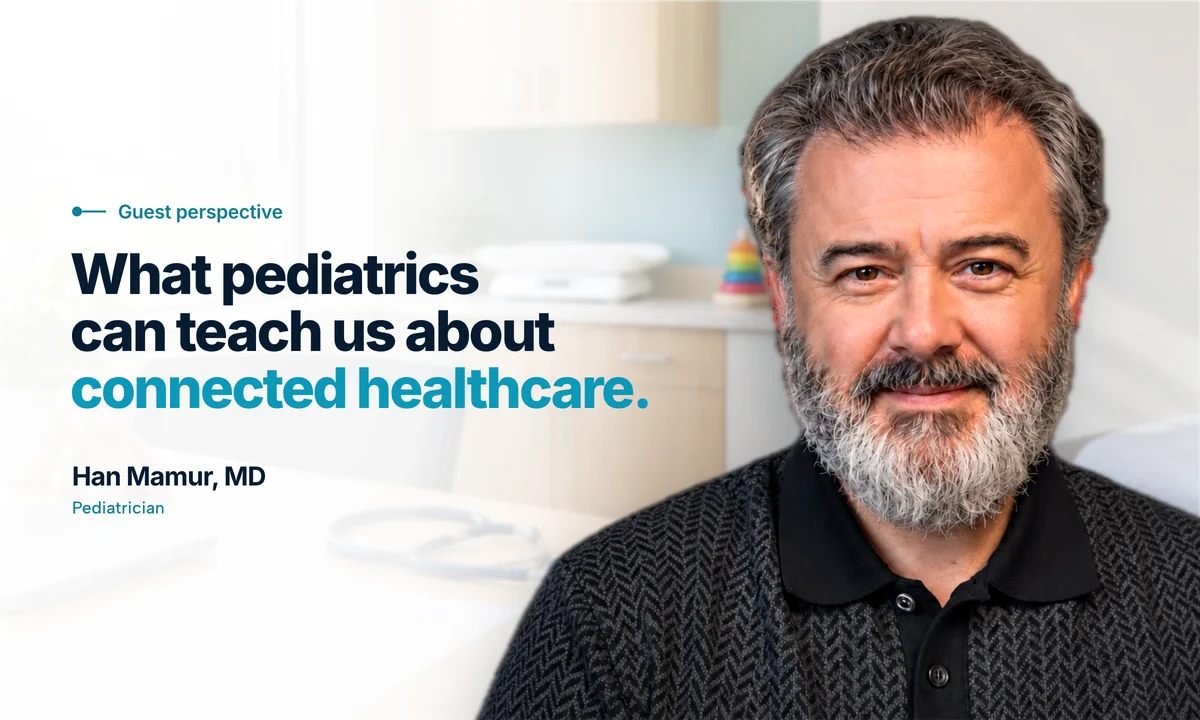
What can AI in pediatrics teach the rest of healthcare? For pediatrician Han Mamur, MD, the lesson is that AI should help physicians understand the clinical story they already have, not hand them more information. Children’s care makes the point plainly: a child’s story starts before birth and changes at every visit.
Dr. Mamur has spent more than 30 years in clinical, administrative and global health roles, including as director of a newborn department with a Level IV NICU. In this guest perspective, he follows a newborn from the delivery room through the handoff to a general pediatrician, and shows how information about one child arrives in pieces from obstetrics, neonatology, specialists and parents. He then sets out what he wants from AI built for physicians: the clinical story first, with the details ready to open, and documentation handled in the background so the physician can keep eye contact with the child and the family.
Key takeaways
- A patient’s story starts before the first visit. In newborn care, the pregnancy, gestational age and prenatal findings shape how the team prepares for delivery.
- A handoff after a NICU stay needs the narrative, not only a list of diagnoses: where the child started, what resolved, and what still needs follow-up at home.
- Information about one child arrives in pieces from obstetrics, neonatology, specialists and parents, and an important detail can take several visits to surface.
- Dr. Mamur asks AI for the clinical story first, with a way to open the details, such as hemoglobin values over time beside iron treatment, or weights on the right growth chart.
- Pediatrics is a stress test for AI because nearly every system in a young child changes at once; a healthy term infant roughly triples birth weight in the first year (Merck Manual, 2025).
- Adding AI turns the child, parent and physician triangle into a tetrahedron, with AI handling documentation in the background so the physician can keep eye contact.
- The aim is understanding, not more information: AI should help physicians see how the pieces connect and bring the doctor and the patient back together.
A Child’s Story Starts Before Birth
One of the most important lessons pediatrics taught me is that a patient’s story does not begin when the patient first appears in front of the physician. In newborn medicine, that becomes obvious. Even before I became a pediatrician, basic science taught us the sequence: sperm and ovum, zygote, embryo, fetus, newborn. Medical school simply deepened the understanding of how complex and vulnerable that process is.
By the time I was practicing pediatrics and leading a newborn service that included neonatal intensive care, I had learned that the pediatric history had to begin before delivery. The mother’s blood group mattered. The course of pregnancy mattered. Fetal growth, morphologic development, gestational age, and prenatal imaging all mattered. If I knew that a very premature infant was about to be delivered, I did not enter the delivery room or operating room with the same expectations I would have for a healthy term newborn. The NICU might already be prepared, the right personnel present, the equipment ready, and the team anticipating several possible scenarios.
I sometimes think of it like an apple. When you pluck an apple from a tree, its story did not begin when you picked it; it began with the seed. The same is true of a newborn. If I could have written one sentence on the wall of the NICU, it would have been, “Here, anything can happen at any time.” Preparation matters because a medically fragile newborn can deteriorate quickly. The better we understand what happened before delivery, the better prepared we can be for what happens afterward.
The Handoff Is Part of the Care
That story does not end when the baby leaves the NICU. When a premature infant comes under the care of a general pediatrician, the story cannot simply restart. The pediatrician is receiving a baton, and birth weight and gestational age define much of the starting point. Was the infant small, appropriate, or large for gestational age? Was there respiratory distress, intracranial hemorrhage, feeding difficulty, or another major complication? What imaging was performed? What follow-up remains?
Prematurity also changes what we watch after discharge. Iron is one example: preterm infants may require specific attention to iron intake and supplementation.1 Development is another. Corrected age matters when assessing milestones in former preterm infants, especially during the first two years, and neonatal complications can shape later surveillance needs.2 Ophthalmology, hearing, nutrition, neurologic, and other follow-up may also continue after discharge.
But I also need to know what is waiting for the baby at home. Is the mother healthy? Does she have help? Are there twins or triplets? Is the feeding plan realistic for this particular family? The home environment is not separate from the medical plan; it affects whether the plan can actually happen.
So when I accepted the care of a baby after a prolonged NICU stay, I did not simply need a list of diagnoses. I needed the narrative: where the child started, what happened, what resolved, what did not, and what still required surveillance. A successful handoff requires more than placing the baton in the next runner’s hand. The next runner needs to know where the race has been and where we are trying to go.
From Fragments to a Clinical Story
Reconstructing that story can be difficult. There may be a discharge summary, laboratory results, imaging reports, specialist notes, feeding histories, growth records, and the parents’ recollection of what happened. Parents are essential sources of information, but medicine can sometimes resemble the old telephone game: a message passes from one person to another, and by the tenth person the story is no longer quite the same.
The obstetrician has one part of the story, the neonatologist another, and specialists contribute additional pieces. Eventually, the general pediatrician has to reconstruct the whole. Sometimes an important detail does not emerge during the first visit. It may take another encounter or two before something surfaces that matters for continuity of care.
This is where I believe a well-designed AI system can become genuinely useful. I do not want AI simply to give me a longer summary. I want it to tell me the clinical story: where this baby began, what happened along the way, what improved, what remains unresolved, and, most importantly, what I need to do next.
Then I want to be able to move from the story into the details. If the child had anemia, show me the hemoglobin values chronologically and overlay the iron treatment. If growth is the concern, show me the birth weight, tell me whether the infant was SGA, AGA, or LGA, and plot subsequent weights on the appropriate growth chart. There is one main story, but within it are many smaller stories – growth, nutrition, respiratory history, neurology, vision, hearing, and development. A useful AI system should help us see the whole story without losing access to any individual chapter.
Pediatrics Is a Stress Test
There is an old maxim: “By failing to prepare, you are preparing to fail.” That principle applies particularly well to pediatrics because the patient is extraordinarily dynamic. During the first year after birth, a healthy term infant typically roughly triples birth weight.3 At the same time, the brain is developing, the lungs are maturing, nutrition is changing, motor skills are emerging, language is beginning, the immune system is developing, and preventive care is moving forward.
The pediatrician is not watching one organ system. We are watching the whole organism while virtually every part of it is changing. At times it feels like three-dimensional chess. Or perhaps like launching a spacecraft: during launch, multiple systems must work together while conditions change rapidly, and only later does the spacecraft reach a more stable orbit. Early childhood can feel like that.
Pediatrics forces us to manage change over time and in parallel. A useful pediatric AI system must understand age, gestational age, corrected age, growth trajectories, development, vaccinations, preventive care, acute illness, screening, laboratory data, imaging, medications, parental observations, specialist recommendations, and age-specific normal values. If we can build a system that helps clinicians manage that degree of complexity without losing sight of the whole child, we have created a strong foundation for many other fields of medicine.
From Triangle to Tetrahedron
Throughout my career, I often described pediatric care to parents as a triangle. At one point was the child, at another the parent, and at the third the physician. Each side represented a relationship. This was not simply “me and you”; all three points mattered, and the strength came from keeping those human connections intact.
For much of the digital era, however, technology often inserted itself directly onto one of those connections. The computer screen could literally sit between the physician and the patient or parent. We listened while typing, turned toward monitors, searched through records, and clicked through fields while the person across from us was trying to tell a story. Technology gave us information, but sometimes it took something in return: our attention. Patients could reasonably wonder, Is my doctor listening to me, or to the computer?
AI gives us an opportunity to redesign that relationship. With appropriate consent and privacy safeguards, an AI-enabled system can listen to the clinical conversation, convert speech into structured information, and assist with documentation while the physician remains engaged with the person in front of them. I can look at my patient. I can look at the parent. I can listen and maintain eye contact while AI works in the background. In that sense, AI can give the doctor back to the patient.
This is where the triangle becomes useful again. Add AI as a fourth point above the original triangle, and the flat shape becomes a tetrahedron. The human triangle remains the base, but AI adds depth by connecting to the physician, the parent, and the child’s clinical information. That added dimension can help us understand the patient serially across time and in parallel across the many people, observations, tests, and specialties contributing to the same story. Traditional digital technology often sat between us; AI has the opportunity to connect us. The physician no longer has to become part of the computer system. The computer system can become part of the physician’s support system.
Bring It Together
If I could give one instruction to the people building AI for healthcare, it would be simple: help us bring it together. Bring the physician and the patient together. Bring the parent, child, and physician together. Bring the obstetric history, neonatal course, laboratory data, imaging, specialist opinions, growth measurements, developmental assessments, and parental observations together. Bring the smaller stories together so we can see the whole picture.
Human attention is finite. A Caltech analysis published in Neuron estimated the information throughput of human behavior at roughly 10 bits per second, despite vastly larger sensory input. The exact interpretation of that estimate remains debated, but the practical lesson is familiar to every clinician: we cannot consciously process everything at once.4,5 AI does not need to change the limits of the human brain. It can help us work within those limits more intelligently.
I do not want a system that gives me a thousand pieces of information faster. I want a system that helps me understand how those thousand pieces relate to one another. Medicine, to me, has always resembled an Impressionist painting. A laboratory result is one brushstroke. A neonatal event is another. An ultrasound, a specialist consultation, a developmental assessment, a parental observation – each adds something to the canvas.
Sometimes we need to move very close and examine one brushstroke. Then we need to step back, because the meaning appears when the brushstrokes become a picture. That is what I want AI to help us do: preserve every important detail while helping us see the whole.
The purpose of AI should not simply be to give physicians more information. It should help physicians understand the information they already have.
For me, understanding often begins with three simple questions: What happened? How did it happen? Why does it matter? Each answer reduces uncertainty. As uncertainty decreases, doubt begins to soften, and with greater understanding comes a degree of mental clarity and peace – not because every outcome is under our control, but because the situation itself has become clearer. This is another role I would ask of AI: help physicians move from information to understanding, from what happened, to how the pieces connect, to why they matter for the patient in front of us.
While doing that, AI should also move technology out of the space between doctor and patient. Bring the information together. Bring the clinical story together. Bring the people caring for the patient together. And ultimately, bring the doctor and the patient back together.
That is what I would ask of AI in healthcare.
Now let’s go and admire Woman with a Parasol – Madame Monet and Her Son (1875).
Frequently asked questions
Why does a newborn’s medical history begin before birth?
A newborn’s history begins with the pregnancy: the mother’s blood group, fetal growth, gestational age and prenatal imaging shape how the team prepares for delivery. Dr. Han Mamur, who directed a newborn department with a Level IV NICU, notes that a very premature birth calls for different staff and equipment than a term birth.
What does a pediatrician need at the handoff after a NICU stay?
The receiving pediatrician needs the narrative, not only a list of diagnoses: where the child started, what happened, what resolved and what still needs surveillance. Follow-up can include iron intake, which the American Academy of Pediatrics addresses in its 2026 clinical report (AAP, 2026), and development judged by corrected age.
Why is pediatrics a stress test for AI in healthcare?
Almost everything in a young child changes at once. A healthy term infant roughly doubles birth weight by 5 months and triples it by 12 months (Merck Manual, 2025), while the brain, lungs, nutrition, language and immunity develop. Dr. Mamur argues that AI able to follow that much change could serve many other fields.
How can AI give the doctor back to the patient?
With consent and privacy safeguards, an AI-enabled system can listen to the visit, turn speech into structured information and help with documentation, so the physician keeps eye contact with the patient and parent. Dr. Mamur describes this as moving technology out of the space between doctor and patient (Mamur, 2026).
What does the triangle-to-tetrahedron model of care mean?
Dr. Mamur describes pediatric care as a triangle of child, parent and physician. Adding AI as a fourth point above it makes a tetrahedron: the human triangle stays the base, and AI adds depth by connecting each point to the child’s clinical information over time and across specialties (Mamur, 2026).
Why should AI help physicians understand information rather than add more?
Human attention is limited. One analysis put human behavioral throughput at about 10 bits per second against sensory input near a billion bits per second (Zheng and Meister, 2025), an estimate others debate. Dr. Mamur asks AI to show how the pieces relate, so physicians see the whole picture.
References
- Powers JM, Heeney MM, Hord J, et al. Prevention, Screening, Diagnosis, and Treatment of Iron Deficiency and Iron Deficiency Anemia in Infants, Children, and Adolescents: Clinical Report. Pediatrics. 2026;158(1):e2026077414. Source
- Davis BE, O’Connor Leppert M, German K, et al. Primary Care Framework to Monitor Preterm Infants for Neurodevelopmental Outcomes in Early Childhood. Pediatrics. 2023;152(1):e2023062511. doi:10.1542/peds.2023-062511. Source
- Graber EG. Physical Growth of Infants and Children. Merck Manual Professional Edition. Reviewed January 2025; updated October 2025. Source
- Zheng J, Meister M. The unbearable slowness of being: Why do we live at 10 bits/s? Neuron. 2025;113(2):192-204. doi:10.1016/j.neuron.2024.11.008. Source
- Sauerbrei BA, Pruszynski JA. The brain works at more than 10 bits per second. Nature Neuroscience. 2025;28:1365-1366. doi:10.1038/s41593-025-01997-0. Source
This is a guest article. The views and opinions expressed are those of the author and do not necessarily reflect the views of ClinicianCore. Guest perspectives are not clinical advice.