Nevada ranks 45th nationally for active physicians per capita and 48th for primary care physicians per capita, according to December 2025 testimony before the U.S. House Committee on Energy and Commerce. Every county in the state includes a federally designated Health Professional Shortage Area. For years, the response to numbers like these has followed a familiar pattern: one health system opens a new clinic, one telehealth vendor signs a contract, one grant funds a pilot program, and the underlying shortage continues largely unchanged.
ClinicianCore spent the past year in a different kind of conversation, meeting independent physician group practices, specialists, educators, and community health advocates across the state to ask a simpler question: what would it take for Nevada’s healthcare community to function like one, rather than a set of disconnected practices working in parallel? This post shares what those conversations taught us, what community engagement has looked like in practice, the shared vision that has come out of it, and an open invitation to join the next phase of the work.
Key Takeaways
- Nevada would need 2,303 additional physicians to match the national average physician-to-population ratio, and 35 of 37 AMA-tracked specialties in the state fall below that average.
- Only 42.2% of U.S. physicians remained in physician-owned private practice in 2024, down from 60.1% in 2012, making independent practices increasingly rare, and increasingly isolated.
- Nevada’s physician shortage will not be solved by a single organization; it requires physicians, practices, hospitals, educators, and innovators working from a shared plan.
- ClinicianCore’s role is to give independent physician group practices a secure, HIPAA-compliant unified clinical communication platform built exclusively for physicians, not to replace the relationships and institutions already doing this work.
- Practices, associations, and educators interested in participating in Nevada’s connected healthcare community can reach out directly (see the invitation below).
Lessons Learned From Nevada’s Physician Shortage
The Numbers Behind the Shortage
The scale of Nevada’s physician shortage is documented well enough that the problem itself is not really in question: a 2,303-physician gap against the national average, a federal shortage designation in every one of the state’s 17 counties, and a per-capita physician rate near the bottom of the country. We laid out that data in full, and what it costs six different groups across the state’s healthcare ecosystem, in an earlier piece on why Nevada needs a more connected clinical infrastructure. What follows here is less about the numbers themselves and more about what changed when we started asking the people living inside them what they actually needed.
Why Supply Alone Does Not Explain the Problem
One lesson stood out in nearly every conversation ClinicianCore had this year: Nevada trains more physicians than it keeps. The state graduates more medical students annually than it has graduate medical education residency slots to place them in, which forces many Nevada-trained physicians to complete residency out of state, where national workforce data consistently shows they are unlikely to return. A pipeline that exports its own graduates cannot close a gap through recruitment alone, no matter how many open positions a practice or health system posts.
A second lesson is less about supply and more about structure. Nationally, only 42.2% of physicians remained in physician-owned private practice by 2024, down from 60.1% in 2012, according to the American Medical Association. Physicians who stay independent, and the Nevada practices that spoke with us this year confirmed this directly, increasingly do so without the built-in referral networks, curbside consult culture, and informal peer support that come standard inside a larger health system. Independence has a cost, and for many of the physicians ClinicianCore spoke with, that cost showed up as isolation rather than as income.
Where This Leaves Independent Practices
For a solo or small independent physician group practice in Nevada, these two lessons compound each other. A practice with fewer nearby colleagues has fewer people to informally consult, and a practice that already runs lean has less administrative capacity to build a peer network from scratch. The practices ClinicianCore spoke with were not asking for fewer patients or lighter schedules; they were asking for a faster, documented way to reach another physician when a case called for a second opinion, and a way to know that message would reach the right person without adding another app to check. More than one practice administrator described juggling a personal phone number, a shared clinic line, and a consumer messaging application just to keep three physicians coordinated across two locations, a pattern that made triage slower rather than faster.
What This Means for ClinicianCore
Neither lesson has a single fix. Residency slots require federal legislative action; Congresswoman Susie Lee’s Physicians for Underserved Areas Act is one example of that work already underway in Congress. Practice ownership trends reflect payment policy and market consolidation well beyond any one company’s reach. Both of those forces will keep shaping Nevada’s physician workforce regardless of what any single vendor builds, and pretending otherwise would not have been an honest way to start this conversation. What ClinicianCore can influence is narrower and more specific: whether the physicians already practicing in Nevada, inside independent practices that have chosen to stay that way, have a secure, HIPAA-compliant unified clinical communication platform built exclusively for physicians in place of the informal, fragmented tools that isolation tends to produce.
Community Engagement: Listening Before Building
Who We Met With
Community engagement, for ClinicianCore, meant conversations before code. Over the past several months, our team met with independent physician group practices in Clark County, Washoe County, and several of Nevada’s rural counties, sat in on discussions with practice administrators managing on-call coverage across scattered locations, and talked with medical educators about where graduating residents were choosing to practice and why. We also spoke with community health advocates working the policy side of Nevada’s physician shortage, people who understand firsthand why a residency slot problem cannot be solved by any single platform, however well designed. Some of these conversations happened at regional medical association meetings, others in a practice’s break room between patient visits, and a few over a series of shorter calls with rural physicians whose schedules rarely allow for a longer sit-down.
What Physicians Told Us
A recurring theme surfaced in nearly every one of these conversations: physicians described feeling professionally alone in ways that had little to do with patient volume. The Physicians Foundation’s 2025 Wellbeing Survey found that 73% of physicians nationally still perceive stigma around seeking mental health support, and nearly six in ten reported feelings of inappropriate anger, tearfulness, or anxiety in the past year. Physicians in independent Nevada practices told us a related but distinct version of the same story: fewer built-in colleagues to message about an unusual case, fewer hallway conversations, fewer people who understood the specific pressure of running a clinical practice and a small business at the same time.
That is the gap a verified peer community is built to close, not by replacing the relationships physicians already have, but by giving physicians across Nevada’s independent practices a direct, NPI-verified way to reach one another. It is also the reasoning behind Physician Lounge, a peer community built as part of ClinicianCore’s platform rather than added on afterward as a separate feature. We have written about that same instinct toward informal peer support from the leadership side, in the physicians who mentor a struggling colleague or rewrite a confusing handoff without ever getting a title for it.
Where We Could Not Solve the Problem Ourselves
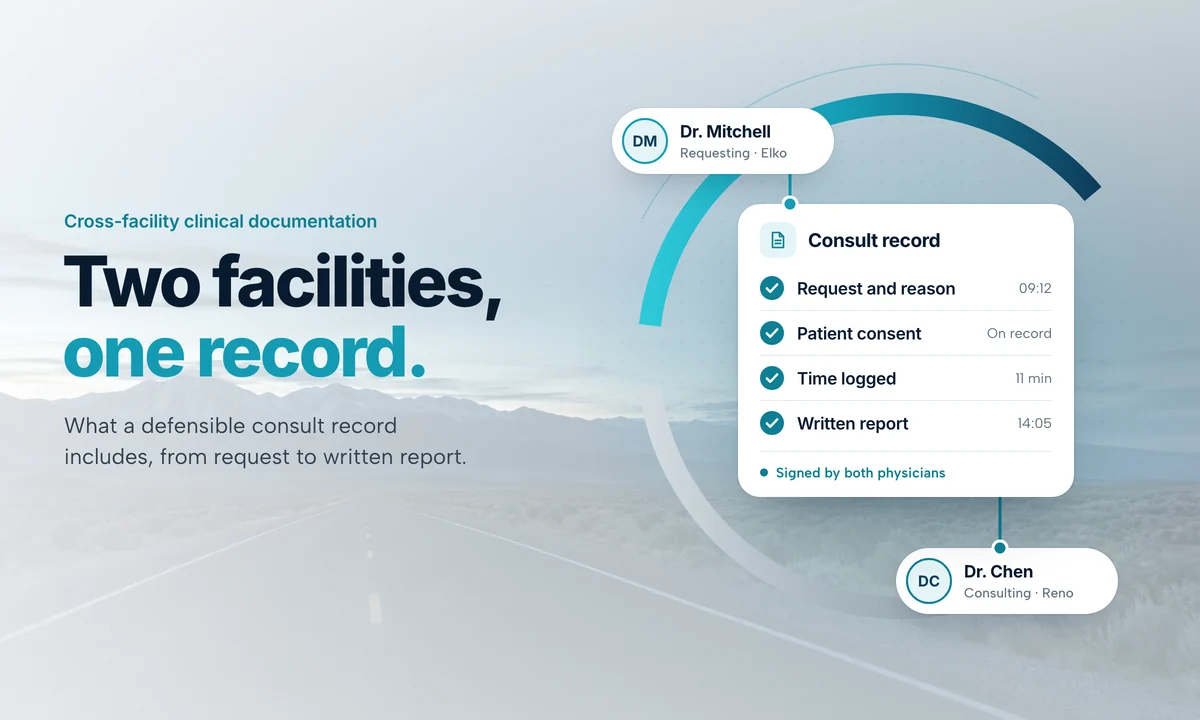
Community engagement also meant listening to concerns ClinicianCore could not resolve on its own: liability questions physician group practices raised about informal consults, credentialing barriers rural physicians described when trying to expand coverage areas, and the practical reality that any new tool introduced into an already overloaded workday needs to reduce work, not add to it. Those conversations shaped the roadmap for the platform’s routing and consult documentation as much as any internal product discussion did, and the conversations are ongoing rather than finished. A few practices asked for features that made sense individually but would have added a second inbox for physicians to check, which is the exact problem a unified platform is supposed to remove, so those requests were reworked rather than shipped as originally proposed. Practices interested in shaping Physician Lounge or the broader approach to physician wellbeing and burnout are still part of that work.
A Shared Vision for Connected Care
A Platform Built Around Existing Relationships
The vision that came out of this year’s conversations is simple to state and harder to build: Nevada’s physicians, independent practices, specialists, educators, and community organizations working from shared information rather than isolated systems, without requiring anyone to give up independence to get there. We published the fuller shape of that vision, and the statewide network launching this September, in a separate piece on building a connected Nevada. What that piece did not have room for is how much of the plan behind it came directly from practices that raised a concern before a single feature was built, which is really what the rest of this section is about.
What the Platform Does and Does Not Replace
Neither smart alert routing nor documented consults are meant to replace the relationships that already exist between Nevada physicians. Both exist to make those relationships easier to sustain across separate practices, specialties, and locations. a secure, HIPAA-compliant unified clinical communication platform built exclusively for physicians is one piece of a shared picture, not the whole of it, and treating it that way shaped how ClinicianCore built it. Practices weighing a unified approach against the point solutions already in daily use, a personal cell number here, a consumer messaging app there, are describing the exact fragmentation problem covered in our earlier piece on Nevada’s connection gap.
Partners Beyond the Platform
The wider vision extends past any single platform. It includes medical educators at Nevada’s medical schools, whose residency placement decisions shape where the next generation of Nevada physicians ends up practicing. It includes rural practices whose on-call physicians cover territory that would be considered unreasonable in a denser state. It includes the associations and advocacy groups already working the federal graduate medical education slot problem, a policy fix no single platform can deliver on its own. What has changed, compared to a year ago, is that these groups are now having some of these conversations together rather than in parallel. That shift, more than any specific product feature, is what “a new chapter” is meant to describe. A shortage this large will not close because one company introduces a better inbox; it closes, gradually, when the organizations already doing the work can see and build on what the others are doing.
How We Will Know This Is Working
A shared vision is only useful if there is a way to check whether it is actually happening. Inside a secure, HIPAA-compliant unified clinical communication platform built exclusively for physicians, ClinicianCore is tracking a small set of measures over the next year rather than a long list: how many independent Nevada practices are actively using documented consult workflows instead of informal ones, how many physicians join Physician Lounge and remain active rather than signing up once and leaving, and how many of the workflow requests raised during community engagement conversations actually ship as features rather than staying on a list. None of these measures are about ClinicianCore’s growth for its own sake. They are proxies for a more basic question: are Nevada physicians less isolated this year than they were last year.
Measuring this honestly means some of the numbers will look worse before they look better, particularly in rural counties where physician density is lowest and where a single departure can eliminate a specialty from an entire county overnight. We also intend to keep showing our work. Where community engagement surfaces a concern ClinicianCore cannot solve directly, such as residency funding or credentialing policy, we plan to say so publicly rather than letting the platform imply it solves everything. Physicians and practices who raised those concerns this year deserve to see them acknowledged, not folded quietly into a product roadmap and left there.
An Invitation to Build Nevada’s Healthcare Ecosystem Together
None of this works as a one-way announcement. If your independent physician group practice is managing on-call coverage across multiple locations, if you lead a residency program placing graduates who are deciding whether to stay in Nevada, if you run a rural clinic covering ground that no single physician should reasonably be responsible for alone, or if you are building something else entirely that touches this same problem, ClinicianCore would like to hear from you.
Physician group practices interested in a secure, HIPAA-compliant unified clinical communication platform built exclusively for physicians can request early access directly through cliniciancore.com. Practices, associations, and educators who want to help shape the roadmap rather than simply use the result are welcome at the table for that conversation too. Several of the workflow decisions described above came directly from practices that raised concerns before a single feature was built, and that pattern is one ClinicianCore intends to keep.
Reaching out does not commit anyone to adopting a new platform. Some of the most useful community engagement conversations this year were with practices and organizations that simply wanted to compare notes on the shortage, the shift away from independent ownership, or the residency slot gap, without any product discussion at all. That kind of conversation is welcome too, and it is part of what building a connected healthcare community actually looks like in practice.
The future of healthcare in Nevada won’t be built by one organization. It will be built by physicians, practices, hospitals, educators, and innovators working together.
Frequently Asked Questions
What is causing Nevada’s physician shortage?
Nevada’s physician shortage stems from low physicians-per-capita supply, a mismatch between medical school graduates and available residency slots, and national trends toward practice consolidation. Nevada ranks 45th nationally for active physicians per capita, according to December 2025 congressional testimony citing AAMC data, a gap ClinicianCore is working to address through community engagement.
How can independent physician practices in Nevada collaborate without merging?
Independent practices can collaborate through shared communication infrastructure rather than shared ownership. ClinicianCore’s platform lets separate, independent physician practices route alerts, document consults, and reach verified peers directly across practice lines, without merging into a single organization or giving up day-to-day autonomy.
What did ClinicianCore learn from meeting with Nevada physicians this year?
ClinicianCore learned that Nevada’s physician shortage is only part of the problem. Physicians in independent practices described professional isolation consistent with national findings from the Physicians Foundation, whose 2025 survey found 73% of physicians perceive stigma around seeking mental health support.
How does ClinicianCore support Nevada’s connected healthcare community?
ClinicianCore supports Nevada’s connected healthcare community through Physician Lounge, an NPI-verified peer community, alongside smart alert routing and documented consult tools, all built specifically for independent physician group practices managing on-call coverage, consult workflows, and coordination across multiple practice locations statewide.
Who can participate in building Nevada’s connected healthcare ecosystem?
Any independent physician group practice, health system specialist, medical educator, or healthcare innovator working in Nevada can participate. ClinicianCore is inviting practices, residency programs, and community health organizations to help shape the next phase of a shared, physician-led healthcare community across the state.
References
- American Association of Medical Colleges. “New AAMC Report Shows Continuing Projected Physician Shortage.” AAMC, 2024. https://www.aamc.org/news/press-releases/new-aamc-report-shows-continuing-projected-physician-shortage
- Health Resources and Services Administration. “Health Professional Shortage Areas: Quarterly Summary Report.” U.S. Department of Health and Human Services, 2026. https://data.hrsa.gov/default/generatehpsaquarterlyreport
- Health Resources and Services Administration, Bureau of Health Workforce. “State of the Primary Care Workforce, 2025.” U.S. Department of Health and Human Services, 2025. https://bhw.hrsa.gov/sites/default/files/bureau-health-workforce/data-research/State-of-the-Primary-Care-Workforce-2025.pdf
- American Medical Association. “Smaller Share of Doctors in Private Practice Than Ever Before.” AMA, 2025. https://www.ama-assn.org/practice-management/private-practices/smaller-share-doctors-private-practice-ever
- American Medical Association. “Physician Burnout Rate Continues to Decline, Falling to Nearly 42%.” AMA, 2026. https://www.ama-assn.org/practice-management/physician-health/physician-burnout-rate-continues-decline-falling-nearly-42
- The Physicians Foundation. “The State of America’s Physicians: 2025 Wellbeing Survey.” Physicians Foundation, 2025. https://physiciansfoundation.org/research/the-state-of-americas-physicians-2025-wellbeing-survey/
- Mwalili, N., Griswold, T., Packham, J., Kaur, S. “Physician Workforce in Nevada, 2025.” Nevada Health Workforce Research Center, University of Nevada, Reno School of Medicine, 2025. https://www.nvha.nv.gov/siteassets/content/community/gme/25_PWIN_FINAL_4-21-25_ADA.pdf
- Lee, Susie (U.S. Representative, NV-03). Testimony before the U.S. House Committee on Energy and Commerce, Member Day Hearing, December 12, 2025. https://democrats-energycommerce.house.gov/sites/evo-subsites/democrats-energycommerce.house.gov/files/evo-media-document/hon-susie-lee_testimony_fc.2025.12.12.pdf