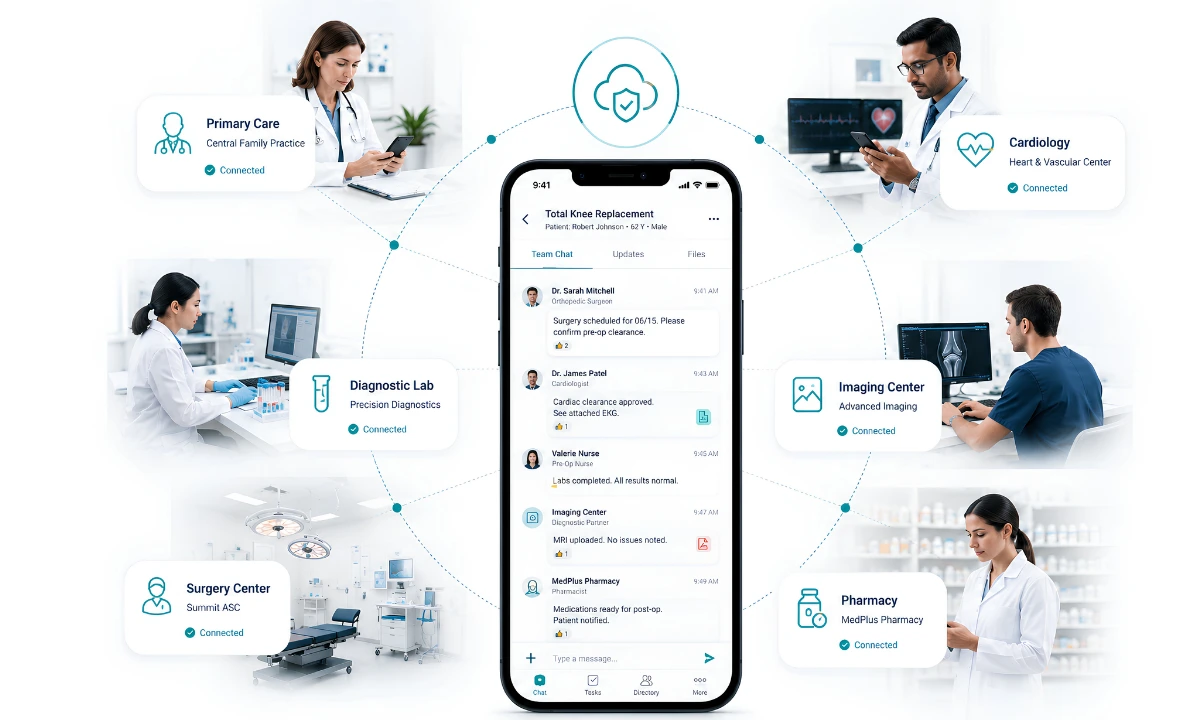
Operating an ambulatory surgery center (ASC) requires precise coordination. Every surgical case depends on a network of pre-operative approvals, primary care consultations, specialist clearances, and post-acute support. When these connections rely on manual phone calls, faxes, or fragmented portals, administrative delays can quickly turn into rescheduled procedures and extended recovery times.
The stakes are rising. ASCs are absorbing higher acuity cases as more procedures shift out of hospitals, and workforce pressure across anesthesia, nursing, and administration is intensifying at the same time. ClinicianCore’s Trusted Entities framework addresses this by establishing secure, pre-verified digital connections between surgery centers and their external healthcare partners. By linking both physicians and non-physician professionals across organizations, this unified clinical communication platform optimizes clinical workflows, expands surgical throughput, and protects continuity of care.
Key Takeaways
- Cancellation rates on the day of surgery in ambulatory settings have been measured as low as 0.5 percent at high-volume academic centers, but modest cancellation rates of even 8 percent can cost a mid-sized clinic more than $240,000 a year.
- ASCs entered 2026 absorbing higher acuity cases and tighter anesthesia coverage constraints, raising the cost of every avoidable scheduling failure.
- Trusted Entities connects both physicians and non-physician staff across partner organizations through one verified digital layer instead of fragmented faxes and phone calls.
- HCC Consult Core allows pre-operative interprofessional case reviews to be documented for potential CPT e-consult billing rather than lost as an informal exchange.
- Every connection inside the framework runs on a HIPAA-compliant, credential-verified network with a unified, encrypted audit trail.
“An operating room doesn’t run on a schedule alone. It runs on the reliability of every clinical connection that happens before the patient ever reaches the table.”/p>

The Cost of Fragmented Pre-Op Coordination
The financial exposure tied to surgical scheduling failures is well documented. Even a modest cancellation rate of 8 percent can carry a substantial financial impact, with a small clinic performing 100 surgeries a month at $2,500 in average revenue per case standing to lose more than $240,000 annually to cancellations. At the high end, academic center data shows overall elective case cancellation rates near 7.5 percent in the general OR, with the top reasons being inadequate preoperative preparation, changes in medical condition, and scheduling issues, and the majority of these cancellations were judged preventable.
Ambulatory centers specifically tend to perform better than hospital based ORs. One academic center study found the cancellation rate inside the ambulatory surgical center to be 5.1 percent, and a large tertiary referral center reported same day cancellations occurring at a rate of just 0.5 percent across more than 41,000 ambulatory procedures, most of which were unforeseeable rather than coordination failures. That gap between hospital and ambulatory cancellation performance is exactly the margin Trusted Entities is designed to protect and extend, since office based and same day surgical centers generally see lower cancellation rates thanks to more streamlined processes.
The industry backdrop makes this more urgent heading through 2026. The ASC sector enters the year with higher acuity cases bringing greater system requirements, evolving site of service policies, and intensifying workforce pressure around anesthesia, nursing, and administration. For centers already subsidizing anesthesia coverage to keep operating rooms running, even modest scheduling limits can translate into canceled cases, strained physician relationships, and margin erosion. Health system investment in the space is not slowing down either; large systems are doubling down on ambulatory care as a core strategy rather than retreating from it.
Use Case: An Outpatient Total Joint Replacement
Consider the journey for a 62-year-old patient scheduled for a total knee replacement at an ambulatory surgery center. Before the surgical team can make the first incision, a multi-step web of pre-operative requirements must clear across several independent organizations:
- Primary Care Physician (PCP): Provides foundational medical history and the initial surgical referral.
- Cardiology and Pulmonology Specialists: Evaluate underlying cardiovascular conditions to issue formal pre-operative cardiac clearance.
- Diagnostic Labs and Imaging Centers: Perform and deliver pre-surgical blood panels, EKGs, and MRI scans.
- Specialty Pharmacies: Confirm postoperative pain management protocols and fill specialized medications before discharge.
- Physical Therapy and Outpatient Rehab: Establish baseline mobility metrics and prepare the postoperative rehabilitation schedule.
The Traditional Challenge
In a standard practice environment, ASC administrative staff must manually bridge these organizations. Schedulers spend hours chasing clearance faxes, holding for diagnostic centers to verify blood work, and leaving voicemails for cardiologists. If one pre-op lab result is misplaced or a cardiac clearance note arrives late, the operating room schedule can collapse, resulting in cancellations, idle surgical suites, and frustrated patients.
The Solution: Trusted Entities in Action
With ClinicianCore’s Trusted Entities architecture, the surgery center interacts with each external partner through a single, pre-verified digital network.
Streamlined referral sync and history sharing. The orthopedic team initiates a direct connection with the referring PCP, who transmits complete medical history notes into the secure platform. The orthopedic surgeon then uses HCC Consult Core to perform structured interprofessional case reviews, keeping diagnostic reasoning embedded directly within the record for potential CPT e-consult billing.
Rapid subspecialty clearances. The surgical coordinator routes the patient’s record directly to the cardiologist, who reviews EKG traces or diagnostic files and approves surgical clearance without forcing the patient through a redundant in-person visit.
Ancillary and diagnostic verification. Non-physician staff, including the ASC surgical prep nurse and medical assistants, communicate directly with partner lab technicians and pharmacists through HCO Practice HQ. Preoperative panels are verified well ahead of admission, and postoperative prescriptions are confirmed before the patient enters recovery.
Coordinated post-acute handoffs. Immediately following a successful procedure, the care team transfers recovery protocols and physical therapy instructions directly to the patient’s chosen outpatient rehab facility, securing a seamless transition of care.
Core Value Vectors for the Surgery Center
Connecting MDs and Non-MDs Across Organizations
Care coordination extends beyond physician to physician communication. The Trusted Entities framework links both clinical leaders and support staff across partner organizations:
- Physician to physician (MD/DO): Orthopedic surgeons, anesthesiologists, primary care doctors, and cardiologists review complex cases, evaluate surgical risk, and align on treatment plans together.
- Non-physician operations: ASC clinical staff, surgical schedulers, registered nurses, and pharmacists communicate directly with external counterparts to resolve order clarifications, handle prior authorizations, and organize diagnostic scheduling without interrupting surgeons mid-procedure.
Operational Throughput and Capacity Protection
Surgical delays or cancellations represent real lost revenue for ambulatory surgery centers, and the exposure only grows as ASCs take on more complex, higher acuity cases in 2026. By replacing manual outreach with direct, role-based communication channels:
- Pre-op friction drops. Preoperative clearances and diagnostic results arrive ahead of schedule, reducing day-of-surgery cancellations, which industry data continues to link to preventable coordination failures rather than clinical necessity.
- Staff reclaims time. Clinical and administrative staff spend less time managing phone queues, freeing capacity for direct patient care and operative logistics, a meaningful lever given the anesthesia and nursing workforce pressures the sector is currently navigating.
Strengthening Referral Partner Networks
Primary care physicians and community specialists prefer referring patients to surgery centers that are organized and easy to work with. Operating on a platform for medical practice efficiency where records, updates, and consults flow without friction builds trust with referring practices and helps expand the ASC’s long term referral base, which matters as health systems continue expanding their ambulatory footprint.
Security and Compliance
Exchanging sensitive clinical information across organizational boundaries can expose practices to compliance risk if staff default to unsecured channels. ClinicianCore maintains full HIPAA-compliant collaboration across every connection:
- Verified credentials. Every external organization and user onboarded as a Trusted Entity is verified before joining the network.
- Unified audit trail. Every message, file transfer, and consult record is encrypted and captured within a single, time-stamped digital audit trail, supporting regulatory compliance across every interaction.
Conclusion
The Trusted Entities framework transforms how ambulatory surgery centers interact with the broader care ecosystem. By linking surgery centers, primary care physicians, subspecialists, diagnostic centers, and post-acute facilities into a single secure layer, ClinicianCore protects surgical schedules, reduces avoidable cancellations, and supports patient care from initial referral through full recovery, exactly the kind of coordination the ASC sector needs as it absorbs more complex cases through 2026 and beyond.
Frequently Asked Questions
What is the Trusted Entities framework?
Trusted Entities is a ClinicianCore feature that establishes secure, pre-verified digital connections between an ambulatory surgery center and its external partners, including referring physicians, specialists, labs, pharmacies, and rehab facilities.
How does Trusted Entities reduce surgical cancellations?
It replaces manual fax and phone-based coordination with direct, role-based digital channels, so pre-operative clearances, labs, and imaging arrive ahead of schedule instead of arriving late or getting lost.
Can non-physician staff use Trusted Entities?
Yes. Surgical schedulers, nurses, medical assistants, and pharmacists can communicate directly with external counterparts to resolve order clarifications and prior authorizations without involving the surgeon.
Does Trusted Entities support billing for pre-operative consults?
Structured interprofessional case reviews conducted through HCC Consult Core can be documented for potential CPT e-consult billing, turning informal case discussion into a captured, billable workflow.
Is data shared through Trusted Entities HIPAA compliant?
Yes. Every organization and user is credential-verified before joining the network, and all communication is encrypted and logged in a unified audit trail.
References
- Dynamics of Elective Case Cancellation for Inpatient and Outpatient in an Academic Center, PubMed — https://pubmed.ncbi.nlm.nih.gov/24286019/
- Same-Day Cancellation in Ambulatory Surgery: A Retrospective Review, PubMed — https://pubmed.ncbi.nlm.nih.gov/29474251/
- Surgery Cancellation Rate Benchmark and Cost Calculator, MyPreOp — https://www.mypreop.org/post/surgery-cancellation-rate-benchmark-cost-calculator
- Top Ambulatory Surgery Center Trends for 2026, ASC News — https://ascnews.com/2026/02/top-ambulatory-surgery-center-trends-for-2026/
- Ambulatory Surgical Center Services Status Report, MedPAC — https://www.medpac.gov/wp-content/uploads/2025/03/Mar25_Ch10_MedPAC_Report_To_Congress_SEC.pdf
- Ambulatory Surgery Center Statistics That Define the Industry — https://blog.sisfirst.com/ambulatory-surgery-center-statistics-that-define-the-industry
- ClinicianCore HCC Consult Core platform page — https://cliniciancore.com/platform/hcc-consult-core/
- ClinicianCore HCO Practice HQ platform page — https://cliniciancore.com/platform/hco-practice-hq/
- ClinicianCore Unified Clinical Communication Platform — https://cliniciancore.com/solutions/unified-clinical-communication-platform/
- ClinicianCore HIPAA Compliant Collaboration https://cliniciancore.com/solutions/hipaa-compliant-collaboration-platform/