The Communication Gap in Modern Medical Practices
The continuous influx of administrative work in modern medical practices often distracts clinicians from what matters most: delivering patient care. While electronic medical records have transformed how patient information is documented, they haven’t solved how healthcare teams communicate and coordinate the work that follows.
A quick look at how most physician group practices operate reveals a common challenge. Conversations are scattered across phone calls, consumer messaging apps, emails, legacy phone trees, physical fax machines, and hallway discussions. As work moves between physicians, nurses, medical assistants, referral coordinators, billing teams, and administrators, communication becomes fragmented, ownership becomes unclear, and unnecessary delays become part of the daily workflow.
Primary care physicians now manage an average of 77 electronic health record (EHR) inbox notifications every day more than double what many specialists receive, according to data highlighted by the American Medical Association [2]. The volume isn’t simply an information problem; it’s a coordination problem. Every notification typically triggers conversations, decisions, follow-ups, and handoffs that extend well beyond the EMR.
This constant operational noise consumes clinical time, contributes to physician burnout, and slows practice efficiency. Regulators have also recognized the growing importance of secure clinical communication. In February 2024, the Centers for Medicare & Medicaid Services acknowledged secure texting platforms as compliant infrastructure for communicating clinical orders [4].
HCO Practice HQ is the clinical communication architecture that transforms fragmented communication into coordinated action by connecting people, workflows, and operational decisions across the healthcare organization.
Key Takeaways
- HCO Practice HQ is the foundational clinical communication architecture within the ClinicianCore platform; additional ClinicianCore modules—including HCC Consult Core and Physician Lounge—expand collaboration beyond the organization, creating a connected healthcare ecosystem.
- The architecture rests on six pillars: encryption and role-based access, one interface for every communication modality, urgency-and-role-based routing, real-time and asynchronous workflows, cross-department coordination, and measurable efficiency.
- Primary care physicians receive an average of 77 EHR inbox notifications a day, more than double the roughly 29 to 30 a specialist typically sees (AMA, 2023).
- CMS formally revised its guidance in February 2024 to recognize secure, encrypted texting platforms as compliant infrastructure for clinical orders (CMS, 2024).
- The Joint Commission’s 2024 sentinel event data lists inadequate communication of critical information and unclear staff roles among the leading contributing factors behind reported delay-in-treatment events (Joint Commission, 2025).
- Independent physician group practices can download early access now at cliniciancore.com/app-download ahead of the September 2026 public launch.
“HCO Practice HQ does not replace the EMR. The EMR remains the system of record for patient information, while HCO serves as the operational layer that streamlines communication, aligns teams, and keeps clinical work moving.”

How HCO Practice HQ Changes the Workflow
Instead of conversations being scattered across multiple communication tools, the entire healthcare organization collaborates within a single secure platform designed specifically for physician practices.
As new work is created—whether it’s a referral, physician consultation, operational request, document review, staffing update, or administrative task—the appropriate people are automatically brought into the conversation based on their role, responsibilities, and availability. Urgent issues receive immediate attention, while routine work follows established workflows without creating unnecessary interruptions.
Communication adapts to the realities of clinical practice. Physicians can respond between patient visits, nurses can review updates during their workflow, referral coordinators can continue the process when insurance authorization is complete, and administrative teams remain informed without relying on phone calls, disconnected messaging applications, or manual follow-ups.
Every conversation, document, decision, and update remains connected in one shared operational workspace. Physicians, nurses, medical assistants, referral coordinators, billing teams, and practice administrators all have visibility into the current status of work, who owns the next step, and what still requires action.
As communication becomes structured instead of fragmented, leadership gains meaningful visibility into response times, workflow bottlenecks, communication patterns, and operational performance. Rather than reacting to inefficiencies after they occur, practices can continuously improve how work flows throughout the organization.
The Difference
HCO Practice HQ does not replace the EMR. The EMR remains the system of record for patient information, while HCO serves as the operational layer that streamlines communication, aligns teams, and keeps clinical work moving without changing how data is stored or documented in the EMR.
The following six architectural pillars define how HCO Practice HQ delivers secure, coordinated, and scalable communication for modern physician group practices.
The Six Architectural Pillars of HCO Practice HQ, what each one means, and what they mean for a physician group practice.
Why Communication Architecture, Not Another Messaging App
Most communication tools used in physician group practices were not built for physician group practices. They were built for general business use, then adopted informally because something had to fill the gap between phone calls, paper notes, and fax. That gap carries a cost. Physician burnout tied to administrative and communication burden remains a documented concern: 43.2% of physicians reported at least one symptom of burnout in 2024, down from 48.2% in 2023, still touching nearly half of the workforce, according to AMA-affiliated research [1]. Separately, 79% of physicians told the Physicians Foundation in 2024 that reducing administrative burden would meaningfully help their well-being [7].
HCO Practice HQ is ClinicianCore’s answer to that gap: one communication architecture built specifically for physician group practices, rather than features stitched together after the fact. Every decision behind it, from how a message is encrypted to how it is routed to who sees it first, was made with a physician group practice’s actual workflow in mind, not a general office’s.
The result is six pillars that work together rather than in isolation. Each is covered below, in the order they show up in a physician’s day: first how information stays protected, then how it moves, then who it reaches, and finally what it saves.
Pillar 1: Secure Clinical Communication by Design
The first architectural decision behind HCO Practice HQ is the one physician group practices care about most: does this keep patient information safe? Every video call, voice message, and text sent through the platform is encrypted end-to-end, with role-based access controls and a full audit trail behind each interaction, consistent with the HIPAA Security Rule’s technical safeguard requirements.
This is not a theoretical concern. In February 2024, the Centers for Medicare & Medicaid Services issued a memorandum formally revising its earlier guidance to recognize secure, encrypted texting platforms as compliant infrastructure for transmitting clinical orders among care team members, reversing a stricter 2018 position [4]. CMS was addressing hospital and critical access hospital settings specifically, but the underlying compliance principle- that an encrypted, auditable platform is now regulator-recognized infrastructure rather than a workaround- applies just as directly to an independent physician group practice choosing between a consumer texting app and a HIPAA-compliant collaboration platform.
That distinction matters because consumer messaging apps were never built with covered-entity obligations in mind: no forced encryption at rest, no role-based permissioning, no audit trail a compliance officer can hand to an auditor.
Every one of the platform’s four modules, HCO Practice HQ, HCC Consult Core, HCX Xchange, and Physician Lounge, inherits the same encryption and access-control layer that defines ClinicianCore as a secure, HIPAA-compliant unified clinical communication platform built exclusively for physicians, so compliance does not vary depending on which module a physician happens to be using that day.
For a closer look at how the compliance layer works across the full platform, see the HIPAA Compliant Collaboration page.
Pillar 2: Unified Clinical Communication Across Every Modality
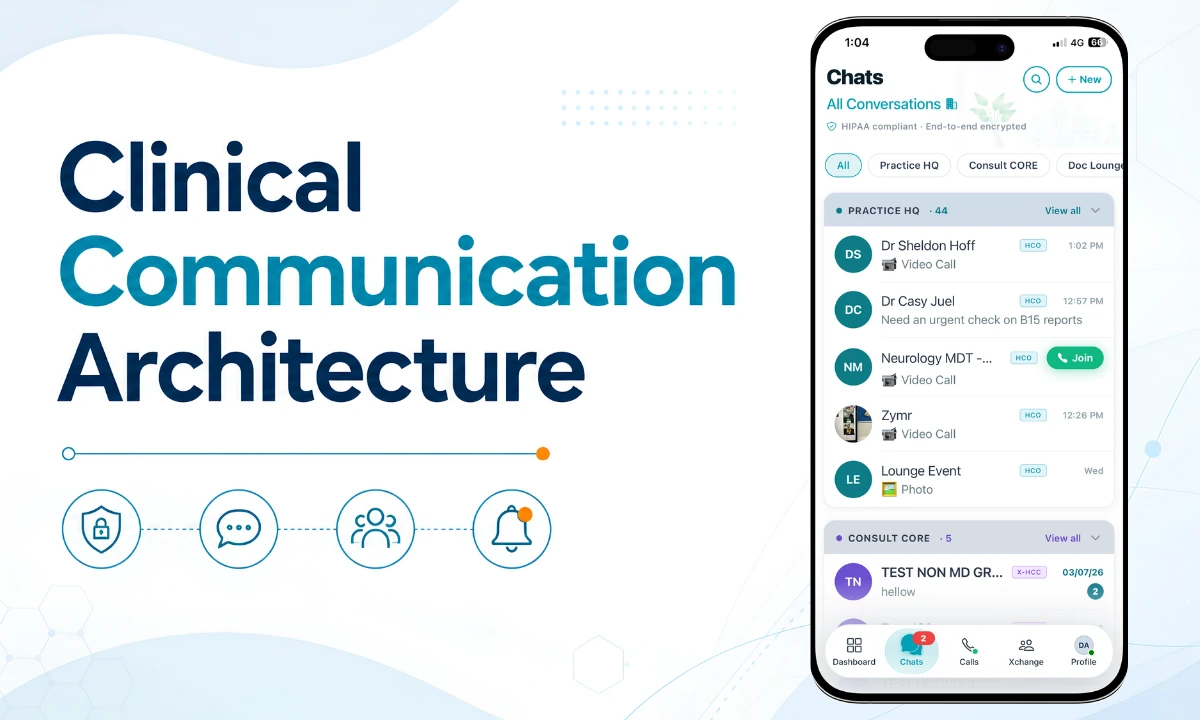
The second feature addresses a different kind of fragmentation: not compliance, but the number of separate apps a physician juggles to reach a care team. Real-time video, asynchronous video, voice, and text all live inside one interface in HCO Practice HQ, rather than requiring a physician to switch between a video platform, a texting app, and a phone line depending on the moment.
This matters because inbox volume alone does not capture the full fragmentation physicians face: a primary care physician juggling 77 inbox notifications a day is also juggling calls, texts, and portal messages across separate systems that do not talk to each other [2]. Bringing every modality into a secure, HIPAA-compliant unified clinical communication platform built exclusively for physicians removes the switching cost that comes with toggling between tools, and it means every message, regardless of format, lives in one auditable place rather than scattered across whichever app happened to be convenient at the time.
The distinction between real-time and asynchronous formats is intentional rather than incidental, and it connects directly to Feature 4 below: an urgent airway concern needs a live video call, while a routine post-op check-in does not need to interrupt anyone’s day to get answered. HCO Practice HQ’s unified interface is designed to support both formats without forcing a physician to guess which app handles which case.
Learn more about how the four modules combine on the Unified Clinical Communication page.
Pillar 3: Intelligent Routing to Reduce Alert Fatigue
Volume alone is not the core problem behind physician communication burden. It is undifferentiated volume: every message arriving with the same visual weight regardless of whether it is a critical alert or a routine reminder. Primary care physicians receive an average of 77 EHR inbox notifications a day, more than double the roughly 29 to 30 a specialist typically sees, according to research summarized by the American Medical Association [2]. When every notification looks the same, physicians either respond to false urgency constantly or start tuning notifications out altogether, and neither outcome is safe.
HCO Practice HQ’s routing engine prioritizes messages by urgency, sender role, and on-call status before they reach a physician’s screen, so the interruptions that do get through are the ones that matter. The design goal is straightforward: physicians should only be interrupted for what actually needs their attention right now, with everything else queued for review on their own schedule.
The stakes behind this go beyond convenience. The Joint Commission’s 2024 sentinel event data lists inadequate communication of critical information among staff, and vague or unclear roles and responsibilities as among the leading contributing factors behind reported delay-in-treatment events, which themselves increased 56% in reported frequency from 2023 [5]. Clear, role-aware routing will not eliminate every communication gap in care delivery, but it directly addresses two of the specific failure patterns regulators are already tracking.
See how routing intelligence fits into the broader platform on the Physician Burnout Reduction page.
Pillar 4: Communication that Fits Clinical Workflows
Not every clinical communication needs an immediate response, and treating all of it as urgent is part of what drives burnout in the first place. HCO Practice HQ supports synchronous communication for the acute change in a patient’s condition that needs a same-minute response, and asynchronous, your-time workflows for non-urgent updates that can wait for a natural break in a physician’s schedule.
This mirrors a broader shift already underway at the federal level. Recent legislation extended Medicare’s telehealth flexibilities, including permanent inclusion of two-way, real-time audio-only communication for eligible services when a patient cannot or does not consent to video, through December 31, 2027, with broader non-behavioral-health telehealth flexibilities extended through the same date [8]. Federal policy increasingly reflects the reality that not every clinically meaningful interaction requires a synchronous, in-person format, and HCO Practice HQ’s architecture reflects that same premise for communication inside a physician group practice.
For a physician group practice, the practical effect is fewer interruptions during a patient encounter and fewer results sitting untouched until the end of the day. A routine lab result acknowledgment does not need to break a physician’s focus mid-visit the way an urgent clinical concern does, and HCO Practice HQ’s interface is built to keep that distinction visible rather than flattening every message into the same alert.
Both formats route through the same encrypted, audited channel described in Feature 1, so the choice between real-time and asynchronous never comes at the cost of the platform’s HIPAA-compliant foundation.
Pillar 5: Build for Healthcare Organization Coordination
A physician group practice runs on more than physician-to-physician communication. Front desk staff, nursing, physicians, billing, and lab all need to reach the right person, and delays at any one of those handoffs slow the whole practice down. HCO Practice HQ connects front desk, nursing, physicians, billing, and lab functions inside one architecture, rather than leaving each function to run its own separate system.
This addresses a specific, documented failure pattern. Among the Joint Commission’s leading contributing factors for reported delay-in-treatment sentinel events in 2024 were vague or unclear roles and responsibilities among staff, and a lack of shared understanding or mental model across the care team [5]. Those are coordination failures as much as clinical ones, and they show up just as easily in an independent physician group practice as anywhere else in care delivery.
Role-based routing, covered in Feature 3, extends naturally into this cross-department layer: a billing question routes to billing, a triage question routes to nursing, and an urgent clinical question reaches the on-call physician directly, without anyone having to know in advance who is covering what that day. The goal is fewer handoffs that depend on someone remembering to forward a message, and more handoffs the architecture itself accounts for.
Practices considering how this fits alongside consult documentation can review HCC Consult Core and HCX Xchange for how the modules connect beyond the front office.
Pillar 6: Operational Efficiency that Scales
The first five features are designed to produce a sixth: measurable time and administrative burden given back to a physician group practice. Faster coordination supports smoother patient flow, reduced administrative drag supports higher physician satisfaction, and better alignment across departments supports fewer delays and errors overall.
The administrative burden this addresses is well documented and growing. MGMA’s 2026 Regulatory Burden Report, based on survey responses from leaders at more than 230 medical group practices, found that escalating federal regulatory and administrative requirements continue to strain practices and contribute to physician burnout [6]. Separately, 79% of physicians told the Physicians Foundation in 2024 that reducing administrative burden would meaningfully help their well-being, a figure that rose to 87% among residents [7].
HCO Practice HQ will not resolve prior authorization requirements or payer complexity on its own. What it can address is the communication-specific share of that burden: the minutes lost to redundant phone tag, the messages read twice because they were not routed correctly the first time, and the time spent checking four different apps for one conversation. Those minutes add up across a physician group practice’s full care team, not just its physicians.
For practices evaluating the efficiency case in more detail, ClinicianCore’s Medical Practice Efficiency page includes a fuller breakdown of where that time is typically recovered.
What This Means Ahead of the September 2026 Launch
HCO Practice HQ’s early access period is a preview of this architecture in the field, not the finished platform. September 2026 brings the full ClinicianCore platform to full public launch: HCC Consult Core for documented, billable interprofessional consultation, HCX Xchange for invite-only physician networking and compliant industry engagement, and Physician Lounge, ClinicianCore’s NPI-verified, physician-only peer community.
Every module shares the architecture described above: encryption and role-based access from Feature 1, one interface for every communication modality from Feature 2, urgency-and-role-based routing from Feature 3, support for both real-time and asynchronous workflows from Feature 4, cross-department coordination from Feature 5, and the efficiency gains that follow from Feature 6. A physician group practice that downloads HCO Practice HQ today is not adopting a standalone tool; it is adopting the entry point to a secure, HIPAA-compliant unified clinical communication platform built exclusively for physicians that expands in September without requiring a second onboarding process.
For a physician group practice weighing whether to wait for the full public launch or start earlier, the practical case for early access comes down to the numbers already covered here: an average of 77 daily inbox notifications for a typical primary care physician [2], regulatory burden that MGMA’s leadership survey found is still increasing year over year [6], and communication-related contributing factors that the Joint Commission continues to flag in its most recent sentinel event data [5]. None of those pressures wait for September.
Independent physician group practices can download early access now ahead of the full public launch in September 2026, and current HCO Practice HQ users get first access to HCC Consult Core, HCX Xchange, and Physician Lounge as each rolls out.
Frequently Asked Questions
What Is HCO Practice HQ?
HCO Practice HQ is the practice-level module of ClinicianCore, a secure, HIPAA-compliant unified clinical communication platform built exclusively for physicians. It unifies video, voice, and text and routes each message by urgency, addressing the alert load behind the 77 daily inbox notifications primary care physicians receive on average.
When Does the Full ClinicianCore Platform Launch?
The full ClinicianCore platform moves to full public launch in September 2026, following HCO Practice HQ’s early access period. MGMA’s 2026 Regulatory Burden Report found administrative and regulatory burden on physician group practices keeps increasing year over year, adding urgency to that timeline (MGMA, 2026).
How Does ClinicianCore Keep Physician Communication HIPAA Compliant?
ClinicianCore encrypts every video call, voice message, and text end to end, with role-based access controls and a full audit trail behind each interaction. This reflects a broader regulatory shift: in February 2024, CMS formally recognized secure, encrypted texting platforms as compliant infrastructure for clinical orders (CMS, 2024).
How Does Intelligent Routing Reduce Alert Fatigue for Physicians?
HCO Practice HQ’s routing engine prioritizes messages by urgency, sender role, and on-call status before they reach a physician’s screen. This directly targets the volume problem behind physician inbox burden: primary care physicians receive an average of 77 daily inbox notifications, more than double what specialists see (AMA, 2023).
Can Independent Physician Group Practices Access HCO Practice HQ Before September 2026?
Yes. Independent physician group practices can download early access to HCO Practice HQ now, ahead of HCC Consult Core, HCX Xchange, and Physician Lounge at full public launch. The Physicians Foundation found 79% of physicians see administrative burden reduction as helpful to their well-being (Physicians Foundation, 2024).
References
- [1] American Medical Association. “Burnout eases for doctors at every career stage as support rises.” 2026. https://www.ama-assn.org/practice-management/physician-health/burnout-eases-doctors-every-career-stage-support-rises
- [2] American Medical Association. “When it comes to inbox overload, U.S. physicians have it worst.” 2023. https://www.ama-assn.org/practice-management/digital-health/when-it-comes-inbox-overload-us-physicians-have-it-worst
- [3] American Medical Association. “Primary care visits run a half hour. Time on the EHR? 36 minutes.” 2024. https://www.ama-assn.org/practice-management/digital-health/primary-care-visits-run-half-hour-time-ehr-36-minutes
- [4] Centers for Medicare & Medicaid Services. “Texting of Patient Information and Orders for Hospitals and CAHs,” Memo QSO-24-05-Hospital/CAH. 2024. https://www.cms.gov/medicare/health-safety-standards/quality-safety-oversight-general-information/policy-memos-states-and-cms-locations/texting-patient-information-and-orders-hospitals-and-cahs
- [5] The Joint Commission. “Sentinel Event Data 2024 Annual Review.” 2025. https://digitalassets.jointcommission.org/api/public/content/eac7511986c0442a9c1ae04b1aa02cc0
- [6] Medical Group Management Association. “2026 Regulatory Burden Report.” 2026. https://www.mgma.com/federal-policy-resources/april-9-2026-regulatory-burden-report
https://www.mgma.com/getkaiasset/8c7263b8-882d-4f6a-8d6c-48180fba72c9/MGMA%202026%20Reg%20Burden%20Report%20.pdf - [7] The Physicians Foundation. “2024 Survey of America’s Current and Future Physicians.” 2024. https://physiciansfoundation.org/research/examining-physician-resident-and-student-wellbeing-and-impact-of-the-current-healthcare-landscape/
- [8] U.S. Department of Health and Human Services, Telehealth.HHS.gov. “Medicare payment policies.” Accessed 2026. https://telehealth.hhs.gov/providers/billing-and-reimbursement/medicare-payment-policies