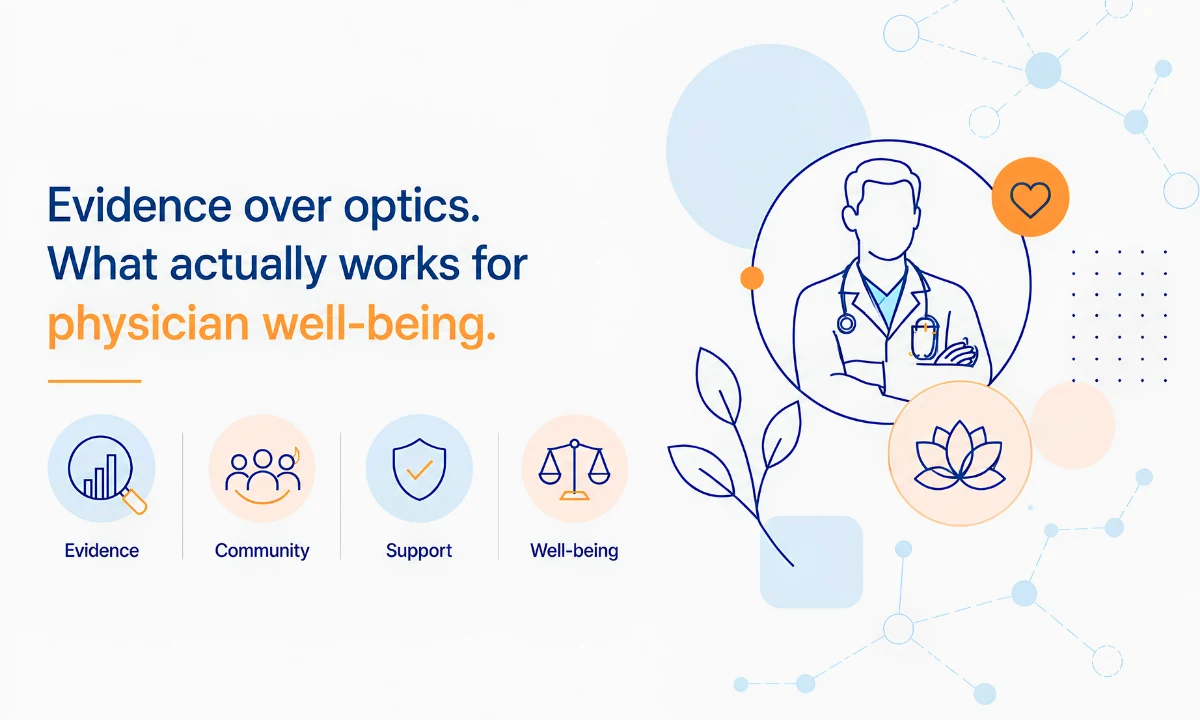
The numbers are uncomfortable. Physician burnout rates, despite billions invested in wellness programs over the past decade, have not normalized. A 2025 Mayo Clinic Proceedings analysis found that while burnout improved slightly between 2021 and 2023, occupational distress in physicians remains markedly elevated relative to the general US workforce. Organizations continue to respond with mindfulness curricula, resilience workshops, and employee assistance programs. Participation rates are tracked. Certificates are issued. Burnout rates stay high.
Spending time in operating rooms and intensive care units for over two decades taught me something about the difference between treating symptoms and addressing disease. A patient with sepsis who receives antipyretics has a lower fever. They do not have less sepsis. The evidence on physician wellness programs reveals a similar pattern: many interventions measurably reduce burnout scores, but the improvements are modest, often short-lived, and frequently fail to address the structural conditions producing the burnout in the first place.
This review examines what the 2026 evidence actually shows, where individual-focused programs succeed and where they fall short, and which structural interventions produce the most durable results. The clinical stakes are too high for organizational convenience to take precedence over evidence.
Key Takeaways
- A 2026 meta-analysis of mindfulness, coaching, and peer support programs found statistically significant but modest reductions in Maslach Burnout Inventory subscale scores. Individual programs function best as adjuncts, not primary solutions.
- Multiple systematic reviews identify organization-directed interventions as more effective than individual-directed interventions for reducing physician burnout. This finding is consistent across independent research groups.
- Individual programs are easier to implement, document, and defend than structural changes. This is an organizational convenience argument, not an evidence argument.
- Physician isolation is a documented structural driver of burnout. Most individual wellness programs are not designed to address it.
- Structured peer community, when physician-credentialed and specialty-specific, functions as a structural intervention targeting the isolation driver directly, the category of intervention the evidence most consistently supports.
“A static routing rule treats every physician the same. Predictive routing treats every physician as an individual, and that distinction is where false-positive interruptions are actually eliminated.”
Why Individual Wellness Programs Persist Despite Limited Evidence
There is a straightforward reason organizations default to mindfulness courses, resilience training, and employee assistance programs. They are easier to procure, document, and defend in a board presentation than structural changes to workload, communication systems, or practice governance. An administrator can report that 74 physicians completed the quarterly well-being curriculum. Reporting that the documentation burden was meaningfully reduced requires a longer timeline and a harder organizational commitment.
This is not a criticism of organizational intent. Institutions investing in physician well-being are, in most cases, genuinely responding to a real and documented problem. The difficulty is that the tools most readily available are not the tools with the strongest evidence behind them. That gap between what is offered and what works is now well-documented in peer-reviewed literature, and it is widening.
A second reason individual programs persist is institutional risk framing. Offering a well-being program signals investment. Not offering one, particularly after a mental health event, creates institutional exposure. That incentive structure has nothing to do with clinical effectiveness and everything to do with liability optics. Physicians inside these programs often recognize this immediately. When a wellness offering feels like a compliance exercise rather than a genuine structural commitment, participation rates drop, and the organization’s credibility on burnout takes a harder hit than if it had offered nothing.
The third factor is that individual programs do produce measurable improvement in some outcomes. They are not inert. Honest analysis requires acknowledging that fact before examining its limits. The question is not whether individual programs produce any effect. The question is whether that effect is sufficient on its own, whether it is durable, and whether it addresses the mechanisms actually driving burnout rather than its downstream symptoms.
What the Evidence Actually Shows: Individual-Focused Intervention Outcomes
A 2026 meta-analysis published in Medicina examined individual-focused physician burnout programs, specifically mindfulness training, coaching, and peer support interventions. Researchers pooled data across studies measuring Maslach Burnout Inventory subscale scores and found statistically significant reductions across all three domains: emotional exhaustion, depersonalization, and personal accomplishment. The improvements were real. They were also modest.
Emotional exhaustion showed a pooled mean difference of -5.56 on the MBI scale. Depersonalization was reduced by -2.11. These are statistically significant findings with relatively narrow confidence intervals, which means the effect is genuine and reproducible. What it means clinically is a smaller reduction than most physicians experiencing severe burnout would find transformative. The authors’ conclusion is precise: structured individual-focused programs may be useful adjuncts to organizational approaches to burnout. Adjuncts. Not primary solutions.
A 2025 BMC Health Services Research systematic review examined a broader set of 36 wellness program intervention studies involving 6,708 physicians. It found that wellness interventions have the potential to benefit physicians, but noted that the complexity of individual wellness is an obstacle to optimizing these interventions further. The review identified significant promise in organization-directed rather than individual-directed interventions, a finding that appeared consistently across multiple independent systematic reviews.
A 2024 Frontiers in Public Health systematic review of 49 randomized controlled trials found that standardized mindfulness programs produce statistically significant burnout score improvements, particularly for emotional exhaustion, and that effect sizes are generally small to moderate. The evidence for long-term durability is inconsistently documented. What this body of research describes collectively is a pattern: individual programs move the needle in the short term, particularly on emotional exhaustion, which is the burnout domain most responsive to coping skill development. Depersonalization and the structural dimensions of burnout are far more resistant to individual-level intervention.
Structural Interventions: The Evidence Base for Durable Burnout Reduction
When the evidence on structural interventions is examined, the contrast with individual programs becomes clear. A ScienceDirect review of organizational strategies found that systematic reviews and meta-analyses consistently reveal that organization-based interventions are more effective at reducing burnout than individual-based interventions. The American Association of Physician Leaders reviewed the literature and concluded that the most effective burnout interventions combine organization-directed approaches with individual-level support, not the reverse. Organization first, individual support as a supplement.
Structural interventions take forms that are harder to package than a mindfulness curriculum. Workload redesign means fewer patients per session or more support staff per physician, which carries a direct operational cost. Documentation burden reduction requires changes to EHR workflow, administrative process redesign, and sometimes technology investment. Communication fragmentation requires building or adopting infrastructure that integrates what is currently scattered across consumer applications, pagers, and informal channels. These are harder organizational commitments than scheduling a resilience workshop.
The evidence for these harder changes is stronger. A 2025 Frontiers in Public Health analysis examining individual participant data and organizational interventions identified that removal of after-hours pager responsibilities was associated with significantly improved empathy perception as a component of burnout, along with improved sleep and peer connection. These were not marginal effects in a wellness program survey. They were functional improvements in physician experience tied directly to changes in the conditions of practice.
The recurring theme across this literature is that burnout is a mismatch between the demands of a work environment and the resources available to meet them. Individual programs provide psychological tools for managing the experience of that mismatch. Structural interventions reduce the mismatch itself. Both have a role, but the relative weight of evidence consistently places organizational change as the primary lever and individual skill development as the supporting one.
Physician Isolation as a Structural Driver
One structural driver receives less attention than documentation burden and workload in the burnout literature: professional isolation. The consolidation of American physicians into larger employed health systems has coincided with a documented erosion of collegial contact. Physicians increasingly work alongside but not with colleagues. Hallway conversations that once provided informal peer consultation, validation, and mutual support have been replaced by electronic workflows that are efficient and impersonal.
Peer connection functions as a protective factor against burnout through mechanisms that extend beyond emotional support. Specialty peer networks provide a channel for clinically grounded validation of difficult cases and decisions, which reduces the sense of diminished personal accomplishment that characterizes one burnout dimension. They create visibility into how colleagues manage the same structural constraints, which normalizes experience and reduces the self-attributional errors that convert structural problems into personal failures.
The coaching evidence supports this indirectly. A randomized clinical trial of six individualized monthly professional coaching sessions for surgeons found reductions in both emotional exhaustion and depersonalization. Coaching works in part because it provides a structured channel for peer-informed reflective conversation. The coaching relationship creates the kind of witnessed, validated clinical reflection that informal peer networks once provided and that isolated employed practice has largely removed.The isolation driver does not respond to mindfulness training. Teaching a physician to breathe differently does not provide them with a specialist peer who shares their clinical context, understands their patient population, and can weigh in on a difficult case at the end of a long week. Those things are structural. They require a channel. For a comprehensive review of the peer support evidence, specifically. For the cost calculus of untreated burnout, see physician burnout reduction and ROI.
Physician Lounge: A Physician-Credentialed Peer Community Built for the Isolation Driver
Physician isolation does not require a wellness program. It requires a peer channel, one that is structured, credential-verified, and specialty-specific enough to be clinically useful rather than generically social.
ClinicianCore built the Physician Lounge as the structural response to that gap. The platform is physician-only, verified at the point of access, and organized by specialty so that a cardiologist asking a clinical question reaches cardiologists, not a general healthcare social feed. The forum structure mirrors the informal hallway consultation that employed practice eroded except it is asynchronous, mobile, and HIPAA-compliant.
What makes it a structural intervention rather than a wellness feature is this: it modifies the professional environment rather than the physician’s response to it. A physician who has a verified peer network available on the same device they use for patient communication has a fundamentally different working context than one who does not. That difference is built into the infrastructure, not taught in a workshop.
What Structured Peer Community Offers That Individual Programs Cannot
The evidence argument for a structured physician peer community is not that peer interaction is pleasant or good for morale. The argument is that it addresses a documented structural burnout driver that individual-focused programs are not designed to reach. When peer connection is removed from the work environment, no amount of resilience training restores what was removed. The intervention must match the driver.
How Cliniciancore Physician Lounge Helps: Structural Peer Community
ClinicianCore, a secure, HIPAA-compliant unified clinical communication platform built exclusively for physicians, developed the Physician Lounge as the structural response to physician isolation. The platform is physician-credentialed, specialty-organized, and mobile-first, which means it goes where physicians are rather than asking them to go somewhere else. The forum structure is built for the way physicians actually consult with each other: case-grounded discussion, specialty-specific thread organization, the ability to ask a clinical question of a verified peer and receive a substantive answer.
Unlike wellness curricula that require physicians to engage with a program outside their clinical environment, Physician Lounge operates within a physician-credentialed, HIPAA-compliant infrastructure rather than migrating peer exchange to consumer applications. Access the Physician Lounge for details on the physician-only peer community.
The platform operates as a peer community within ClinicianCore’s broader framework as a secure, HIPAA-compliant unified clinical communication platform built exclusively for physicians. What distinguishes it from generic professional social networks is credential verification at the point of access, which protects the clinical tone and relevance of discussion and eliminates the noise that makes consumer platforms unsuitable for genuine clinical peer exchange.
Peer community platforms function as structural interventions when they modify the professional environment itself, not when they offer supplemental content for physicians to consume. The distinction matters clinically. A physician who has a verified peer network available during a difficult consult situation has a different working environment than one who does not. That difference is a structural change, not a coping tool. For physicians seeking a structural approach to burnout reduction at the practice level, the physician burnout reduction platform outlines the full framework, including peer community, communication infrastructure, and alert management.
How to Evaluate What Your Organization Is Offering
For physicians evaluating their organization’s well-being offerings, or for medical directors and CMOs making decisions about where to invest, the evidence points toward a useful framework. Start by identifying which burnout drivers are being targeted. If the answer is primarily individual coping, stress management, or resilience skill development, the intervention is individual-directed. If the answer includes workload, documentation burden, communication fragmentation, or professional connection, the intervention is structural.
The second question is durability. Individual interventions that produce improvements in emotional exhaustion often do so in the short term. Follow-up data at six months and twelve months show significant attenuation of the initial effect in many studies. Structural changes, when implemented consistently, produce more stable effects because the conditions creating burnout have actually changed rather than the physician’s momentary capacity to manage them.
The third question is whether the intervention addresses the specific drivers most prevalent in your setting. Burnout in a high-volume surgical group operating under documentation pressure and communication fragmentation requires a different structural response than burnout in an academic hospitalist group managing shift work and value misalignment. Structural interventions, like structural diagnoses, need to be specific. Generic wellness programs are, by definition, not specific. Physicians who understand this framework are better positioned to advocate for interventions that actually move the needle. Medical practice efficiency gains, physician peer connection, and communication infrastructure redesign are not soft well-being preferences. They are the evidence-backed structural levers that the data consistently place above individual-directed programs when durable burnout reduction is the goal. The medical practice efficiency platform addresses the workflow and efficiency dimensions of structural change with measurable ROI.
Frequently Asked Questions
Do physician wellness programs reduce burnout?
Yes, with important caveats. A 2026 meta-analysis found that individual-focused programs produce statistically significant but modest reductions in Maslach Burnout Inventory subscale scores. Emotional exhaustion improved with a pooled mean difference of -5.56. These programs are useful adjuncts but are unlikely to address the structural burnout drivers in isolation.
What is the evidence for mindfulness-based burnout programs in physicians?
The evidence shows measurable but modest reductions. A 2024 Frontiers in Public Health systematic review of 49 randomized controlled trials found that standardized mindfulness programs produce statistically significant burnout score improvements. Effect sizes are generally small to moderate, with the strongest evidence for emotional exhaustion reduction. Long-term durability remains inconsistently documented across studies.
What structural interventions are most effective for physician burnout prevention?
Multiple systematic reviews identify organization-directed interventions as more effective than individual-directed programs. Evidence supports workload redesign, documentation burden reduction, EHR usability improvement, scheduling flexibility, and structured peer connection. The most durable results come from organizational changes combined with individual-level support, with organizational change as the primary intervention.
Why do individual wellness programs fail to produce durable burnout reduction?
Individual programs address physician responses to structural conditions but leave the conditions unchanged. Burnout is driven by workload, administrative burden, communication fragmentation, and professional isolation. Programs targeting how physicians respond to these conditions produce effects that diminish when the conditions persist. Structural modification of the work environment is required for durable reduction.
How does the Physician Lounge qualify as a structural burnout intervention?
ClinicianCore, a secure, HIPAA-compliant unified clinical communication platform built exclusively for physicians, designed Physician Lounge as a physician-credentialed peer community targeting the professional isolation driver. Unlike wellness curricula, it modifies the professional environment by enabling verified, specialty-specific peer connections. This directly addresses a documented structural burnout driver that individual programs are not designed to reach.
References
- American Medical Association. AMA Physician Well-Being Program: Research and Evidence-Based. Updated February 2026. https://www.ama-assn.org/practice-management/physician-health/ama-physician-well-being-program
- Physicians Foundation. Amplifying Physician, Resident and Student Voices to Drive Wellbeing and Care Delivery Solutions: 2023 Survey of America’s Current and Future Physicians. 2023. https://physiciansfoundation.org/research/amplifying-physician-resident-and-student-voices-to-drive-wellbeing-and-care-delivery-solutions/
- Panagioti M, Panagopoulou E, Bower P, et al. Controlled interventions to reduce burnout in physicians: a systematic review and meta-analysis. JAMA Intern Med. 2017;177(2):195-205. doi:10.1001/jamainternmed.2016.7674. https://jamanetwork.com/journals/jamainternalmedicine/fullarticle/2588814
- Southwick SM, Southwick FS. The loss of social connectedness as a major contributor to physician burnout: applying organizational and teamwork principles for prevention and recovery. JAMA Psychiatry. 2020;77(5):449-450. doi:10.1001/jamapsychiatry.2019.4800. https://jamanetwork.com/journals/jamapsychiatry/article-abstract/2761564
- Guille C, Sen S. Burnout, depression, and diminished well-being among physicians. N Engl J Med. 2024;391:1519-1527. doi:10.1056/NEJMra2302878. https://www.nejm.org/doi/abs/10.1056/NEJMra2302878
- Dyrbye LN, Shanafelt TD, West CP, et al. Changes in burnout and satisfaction with work-life integration in physicians and the general US working population between 2011 and 2023. Mayo Clinic Proceedings. Published April 2025. doi:10.1016/S0025-6196(24)00668-2. https://www.mayoclinicproceedings.org/article/S0025-6196(24)00668-2/fulltext
- Khan A, Kim D, Atwater R, Reddy R. Individual-focused interventions for physician burnout: a meta-analysis of mindfulness, coaching, and peer support. Medicina. 2026;62(1):39. doi:10.3390/medicina62010039. https://pmc.ncbi.nlm.nih.gov/articles/PMC12843167/
- Shoker D, Desmet L, Ledoux N, et al. Effects of standardized mindfulness programs on burnout: a systematic review and original analysis from randomized controlled trials. Frontiers in Public Health. 2024;12:1381373. doi:10.3389/fpubh.2024.1381373. https://www.frontiersin.org/journals/public-health/articles/10.3389/fpubh.2024.1381373/full
- Williamson D, et al. Effectiveness of wellness program interventions to improve physician wellness: a systematic review. BMC Health Services Research. 2025. doi:10.1186/s12913-025-12934-z. https://link.springer.com/article/10.1186/s12913-025-12934-z
- Frandsen TF, et al. Toward better prevention of physician burnout: insights from individual participant data using the MD-specific Occupational Stressor Index and organizational interventions. Frontiers in Public Health. Published February 26, 2025. doi:10.3389/fpubh.2025.1514706. https://www.frontiersin.org/journals/public-health/articles/10.3389/fpubh.2025.1514706/full