A Message from the Chief Executive Officer
The practice of modern medicine remains an extraordinary privilege. I say that not as an abstraction, but as a belief that shaped every architectural decision we made when building ClinicianCore. For decades, healthcare systems have deployed fragmented communication tools that fail to respect the unique cognitive and workflow demands of practicing physicians. As a result, practitioners have been forced to operate inside rigid, legacy software that silos information, compounds administrative burden, and steadily erodes the satisfaction that drew people to medicine in the first place.
When Dr. Kevin Halow and I set out to build ClinicianCore, we did not set out to build another messaging application. We set out to engineer a secure, HIPAA-compliant unified clinical communication platform built exclusively for physicians, one designed natively around the way medicine actually works, not around the conventions of enterprise software. This piece reflects on what we built, why we built it the way we did, and what it means for the physician practices we are now inviting to join us for the ClinicianCore HCO soft launch ahead of our comprehensive September 2026 market launch.
Key Takeaways
- 41.9% of U.S. physicians report at least one burnout symptom; administrative workload and ineffective EHR tools are the primary drivers (AMA, 2025).
- Communication inefficiencies cost the U.S. healthcare system over $11 billion annually; individual clinicians lose between 45 and 90 minutes per working day to communication friction (Ponemon Institute, 2024).
- ClinicianCore’s AI-native architecture was trained on medical taxonomy and built to understand clinical context, not adapted from a general-purpose language model.
- The HCC Consult Core auto-converts interprofessional consultations into billable records under active 2026 CMS CPT codes 99446–99449 and 99451–99452, reducing documentation task load by up to 35% (JAMA Network Open, 2025).
- The HCO Practice HQ soft launch is open now. The comprehensive market launch across all four modules is scheduled for September 2026.
Why the Existing Tools Have Failed Us
The data confirms what physicians have known for years. According to the American Medical Association’s 2025 National Physician Comparison Report, approximately 41.9% of physicians report experiencing at least one symptom of professional burnout. In high-intensity environments such as emergency medicine and primary care, that figure approaches 50%. The primary drivers cited are ineffective electronic health record systems and excessive administrative tasks. For every hour of direct patient care, physicians spend nearly two additional hours on documentation and administrative workflows. That imbalance is not a nuisance. It is a crisis.
The financial toll compounds the human one. Independent research from the Ponemon Institute estimates that communication inefficiencies generate over $11 billion in annual losses across the U.S. healthcare sector. For an individual hospital, that translates to approximately $1.75 million per year in delayed patient admissions, extended emergency response coordination, and prolonged patient transfers. Daily, an individual clinician loses between 45 and 90 minutes entirely to communication friction and waiting for responses that should have arrived in seconds.
We have spent years listening to physicians describe this reality. What struck me most was not the frustration, though that was palpable. It was the resignation. The collective sense that this is simply how healthcare communication works. We built ClinicianCore because we refused to accept that conclusion. For a more detailed look at the operational and human cost of this communication gap, visit our physician burnout reduction platform.
The Architecture We Chose: AI-Native from the Start
The architecture of ClinicianCore was not conceived in a technological vacuum. It was forged through thousands of hours of direct consultation with practicing physicians, medical directors, and healthcare executives who expressed a collective exhaustion with existing software. The market is saturated with generic enterprise chat applications and cumbersome medical paging systems. Neither was designed with physicians in mind. Neither has solved the problem.
We structured our engineering journey around three non-negotiable principles: zero-latency data transmission, complete data security, and an interface designed to minimize cognitive load on clinicians already operating under significant pressure. To achieve this, we developed custom natural language processing models trained on medical taxonomy and clinical terminology. This allows ClinicianCore to comprehend the context of a conversation as it occurs, ensuring the AI layer provides real-time documentation support and routing clarity rather than adding yet another layer of administrative overhead.
During the backend engineering phase, we focused heavily on encryption protocol stability and predictive data caching. A physician reviewing a critical lab value during a high-volume shift cannot tolerate software delays. By applying machine learning algorithms that predict network traffic patterns within a clinic, ClinicianCore optimizes data delivery so that voice and video quality remain uncompromised at peak operational hours. The result is a secure, HIPAA-compliant unified clinical communication platform built exclusively for physicians that is not merely reactive, but actively anticipatory. For context on where this AI-native design fits within the broader landscape of healthcare technology investment, visit our healthcare AI and innovation platform.
Four Modules, One Unified Environment
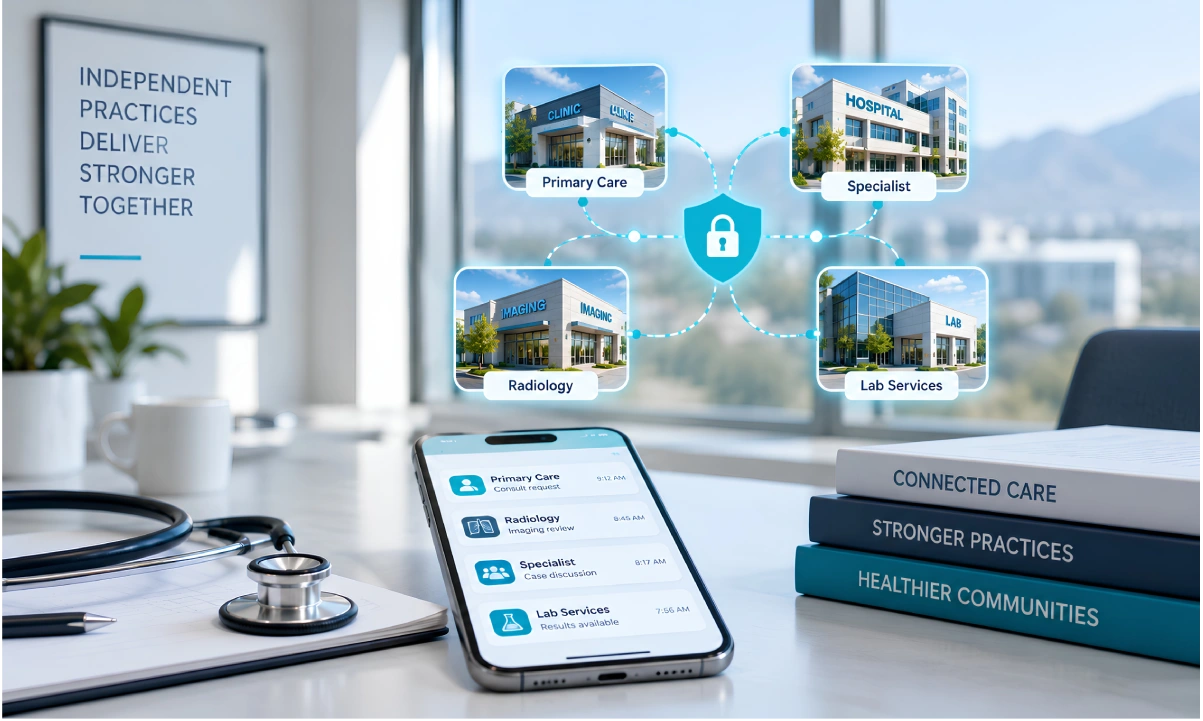
True clinical connectivity requires an approach that addresses the distinct environments in which physicians operate. We designed four interconnected modules, each with AI capabilities tailored to a specific dimension of clinical communication. Together, they constitute a secure, HIPAA-compliant unified clinical communication platform built exclusively for physicians, covering intra-practice coordination, inter-organizational consultation, industry engagement, and a physician-only peer community.
HCO Practice HQ: Smart Alert Routing for the Internal Practice
HCO is where we began and where the soft launch starts. This module is a cloud-based communication platform designed for internal medical practices. It brings linear and non-linear video, voice, and text into a single environment, supported by an AI layer that predictively routes critical alerts and automatically summarizes extended communication threads.
The practical consequence is one I hear physicians describe as the thing they most needed and did not know was possible: urgent patient updates reach the right physician without competing for attention with routine reminders. The noise is separated from the signal before it ever arrives. This is the module we are placing before the physician community now, in advance of our September 2026 comprehensive launch.
Learn more about HCO’s smart routing architecture at the HealthCare Organization module page.
HCC Consult Core: Making the Curbside Consult Count
Communication challenges grow significantly when providers must consult with external specialists, hospitalists, and regional networks. ClinicianCore’s HCC Consult Core was built to address a specific failure in how those consultations are currently handled: they happen constantly, they are rarely documented, and they generate no reimbursement for either the requesting or consulting physician.
HCC supports structured interprofessional consultations with embedded AI documentation that captures clinical reasoning and decision context in real time. Those consultations are automatically converted into billable records under active 2026 CMS CPT codes, including 99446 through 99449 for telephonic consultations and 99451 for consultant-side written or internet consultations. Research published in JAMA Network Open demonstrates that integrating AI documentation tools into clinical workflows can reduce documentation task load by up to 35%. We built HCC because the hallway consultation has never been invisible to the physician, only to the billing system.
Explore the HCC documentation and billing workflow at the HealthCare Collaboration module page.
HealthCare Xchange (HCX): A Protected Space for Strategic Dialogue
We built HCX for the physicians, administrators, and innovators who need a protected environment to discuss macro trends, emerging research, and organizational direction without the risks that come with uncontrolled channels. Every exchange within HCX operates under the same HIPAA-compliant infrastructure that governs our clinical modules. An AI moderation layer works continuously to prevent accidental data disclosure while curating a personalized content feed based on emerging medical literature and professional interests.
Physician Lounge: The Doctors’ Lounge, Rebuilt for the Digital Era
The final module is perhaps the one closest to my heart as a co-founder. The Physician Lounge Lounge addresses something the other three modules cannot: the professional isolation that quietly fuels physician burnout over years and careers. Doc. is a private, physician-only community space, completely free from administrators, insurance representatives, and external scrutiny.
It is the digital version of the hospital doctors’ lounge, a space where physicians can speak candidly, debate clinical cases, and rediscover the collegial dimension of medical practice. AI within Doc. assists with credential verification at onboarding and intelligently categorizes discussion threads so physicians immediately find the communities most relevant to their specialty.
Explore Physician Lounge Lounge
An Invitation to the May 2026 Soft Launch
A platform built to address the real-world complexity of clinical workflows must be validated by the physicians who live within those workflows every day. Theoretical validation in a controlled environment cannot replicate the pressures of a busy medical practice, and we have never pretended otherwise.
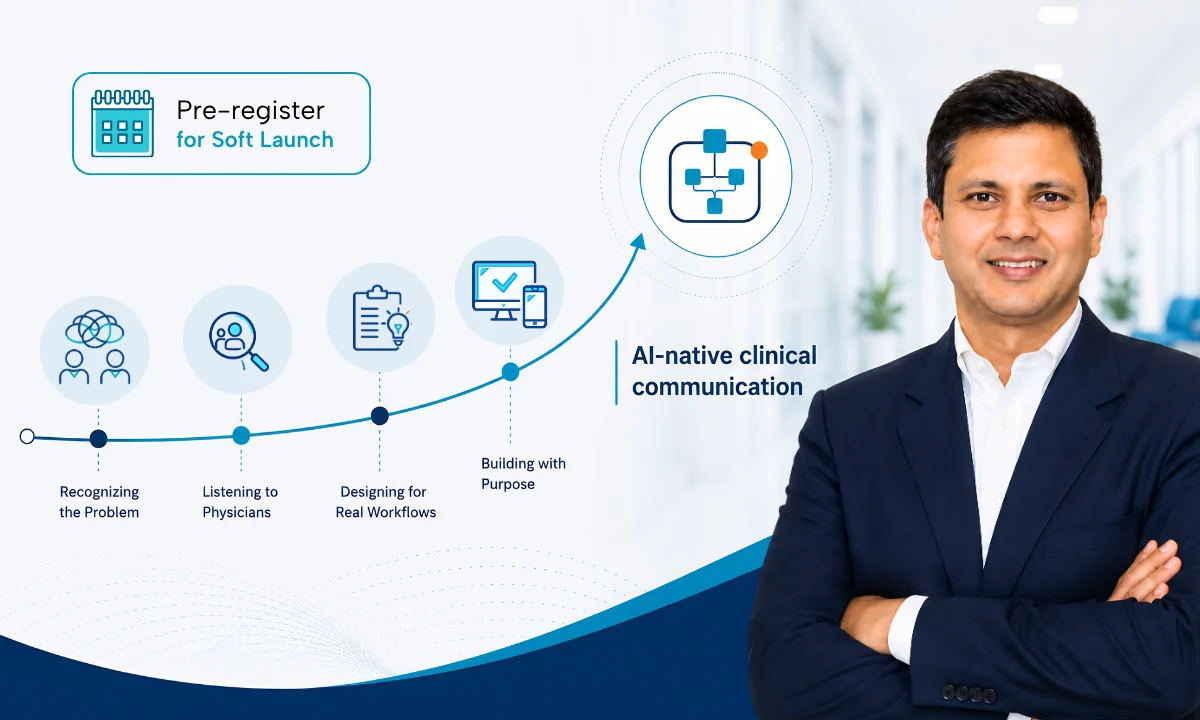
This month, we are formally opening the soft launch phase for our HealthCare Organization module. We are extending an invitation to a select cohort of independent primary care clinics, multi-specialty groups, and outpatient practice leaders to integrate HCO into their daily operations and share direct feedback before our comprehensive market launch in September 2026.
Participants will interact with the full HCO environment and directly shape our AI training sets, interface configurations, and feature priorities. For participating practices, this is an opportunity to operate on a secure, HIPAA-compliant unified clinical communication platform built exclusively for physicians before the broader market has access. If your practice is committed to reducing administrative friction and reclaiming clinical time, I invite you to register your interest for ClinicianCore 2026 Soft Launch. To calculate what communication-related inefficiency may be costing your practice specifically, visit our medical practice efficiency platform.
Three Questions I Am Asking the Physician Community
The AI capabilities within ClinicianCore continue to evolve in direct response to clinical feedback. We believe, as we always have, that true progress in this space is a collaborative endeavor. As we move through the soft launch phase, three questions are shaping our roadmap:
- What specific administrative or communication bottlenecks currently contribute most significantly to professional burnout within your medical practice?
- How do you envision AI-assisted documentation impacting your daily workflow efficiency and your time with patients?
- What structural elements do you consider most essential for maintaining trust, security, and genuine professional integrity in a verified physician peer community?
These are not rhetorical questions. Every response from the soft launch cohort informs the AI training sets, interface decisions, and feature priorities that will ship in September 2026. We want to hear from you. Together, we can dismantle the fragmented systems of the past and build a clinical communication infrastructure that actually serves the people who built their lives around medicine.
Frequently Asked Questions
What is an AI-native clinical communication platform?
An AI-native clinical communication platform integrates artificial intelligence at the architectural level, not as a feature add-on. ClinicianCore was trained on medical taxonomy to route alerts by acuity, auto-document interprofessional consultations, and verify physician credentials in real time, all within a HIPAA-compliant environment.
How does ClinicianCore’s HCO Practice HQ reduce physician burnout?
ClinicianCore’s HCO Practice HQ uses AI-powered smart alert routing to filter low-priority notifications before they reach the physician, surfacing only time-sensitive clinical updates. This reduces communication-related cognitive load, which the AMA identifies as a primary driver of burnout affecting 41.9% of U.S. physicians. Individual clinicians reclaim up to 90 minutes daily.
What CPT codes does ClinicianCore’s HCC Consult Core support for billable consultations?
ClinicianCore’s HCC Consult Core supports active 2026 interprofessional consultation CPT codes: 99446 (telephonic 5–10 min), 99447 (11–20 min), 99448 (21–30 min), 99449 (31+ min), 99451 (consultant written or internet consultation), and 99452 (requesting provider). All represent non-face-to-face consultations requiring no patient visit (CMS, 2026).
How does ClinicianCore ensure HIPAA compliance across all four modules?
ClinicianCore maintains HIPAA compliance across HCO, HCC, HCX, and Physician Lounge through encryption in transit and at rest, a zero-unencrypted-transmission architecture, AI-assisted credential verification, and proactive data exposure prevention built into the AI moderation layer. All four modules meet the standards of a secure, HIPAA-compliant unified clinical communication platform built exclusively for physicians.
When will ClinicianCore be available to all medical practices?
ClinicianCore’s HCO Practice HQ entered a structured soft launch in May 2026, open to a select cohort of independent clinics and multi-specialty groups. The comprehensive market launch across all four modules is scheduled for September 2026. Practices can register interest at ClinicianCore.com (ClinicianCore, 2026).