Building evidence-grounded and dependable healthcare systems
The field of information retrieval (IR) has a long history, dating back to practical information retrieval systems developed in the 1960s. Within computer science, it overlaps with many subjects, like database systems, human-computer interaction, language technology, image recognition and artificial intelligence, of which it is a subfield. Before the arrival of the web, it was largely confined to laboratories. After the web, large-scale retrieval systems rapidly emerged in the form of search engines.
The reason people use search is to acquire knowledge: there is a knowledge gap the user is seeking to fill. However, the user does not always articulate that need in a textual query (Belkin, 1980; Ingwersen & Järvelin, 2005) [1][2]. Each interaction with the search retrieval system changes the user’s state of knowledge. This challenge is particularly acute in medical information retrieval, where users may lack the medical knowledge needed to articulate their information needs precisely. From bag-of-words representation to agentic LLMs, everything about retrieval is changing very fast.
Key takeaways
- Medical knowledge is hierarchical, from drug class to ingredient to formulation and strength. A flat index of text chunks strips away that context.
- In medicine, a plausible-sounding answer is dangerous. Every answer must be backed by grounded evidence, traceable to a trusted source.
- High recall is mandatory: missing one rare case report, gene mutation or critical lab value can lead to a wrong diagnosis.
- Mean Reciprocal Rank and LLM-as-a-judge scoring both have known flaws, and AI agents need evaluation at every intermediate step, not only on the final answer.
- Without transparency on how a model was trained and validated, clinicians stay skeptical, and too many false positives lead to alarm fatigue.
- A trustworthy medical retrieval system anchors its answers in medical concepts and explains them in plain language.
“Medical AI demands zero tolerance for hallucinations, because the cost of being wrong is not a bad review or a lost sale but a misdiagnosis, a harmful drug interaction, or a patient who acts on false assurance.”
Pradeep Pujari, AI researcher, founder of the TensorHealth newsletter
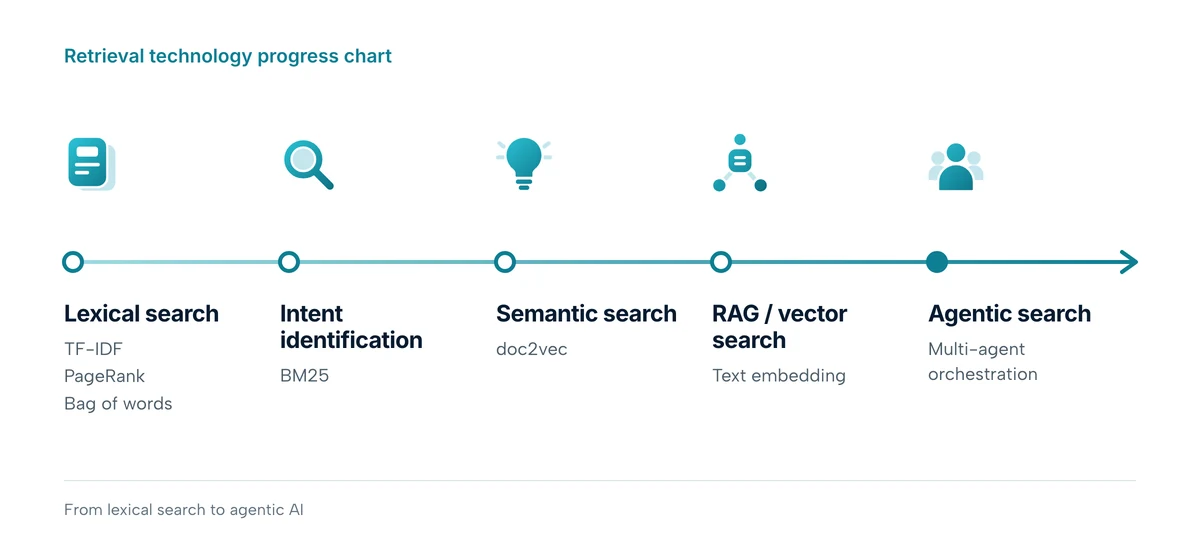
The evolution of information retrieval: from lexical search to agentic AI
Why is medical retrieval different?
Retrieval systems are built on a simple promise: getting the right information to the right people, in the right way, at the right time. Modern retrieval systems have evolved considerably, from lexical matching to embedding-based retrieval and LLM-powered agentic systems. Yet, despite these advances, a fundamental challenge remains. In medical AI, a system must also earn trust: ranking documents fairly, avoiding bias, never hallucinating, and being open about how answers are found, that is, transparency.
Most retrieval systems today use a flat data index structure: documents are split into chunks, embedded, and returned by similarity, with every chunk sitting on one level. Medical knowledge, however, is hierarchical by nature, from drug class to ingredient to formulation and strength, and from guideline to recommendation to supporting evidence. Flattening those layers strips away context, so a line like “the recommended dose is 500 mg” can lose track of which drug, formulation, or patient group it refers to. It also lets look-alike items, such as similar drug names or immediate-release versus extended-release versions, get retrieved interchangeably, which can be dangerous.
Unstructured data
Most electronic health record (EHR) data consists of free-text clinical notes, abbreviations, non-standard spelling, and temporal timelines that resist standard database querying tools like SQL. Medical data is full of qualifiers, contradictions, and temporal timelines.
Example: A patient’s file might say: “Patient exhibits symptoms of Disease X, however, genetic testing ruled this out.” A low-reliability retriever might pull the first half of the sentence and conclude the patient has Disease X.
Synonymy and polysemy
Medical concepts are expressed in multiple ways. A search for a drug might require knowing its brand names, generic names, chemical structures, or street names. Conversely, single terms can mean different things across specialties.
Drug and disease names are hard to spell. Few people can spell “metformin” or “gastroesophageal reflux disease” correctly, and many cannot. They type what they remember or how it sounds (“metfromin,” “acid reflux thing,” “that blood thinner my dad takes”) and hope for a useful answer. A retrieval system that only matches exact words will fail these readers’ expectations. A good medical retrieval system understands misspellings, phonetic guesses, brand names, and everyday descriptions, and connects them to the right drug or condition behind the scenes.
Data fragmentation and silos
High-quality research data is frequently distributed across isolated portals, unstandardized tables, and heterogeneous publishing frameworks. This lack of uniform data standards prevents discovery engines from drawing unified scientific links across diverse disease areas. Patient data tends to be siloed within hospitals and carefully guarded to protect privacy.
When plausible is dangerous
In standard AI applications, a “plausible-sounding” answer is often acceptable. In medicine, plausibility is dangerous.
Example: An AI might perfectly mimic the tone of a medical journal while hallucinating a drug dosage (e.g., writing 10.0 mg instead of 1.0 mg), or falsely claiming a drug is safe during pregnancy.
Unlike an AI search engine generating a recipe or an email summary, a failure in medical information retrieval can directly cause diagnostic errors, improper treatments, or lethal drug interactions. Medical AI demands zero tolerance for hallucinations, because “the cost of being wrong” is not a bad review or a lost sale but a misdiagnosis, a harmful drug interaction, or a patient who acts on false assurance. Every answer must be backed by grounded evidence, traceable to a trusted source rather than generated from the model’s best guess. Even a single confident error can destroy trust in the retrieval system itself, and that trust is slow to build and quick to lose.
Legal, regulatory, and liability
Hospital systems, medical journals, and software vendors face massive legal liabilities if an automated system provides unverified or harmful information.
How do we build trust?
In the medical domain, evaluation and reliability are not just engineering metrics — they are critical safety mechanisms, because the cost of an error is human life. They build the clinical trust required for real-world adoption.
Lack of evaluation metrics
The field of IR has a very long history of experiment-oriented research and has spent enormous effort improving relevance. Measuring recall and precision using human judgment is very expensive. Mean Reciprocal Rank (MRR) violates basic requirements for a metric, and MAP is based on unrealistic assumptions [3]. Often, reproducing these experiments is nearly impossible. Very often, researchers and practitioners regard them as established procedures.
Avoid MRR
The definition of Mean Reciprocal Rank (MRR) assumes that a user scans the ranked list and stops after the first relevant document is found.
Reciprocal rank: RR(r) = 1/r, where r is the rank of the first relevant document. Assume that three queries are sent to system A and system B. System A ranks the first relevant document at positions 1, 2 and 4. System B returns the first relevant document at rank 2 in each case.
- System A: average rank = 1/3 (1 + 2 + 4) = 2.33; MRR = 1/3 (1/1 + 1/2 + 1/4) = 0.58
- System B: average rank = 1/3 (2 + 2 + 2) = 2.0; MRR = 1/3 (1/2 + 1/2 + 1/2) = 0.5
Evaluation frameworks test the system’s ability to parse complex linguistic structures (negations, conditional statements, and temporal sequences) to ensure the AI doesn’t strip away vital clinical nuance. Rigorous evaluation metrics (like faithfulness and groundedness) ensure that the system cannot output information that does not explicitly exist in the verified source text.
Automated evaluation frameworks like LLM-as-a-judge are a cheaper, faster and scalable alternative, but they are biased. They systematically assign inflated scores to irrelevant results, depending on passage length and surface-level lexical cues [4].
What about LLM agents?
Evaluating agents is hard because it means judging conversations (traces), and IR has long struggled to go beyond query-result pairs. Evaluation should not be on the final answer only; it should be an inside-the-loop evaluation of every intermediate step.
The “missing needle” problem: high recall is mandatory
The answer was available, but the retriever didn’t surface it. In general web search, if you search for a recipe, you only need a few good results (high precision). In medical research or clinical diagnostics, missing one rare case report, a specific gene mutation, or a critical lab value can lead to a wrong diagnosis.
Example: If a researcher is checking for rare adverse side effects of a new drug, and the retrieval system misses the two published papers detailing lethal interactions, the evaluation fails entirely.
Risk: An unreliable tool forces the clinician to manually double-check every single claim, defeating the entire purpose of a retrieval system.
Risk: If an AI tool recommends an incorrect clinical pathway that leads to patient harm, the hospital faces malpractice lawsuits and regulatory penalties from bodies like the FDA.
Evaluation frameworks should provide a verifiable audit trail to regulators and legal teams that the retrieval architecture has been systematically stress-tested against rigorous biomedical benchmarks like BioASQ or MedQA [5][6] and operates within safe parameters.
The transparency deficit
A University of Michigan study says companies often make highly specific claims about how AI tools improve workflow and generate financial savings, yet are under no obligation to release information that would make it easier to verify such supposed benefits [7]. This could include “how the model was trained, what kind of dataset was used, what methodology did they use to develop it, and where did they validate the model to come up with the reported performance statistics.” Without such transparency, clinicians are skeptical of technology that wastes their time or provides noisy, irrelevant information. If a retrieval system yields too many false positives, doctors will experience alarm fatigue and completely stop using the tool.
Conclusion
A recent MIT Technology Review brief highlights how AI models are increasingly trained to refuse user prompts, raising concerns about over-reliance on automated safeguards [8]. Understanding AI refusal mechanisms is essential for safe deployment of clinical retrieval knowledge tools.
A trustworthy medical retrieval system has to do two things well:
- Anchor its answers in medical concepts and medicine composition.
- Explain them in plain language, ideally through short videos the public can follow.
Retrieval needs to be anchored in medical concepts
Many medical retrieval systems match text to text without anchoring results to the underlying medical concepts. They can’t reliably drill down from a condition to its treatments, or from a medicine to its composition, such as active ingredients, strengths, and formulations. Without that anchor, a system can return something that sounds relevant but misses what actually matters, such as which ingredient is in a product, how it relates to a condition, or how it differs from a similar-sounding alternative. Grounding retrieval in structured medical knowledge makes answers more precise, traceable, and trustworthy.
Retrieval should explain, not just return documents
Relevance is not everything in medical science. Accurate information is only useful if the person asking can understand it. Most people searching for medical answers are not clinicians, yet results are often written in dense clinical language. Medical retrieval systems should also surface short video explanations that answer the query in simple, everyday words. A brief, well-made video can turn a technical answer into one a general reader understands and can act on, which is a large part of what makes a healthcare system dependable in practice.
Frequently asked questions
What is medical information retrieval?
Medical information retrieval is finding the right medical evidence for a question, from drug and disease facts to guidelines and research. People often cannot put their need into exact words (Belkin, 1980), so a good system understands misspellings, brand names and everyday descriptions and maps them to the right concept.
Why is retrieval in medical AI harder than general web search?
Medical knowledge is hierarchical, running from drug class to ingredient to formulation and strength, while most retrieval systems use a flat index of text chunks. Flattening strips context, so a dose can lose track of its drug or patient group (Pujari, 2026). EHR data adds free text, negations, abbreviations and timelines that resist standard queries.
Why is Mean Reciprocal Rank a weak metric for medical retrieval?
Mean Reciprocal Rank only scores the first relevant document, as if every user stops reading there. In a three-query example, a system with first relevant results at ranks 1, 2 and 4 scores 0.58 and beats one at rank 2 every time, which scores 0.5, despite a worse average rank (Fuhr, 2018).
Can an LLM-as-a-judge evaluate medical search results?
An LLM-as-a-judge is cheaper, faster and more scalable than human relevance judgment, but it is biased. A 2026 study found that LLM judges systematically gave inflated relevance scores to passages that did not meet the need, swayed by passage length and surface word cues (Yu et al., 2026). Human review still matters.
Why does high recall matter in medical retrieval?
In medical research and diagnostics, missing one rare case report, gene mutation or critical lab value can lead to a wrong diagnosis. A drug-safety search that misses the two papers describing lethal interactions has failed, however precise its other results. Systems should be stress-tested against biomedical benchmarks such as BioASQ, launched in 2013 (BioASQ, 2013).
How can a medical AI retrieval system earn clinicians’ trust?
It anchors answers in medical concepts, such as a medicine’s active ingredients, strengths and formulations, and backs each answer with grounded evidence traceable to a trusted source. It is open about how its model was trained and validated (Pujari, 2026), and it explains answers in plain language that non-clinicians can understand and act on.
Guest perspectives reflect the author’s own views and experience. They are not clinical advice.
References
[1] Belkin NJ. Anomalous states of knowledge as a basis for information retrieval. Canadian Journal of Information Science, 1980;5:133–143.
[2] Ingwersen P, Järvelin K. The Turn: Integration of Information Seeking and Retrieval in Context. Springer, 2005. https://link.springer.com/book/10.1007/1-4020-3851-8
[3] Fuhr N. Some common mistakes in IR evaluation, and how they can be avoided. SIGIR Forum, 2018. https://dl.acm.org/doi/10.1145/3190580.3190586
[4] Yu C, Li H, Zuccon G, Mackenzie J, Leelanupab T. When LLM Judges Inflate Scores: Exploring Overrating in Relevance Assessment. SIGIR, 2026. https://arxiv.org/abs/2602.17170
[5] BioASQ: a challenge on large-scale biomedical semantic indexing and question answering. http://bioasq.org/
[6] Jin D, Pan E, Oufattole N, Weng WH, Fang H, Szolovits P. What Disease Does This Patient Have? A Large-scale Open Domain Question Answering Dataset from Medical Exams (MedQA). arXiv, 2020. https://arxiv.org/abs/2009.13081
[7] University of Michigan study on AI vendor claims and transparency.
[8] We’re putting too much faith in AI’s ability to say no. MIT Technology Review, 9 October 2026. https://www.technologyreview.com/2026/10/09/1145728/we-are-putting-too-much-faith-in-ai-to-say-no/