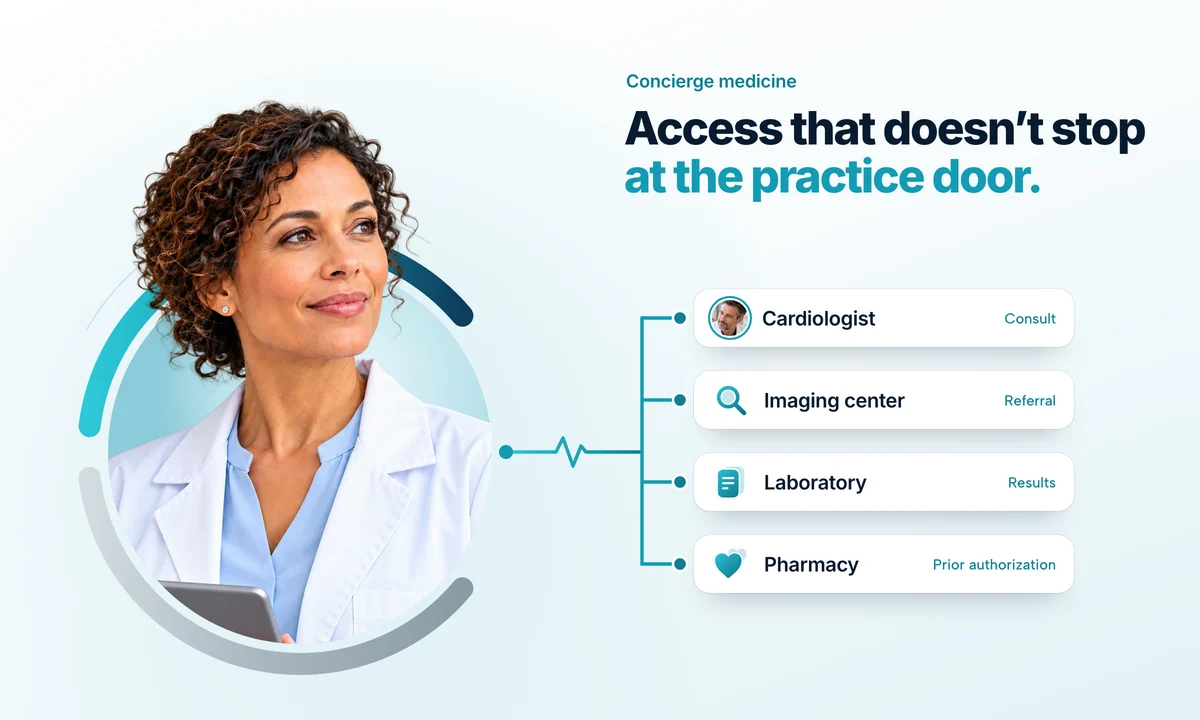
A member messages her concierge physician about a new rash that appeared shortly after starting a medication. The physician suspects a drug reaction but wants dermatology input before changing treatment. Instead of sending the member to a specialist and waiting weeks for an appointment, the physician submits an eConsult with photographs and relevant clinical history. A dermatologist reviews the case, recommends next steps, and the member gets answers quickly from the physician she already knows and trusts.
That is the promise of an eConsult: specialist expertise without automatically sending the patient elsewhere. An eConsult is an interprofessional consultation in which a specialist advises the treating physician without seeing the patient directly. The concierge physician remains responsible for the member’s care, communication, and follow-up. A referral, by contrast, transfers part of the member’s care to the specialist. Many clinical questions require only the first approach.
The distinction matters especially in concierge medicine. Members pay for direct access to a physician who knows their history, understands their goals, and coordinates what happens next. A referral that results in a five-week wait to see an unfamiliar specialist is often the experience they joined a concierge practice to avoid. In a survey of patients at nine U.S. academic medical centers, 78% of those who received an eConsult said they would choose one again for a similar problem, and researchers found that trust in their primary care physician was a key contributor to a positive experience [1].
This guide explains when to use an eConsult and when a referral is the better choice, how to frame a consult question, what to communicate to members, and how specialist recommendations become part of the medical record. It builds on our overview of how concierge practices coordinate consults, referrals, and outside organizations. ClinicianCore, a secure, HIPAA-compliant clinical communication platform built exclusively for physicians, supports each step through ConsultCore.
Key Takeaways
- An eConsult brings specialist expertise into the care plan while allowing the concierge physician to remain the member’s primary clinician. A referral transfers part of the member’s care to the specialist.
- eConsults work best for focused clinical questions about labs, imaging findings, medications, diagnoses, and treatment options. Conditions requiring an in-person examination, procedure, or urgent intervention generally warrant a referral.
- The quality of the answer depends on the quality of the question. Include the clinical question, relevant history, test results, member goals, urgency, and the specific guidance you need.
- Keep members informed before and after the eConsult. Understanding that their physician sought specialist input on their behalf reinforces trust and continuity of care.
- Make sure specialist recommendations become part of the medical record. When consultations occur outside the EHR, the requesting physician is typically responsible for documenting the advice and resulting care plan.
When should a concierge physician ask for an eConsult?
The American College of Physicians describes the difference plainly. A cognitive consultation answers “a discrete question” in one or a few rounds of communication, and the requesting physician stays “responsible for delivering care” while the specialist provides expert guidance. Between clinicians, that usually takes the form of an eConsult [2].
An eConsult fits when the question can be answered from data. At Massachusetts General Hospital, abnormal liver tests and imaging findings made up nearly half of 2,416 gastroenterology eConsults, and the authors found the service most useful for “objective, data-driven questions” [3]. Medication questions, the next step in a workup, and “does this need a specialist visit at all?” fall in the same group.
Refer straight away when:
- the problem is urgent;
- the specialist needs to examine the member or perform a procedure;
- the member already has a relationship with that specialist; or
- the member would rather be seen in person (more on this below).
The stakes for the member are time. AMN Healthcare’s 2025 survey of 15 large metro areas found an average wait of 31 days for a new-patient appointment across six specialties [4]. An eConsult does not always avoid that wait, but it often answers whether the wait is needed. In the Veterans Health Administration, only 21.5% of more than 3.1 million eConsults led to an in-person visit with the same specialty within a year [5]. That is a large health system with salaried specialists, so treat it as a sign of what is possible, not a forecast for your practice.
What should the question to the specialist include?
The specialist cannot ask the member anything, so the question has to carry the case. ACP calls a clear clinical question and enough history “critical” for eConsults, because the specialist “will not have the opportunity to clarify details with the patient” [2]. Its playbook lists what a strong request contains [2]:
- the clinical question;
- a summary of pertinent details;
- the patient’s goals;
- the urgency;
- supporting data; and
- the role you want the specialist to play.
Here is how that looks for a common concierge question. Dr. Mitchell, a concierge internist, sees a mildly raised ALT on two sets of routine labs for a member who takes a statin and feels well. A request built on those six elements might read:
| Element | What Dr. Mitchell writes |
|---|---|
| Clinical question | Does this persistent mild ALT elevation need a hepatology visit, or can I complete the workup here? |
| Pertinent details | Two results three months apart, current medications, alcohol history, weight trend |
| Member’s goals | Wants to stay on the statin and avoid procedures that aren’t needed |
| Urgency | Routine |
| Supporting data | Liver panel, hepatitis serologies, abdominal ultrasound report |
| What I need back | Next tests, a threshold for referral, and whether to adjust the statin |
The wording matters more than it looks. In a Canadian study of 300 rheumatology requests, 38.7% of faxed referrals had no specific question at all, and the rheumatologist judged that 72% of them could have benefited from an eConsult [6]. An earlier analysis of 1,055 eConsults found that referral outcomes depended on “the type of question being asked, the formulation of each question, and the specialty” [7]. Yale’s program built condition-specific templates for exactly this reason: to help primary care physicians ask a clear clinical question and pull in the relevant record [8].
How do you explain an eConsult to a member?
Members are often left out of the loop. In the multicenter patient survey, 52.9% of patients who had an eConsult did not know their physician had placed one [1]. The same researchers concluded that “trust and confidence in one’s PCP are crucial ingredients for a satisfying eConsult experience,” and called for more effort to include patients in eConsult decisions and communication [1].
That is the concierge physician’s strength. A short conversation before the consult covers what ACP asks the patient side to understand: the specialist is being asked for advice, not to take over the care, and the member should know how the result will come back [2]. ACP also expects patients to be able to say they would prefer an in-person consultation [2]. Dutch patients interviewed about digital specialist consults said the decision was usually made without them, and that they valued a follow-up conversation, especially when the answer was uncertain [9].
A script can be this simple: “I’d like a hepatologist’s view on your liver tests. I’ll send her your results and my questions, she’ll send me her advice, usually within a few days, and I’ll call you to go through it. If she thinks you should see her, we’ll book that together. Is that all right with you?”
When Medicare is billed for the consultation, the member’s agreement is also a requirement. CMS requires “the patient’s verbal consent that is noted in the medical record for each interprofessional consultation,” and that consent includes making the patient aware of any cost sharing [10]. That applies to most concierge and hybrid practices: about 60% of the clinicians in a national study of concierge and direct primary care practices billed Medicare [11].
How fast do specialists answer, and what should the answer contain?
In recent US programs, answers usually came within a few business days. Yale’s eConsult program averaged one business day across 34 specialties, and 53% of eConsults took the specialist 10 minutes or less [8]. Massachusetts General Hospital’s gastroenterology service averaged 2.6 business days [3]. Across the 72 studies in a 2024 systematic review, median response times ranged from 1 hour to 39 days, so expectations should be agreed with each specialist rather than assumed [12].
ACP describes a useful reply as one that includes [2]:
- specific recommendations;
- the reasoning behind them;
- “if-then” guidance for what might happen next; and
- when to consult again or when a face-to-face visit is needed.
The specialist can also say that a case is too complex for a consult and propose co-managing it [2]. For the member, there are three possible outcomes: the concierge physician manages the problem with the specialist’s advice, the specialist asks for more information first, or the member needs a visit. In every case, the member hears it from their own physician.
How does the answer reach the chart and the member?
ACP is explicit on both points. For eConsults, the specialist sends the recommendations to the referring physician, “who will then communicate with the patient/family” [2]. And when the eConsult platform is not part of the EHR, “the requesting clinician is responsible to make sure the recommendations … are incorporated into the patient’s medical record” [2].
For independent practices that second point is the weak spot. In a 2024 survey of 8,122 family physicians, only 19% said they often received notes and consultation reports from independent practices automatically in their EHR [13]. An answer that lives in a text thread or a phone call cannot show what was recommended, by whom, or when.
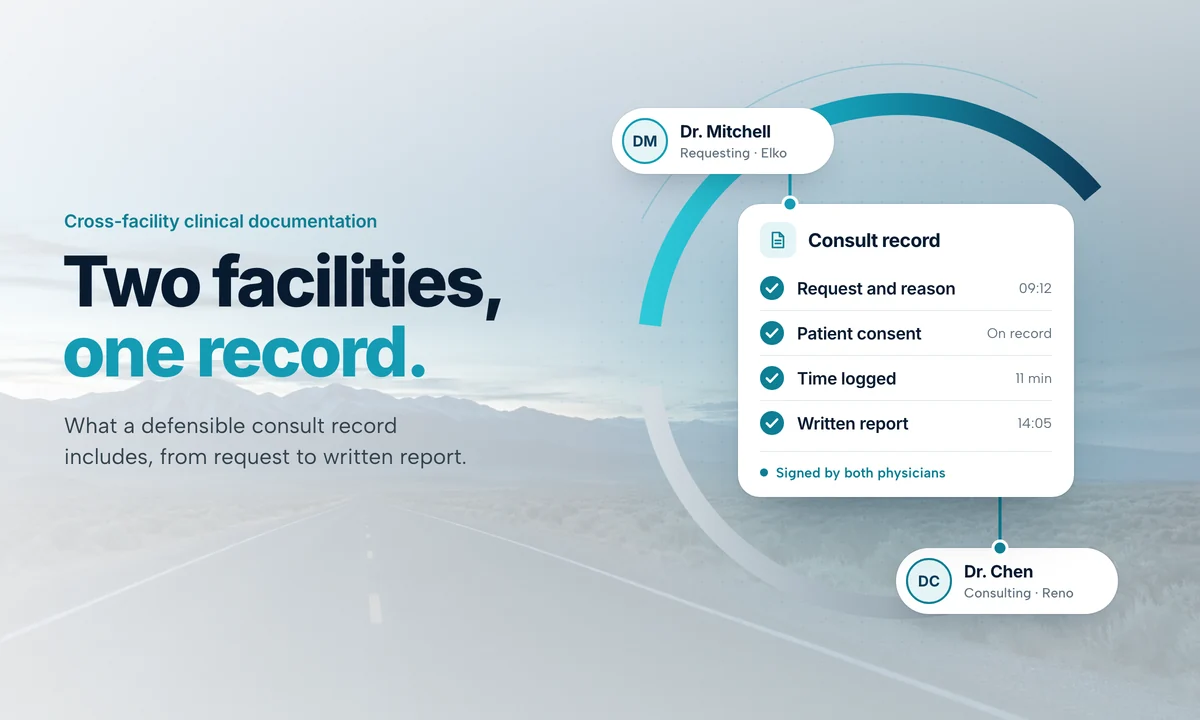
ClinicianCore, a secure, HIPAA-compliant unified clinical communication platform built exclusively for physicians, produces a signed consult record that can be downloaded and added to the member’s chart, so the answer, the reasoning and both physicians’ signatures stay together. More on the platform: unified clinical communication platform.
Which specialists will answer, and how do you keep them answering?
Concierge practices rarely employ the specialists they rely on, so the consulting panel has to be built. ACP’s advice is to start with specialists “who already have a strong relationship with the referring clinicians,” and to keep a simple two-way feedback loop on whether the request was clear and the answer useful [2]. Physician Lounge, ClinicianCore’s physician-only space, is one place to meet and keep in touch with those colleagues.
Respect for the specialist’s time is the other half. In a survey of specialists in Newfoundland and Labrador published in 2026, 90% had no protected time for eConsults, 92% answered them outside working hours at least some of the time, and only 44% were paid for them [14]. That unprotected, after-hours work adds to the load behind physician burnout. Ontario specialists said their main reasons for answering eConsults were “innovative patient care”, shorter waits and direct contact with primary care [15]. A concierge physician who sends complete, specific questions, accepts the specialist’s preferred turnaround and thanks them with feedback is the colleague specialists keep answering.
Any payment to a specialist must be for consultative work actually done. No one is paid for sending or receiving referrals.
Where does billing fit for a concierge practice?
Medicare pays for interprofessional consultations on both sides: the requesting physician (CPT 99452) and the consulting specialist (CPT 99446–99449 and 99451) [16]. Separate payment is for consultations that benefit the specific patient, not for professional courtesy or continuing education [10]. Whether a given consult qualifies depends on payer rules, time, format, documentation and consent. For the details, see what CPT requires for interprofessional consult billing and telephonic vs written interprofessional consultation. Retainer fees should stay clearly separate from anything billed to insurance.
What does the evidence on eConsults actually show?
The evidence is promising but limited, and it comes from health systems, not concierge practices. A 2024 systematic review of 72 studies found eConsults associated with better access to specialist care and more avoided referrals, but graded the evidence low or very low [12]. A 2020 review found “only modest empirical evidence” on important outcomes [17], and a randomized trial in Ontario was inconclusive on whether eConsults change referral rates [18]. The fair reading is that an eConsult is a good tool for the right question, used by physicians who know their patients. That describes concierge practice well.
How does ConsultCore support an eConsult?
ConsultCore is the physician-to-physician consultation module of ClinicianCore, a secure, HIPAA-compliant unified clinical communication platform built exclusively for physicians. For the liver question above, it works like this:
- Dr. Mitchell starts a consult now or schedules one, or asks a member of staff to set it up.
- She invites the hepatologist, even if the specialist is not yet on ClinicianCore, and shares the question and relevant history.
- The two physicians discuss the case in the consult, and the specialist can ask what she needs to know.
- ConsultCore produces a transcription and a summary for physician review, and suggests a CPT code based on who is consulting. The code can map to a billable service when payer requirements are met; nothing is billed automatically.
- Both physicians sign the record, and Dr. Mitchell downloads it for the chart.
- Dr. Mitchell calls the member, explains the advice and agrees the next step.
ConsultCore supports the conversation and the record. The clinical decision stays with the physicians.
Conclusion
Most questions a concierge physician sends outside the practice are questions, not handovers. An eConsult answers them quickly, keeps the member with the physician they chose, and saves the referral for the problems that need one. It works best with a clear question, a member who knows what is happening, a specialist who is respected, and a record that reaches the chart.
ClinicianCore is a secure, HIPAA-compliant unified clinical communication platform built exclusively for physicians, with ConsultCore for documented physician-to-physician consultation. For the wider picture of consults, referrals and outside organizations in concierge care, read how concierge practices coordinate care beyond the practice and our white paper on physician-to-physician consultation.
To see how ConsultCore works for a concierge practice, Request a Live Demo.
Frequently asked questions
Can a member ask to see the specialist instead of having an eConsult?
Yes. Professional guidance expects patients to be able to state a preference for an in-person consultation, and the concierge physician should offer that choice. Most eConsult patients surveyed were satisfied with the specialist’s advice: 81.4% (JGIM, 2020). If the member chooses a visit, the signed ClinicianCore ConsultCore record can go with the referral.
What happens if the specialist says the member needs a visit?
The concierge physician books the referral with the context already gathered, and tells the member why. In the Veterans Health Administration, 21.5% of eConsults led to an in-person visit with the same specialty within a year (AJMC, 2021). ClinicianCore ConsultCore keeps the signed consult record for the referral.
Is an eConsult appropriate for an urgent problem?
No. Urgent problems, and anything needing an examination or procedure, should go to a direct referral or emergency care. Answers in recent US programs took about one to three business days, for example one business day on average at Yale (PLOS One, 2024). ClinicianCore ConsultCore is meant for planned, question-focused consultations, not emergencies.
Does the member have to agree to an eConsult?
When Medicare is billed, yes: CMS requires the patient’s verbal consent, noted in the record, for each consultation, including awareness of cost sharing (CMS, 2018). It is good practice either way, since 52.9% of eConsult patients did not know one happened (JGIM, 2020). ClinicianCore keeps the consult on record.
How long does a specialist take to answer an eConsult?
Usually a few business days, but it varies by program. Massachusetts General Hospital’s gastroenterology eConsults averaged 2.6 business days (Gastro Hep Advances, 2026). Agree a realistic turnaround with each specialist in advance. ClinicianCore ConsultCore lets physicians start a consult immediately or schedule one.
Who tells the member what the specialist recommended?
The concierge physician does. Professional guidance says the specialist reports to the requesting physician, who then talks to the patient, and the requesting physician makes sure the advice reaches the chart. Only 19% of family physicians often receive outside consult reports automatically (JAMA Network Open, 2025). ClinicianCore provides a signed, downloadable consult record.
References
[1] Ackerman SL, Gleason N, Shipman SA. Comparing Patients’ Experiences with Electronic and Traditional Consultation: Results from a Multisite Survey. Journal of General Internal Medicine, 2020. https://pubmed.ncbi.nlm.nih.gov/32076987/
[2] Beyond the Referral: Principles of Effective, Ongoing Primary and Specialty Care Collaboration (Playbook). American College of Physicians, 2022. https://acponline.org/sites/default/files/acp-policy-library/policies/beyond_the_referral_playbook_2022.pdf
[3] Bonilla C, Palchaudhuri S, Thiim M, et al. From Pilot to Practice: A Large-Scale Evaluation of Gastroenterology E-Consultations at an Academic Medical Center. Gastro Hep Advances, 2026. https://pubmed.ncbi.nlm.nih.gov/42232890/
[4] 2025 Survey of Physician Appointment Wait Times and Medicare and Medicaid Acceptance Rates. AMN Healthcare, 2025. https://www.amnhealthcare.com/siteassets/amn-insights/physician/ps-2025-physician-appt-wait-times—wp-v6.pdf
[5] Saxon DR, Kaboli PJ, Haraldsson B, et al. Growth of Electronic Consultations in the Veterans Health Administration. American Journal of Managed Care, 2021. https://pubmed.ncbi.nlm.nih.gov/33471457/
[6] Keely E, Rostom K, Smith D, Liddy C. A comparison of faxed referrals and eConsult questions for rheumatology referrals: a descriptive study. CMAJ Open, 2021. https://cmajopen.ca/content/9/1/E38
[7] Tran C, Liddy C, Pinto N, Keely E. Impact of Question Content on e-Consultation Outcomes. Telemedicine and e-Health, 2016. https://pubmed.ncbi.nlm.nih.gov/26281010/
[8] Arora A, Fekieta R, Spatz E, et al. Implementation and evaluation of an electronic consult program at a large academic health system. PLOS One, 2024. https://pubmed.ncbi.nlm.nih.gov/39264980/
[9] Peeters KMM, Hidding CY, Buist P, et al. Exploring patient involvement and influencing factors in digital interdisciplinary consultation. Patient Education and Counseling, 2025. https://pubmed.ncbi.nlm.nih.gov/41046819/
[10] Medicare Program; Revisions to Payment Policies Under the Physician Fee Schedule and Other Revisions to Part B for CY 2019 (83 FR 59452). Centers for Medicare & Medicaid Services, Federal Register, 2018. https://www.govinfo.gov/content/pkg/FR-2018-11-23/html/2018-24170.htm
[11] Zhu JM, Marsh T, Polsky D, Huntington A, Song Z. Growth in Number of Practices and Clinicians Participating in Concierge and Direct Primary Care, 2018–23. Health Affairs, 2025. https://pmc.ncbi.nlm.nih.gov/articles/PMC12965179/
[12] Peeters KMM, Reichel LAM, Muris DMJ, Cals JWL. Family Physician-to-Hospital Specialist Electronic Consultation and Access to Hospital Care: A Systematic Review. JAMA Network Open, 2024. https://pmc.ncbi.nlm.nih.gov/articles/PMC10787322/
[13] Everson J, Adler-Milstein J, Phillips RL, Bazemore AW, Patel V. EHR Interoperability Experiences Reported by Family Physicians. JAMA Network Open, 2025. https://pubmed.ncbi.nlm.nih.gov/41231471/
[14] Mader J, Angelique M, Cooke-Hubley S. Experiences of specialist physicians with e-consultations. Digital Health, 2026. https://pubmed.ncbi.nlm.nih.gov/41982623/
[15] Keely E, Williams R, Epstein G, Afkham A, Liddy C. Specialist Perspectives on Ontario Provincial Electronic Consultation Services. Telemedicine and e-Health, 2019. https://pubmed.ncbi.nlm.nih.gov/29746210/
[16] Medicare and Medicaid Programs; CY 2025 Payment Policies Under the Physician Fee Schedule (89 FR 97710). Centers for Medicare & Medicaid Services, Federal Register, 2024. https://www.govinfo.gov/content/pkg/FR-2024-12-09/html/2024-25382.htm
[17] Vimalananda VG, Orlander JD, Afable MK, et al. Electronic consultations (E-consults) and their outcomes: a systematic review. Journal of the American Medical Informatics Association, 2020. https://pubmed.ncbi.nlm.nih.gov/31621847/
[18] Liddy C, Moroz I, Keely E, et al. Understanding the impact of a multispecialty electronic consultation service on family physician referral rates to specialists: a randomized controlled trial. Trials, 2019. https://pubmed.ncbi.nlm.nih.gov/31182123/
Statistics are reported as published by each source. Most eConsult studies come from health systems and the VA, not concierge practices. CPT codes and payer rules change; confirm current requirements before billing. CPT is a registered trademark of the American Medical Association.