I still remember a late Tuesday evening in a regional medical center outside Reno. The call board was full, the waiting room was backed up, and our shift was already two hours past its scheduled end. A complicated handoff had come in for a patient with multiple severe comorbidities. The charts were fragmented, the previous shift had vanished into well-earned sleep, and the critical context was nowhere to be found. In that moment of quiet tension, a senior colleague stepped in. She did not raise her voice, nor did she issue a grand directive. Instead, she sat down at the terminal, methodically parsed through the fragmented notes, organized the critical care priorities, and walked the resident through the exact decision logic needed to keep that patient safe through the night.
That single act of composure saved a life that evening, but it also taught me what real clinical guidance looks like. It is rarely delivered from a boardroom podium or attached to a formal administrative title. In states like Nevada, where resources are stretched thin and clinical demands are high, it is the quiet, steady leadership of dedicated physicians that holds the entire healthcare framework together.
Nevada has fewer physicians per resident than almost any other state, yet its clinical teams still run rounds on time, cover overnight call, and keep patients out of the emergency department when a phone call would do instead. That does not happen by accident. It happens because physicians across the state, in Reno exam rooms and Las Vegas nursing stations alike, quietly take on leadership that never shows up on an org chart: the attending who rewrites a confusing handoff template, the family physician who mentors a resident through a hard rotation, the surgeon who insists a documented consult replace a hallway guess.
This piece looks at what that leadership actually does for patient care, for the teams physicians lead, and for the communities those teams serve. ClinicianCore, a secure, HIPAA-compliant unified clinical communication platform built exclusively for physicians, exists because that leadership deserves tools that keep up with it.
Key Takeaways
- Nevada’s active physician density runs well below the national average by every recent federal measure, so each physician leader’s influence reaches further than it would in a better-staffed state (AAMC, 2025).
- Leadership and communication are consistently named among the top reported root causes of sentinel events nationwide, and communication lapses factor into a large share of serious errors (The Joint Commission, 2024).
- U.S. physician burnout fell below 45 percent in 2025, the lowest rate since before the pandemic, even as reported stress and anxiety climbed back toward pandemic-era levels (AMA, 2025; The Physicians Foundation, 2025).
- Physician engagement in leadership has been linked to better patient care, stronger organizational performance, and improved staff well-being (NIH-hosted review, 2024).
- All 17 Nevada counties currently carry some level of federal Health Professional Shortage Area designation, which is part of why local, informal physician leadership carries outsized weight (Nevada DPBH / HRSA, 2026).
“Most of the leadership holding Nevada’s care teams together never earns a title. It is the physician who rewrites the confusing order set, mentors the resident nobody has time for, and turns a hallway consult into something the next doctor can actually use. That is the leadership worth celebrating.”
Nevada’s Physician Shortage Makes Leadership Non-Optional
Nevada is not simply short on physicians. It is short in nearly every specialty at once. The Association of American Medical Colleges found that Nevada tied with Oklahoma, Texas, and Utah for the fewest direct patient care general surgeons per capita in the country in 2025, at five per 100,000 residents against a national figure of six. Depending on which federal count is used, Nevada’s active physician density runs well under the national norm across most specialties. The Nevada Division of Public and Behavioral Health reports that all 17 counties in the state currently carry some form of federal Health Professional Shortage Area designation, a status tied to population-to-provider ratios, poverty rates, and travel time to care.
None of that changes what a patient in Elko or Henderson needs on a Tuesday afternoon. It does change how much weight rests on the physicians already practicing. When a specialty has five surgeons per 100,000 people instead of the national average of six, the surgeon who takes five extra minutes to mentor a resident, or who pushes a department to standardize its handoff, is not doing something optional. She is doing the only version of workforce expansion Nevada has access to in the short term: making the physicians already here more effective, and making sure fewer of them leave.
That is the quiet leadership this piece is about. It rarely comes with a title.
What Quiet Leadership Actually Looks Like
Physician leadership is often pictured as a chief medical officer’s office or a department chair’s title. Most of it is not that. A 2024 review of physician leadership research hosted by the National Institutes of Health’s PubMed Central library found that physician engagement in the leadership of health systems has been linked to better patient care, stronger organizational performance, improved staff well-being, and better patient outcomes overall. The same review noted something less flattering: most physicians move into these roles with little formal preparation, learning the skill on the job rather than in training.
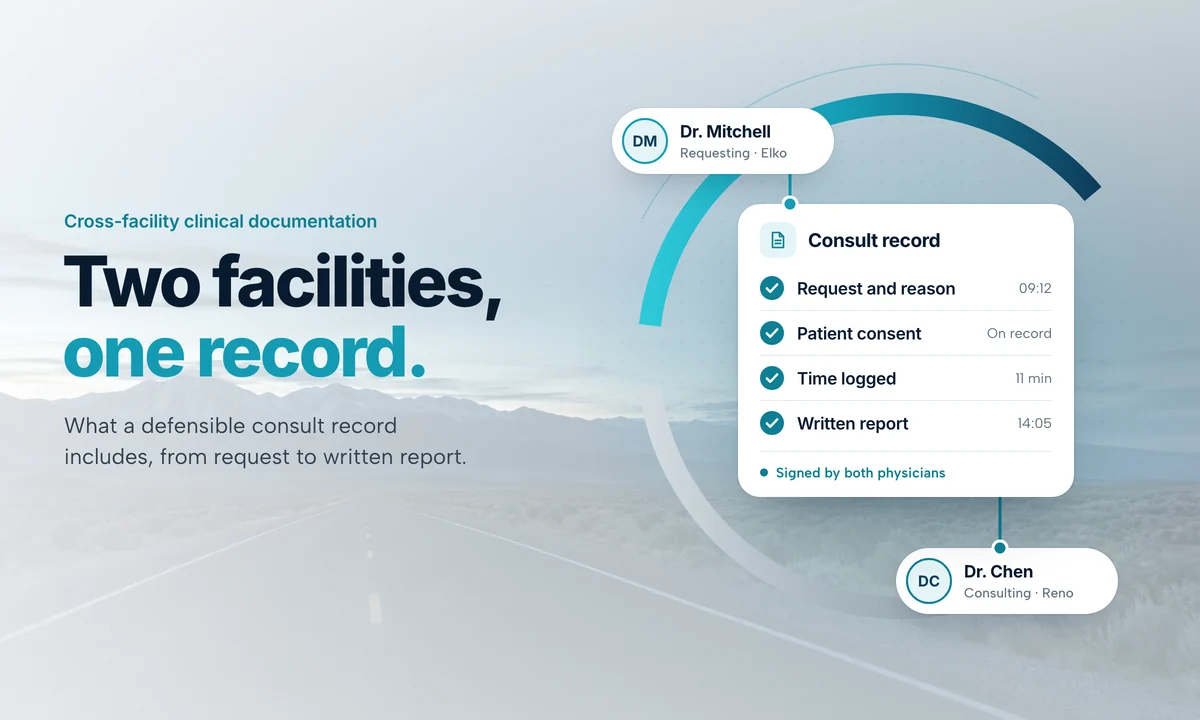
In a Nevada clinic or hospital unit, that leadership tends to look ordinary. It is the physician who rewrites a confusing order set after the third nurse asks about it. It is the one who calls a struggling colleague before a shift instead of after a complaint. It is the one who insists that a curbside opinion in the hallway gets turned into a documented, billable interprofessional consult, so the next physician who reads the chart knows exactly what was decided and why. None of it requires a leadership seminar. It requires a physician who has decided that the team’s clarity is part of the job, not an extra.
That decision is where the connection to patient outcomes actually starts.
The Direct Line Between Physician Leadership and Patient Care
The data on why this matters is not abstract. The Joint Commission’s sentinel event reporting has consistently placed leadership and communication among the top reported root causes of the serious, preventable harm events hospitals investigate, and a large share of those errors trace back to a communication lapse, often during a handoff between clinicians. The Agency for Healthcare Research and Quality built its TeamSTEPPS 3.0 training, released in 2024, around four core modules for exactly this reason: Communication, Team Leadership, Situation Monitoring, and Mutual Support. Leadership is not an add-on to that framework. It is one of the four pillars holding it up.
Physicians who lead quietly are already doing informal versions of what TeamSTEPPS tries to teach formally. They close the loop on a verbal order instead of assuming it was heard correctly. They ask the newest nurse on the unit to repeat back a critical value. They make sure the physician covering nights has the same picture of a complicated patient that they do. This is where a secure, HIPAA-compliant unified clinical communication platform built exclusively for physicians earns its place: not as a replacement for that judgment, but as the record that keeps it from disappearing at shift change. ClinicianCore’s ConsultCore module exists to turn exactly that kind of informal consult into a documented one, and the unified clinical communication platform behind it is built so a video call, a voice memo, and a secure text thread about the same patient live in one place instead of three.
Leadership That Steadies the Team, Not Just the Chart
Physician well-being is where leadership’s effect is easiest to measure and hardest to talk about. The American Medical Association reported in 2025 that physician burnout had fallen below 45 percent nationally, the lowest rate recorded since before the COVID-19 public health emergency, based on survey data from nearly 18,000 physicians across more than 100 health systems. That is real progress. It is also not the whole picture. The Physicians Foundation’s 2025 Wellbeing Survey, fielded the same year, found that while physicians reporting frequent burnout declined from 60 percent to 54 percent, more than half of physicians surveyed had experienced debilitating stress, and reported anxiety and withdrawal from family and colleagues had climbed back toward levels last seen during the height of the pandemic.
Physician leaders sit in the middle of that gap. A department head or senior physician who protects a colleague’s inbox from unnecessary alert noise, who routes an escalation to the right person instead of the whole team, or who simply asks a struggling colleague how they are doing before a shift starts is doing the kind of team-level work that national survey numbers cannot capture but every physician on that team feels. That is part of why ClinicianCore built Practice HQ around intelligent routing rather than blanket notifications: a physician leader can only protect a team’s attention if the platform underneath them is capable of the same discipline. Reducing the noise a team absorbs is a leadership decision before it is a technology feature, and the physician burnout reduction platform ClinicianCore has built exists to support that decision, not replace it.
How Individual Leadership Adds Up to Community Health
Nevada’s physician shortage is ultimately a retention problem as much as a training problem. Physicians who complete both their medical school and residency training in Nevada are considerably more likely to stay and practice in the state than those who train elsewhere, which is why the mentorship physician leaders provide to residents and students matters beyond the walls of a single clinic. Every attending who takes the time to make a rotation worthwhile, every specialist who agrees to precept a student, is doing community health work, even though nobody would describe it that way on a resume.
The Nevada State Medical Association has represented physicians at the state and federal level since 1875, making it one of the oldest continuously operating physician advocacy organizations in the country. Physicians who show up for that kind of organizational leadership, whether through NSMA, a county medical society, or a hospital’s own governance structure, are doing the slower, less visible work of keeping Nevada’s healthcare system responsive to the population it actually serves. In a state where every county carries some form of federal shortage designation, that advocacy is not a side project; it is part of how access to care gets protected for the next patient, not just the one currently on the schedule. That same instinct toward peer support is part of why ClinicianCore built Physician Lounge as a verified, physician-only space to trade exactly that kind of guidance without leaving a clinical workflow.
What Support for That Leadership Should Look Like
None of this leadership happens because physicians have spare time. It happens because individual physicians decide their team, their patients, or their state are worth the extra effort, usually on top of an already full schedule. The tools those physicians use should not make that decision harder. A consult that has to be reconstructed from memory during a review, an alert system that treats a routine lab value with the same urgency as a Code Blue, or a messaging app that was never built with protected health information in mind all quietly punish the physicians trying to lead.
That is the specific problem ClinicianCore was built to solve. It is a secure, HIPAA-compliant unified clinical communication platform built exclusively for physicians, not a general-purpose messaging tool retrofitted for healthcare, and its modules, Practice HQ for organization-wide routing, ConsultCore for documented interprofessional consults, HCX Xchange for bringing video, voice, and text into one thread, and Physician Lounge for physician-only peer connection, exist because the physicians already leading Nevada’s care teams deserve infrastructure that matches the standard they hold themselves to. The compliance backbone behind all four modules is covered in more detail on ClinicianCore’s HIPAA compliant collaboration page, for practices that need to walk their compliance officer through exactly how that protection works.
Frequently Asked Questions
What does physician leadership mean inside a Nevada clinical practice?
Physician leadership inside a Nevada practice usually means informal influence, not a title, such as standardizing handoffs or mentoring residents. A 2024 NIH-hosted review links this kind of engagement to better patient care and staff well-being. ClinicianCore supports physicians carrying that role daily.
How does physician leadership improve patient outcomes?
Physician leadership improves patient outcomes primarily by closing communication gaps, since The Joint Commission has repeatedly named leadership and communication among the top root causes of reported sentinel events in 2024. ClinicianCore’s ConsultCore turns informal physician guidance into a documented, billable record instead of a hallway memory.
Why does physician leadership matter more in Nevada than in other states?
Physician leadership matters more in Nevada because the state has one of the lowest physician-to-population ratios in the country, with the AAMC reporting Nevada tied for the fewest direct patient care general surgeons per capita nationwide in 2025. ClinicianCore’s Practice HQ was built with that scarcity in mind.
Can physician leadership reduce burnout among clinical teams?
Yes, physician leadership can reduce burnout among clinical teams, since AMA survey data from 2025 shows burnout dropped below 45 percent nationally as organizations changed how much unstructured interruption reached physicians. ClinicianCore’s alert routing tools are built around that same idea.
Does ClinicianCore replace the physician leadership described in this article?
No, ClinicianCore does not replace physician leadership, it supports it, since a 2024 NIH-hosted review found leadership skill is usually learned informally on the job rather than through structured training. ClinicianCore is a secure, HIPAA-compliant unified clinical communication platform built exclusively for physicians, designed around that reality.
References
- American Medical Association. “U.S. physician burnout hits lowest rate since COVID-19.” AMA, 2025. https://www.ama-assn.org/practice-management/physician-health/us-physician-burnout-hits-lowest-rate-covid-19
- The Physicians Foundation. “The State of America’s Physicians: 2025 Wellbeing Survey.” The Physicians Foundation, 2025. https://physiciansfoundation.org/research/the-state-of-americas-physicians-2025-wellbeing-survey/
- Agency for Healthcare Research and Quality. “TeamSTEPPS.” AHRQ, updated 2024. https://www.ahrq.gov/teamstepps-program/index.html
- National Institutes of Health, PubMed Central. “Physicians’ Perceptions and Experiences Regarding Leadership: A Link Between Beliefs and Identity Formation.” PMC, 2024. https://pmc.ncbi.nlm.nih.gov/articles/PMC11227044/
- The Joint Commission. “Joint Commission Online.” The Joint Commission, 2024. https://www.jointcommission.org/en-us/knowledge-library/newsletters/joint-commission-online/15-may-24
- Nevada Division of Public and Behavioral Health. “Health Professional Shortage Area Designations.” State of Nevada, accessed 2026 (HRSA designation data). https://www.dpbh.nv.gov/programs/health-planning-primary-care/shortage-area-designations-hpsas-and-mua-ps/
- Association of American Medical Colleges. “2025 Key Findings.” AAMC, 2025. https://www.aamc.org/data-reports/data/2025-key-findings
- Nevada State Medical Association. “About – NSMA.” NSMA, accessed 2026. https://nvdoctors.org/about/