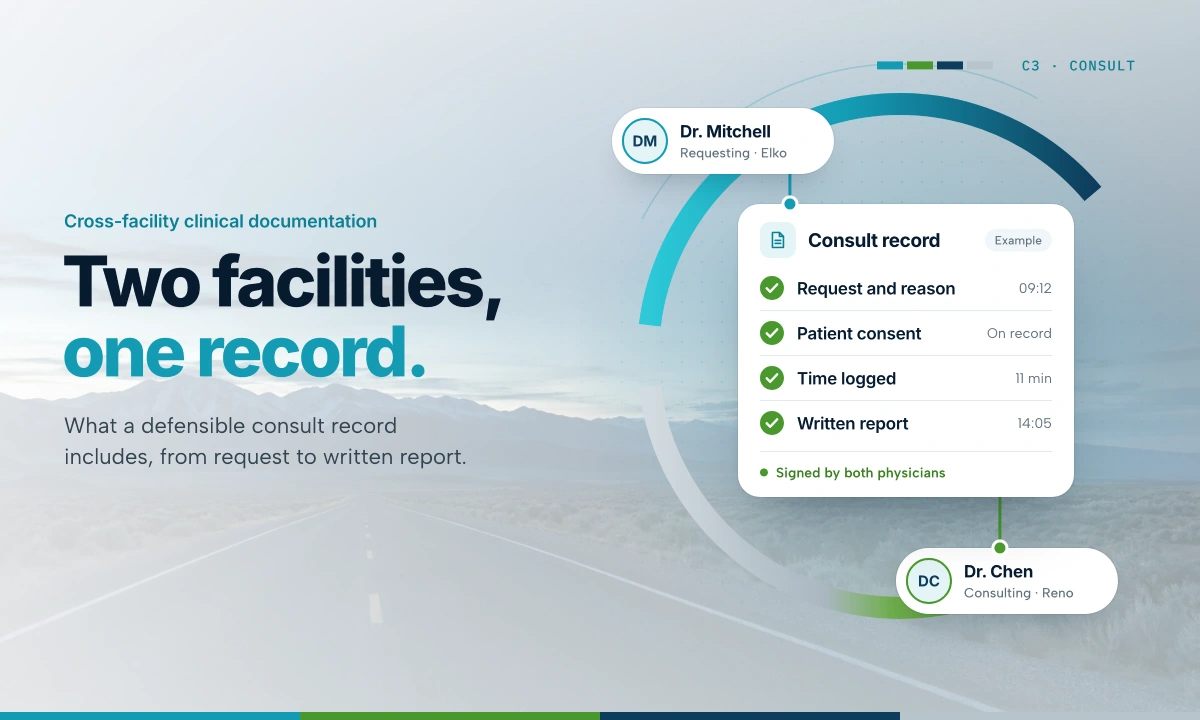
The distinctions between telephonic and written interprofessional consultation are not a billing technicality; they are the difference between a reimbursable claim and a denial. CPT codes 99446 through 99449 and CPT 99451 to 99452 form the Interprofessional Consultation series, a code set designed specifically for physician-to-physician consultations conducted without a face-to-face patient visit. Within that series, codes differ by consultation format and by documented time: 99446 through 99449 cover telephonic (oral) exchanges at four duration tiers, 99451 covers the consulting physician’s written or internet consultation, and 99452 covers the requesting physician’s preparation time in a written or internet consultation. The documentation threshold, time minimum, and consent obligations differ across codes within the series, and CMS enforces those differences in its 2026 Physician Fee Schedule final rule.
According to a 2024 MGMA Stat poll, 60% of medical group leaders reported an increase in claim denial rates, a denial environment in which format-based documentation errors carry direct revenue consequences and create compliance exposure that persists through the claims process.
ClinicianCore is a secure, HIPAA-compliant unified clinical communication platform built exclusively for physicians. This post maps the exact CPT requirements for each consultation format so physicians and billing managers can eliminate format-based denials before they occur.
Key Takeaways
- CPT 99446 through 99449 and CPT 99451 to 99452 form the Interprofessional Consultation series, designed for physician-to-physician consultations without a face-to-face patient visit. The telephonic tier (99446-99449) covers four duration brackets: 5-10 min, 11-20 min, 21-30 min, and 31+ min. All four telephonic codes require oral summary to the requesting physician, code-specific time documentation, and a clinical summary in the medical record.
- CPT 99451 covers written (asynchronous) consultations by the consulting physician and requires a written report transmitted to the requesting physician; an oral summary alone does not satisfy this code. CPT 99452 covers the requesting or treating physician’s preparation time in a written or internet consultation.
- Patient consent is required for all six codes. CMS (2026) specifies that consent must be obtained and documented before the consultation is conducted, regardless of format.
- According to a 2024 MGMA Stat poll, 60% of medical group leaders reported higher claim denial rates, underscoring the need for format-correct documentation for interprofessional consultations as a direct revenue protection measure.
- ClinicianCore HCC identifies the consultation format at initiation and applies the correct CPT-compliant documentation template, reducing format-driven denials. Optimize consultation workflows alongside billing compliance on the medical practice efficiency platform.
What Format Means in the CPT Interprofessional Consultation Framework
The Interprofessional Consultation series CPT 99446 through 99449, and CPT 99451 to 99452 was designed around a specific premise: a physician with a patient in their care seeks a specialist’s opinion, and that exchange should be documentable, billable, and compliant regardless of the channel through which it occurs. CMS structured the series with format-specific codes to reflect that a telephone consultation and a written asynchronous consultation create different documentation trails and entail different compliance obligations.
The series covers every format in which that physician-to-physician exchange can occur, from a five-minute telephonic discussion to a fully documented written report with transmission confirmation.
Format in this framework refers to the mode of exchange between the consulting and requesting physicians. It is not about how the consultation is scheduled or recorded after the fact. It is determined at the point the consultation occurs: was it an oral exchange conducted over the telephone, or was it a written exchange conducted asynchronously via documented message or written report?
For a broader overview of the complete 2026 interprofessional consult billing landscape, see ClinicianCore’s interprofessional consult billing CPT codes 2026 guide.
Telephonic Interprofessional Consultations: CPT 99446, 99447, 99448, and 99449
Telephonic interprofessional consultations are oral exchanges. The consulting physician speaks directly with the requesting physician by telephone. No written report is transmitted between them. The exchange is verbal, and the supporting billing documentation reflects that.
CPT 99446: Telephonic Consultation, 5-10 Minutes
CPT 99446 applies to a telephonic interprofessional consultation that lasts a minimum of five minutes and a maximum of ten minutes of medical consultative discussion and review. The AMA CPT 2026 professional edition specifies that the time counted is medical consultative discussion and review, not total time on the phone, not administrative exchange, not scheduling conversation.
Documentation required under CPT 99446:
- A verbal summary of the consultation provided to the requesting physician during or following the call
- Time documentation in the medical record specifying that the consultative discussion lasted 5-10 minutes
- A clinical summary of the consultation in the consulting physician’s medical record, sufficient to support the complexity and conclusions of the consultation
- Documentation confirming patient consent was obtained and recorded before the consultation
CMS (2026) does not require the consulting physician to generate a written report for CPT 99446. The code is intentionally designed for oral-only exchanges. Generating a written report and billing 99446 does not make the claim invalid; however, the documentation thresholds for 99446 do not require it. Billing 99451 when no written report was transmitted is a different error covered below.
CPT 99447: Telephonic Consultation, 11-20 Minutes
CPT 99447 applies to a telephonic interprofessional consultation with medical consultative discussion and review lasting 11 to 20 minutes. The same oral-only structure applies: no written report is transmitted, the exchange is verbal, and the documentation requirements mirror those for 99446, with the applicable time threshold adjusted.
Documentation required under CPT 99447:
- A verbal summary of the consultation provided to the requesting physician during or following the call
- Time documentation in the medical record confirming that the medical consultative discussion and review lasted 11-20 minutes
- A clinical summary of the consultation in the consulting physician’s medical record
- Documentation confirming patient consent was obtained and recorded before the consultation
Cumulative time within a single consultation session may be aggregated toward the 11-20 minute threshold, but time must be documented in the record as meeting the specific range. A consultation that exceeds 21 minutes should be assessed for the appropriate higher code.
CPT 99448: Telephonic Consultation, 21-30 Minutes
CPT 99448 covers telephonic interprofessional consultations lasting 21 to 30 minutes. Accurate documentation of this duration is vital to support proper billing, especially since longer calls may qualify for a different code. Like 99446 and 99447, this code involves oral exchanges with no written report transmitted between physicians.
Documentation required under CPT 99448:
- Verbal summary of the consultation to the requesting physician
- Cumulative time documentation confirming that the medical consultative discussion and review totaled 21-30 minutes
- Clinical summary in the consulting physician’s medical record
- Documentation confirming patient consent was obtained before the consultation
Precise time documentation is crucial at this duration tier because exceeding 30 minutes shifts the code to 99449. Physicians should distinctly record substantive clinical discussion time separate from administrative tasks to ensure correct billing and avoid denials.
CPT 99449: Telephonic Consultation, 31 or More Minutes
CPT 99449 covers the same telephonic format as 99446, 99447, and 99448 oral exchange, no written report transmitted, but applies when the medical consultative discussion and review exceed 31 minutes. Cumulative time across a single consultation session may be aggregated, but time must be documented in the record as meeting the 31-minute threshold.
Documentation required under CPT 99449:
- Verbal summary of the consultation to the requesting physician
- Cumulative time documentation confirming that the medical consultative discussion and review totaled 31 or more minutes
- Clinical summary in the consulting physician’s medical record
- Documentation confirming patient consent was obtained before the consultation
For context on the cost of undocumented and underbilled consultations, ClinicianCore’s analysis of curbside consult costs quantifies the revenue exposure across a typical physician group practice.
Written Interprofessional Consultations: CPT 99451 and CPT 99452
Written interprofessional consultations are asynchronous exchanges conducted via documented message, internet-based communication, or written report. Unlike telephonic codes, written consultation codes do not require a live telephone call. The billing format is determined by what was actually transmitted and documented.
CPT 99451: Consulting Physician Written or Internet Consultation
CPT 99451 covers written, asynchronous interprofessional consultations billed by the consulting or specialist physician. The distinguishing feature is the written report: the consulting physician prepares and transmits it to the requesting physician. The consultation does not require a telephone call. If a phone call occurs and a written report is also transmitted, the billing format is determined by the higher documentation requirement, and the presence of a written report transmitted to the requesting physician moves the encounter into 99451 territory.
Documentation required under CPT 99451:
- A written report generated by the consulting physician and transmitted to the requesting physician is the core requirement that distinguishes 99451 from telephonic codes.
- Minimum of five minutes of medical consultative discussion and review, documented in the record
- Documentation of the date of consultation and the date the written report was transmitted
- Clinical summary in the consulting physician’s medical record is consistent with the written report transmitted.
- Documentation confirming patient consent was obtained before the consultation.
The written report requirement is absolute under CMS (2026). A verbal summary to the requesting physician does not satisfy the 99451 documentation standard. A written summary stored only in the consulting physician’s record does not satisfy 99451. The report must be transmitted to the requesting physician. This is the single most common documentation failure for this code: the consultation occurred, the clinical work was done, but the transmission step was either not completed or not documented as completed.
HIPAA requirements apply to written consultation content transmitted between physicians. HHS OCR (2025) guidance on telephonic consultation PHI handling extends to written asynchronous consultations: any written report containing protected health information must be transmitted through a HIPAA-compliant channel. Consumer messaging applications, personal email, and undocumented fax pathways do not satisfy this requirement. For an overview of what HIPAA-compliant physician communication requires, the HIPAA-compliant collaboration platform resource covers the compliance standard in full.
CPT 99452: Requesting Physician Written or Internet Consultation
CPT 99452 covers the requesting or treating physician’s preparation time for a written or internet interprofessional consultation. Unlike 99451, which the consulting specialist reports, 99452 is reported by the treating physician initiating the consultation, the physician who has the patient in their care and is seeking specialist input.
Documentation required under CPT 99452:
- Documentation of the requesting physician’s time preparing and transmitting the written or internet consultation request to the specialist
- Minimum of five minutes of preparation time documented in the medical record
- Documentation confirming the consultation request was transmitted to the consulting physician.
- Clinical summary in the requesting physician’s medical record documenting the reason for the consultation
- Documentation confirming patient consent was obtained before initiating the consultation.
Their respective physicians may bill CPT 99452 and CPT 99451 for the same consultation encounter, 99452 by the treating physician who initiated the request, and 99451 by the specialist who completed the written review and transmitted the report. Both require a minimum of five minutes of documented preparation or consultative time. Neither requires a face-to-face patient encounter.
CPT 99446 vs 99447 vs 99448 vs 99449 vs 99451 vs 99452: Side-by-Side Requirements
The following table summarises the final rule requirements of the 2026 CMS Physician Fee Schedule for each active interprofessional consultation code.
| CPT Code | Format | Min Time | Documentation Required | Patient Consent |
|---|---|---|---|---|
| 99446 | Telephonic (oral) | 5-10 min | Verbal summary to requesting physician; time documentation; clinical summary in medical record | Written or verbal consent required; must be documented |
| 99447 | Telephonic (oral) | 11-20 min | Verbal summary to requesting physician; time documentation; clinical summary in medical record | Written or verbal consent required; must be documented |
| 99448 | Telephonic (oral) | 21-30 min | Verbal summary to requesting physician; cumulative time documentation; clinical summary in medical record | Written or verbal consent required; must be documented |
| 99449 | Telephonic (oral) | 31+ min | Verbal summary to requesting physician; cumulative time documentation; clinical summary in medical record | Written or verbal consent required; must be documented |
| 99451 | Written (asynchronous) – consulting physician | 5+ min | Written report transmitted to requesting physician; time documentation; date of transmission documented; clinical summary in medical record | Written or verbal consent required; must be documented |
| 99452 | Written/Internet – requesting physician | 5+ min | Consultation request prepared and transmitted; requesting physician preparation time documented; clinical summary in medical record | Written or verbal consent required; must be documented |
Note: CPT 99251 is deleted. CPT 99252-99254 are non-payable under the 2026 Medicare Physician Fee Schedule. Do not submit claims under these codes.
Common Billing Errors by Format
The following three failure patterns account for the majority of interprofessional consultation format-related claim denials.
ClinicianCore, a secure, HIPAA-compliant unified clinical communication platform built exclusively for physicians, addresses all three through format-locked documentation workflows.
Error 1: Billing 99451 for a Telephonic Consultation
A consultation conducted entirely by telephone, with no written report transmitted, cannot be billed under CPT 99451. Billing 99451 requires a written report transmitted to the requesting physician. If that report was not generated and transmitted, the claim will be denied on audit. The correct code depends on the documented duration of the medical consultative discussion: 99446 for 5-10 minutes, 99447 for 11-20 minutes, 99448 for 21-30 minutes, and 99449 for 31 or more minutes.
Error 2: Billing 99446, 99447, 99448, or 99449 When a Written Report Was Transmitted
If the consulting physician generated and transmitted a written report to the requesting physician, the encounter satisfies the 99451 documentation standard. Billing any telephonic code in this scenario can underbill the consultation and create a documentation mismatch between the billing code and the clinical record. The format of the consultation, as evidenced by what was actually transmitted and documented, determines the correct code.
Error 3: Missing or Undocumented Time
All six codes require documented time meeting the applicable threshold. For 99446, documented consultative time of 5-10 minutes. For 99447, documented consultative time of 11-20 minutes. For 99448, documented cumulative time of 21-30 minutes. For 99449, documented cumulative time of 31 or more minutes. For 99451 and 99452, documented for a minimum of 5 minutes. A consultation that meets the clinical standard but lacks time documentation in the medical record does not meet the billing standard. The documentation must exist in the record at the time of billing, not reconstructed afterwards.
Patient Consent Requirements by Format
CMS (2026) requires patient consent for all six interprofessional consultation codes. The consent requirement applies regardless of whether the consultation is telephonic or written, and whether the patient is present during the consultation. The consent that must be documented is the patient’s consent for the consulting physician to review their case and for the requesting and consulting physicians to discuss that case. ClinicianCore, a secure, HIPAA-compliant unified clinical communication platform built exclusively for physicians, captures this consent within the consultation initiation workflow for all six codes.
The documentation requirements for consent do not differ materially between formats. Consent must be obtained before the consultation and documented in the patient’s medical record. HHS OCR (2025) has confirmed that telephonic consultation exchanges involving patient PHI are subject to the same HIPAA consent and disclosure standards as written consultations.
One practical difference exists: for written consultations under 99451, the written report itself constitutes a PHI transmission. The consent and HIPAA documentation requirements, therefore, attach not only to the consultation exchange but to the transmission of the written report. The consulting physician’s documentation should reflect that both the consultation and the report transmission were conducted in a HIPAA-compliant channel. The same principle applies to 99452: the consultation request prepared and transmitted by the requesting physician must travel through a HIPAA-compliant pathway.
How ClinicianCore HCC Handles Format-Correct CPT Documentation
ClinicianCore HCC, a secure, HIPAA-compliant, unified clinical communication platform built exclusively for physicians, identifies whether a consultation is telephonic or written at the point of consultation initiation and automatically applies the correct documentation template. Time-threshold fields, clinical reasoning capture, and patient consent documentation differ by format and by code, and the platform enforces the correct structure for each before a billing report is generated.
Telephonic consultations under CPT 99446, 99447, 99448, or 99449 route to an oral-summary confirmation workflow with a time-elapsed tracker matched to the applicable code threshold. A written consultation under CPT 99451 routes to a written-report workflow that produces a transmittable document for the requesting physician. CPT 99452 is captured on the requesting physician’s side of the consultation initiation, with preparation time and transmission confirmation documented automatically.
The billing report generated matches the CPT requirements for the specific code used, eliminating the format-mismatch documentation errors that drive interprofessional consultation claim denials. Learn how this supports your practice’s bottom line on the medical practice efficiency platform.
Frequently Asked Questions
What is the difference between CPT 99446 and CPT 99451?
CPT 99446 covers telephonic interprofessional consultations of 5-10 minutes conducted orally with no written report required. CPT 99451 covers written, asynchronous consultations that require a written report transmitted to the requesting physician. According to CMS (2026), the format of the consultation, oral or written, determines which code applies, not physician preference. ClinicianCore HCC applies the correct template at consultation initiation.
What documentation is required for a telephonic interprofessional consultation?
Telephonic interprofessional consultations require a verbal summary to the requesting physician, documented time at the applicable threshold (5-10 min for 99446, 11-20 min for 99447, 21-30 min for 99448, 31+ min for 99449), and a clinical summary in the medical record. CMS (2026) requires documented patient consent before the consultation. ClinicianCore HCC captures all required fields automatically.
Does CPT 99451 require a written report submitted to the requesting physician?
Yes. CPT 99451 requires a written report generated by the consulting physician and transmitted to the requesting physician. CMS (2026) specifies that a verbal summary alone does not satisfy the 99451 documentation standard. The report must be transmitted, not simply stored in the consulting physician's record. ClinicianCore HCC's written consultation workflow documents the transmission date and recipient as part of the billing record.
What patient consent is required for telephonic versus written interprofessional consultations?
Patient consent is required for all interprofessional consultation codes under CMS (2026), regardless of format. Telephonic codes 99446-99449 and written codes 99451 and 99452 all require consent obtained and documented before the consultation occurs. HHS OCR (2025) confirms HIPAA standards apply to all formats. ClinicianCore HCC captures consent within the initiation workflow.
How does ClinicianCore HCC handle telephonic and written consultation billing differently?
ClinicianCore HCC, a secure, HIPAA-compliant unified clinical communication platform built exclusively for physicians, identifies consultation format at initiation and applies the CPT-specific template. Telephonic codes 99446-99449 route to time-capture workflows. Written codes 99451 and 99452 route to written-report workflows. Format-correct documentation at the point of initiation eliminates documentation-mismatch errors that drive interprofessional consultation claim denials.
References
- https://www.mgma.com/articles/ensure-compensation-for-consultations-making-sense-of-cpt-codes-99446-99452
- https://www.mgma.com/mgma-stat/strategic-improvements-in-your-rcm-to-reduce-your-practices-claim-denials
- https://www.cms.gov/newsroom/fact-sheets/calendar-year-cy-2026-medicare-physician-fee-schedule-final-rule-cms-1832-f
- https://www.hhs.gov/hipaa/for-professionals/privacy/guidance/hipaa-audio-telehealth/index.html
- https://www.cms.gov/medicare/payment/fee-schedules/physician
- https://codingintel.com/interprofessional-internet-consultations/
- https://www.hhs.gov/hipaa/for-professionals/privacy/guidance/index.html