
Introduction
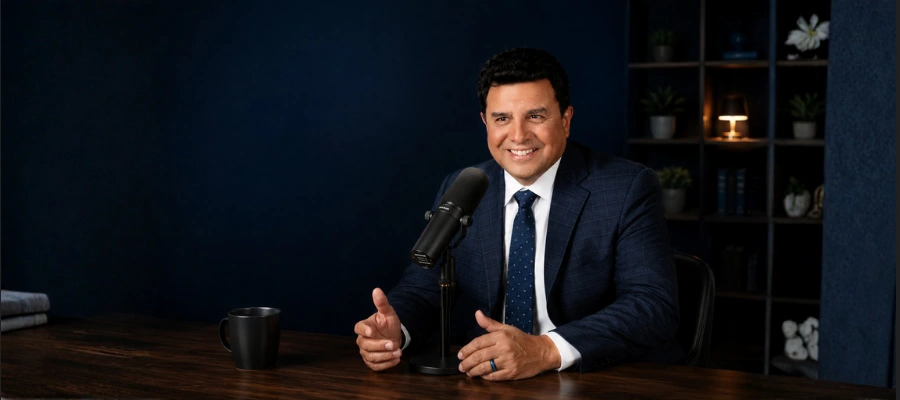
Welcome back to the Connected Practice, another in our series of podcasts. I’m Dr. Kevin Halow, co-founder and Chief Medical Officer of Clinician Core. Today we’re going to look at the intersection of clinical intuition and communication technology through the lens of a single patient encounter. Specifically, how typing and texting can lead to burnout. I know that may seem crazy, but hear me out.
The Burden of Typing
We often talk about documentation burden as an abstract concept. The American Medical Association notes that physicians and clinicians spend about four and a half hours daily on administrative tasks. But to truly understand why we need to shift away from typing and towards video and audio-first communication, we must look at how the keyboard actually interferes with the delivery of care.
A Clinical Scenario
Let us consider a hypothetical patient named Mr. Elias Henderson. Mr. Henderson is a 68-year-old male with a complex medical history including type 2 diabetes and congestive heart failure. He is currently recovering, post-op day three on the surgical ward after a difficult but uncomplicated femoral popliteal bypass. It is 0800 in the morning and the floor is at peak activity.
The patient’s attending internal medicine hospitalist is Dr. Tatiana Delamus. As Dr. Delamus rounds on Mr. Henderson, she notices a subtle but concerning change. He seems slightly more confused than he was yesterday. His oxygen saturation has dipped just a few percentage points. His lung sounds a bit wet. He’s not tachycardic, his surgical site is clean and dry. It’s really nothing that triggers a rapid response, but as a seasoned physician, Dr. Delamus feels that gut pull that suggests something just isn’t right.
In a traditional hospital environment, Dr. Delamus has few choices for communicating this concern to the surgeon, Dr. Beale, the cardiology consultant, Dr. Ho, and the patient’s nurse, Stacy Washington. Dr. Delamus can find a workstation and type a clinical note, but that will not really get the information out right away. She can try calling Dr. Beale or Dr. Ho. But that usually results in getting a voicemail. She can also use her cell phone and send out a text to Dr. Beale and Dr. Ho. While it’s not secure, it is fast and it is convenient. Dr. Delamus also wants to meet with the patient’s nurse, Stacy Washington. Tracking her down can be difficult.
The Asynchronous Solution
Now, let’s take a moment and look at that same scenario using the healthcare organizational HCO module and the HCC module within the Clinician Core platform. As Dr. Delamus leaves Mr. Henderson’s room, she does not look for a computer. She pulls out her mobile device from her pocket. She opens Clinician Core. And within this secure and HIPAA-compliant environment of HCO, using only a few clicks, Dr. Delamus sets up a group via the HCC to include Dr. Ho, the cardiologist, Dr. Beale, the vascular surgeon, and the patient’s nurse, Stacy Washington.
Dr. Delamus records a 45-second non-linear personalized private video message describing the situation and iterating her plan. It would probably sound something like this:
“Greetings team. Regarding Mr. Henderson in room 218, I’m seeing a slight change in mental status and a small dip in his O2 sats. Overall the patient looks okay, however he seems a little confused and a bit wet on cardiopulmonary exam. The surgical site looks clean. I’m going to get a fresh chest x-ray, EKG, and some labs. Maybe he needs a little diuresis. Let me know your thoughts when you round. I’m not comfortable with his current trajectory, he seems like he’s falling off the track a bit.”
Now, in those 45 seconds, Dr. Delamus has communicated more than a typed message ever could. She has conveyed her level of concern through her inflections and the tone of her voice. She has provided clinical reasoning. Most importantly, she did it while walking towards her next encounter. She never touched a keyboard.
Reclaiming Workflow
Let’s take a moment and analyze this event. This is a classic example of the concept of store-and-forward voice messaging. It’s a communication format that respects the reality of the physician workflow. According to research in JAMA Network Open from 2024, the act of typing is a primary driver of workflow disruption. It’s a typing tax that we pay every single day. By moving to video and voice first, Dr. Delamus has reclaimed 10 minutes of her life. Multiply that by 20 patients and she has reclaimed over three and a half hours of her day.
Now, to be fair, not all patients on Dr. Delamus’ rounds will be like Mr. Henderson. But you can easily see that, as physicians, we have very small margins and very tight schedules. It does not take much to disrupt our day. If we look at the bigger picture, the Physician Foundation noted in 2023 that physicians prefer asynchronous communication over synchronous interruptions by a nearly three to one margin.
In this particular story that we’re using as an example, Dr. Ho, the cardiology consultant, received that video memo from Dr. Delamus. Turns out he is currently in the middle of a consult himself. But Dr. Delamus did not have to interrupt him with a phone call. Instead, Dr. Ho watched Dr. Delamus’s video 10 minutes after she sent it. He saw her facial expressions and heard the concern in her voice. He now understands the clinical nuance immediately, and he can adjust his plan accordingly.
As it turns out, Dr. Beale received the same information as well. She was in the operating room. But when she was out, 30 minutes later, she saw the video too. Not only did Dr. Delamus receive feedback that both Dr. Ho and Dr. Beale received the messages and opened them, but she also noted that they responded. Dr. Ho with a video message, and Dr. Beale with an audio message. Finally, the patient’s nurse, Stacy, also received the message. She had a quick video call with Dr. Delamus to clarify some orders. And just like that, the dialogue has begun.
HIPAA Compliance & Security
Many of you are listening to this podcast and you’re probably thinking, “Okay, this sounds way too good to be true.” No more texts and typing? Seamless video and audio communication with my colleagues and staff? There is no way that this can occur regularly and yet be private and secure. Let’s take a moment to address the elephant in the room, which is HIPAA compliance.
Many physicians and clinicians regularly use consumer texting out of desperation to save time. It happens routinely. I do it. It’s not right, but it happens. We’re just too busy. However, this is a big risk. Under HIPAA Security Rules, section 164.312, the technical safeguards for audio-protected health information are very specific. You must have encryption in transit and at rest. You must have unique user identification and emergency access procedures. You must have a full audit trail of who accessed that audio file and when.
The Clinician Core platform was designed to solve this exact problem. The HCO module provides a secure and encrypted cloud-based unified communication system where these voice memos clinical communications live. They are not stored on the device itself, and they do not travel through unencrypted consumer channels. When Dr. Delamus sends that video memo, she is protected. Her practice is protected. When Dr. Ho and Dr. Beale and Nurse Stacy respond, they are also doing so with full assurance that everything that they say is protected. More importantly, Mr. Henderson’s data is protected.
This is how we have set up Clinician Core. It is not just the HCO that is protected, every module on Clinician Core. HCO, HCC, HCX, and the Doc Lounge are all private, protected, and secure. Whether you are in the HCO working with colleagues and staff, or performing a consult in the HCC, having a meeting in the HCX, or catching up with colleagues in the Doc Lounge, you can feel confident that your communications are completely safe because they are fully encrypted.
Conclusion
The story of Mr. Henderson highlights the true cost of our current documentation habits. When we are forced to type everything, we lose the human element of clinical handoffs. We lose the nuance that saves lives. The 2024 JAMA study demonstrated that physicians in the highest typing burden category were over twice as likely to report clinically significant burnout. That burnout is not just a personal problem for the physician, it’s a systemic risk to patient safety. When we reduce the friction of communication, we improve the quality of care.
Our Clinician Core HCO module is the foundation of how we recreate physician-centric communication. It allows us to speak our clinical truths in the moment that they occur, rather than waiting for a break in the schedule that never comes. That foundational security carries through every module on Clinician Core to create a physician-centric network that is private, safe, and secure. On the Clinician Core network, we want you to feel comfortable using it to manage patients, attend meetings, reengage in dialogue, and reconnect with colleagues. Private, safe, and secure.
If you want to see how this technology can transform your practice portfolio, I encourage you to visit cliniciancore.com. You can learn more about our unified clinical communication platform and how it integrates voice and audio to help you reclaim your time. Don’t worry, we still have the ability to text, but we’re putting it on the back burner. Voice and audio are the way to go. We also have extensive resources on physician burnout reduction and the legal requirements for HIPAA-compliant audio and video communication.
We owe it to ourselves and to patients like Mr. Henderson to use tools that work the way we think. As physicians, clinicians, and leaders in healthcare, it’s time for us to reconnect and reengage on our own terms, when it is convenient for us, safely, securely, and privately.
This has been the Connected Practice, another in our series of podcasts. I am Dr. Kevin Halow, co-founder and Chief Medical Officer of Clinician Core. Thanks for listening.