
ClinicianCore Physician Burnout Reduction Platform
Physician Burnout Reduction Platform
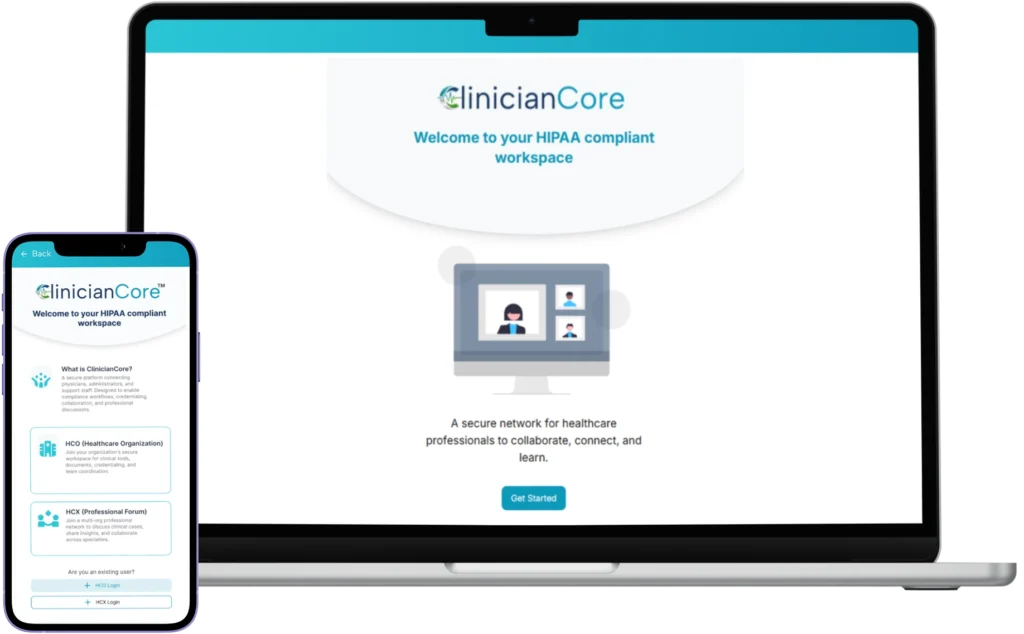
ClinicianCore is a physician-designed, HIPAA-compliant unified clinical communication platform built to eliminate the communication fragmentation that drives physician burnout
Physician Burnout Reduction Platform is a systems-level strategy focused on delivering real physician burnout solutions — eliminating administrative overload, communication fragmentation, and alert fatigue that drive turnover and disengagement in healthcare organizations.
- Reclaim 90+ minutes per day.
- Reduce alert fatigue.
- Restore the joy of practicing medicine.
Physician burnout is not a resilience failure. It is a system design failure caused by fragmented clinical communication infrastructure that forces physicians to manage tools instead of patients.
Physician-Designed Platform
HIPAA-Compliant Infrastructure
Burnout is Not a Personal Failure.
It is a System Failure.
The Cost of Physician Burnout to Healthcare Organizations
- 63% of physicians report symptoms of burnout
- Turnover costs $500K–$1M per physician
- Communication inefficiency is a leading driver
Healthcare organizations lose between $500,000 and $1,000,000 per physician who leaves due to burnout-related turnover — making communication infrastructure a direct financial investment, not an operational expense.
Alert Fatigue
Constant Pings
Endless Alerts
Communication Debt
Phone Tag
Lost Messages
Work Bleed
Late Nights
Interrupted Home Life
You didn't train for a decade to manage fragmented systems.
You trained to practice medicine.
It's time we fix the system failure that's burning us out.
Alert fatigue is the clinical desensitization caused by excessive, low-priority notifications is among the top three structural causes of physician disengagement in modern hospital systems.
- Physician burnout now affects 63% of physicians — up from 44% pre-pandemic — with communication overload and administrative burden cited as the top two contributing factors (AMA Physician Burnout Study, 2024)
- Physician burnout costs the U.S. healthcare system an estimated $4.6 billion annually — driven by turnover, reduced hours, and declining productivity (Mayo Clinic Proceedings, 2019)
- Replacing a single physician costs between $500,000 and $1 million per departure when recruiting, onboarding, and productivity loss are factored together (AAMC Physician Workforce Report, 2024)
- Communication failures are cited in over 70% of serious adverse events reviewed by The Joint Commission — making fragmented clinical messaging a direct patient safety risk, not merely an efficiency problem (The Joint Commission Sentinel Event Data, 2023)
- Physicians spend an average of 4.5 hours per day on EHR and administrative tasks — more than half of their total working hours — leaving fewer than 4 hours for direct patient care (Annals of Internal Medicine — Sinsky et al., 2016)
How Does Communication Inefficiency Cause Physician Burnout?
Communication inefficiency causes physician burnout by fragmenting clinical attention across multiple tools — pagers, EHR inboxes, personal phones, and email — with no unified record or intelligent routing. Physicians spend an average of 90 or more minutes per shift managing this fragmentation instead of practicing medicine. That sustained cognitive overhead accumulates into emotional exhaustion and disengagement.
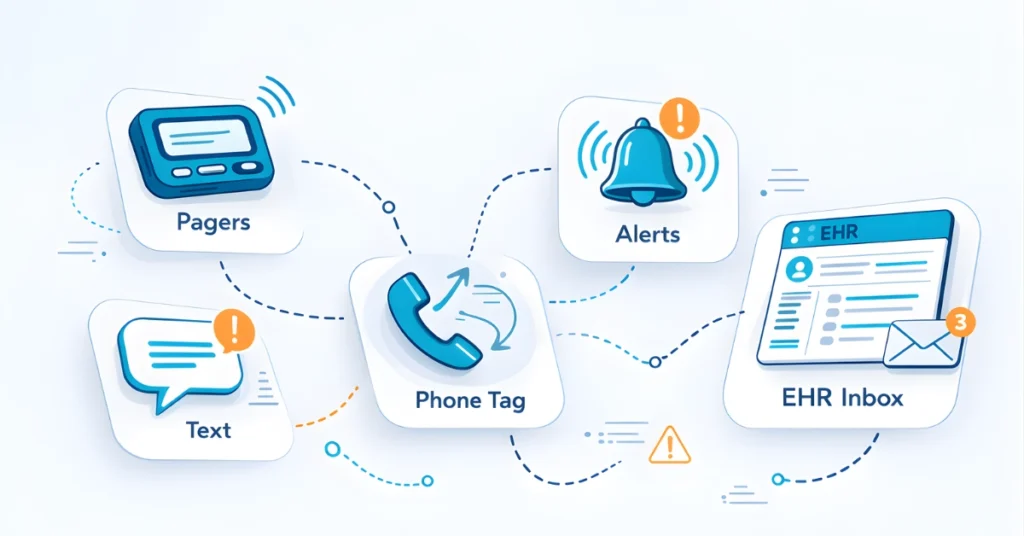
Phone Tags
End endless back-and-forth communication loops.
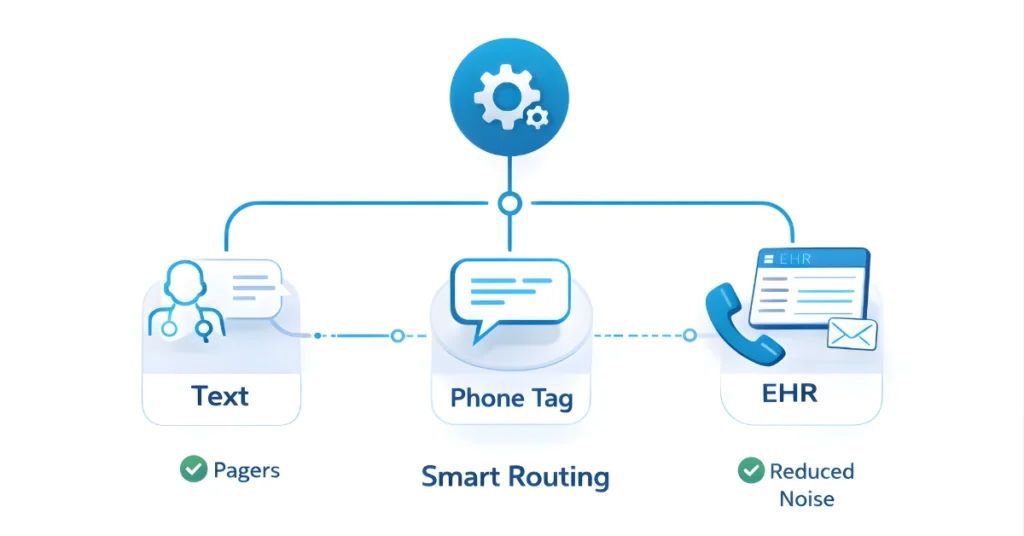
Smart Routing
Route messages instantly to the right clinician.
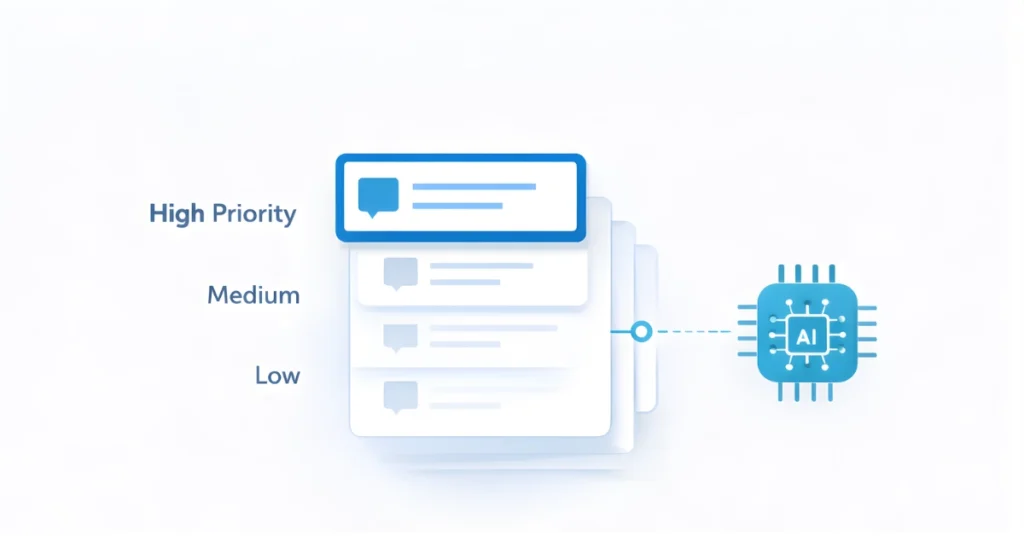
AI Prioritization
Surface urgent cases. Reduce cognitive overload.
Secure Messaging
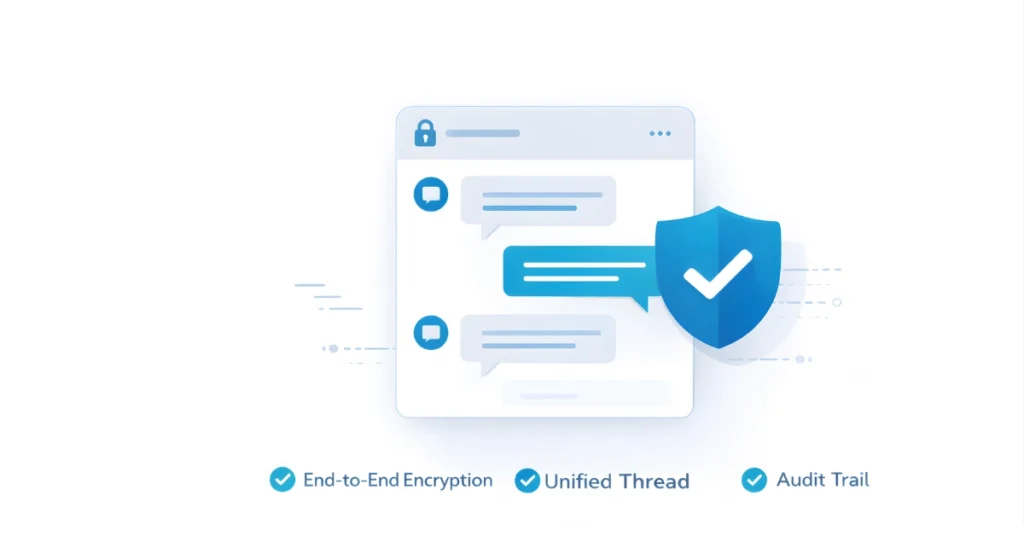
Protect PHI with unified, compliant communication with full audit trail.
ClinicianCore’s smart routing reduces alert volume by 85%, directing notifications only to the appropriate clinician eliminating the constant interruption cycle that fragments physician attention during clinical shifts.
Healthcare organizations using unified clinical communication report measurable improvements in time savings, error reduction, and response speed.
90+ min
Saved Daily
70%
Fewer Errors
85%
Faster Response
What Technology Actually Reduces Physician Burnout in Healthcare?
Technology reduces physician burnout only when it removes friction rather than adds complexity. A unified clinical communication platform — combining secure messaging, smart alert routing, video, voice, and consult documentation — eliminates tool-switching and reduces daily communication overhead by 90 or more minutes per physician.
5 Root Causes of Physician Burnout
Physician burnout is not a personal resilience failure. It is the direct result of structural, operational, and systemic breakdowns inside healthcare organizations.
-
1Administrative OverloadPhysicians spend an average of 2 hours on administrative tasks — documentation, inbox management, and prior authorizations — for every 1 hour of direct patient care. This inversion of clinical purpose is the leading structural driver of burnout.2:1 Admin-to-Patient Time Ratio
-
2Fragmented Communication SystemsClinicians navigate an average of 4–7 disconnected tools per shift — EHR inboxes, pagers, text threads, phone calls, and secure messaging apps. Each context switch adds cognitive load, delays responses, and fragments clinical decision-making.4–7 Disconnected Tools Per Shift
-
3Alert Fatigue from Unfiltered NotificationsPhysicians receive hundreds of alerts, pages, and notifications per shift — the vast majority clinically irrelevant. Without intelligent routing and prioritization, every alert demands cognitive triage, depleting mental reserves and increasing error risk.85% of Alerts Are Low Priority
-
4Uncompensated Curbside ConsultationsInformal hallway consults and curbside clinical questions consume an estimated 30–60 minutes of physician time daily — none of it billable. This is a direct financial loss to the practice and an invisible daily tax on physician time and cognitive energy.30–60 Min Daily — Unbillable
-
5Work-Life Boundary ErosionClinical communication that bleeds into personal time — late-night messages, after-hours pages, and unresolved care coordination — eliminates recovery time and accelerates emotional exhaustion, disengagement, and eventually departure from medicine.After-Hours Work Bleed
4 Ways ClinicianCore Reduces Physician Burnout
Burnout reduction technology only works when it removes friction rather than adds complexity. ClinicianCore addresses the structural causes — not the symptoms.
-
1Unified Clinical Communication — One Platform, Zero Tool SwitchingClinicianCore consolidates voice, video, secure messaging, and consult workflows into a single HIPAA-compliant platform. Physicians stop losing time and mental energy switching between EHR inboxes, pagers, personal texts, and phone calls. Every message, consult, and handoff lives in one secure, auditable thread.90+ Minutes Reclaimed Per Physician Per Day
-
2Smart Alert Routing — Urgent Cases Surface. Noise Disappears.Intelligent routing directs each alert only to the appropriate provider, with escalation logic that preserves context inside a single secure thread. Physicians stop performing cognitive triage on hundreds of irrelevant notifications and regain the protected focus time clinical decision-making demands.85% Reduction in Alert Fatigue
-
3Billable Consult Documentation — Convert Curbside Time Into RevenueClinicianCore's structured consult workflow transforms informal hallway consultations into documented, billable clinical interactions. Every interprofessional consult is captured with the clinical context needed for billing — converting 30–60 minutes of daily unbillable work into recoverable revenue while reducing the invisible time tax on physician schedules.Curbside Consults → Billable Encounters
-
4D.O.C. Lounge — Physician-Only Peer Space for Human ConnectionThe Doctor's Opinion Count (D.O.C.) Lounge restores protected peer connection in a private, physician-only digital environment free from administrative noise. As the physical doctor's lounge disappeared from hospitals, so did informal professional support. D.O.C. brings it back: peer consultation, shared clinical insight, and decompression without exposure to organizational oversight.Peer Support Without Admin Noise
5 Warning Signs Your Physicians Are Burning Out
Physician burnout rarely announces itself. It accumulates in operational patterns — visible in your data and your workflows long before a physician resigns. Here is what to look for.
-
1Inbox Response Latency Is GrowingMessages, lab results, and care coordination requests that once received same-shift responses are now going hours — or days — unanswered. Delayed responses signal communication overload, not indifference.Response Time Increasing
-
2After-Hours Clinical Activity Is IncreasingEHR logins, message responses, and documentation activity happening outside normal shift hours indicate that physicians cannot complete clinical work within protected time — a direct marker of workflow unsustainability.Work Bleeding Into Personal Time
-
3Patient Satisfaction Scores Are DecliningEmotionally exhausted physicians exhibit measurably reduced empathy, communication quality, and engagement during patient encounters. Declining Press Ganey or HCAHPS scores often reflect physician distress before it becomes a retention crisis.HCAHPS / Press Ganey Declining
-
4Turnover Conversations Are Starting Earlier in TenureWhen physicians begin exploring departure options within 2–3 years of joining — rather than 7–10 — workflow fragmentation and communication overload are the most common structural causes. Replacing each physician costs $500K–$1M.Early Attrition Signal
-
5Near-Miss and Medication Error Rates Are ClimbingAlert fatigue and communication fragmentation directly increase clinical error risk. When physicians operate in sustained interruption mode — triaging irrelevant notifications instead of concentrating on patient care — the probability of adverse events rises measurably.Patient Safety Risk Elevated
What Are the Most Effective Physician Burnout Solutions for Healthcare Organizations?
The most effective physician burnout solutions address root causes — not symptoms. They include: smart alert routing to reduce notification volume, unified secure messaging to eliminate tool-switching, billable consult workflows to end unpaid clinical labor, and protected physician peer support environments. ClinicianCore delivers all four in a single HIPAA-compliant platform.
Doctor’s Opinion Count (D.O.C.)
A Physician Wellness Platform for Peer Support
D.O.C. Lounge
Peer Support, No Admin Noise
ClinicianCore reduces physician burnout by unifying secure messaging, smart routing, billable consult workflows, and peer support into a single HIPAA-compliant communication platform.
The D.O.C. Lounge is the only HIPAA-compliant, physician-only peer support environment in the clinical communication market designed to restore the collegial connection that physical physician lounges once provided.
Unified Clinical Communication vs. Fragmented Tools
| Compare by Factor | Status quo Fragmented Tools | The solution ClinicianCore Platform |
|---|---|---|
|
|
High burden 90 + minutes per physician per shift consumed by tool-switching, missed messages, and duplicate communication across pagers, EHR inboxes, phones, and email. |
Recovered 90+ min reclaimed per physician daily |
|
|
Unfiltered Every alert reaches every clinician regardless of role, availability, or clinical relevance. Alert fatigue desensitizes physicians to all notifications — including urgent ones. |
85% reduced Smart routing directs notifications only to the appropriate clinician based on role, availability, and clinical context — preserving signal, eliminating noise. |
|
|
Compliance risk Consumer apps — WhatsApp, iMessage, standard SMS — are not HIPAA-compliant. Every message about a patient on a personal device creates regulatory exposure and PHI risk. |
Fully compliant End-to-end encryption, role-based access controls, complete audit trails, and secure cloud architecture — across all channels: messaging, voice, video, and consult documentation. |
|
|
Undocumented 5 to 15 curbside consults per physician per day — unpaid, unrecorded, and unprotected by professional liability documentation. 60 to 120 minutes of clinical labor for zero compensation. |
Billable & recorded HCC module converts every informal curbside consult into a documented, reimbursable interprofessional consultation — capturing revenue that was previously lost. |
|
|
None Physical physician lounges have largely disappeared. No digital equivalent exists in standard communication stacks — leaving physicians professionally isolated in an already high-stress environment. |
D.O.C. Lounge A private, physician-only peer support environment for clinical discussion, professional reflection, and collegial connection — HIPAA-compliant, admin-free, and designed for decompression. |
|
|
5+ disconnected tools Pager, EHR inbox, personal phone, hospital phone, email, and consumer messaging apps — each requiring a separate login, separate context, and separate cognitive overhead. |
One unified platform Voice, video, secure messaging, smart routing, consult documentation, and peer support — in a single HIPAA-compliant interface with one login, one record, zero tool-switching. |
|
|
Elevated risk Fragmented communication is the leading root cause of preventable clinical errors. The Joint Commission identifies communication failures in the majority of serious adverse events. |
70% fewer errors Unified communication with preserved context, single-thread documentation, and intelligent routing eliminates the miscommunication and message loss that generate clinical errors. |
|
|
Delayed Phone tag, missed pages, and inbox overflow create multi-step delays for time-sensitive clinical decisions — including patient handoffs, discharge coordination, and urgent consults. |
85% faster Smart routing connects the right clinician immediately — eliminating the back-and-forth that delays critical decisions and extends patient wait times. |
Ready to see the numbers for your practice? Calculate exactly how much fragmented communication is costing your physicians — in time, revenue, and retention.
Calculate My SavingsWhat Is Physician Burnout Costing Your Healthcare Organization?
Physician burnout costs healthcare organizations $500,000 to $1,000,000 per physician in direct turnover costs, lost revenue from reduced billing capacity, and patient safety risk from fatigued clinical decision-making. For a practice of 10 physicians, that represents $5 million to $10 million in exposure — most of which is preventable through communication infrastructure improvement.
Built by Physicians Who Lived the Burnout
Dr. Kevin Halow, MD, MBA, FACSCo-Founder & Chief Medical Officer, ClinicianCore27 years as a practicing surgeon | US Air Force Officer | UNC MBA”I built ClinicianCore because I lived the burnout. Every tool we added made it worse.The problem was never the physicians, it was always the infrastructure.
- 90+ Minutes Reclaimed Daily
- 85% Less Alert Fatigue
- Unified Voice, Video & Secure Messaging
- Built by Physicians
Why Do Most Physician Burnout Programs Fail to Produce Results?
Most physician burnout programs fail because they treat the symptom — exhaustion — rather than the structural cause. Wellness apps, resilience training, and EAP programs cannot reduce the alert volume, communication fragmentation, and unpaid consult burden that generate burnout in the first place. Burnout is an infrastructure problem. Wellness programs are not infrastructure solutions.
- Wellness programs treat symptoms, not infrastructure.
- Additional apps increase communication load.
- Burnout is caused by system fragmentation, not resilience gaps.
Physicians using ClinicianCore reclaim 90 or more minutes per day by consolidating voice, video, secure messaging, and consult workflows into one unified platform eliminating tool-switching across an average clinical shift.
Calculate Your Annual Burnout Cost
Physicians using ClinicianCore reclaim 90 or more minutes per day by consolidating voice, video, secure messaging, and consult workflows into one unified platform eliminating tool-switching across an average clinical shift.
(Per Physician)
(Practice Total Cost)
Join the Early Access
Frequently Asked Questions
What causes physician burnout?
Physician burnout is caused by four structural system failures: (1) Alert fatigue — the constant stream of undifferentiated notifications that forces physicians to process noise instead of signal. (2) Communication fragmentation — the daily burden of switching between pagers, EHR inboxes, personal phones, and email with no unified record. (3) Administrative overload — documentation and scheduling tasks that consume time better spent on patient care. (4) Loss of clinical autonomy — when workflow systems impose process on physicians rather than supporting their judgment. Burnout is not a resilience failure. It is what happens when infrastructure fails the clinician.
Can technology really reduce physician burnout?
Technology reduces physician burnout only when it removes friction rather than adds complexity.
Adding more disconnected tools increases cognitive load.
Unifying communication reduces it.
ClinicianCore does not create another inbox. It replaces fragmented systems with a secure, integrated infrastructure that consolidates:
Voice communication
Secure messaging
Video collaboration
Interprofessional consult documentation
Physician-only peer space
Burnout decreases when operational chaos decreases.
Infrastructure—not more features—restores clinical clarity.
For physicians searching for doctor burnout solutions that go beyond wellness apps or EAP programs, ClinicianCore provides the infrastructure-level change that wellness programs alone cannot deliver.
Cost of physician burnout to hospitals?
Burnout costs hospitals $500K–$1M per physician in turnover, lost revenue, and productivity decline.
Is physician burnout really caused by communication inefficiency?
Yes. Communication inefficiency is a primary structural driver of physician burnout in modern healthcare systems.
Physician burnout does not begin with exhaustion. It begins with cognitive overload caused by:
Alerts without prioritization
Fragmented communication across multiple systems
Unpaid “hallway” or curbside consults
Work extending into personal time
Lack of protected peer support
When clinical communication is fragmented, physicians operate in constant interruption mode. That sustained fragmentation increases emotional exhaustion, depersonalization, and disengagement.
Physician burnout is not a resilience failure.
It is a system design failure.
How does ClinicianCore reduce alert fatigue?
ClinicianCore reduces alert fatigue through intelligent routing, escalation logic, and unified communication workflows.
Instead of every message reaching every clinician:
Smart routing directs alerts only to the appropriate provider
Escalation rules reduce unnecessary noise
Context remains preserved inside one secure communication thread
Conversations occur within a unified “Digital Hallway”
By reducing cognitive switching and improving signal-to-noise ratio, clinicians regain protected focus time — a critical factor in physician burnout reduction.
What is the role of D.O.C. Lounge in physician burnout reduction?
The Doctor’s Opinion Count (D.O.C.) Lounge reduces physician isolation by restoring protected peer connection in a secure digital environment.
Isolation accelerates burnout.
Historically, the physical doctor’s lounge allowed decompression, peer consultation, and reflection. As those spaces disappeared, so did informal professional support.
The D.O.C. Lounge is a private, physician-only environment designed for:
Peer discussion
Clinical insight exchange
Professional reflection
Protected conversation without administrative intrusion
Burnout reduction requires both workflow efficiency and human connection.
D.O.C. addresses the structural loss of physician community.
Is ClinicianCore HIPAA compliant for clinical communication?
Yes. ClinicianCore is a physician-designed, HIPAA-compliant unified clinical communication platform built specifically for healthcare environments.
Security infrastructure includes:
End-to-end encryption
Role-based access controls
Audit trails
Secure cloud architecture
Many burnout-driving workflows rely on consumer messaging tools that create compliance risk. ClinicianCore reduces both communication fragmentation and regulatory exposure simultaneously.
Burnout reduction must never compromise patient privacy.
Who is ClinicianCore built for?
ClinicianCore is built for physicians and healthcare leaders who require secure, unified clinical communication infrastructure.
The platform supports:
Physicians and surgeons
Medical directors
Practice administrators
Clinical leadership teams
It was designed by practicing physicians who experienced communication overload firsthand.
This is not technology imposed on medicine.
It is infrastructure built from within medicine.
How long does it take to reduce physician burnout?
Organizations using ClinicianCore report measurable improvements in three specific areas within 30 to 90 days of deployment: physician time savings of 90 or more minutes per day, alert volume reductions of up to 85%, and faster consult response times. Structural burnout reduction — the kind that changes how physicians experience their workday — typically shows measurable impact in the first billing cycle after deployment, as unpaid curbside consults transition into documented, reimbursable workflows.
Is physician burnout a system failure?
Yes. Physician burnout is a system design failure, not a personal one. Research published by the American Medical Association consistently identifies institutional and operational factors not individual resilience deficits as the primary drivers. When physicians are required to operate across fragmented communication systems, manage undifferentiated alert volumes, and perform unpaid consultative work without documentation infrastructure, burnout is the predictable outcome of that system design. Fixing burnout requires fixing the infrastructure, not coaching the clinician.
Does secure messaging reduce physician burnout?
Yes — but only when implemented correctly. Secure messaging reduces physician burnout by eliminating the communication compliance burden that forces physicians onto consumer apps like WhatsApp or iMessage, which create HIPAA risk and administrative anxiety. When secure messaging is unified with voice, video, and consult documentation in a single platform, it removes the tool-switching overhead that consumes an average of 90 or more minutes per physician per day. ClinicianCore’s secure messaging is HIPAA-compliant, integrated with routing intelligence, and designed to reduce cognitive load rather than add another inbox.
What is the difference between physician burnout and physician stress?
Physician stress is an acute, time-limited response to demanding clinical situations — it resolves when the demand passes. Physician burnout is a chronic syndrome defined by three dimensions: emotional exhaustion, depersonalization toward patients, and a reduced sense of personal accomplishment. Unlike stress, burnout does not resolve with rest alone. It requires structural change — specifically, reduction of the administrative, communication, and workflow burdens that sustain it. The Maslach Burnout Inventory (MBI) is the clinical standard for measuring burnout severity. ClinicianCore addresses the structural communication causes, not the symptom.
What is alert fatigue in healthcare and how does it cause burnout?
Alert fatigue in healthcare is the desensitization that occurs when clinicians receive so many notifications — from EHR systems, monitoring devices, pagers, and messaging apps — that they begin to ignore or delay responses to all of them, including urgent ones. Alert fatigue causes burnout because it places physicians in a sustained state of cognitive vigilance without meaningful signal. Every undifferentiated alert requires a decision: act or ignore. Over a typical shift, that decision burden accumulates into cognitive exhaustion. ClinicianCore’s smart routing system reduces alert volume by 85% by directing notifications only to the appropriate clinician based on role, availability, and clinical context.
How does physician burnout affect patient safety?
Physician burnout directly increases patient safety risk. Studies published in the Journal of the American Medical Association link high burnout scores to a two-fold increase in medical error rates, reduced diagnostic accuracy under cognitive fatigue, and higher rates of near-miss events in burned-out clinical teams. Burned-out physicians are also more likely to order unnecessary tests as a defensive measure — increasing costs without improving outcomes. Reducing physician burnout through communication infrastructure improvement is therefore a patient safety intervention, not just a physician wellness initiative.
What is a curbside consult and why does it contribute to physician burnout?
A curbside consult — also called a hallway consult or informal consult — is when a physician provides clinical advice to a colleague informally, outside of a documented patient encounter. These consults are typically unpaid, unrecorded, and unprotected by professional liability documentation. A specialist physician may perform 5 to 15 curbside consults per day, representing 60 to 120 minutes of clinical work for which they receive no compensation and which creates no formal record. Over time, this unpaid cognitive and clinical labor contributes directly to burnout through compensation inequity and blurred professional boundaries. ClinicianCore’s HCC module converts curbside consults into documented, billable interprofessional consultations.
What role does HIPAA compliance play in reducing physician burnout?
HIPAA compliance reduces physician burnout in two specific ways. First, it eliminates the compliance anxiety that comes from using consumer messaging apps like WhatsApp, iMessage, or standard SMS — which are not HIPAA-compliant and expose physicians to regulatory risk every time they communicate about a patient. That background anxiety is a real cognitive burden. Second, a HIPAA-compliant unified platform removes the need to context-switch between a secure system for protected health information and insecure apps for everything else. ClinicianCore delivers both benefits in one platform: full HIPAA compliance with end-to-end encryption, audit trails, and access controls — without adding communication friction.
Can physician burnout be prevented, or only treated after it occurs?
Physician burnout can be structurally prevented — not just treated after onset — when healthcare organizations address the root causes at the systems level rather than the individual level. Prevention requires: (1) eliminating communication fragmentation through unified platform infrastructure, (2) implementing intelligent alert routing to reduce notification volume, (3) converting unpaid consult work into documented and reimbursable workflows, and (4) providing protected physician peer support environments. Organizations that implement these structural changes report measurable burnout prevention — not just burnout recovery — within 90 days. ClinicianCore’s platform was designed with prevention as the primary design goal, not symptom management.
Can’t find your questions?
Testimonials
Physician Burnout Reduction Research and Case Studies



Reclaim Your Time. Restore Your Focus.
Healthcare organizations use ClinicianCore as part of their physician retention strategies improving satisfaction, reducing turnover, and protecting their most valuable clinical resource.