
ClinicianCore Unified Clinical Communication Platform
Unified Clinical Communication Platform for Modern Healthcare
Unified clinical communication is a secure integrates messaging, alerts, voice, video, and EHR connectivity into a single, governed platform — replacing fragmented tools with one intelligent infrastructure that reduces clinical errors, eliminates alert fatigue, and restores clinical time across every care team role.
- Eliminate fragmented tools.
- Reduce communication errors.
- Reclaim clinical time.
Physician-Designed Platform
HIPAA-Compliant Infrastructure
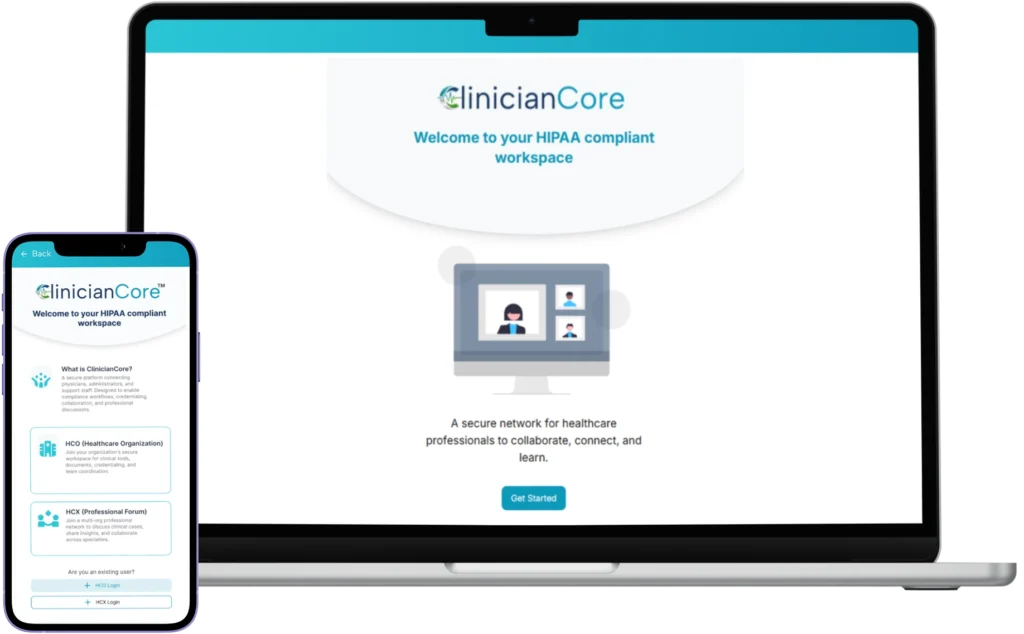
Unified Architecture
What Is Unified Clinical Communication?
Unified clinical communication integrates messaging, alerts, voice, video, EHR connectivity, and smart routing into one secure, governed healthcare platform designed to reduce friction and prevent communication failure.
Why Fragmented Communication Fails in Healthcare
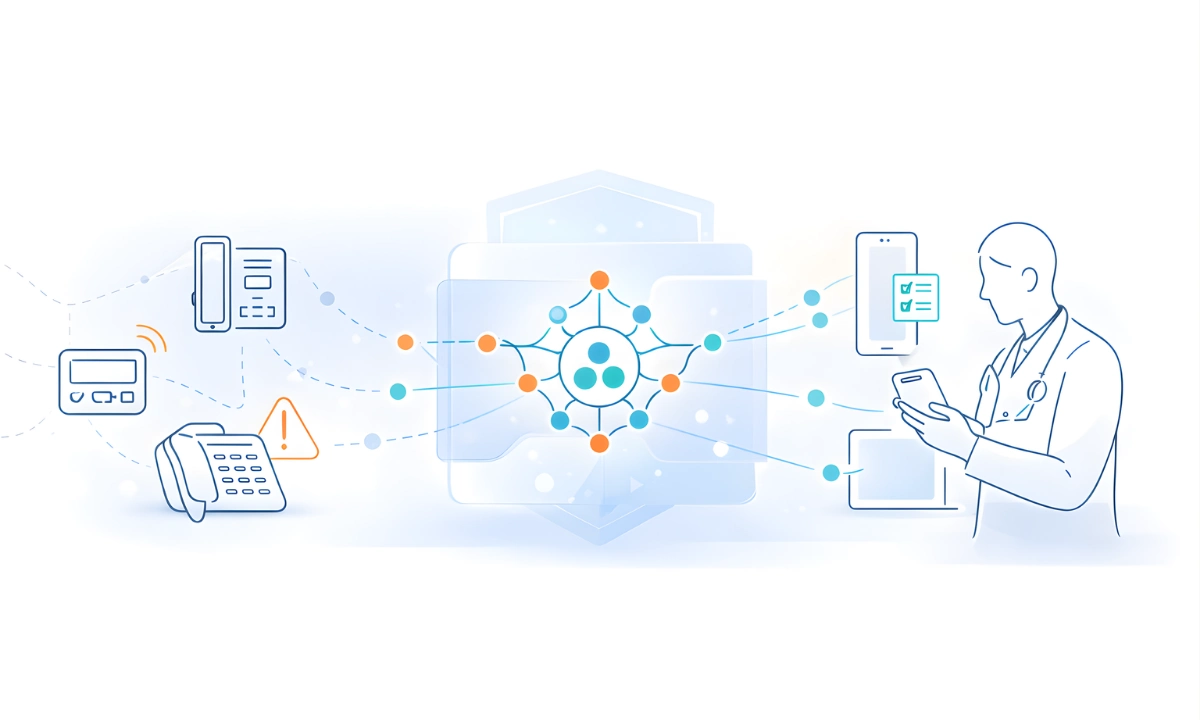
Most healthcare organizations rely on disconnected tools, in-secure messaging apps, EHR inboxes, pagers, and phone calls; that operate without shared context. Fragmented communication increases cognitive load, delays escalation, and creates avoidable clinical risk.
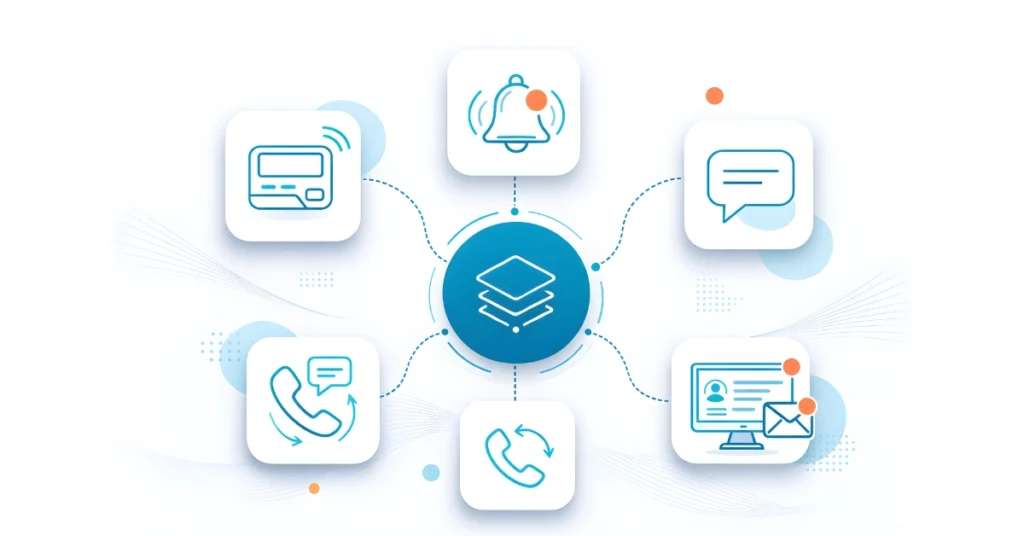
Unified Platform Architecture
How ClinicianCore Unifies Clinical Communication
ClinicianCore is not another messaging tool.
It is a structured communication infrastructure built across four integrated modules — each solving a specific layer of clinical fragmentation.
HealthCare Organization (HCO)
Smart internal routing and workflow orchestration that eliminates alert fatigue and restores structured communication inside healthcare organizations.
- Intelligent message prioritization.
- Secure intra-team communication.
- Reduced cognitive overload.
HealthCare Collaboration (HCC)
Cross-institution communication infrastructure enabling compliant interprofessional consults and structured revenue capture.
- Secure physician-to-physician consults
- CPT-compliant documentation workflows
- Revenue capture from digital consults
HealthCare Xchange (HCX)
A secure strategic collaboration environment for healthcare leaders, administrators, and system architects.
- Cross-organizational collaboration.
- Structured industry dialogue.
- Governance-aligned communication.
Doctor’s Opinion Count (D.O.C.)
A private physician-only digital lounge restoring peer dialogue, trust, and professional autonomy.
- Burnout mitigation through peer support.
- Secure clinical discussion space.
- Protected physician community.
AI-Powered Message Prioritization for Clinical Workflows
Not every alert is created equal. ClinicianCore uses an intelligent combination of smart routing and Al-driven prioritization to reduce alert fatigue, stratify risk, and accelerate clinical decision-making.
AI-Driven Clinical Messaging That Reduces Alert Fatigue by Up to 85%
Reduced alert fatigue
Reduces non-urgent iterruptions, eliminating redundant alerts
Surfaces high-risk cases first, prioritizing by severity
Learns clinician patterns, routes messages to the right person
Accelerates urgent consults and escalates high-priority cases
ClinicianCore’s HCO module uses AI-driven smart routing to reduce non-urgent alert interruptions by up to 85%, directing messages to clinicians based on their role, on-call schedule, and the urgency level of each communication.
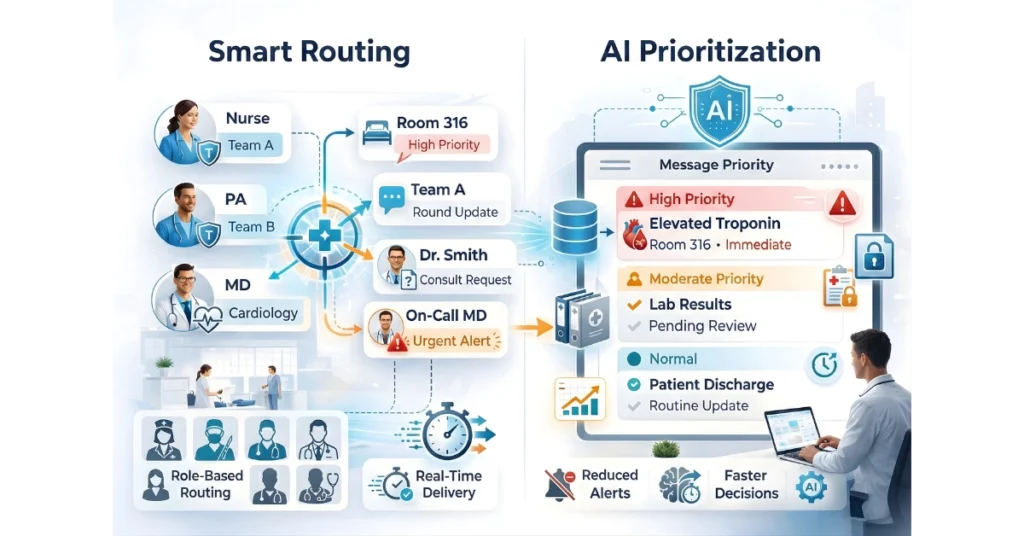
Smart Routing
Routes messages based on role, availability, and urgency
Al Prioritization
Classifies alerts by risk, context, and severity
HIPAA-Compliant Unified Collaboration by Design
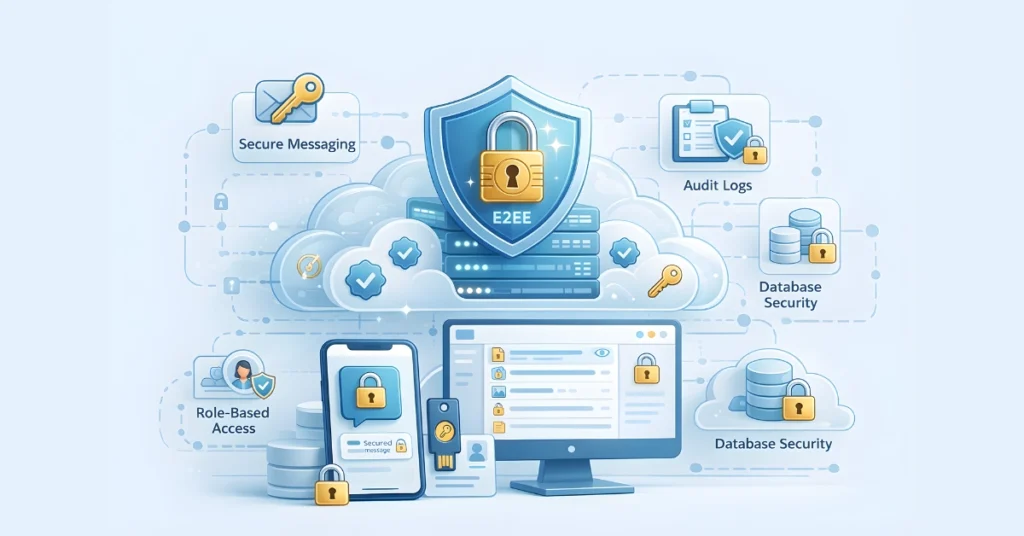
Healthcare communication isn’t secure because it says it is.
It’s secure because it’s architected that way from the foundation.
ClinicianCore was built with compliance as infrastructure — not as a feature layer added later.
From message transmission to audit validation, every interaction is governed, encrypted, and traceable.
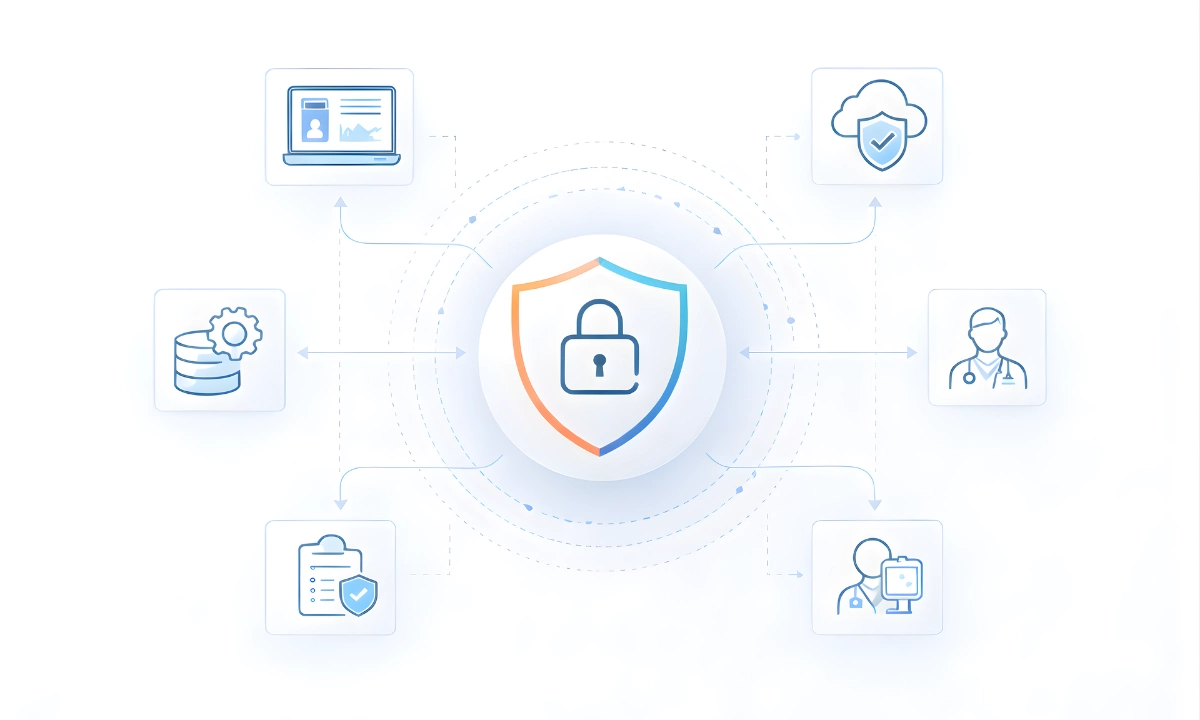
ClinicianCore is HIPAA-compliant by architectural design — every message, voice call, video session, and file transfer is encrypted end-to-end using enterprise-grade protocols, with immutable audit trails that are time-stamped, traceable, and exportable for regulatory review.
Secure Clinical Messaging Built for HIPAA Compliance from Day One
End-to-End Encryption
All communication — voice, video, text, file transfer — is encrypted in transit and at rest using enterprise-grade protocols.
Every interaction is time-stamped, traceable, and exportable for regulatory review. No blind spots. No undocumented exchanges.
Clinicians see what they are authorized to see. Access is structured by department, function, and credential level.
Administrative dashboards provide visibility into communication flows, usage patterns, and compliance metrics.
Fragmented Communication vs Unified Clinical Communication
See what changes when communication becomes infrastructure - not interruption.
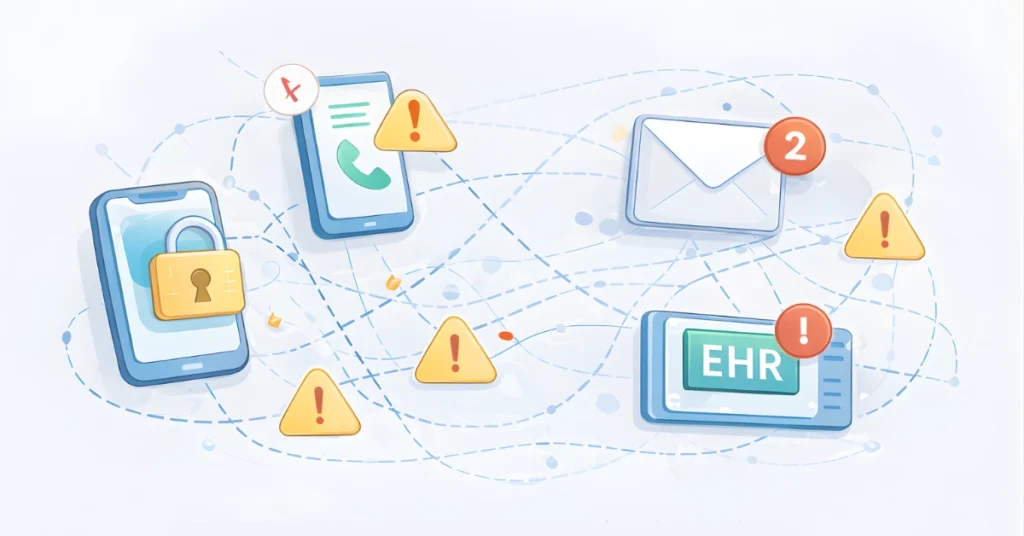
- Phone tag between departments
- Unsecured texting on personal devices
- Duplicate messages across tools
- Missed alerts buried in inboxes
- Physicians working after hours to "catch up"
Fragmentation increases cognitive load and clinical risk.
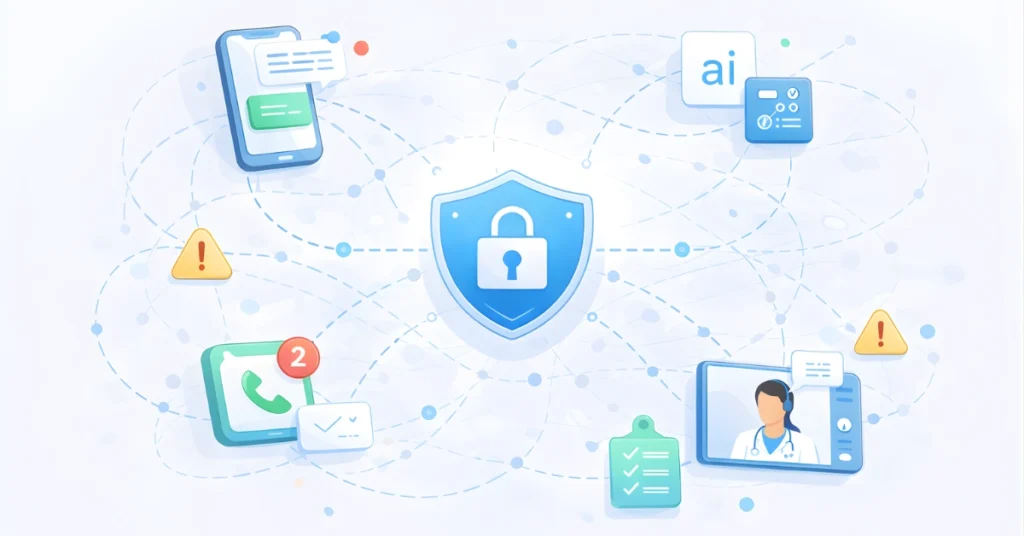
- Secure, HIPAA-compliant messaging in one platform
- Smart routing eliminates unnecessary interruptions
- All conversations auditable and structured
- Faster decisions with shared context
- Physicians reclaim 90+ minutes daily
Unified communication restores clarity, speed, and control.
Calculate Your Communication Impact
See what unified communication could mean for your team.
What Makes a Clinical Communication Platform Enterprise-Grade?
Enterprise-grade clinical communication platforms go beyond messaging to deliver EHR-integrated alerts, role-based access controls, immutable audit trails, and cross-facility interoperability. ClinicianCore is built for health systems that require governance, not just convenience — every interaction is encrypted, traceable, and exportable for regulatory review. Scalable from a single physician group to a multi-facility health network, the platform adapts to your organizational structure rather than forcing your workflows to adapt to the tool.
ClinicianCore vs Traditional Clinical Communication and Collaboration (CC&C) Tools
| Feature | ✕ Fragmented Tools | ✓ ClinicianCore |
|---|---|---|
| Message Security |
Unsecured texting on personal devices
|
HIPAA end-to-end encrypted across all channels
|
| Alert Routing |
Manual, no prioritization
|
AI-driven routing by role, urgency & availability
|
| EHR Integration |
None or limited
|
Native EHR connectivity with patient context
|
| Audit Trail |
None
|
Immutable, exportable, regulatory-grade
|
| Physician Time Impact |
2+ hours lost to admin daily
|
90+ minutes reclaimed per clinician daily
|
| Cross-Institution |
Not supported
|
Seamless via HealthCare Xchange (HCX)
|
| Alert Fatigue |
Increases with every disconnected tool
|
Reduced up to 85% with AI prioritization
|
| Consult Documentation |
Undocumented curbside, zero reimbursement
|
CPT-compliant billing with revenue capture
|
How ClinicianCore Re-Architects Clinical Communication
Burnout is not a resilience failure. It’s a systems design problem. These four modules work together to fix it.
HealthCare Organization (HCO)
Up to 85% less alert fatigue.
Smart Alert Routing
Reduce alert fatigue by prioritizing what truly matters.
AI-driven routing ensures critical messages reach the right clinician at the right time.
HealthCare Organization (HCO)
No more fragmented consult communication.
Billable Interprofessional Consults
Turn curbside consults into documented, revenue-captured events.
Secure, structured collaboration eliminates phone tag and protects billing integrity.
HealthCare Xchange (HCX)
Faster coordination. Fewer missed transitions.
Cross-Facility Collaboration
Seamless handoffs across organizations.
Secure external collaboration reduces delays and strengthens care continuity.
Doctor’s Opinion Count (D.O.C.)
Protect connection. Reduce isolation.
The Private Digital Doctors’ Lounge
Peer support without administrative noise.
A secure physician-only space to reconnect, decompress, and collaborate.
How Healthcare Organizations Implement Unified Clinical Communication
Connect to Your EHR — Surface Context Alongside Every Alert
ClinicianCore integrates natively with your existing EHR infrastructure, pulling patient context — name, MRN, active orders, and care team assignment — directly into every alert, message, and escalation. Clinicians receive the right information alongside the right communication, eliminating the need to switch between systems during critical decisions.
- Patient-tethered messaging — every communication is contextually linked to the relevant encounter
- Zero duplicate entry — patient data flows from EHR into the communication layer automatically
- Bi-directional alerts — lab results, order changes, and discharge triggers surface in the unified inbox
Go Live in Weeks — Not Months of Disruptive IT Projects
ClinicianCore's structured onboarding is designed for organizations that cannot afford disruption to clinical workflows. From initial assessment through staff training to go-live, most healthcare organizations complete deployment within six to eight weeks — with a dedicated implementation team managing configuration, role mapping, and escalation protocol setup.
- Week 1–2: Workflow assessment, role mapping, and EHR integration configuration
- Week 3–4: Platform configuration, smart routing rules, and on-call schedule setup
- Week 5–6: Staff training by department, pilot with selected care team, feedback loop
- Week 7–8: Full go-live, real-time monitoring, and optimization of routing rules
Quantify the Loss — Then Reclaim It
Fragmented communication is not a workflow inconvenience — it is a measurable financial and clinical liability. When a physician loses 90 minutes daily to communication friction, across 250 working days, the compounding cost to a health system is significant. ClinicianCore recaptures that time while converting undocumented consults into billable CPT events.
- 90 min/day × 250 days = 375 hours of physician time lost annually — per clinician
- Undocumented curbside consults represent zero reimbursement for real clinical work performed
- Up to 70% reduction in communication-related clinical errors eliminates downstream liability costs
- HCC module captures revenue from interprofessional consults that currently go unbilled
Compliance by Architecture — Not by Feature Addition
ClinicianCore satisfies the three compliance frameworks that healthcare procurement teams and legal departments require before approving any communication platform. Compliance is not a layer added after the fact — it is foundational to how every interaction is transmitted, stored, and governed.
- HIPAA — End-to-end encryption, role-based access controls, and immutable audit trails satisfy all HIPAA Security Rule technical safeguards
- HITECH — Breach notification readiness, EHR interoperability standards, and audit log exportability satisfy HITECH meaningful use requirements
- SOC 2 Type II — Infrastructure-level security controls and data governance dashboards satisfy SOC 2 Trust Service Criteria for availability, confidentiality, and security
full go-live
clinical errors
per clinician daily
by architecture
Frequently Asked Questions
Still evaluating secure healthcare communication platforms?
These answers address the most common leadership questions.
What is unified clinical communication?
Unified clinical communication is a secure healthcare platform that integrates messaging, voice, video, alerts, and EHR connectivity into one system to reduce clinical risk and communication errors. ClinicianCore achieves this through four integrated modules — HCO, HCC, HCX, and DOC — each solving a specific layer of communication fragmentation.
How does unified communication reduce medical errors?
Unified communication reduces medical errors by eliminating the fragmented tool-switching that causes missed alerts, delayed escalations, and unsecured information transfer. ClinicianCore’s AI-driven smart routing ensures critical messages reach the right clinician at the right time, reducing communication-related clinical errors by up to 70%.
Is unified communication HIPAA compliant?
Yes. ClinicianCore is HIPAA-compliant by architectural design — not as an add-on feature. Every voice call, message, video session, and file transfer is encrypted end-to-end using enterprise-grade protocols, with immutable audit trails, role-based access controls, and administrative data governance dashboards.
How does unified communication reduce physician burnout?
Unified communication reduces physician burnout by eliminating non-urgent interruptions through AI prioritization, reducing alert fatigue by up to 85%, and restoring 90+ minutes of clinical time daily that is currently lost to fragmented communication management.
What is the ROI of unified communication platforms?
The ROI of unified communication platforms includes up to 70% reduction in clinical errors, 90+ minutes of daily physician time reclaimed per clinician, and new revenue from CPT-compliant documentation of previously undocumented interprofessional consults — consults that currently generate zero reimbursement.
What is the difference between a unified communication platform and a clinical messaging app?
A clinical messaging app handles only text-based secure messaging. A unified clinical communication platform also integrates voice, video, EHR alerts, smart routing, and cross-institutional collaboration into one governed, auditable system.
What is CC&C in healthcare?
CC&C stands for Clinical Communication and Collaboration — the industry term for integrated platforms that enable secure, real-time communication between care team members across all channels and facilities.
How does smart routing work in clinical communication?
Smart routing in clinical communication automatically directs messages to the right clinician based on their role, on-call schedule, availability, and message urgency — eliminating phone tag and missed critical alerts.
Can unified communication platforms integrate with EHR systems?
Yes. Enterprise unified clinical communication platforms integrate directly with EHR systems to surface patient context alongside alerts and messages, enabling faster clinical decisions without switching between applications.
What is the difference between a unified communication platform and a clinical messaging app?
A clinical messaging app handles only text-based secure messaging between clinicians. A unified clinical communication platform integrates voice, video, EHR alerts, AI-powered smart routing, and cross-institutional collaboration into one governed, auditable system — replacing the entire fragmented communication stack.
What is CC&C in healthcare?
CC&C stands for Clinical Communication and Collaboration — the healthcare industry term for integrated platforms that enable secure, real-time communication across all care team members, channels, and facilities. ClinicianCore is a full CC&C platform, not a point messaging solution.
How does smart routing work in clinical communication?
Smart routing in clinical communication automatically directs messages to the correct clinician based on their role, real-time availability, on-call schedule, and message urgency level. This eliminates phone tag, prevents missed critical alerts, and reduces the cognitive load of manual message triage.
Can unified communication platforms integrate with EHR systems?
Yes. Enterprise unified clinical communication platforms integrate directly with EHR systems to surface patient context — including patient name, MRN, and relevant orders — alongside alerts and messages, enabling faster clinical decisions without switching between applications.
Can’t find your questions?
Unified Clinical Communication Research and Case Studies

Reclaim Clinical Time. Reduce Operational Risk.
Unified communication that reduces burnout, strengthens compliance, and restores workflow control.