
Welcome back to the connected practice, part of our series of Clinician Core podcasts. I’m your host, Dr. Kevin Halow, co-founder and chief medical officer of Clinician Core.
In our last session, we discussed the internal foundations of the Clinician Core platform. Specifically focusing on the HCO feature for intra-organizational flow. But as any physician knows, medicine does not happen in a vacuum. We are part of a vast interconnected web of specialists, hospitals and diagnostic centers. Yet, for all of our medical sophistication, the way that we communicate between these organizations is often broken.
Think about the last time you tried to coordinate a complex consult across different health systems. What specialist should you contact? Who do you know that can help you with this patient? How do you reach them? Can you send them a message? Are your EHR systems even compatible? It’d be nice to discuss the case first before you send a referral. Do you have the specialist’s cell phone number? Do you even have their office or exchange number? How would you even find it? Are they listed on the internet?
This fragmentation is not just an administrative headache, it is a clinical risk. It leads to delayed diagnoses, redundant testing, and a profound sense of isolation, especially for the primary physician or clinician. This is exactly why we built the second pillar of the Clinician Core platform, HCC or Healthcare Collaboration.
While HCO manages the world inside your own four walls, HCC is designed to unify connectivity across different organizations. It is an AI-powered secure bridge that allows physicians and clinicians to communicate seamlessly regardless of which hospital or clinic they call home. Today, I’m going to walk you through how Healthcare Collaboration is recreating physician-centric communication and tackling the burnout caused by our fragmented communication systems.
In a traditional setting, a consult is often a brief, informal conversation or a static, one-page letter that lacks context. When I send a patient to a specialist, I want them to understand my reasoning, my concerns, and the specific questions I need answered. Conversely, when I receive a consult, I need more than just a diagnosis. I need the decision trail.
HCC transforms this process by supporting structured and dynamic consults with embedded documentation. When you initiate a conversation through Healthcare Collaboration, the platform captures the entire context and reasoning behind the request. It’s not just a text message, it is clinical dialogue. Because it’s part of the Clinician Core platform, all of this reasoning and decision data is convertible into billable compliant revenue. This means that the time you spend collaborating with your colleagues is finally recognized and documented. We are moving away from the curbside consult that leaves no trail and toward a more professional, structured interaction that reflects real clinical thinking. By using HCC, we ensure that nothing is lost in the handoff between organizations, and we provide the clarity that interdisciplinary conversations desperately need.
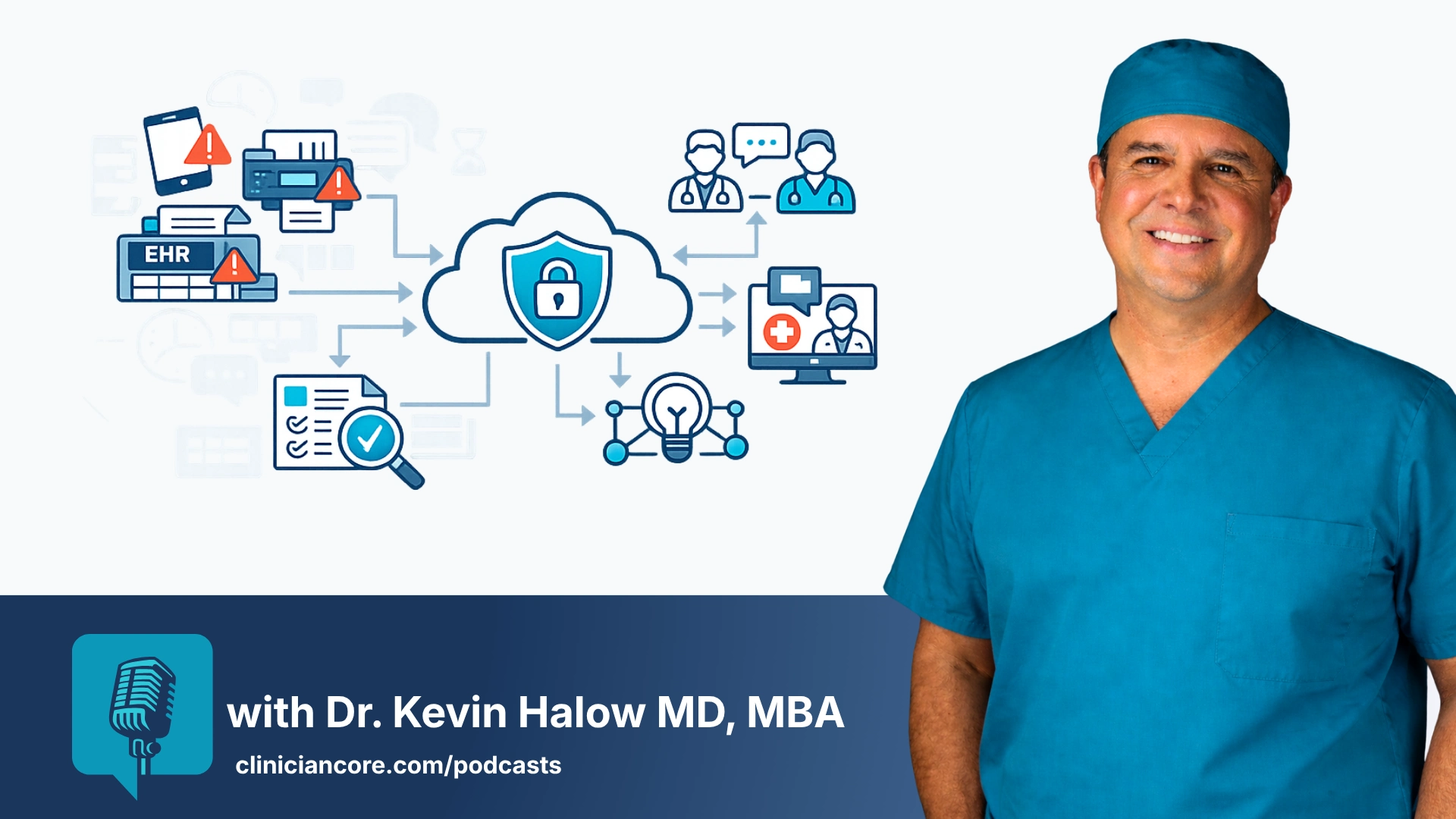
We have all felt the frustration of being locked out of a conversation because we belong to a different healthcare organization or use a different EHR. These digital silos are a major barrier to efficient patient care. They force us back to the fax machine and the telephone, which are the primary sources of legacy alert fatigue and administrative delay.
HCC is specifically built to eliminate the friction of establishing these cross-organizational conversations. It acts as a universal secure layer that sits above the individual EHR systems. Because it is a cloud-based, HIPAA-compliant feature of the Clinician Core platform, it does not matter if your colleague is across the street or across the state. You can connect, share data, and collaborate without disrupting your own patient flow.
This seamless connectivity is how we tackle physician burnout. When you do not have to fight the system just to connect with a colleague, you can spend more time actually practicing medicine. Imagine that. Healthcare Collaboration recreates the personal one-on-one conversations that we as physicians and clinicians are used to having.
Consults have been and should be physician to physician. The HCC section of Clinician Core ensures that this professional dialogue happens naturally and securely, regardless of organizational boundaries. It does so in a completely private, encrypted, and HIPAA-compliant environment. It provides a sanctuary of clarity in a world of healthcare administrative chaos.
Waiting hours or days for a consult response is simply not an option. We need a real-time interaction. HCC supports this by providing a platform for structured, dynamic consults that can happen in real time. Imagine a general surgeon, Dr. Gray, in a community hospital who needs help from a hepatobiliary surgeon at a university hospital about a complicated patient. Using the Healthcare Collaboration feature, Dr. Gray can immediately find Dr. Jones, a hepatobiliary specialist who is available. Dr. Gray knows exactly how to reach Dr. Jones because they’re both on the Clinician Core network. Dr. Gray sends Dr. Jones a non-linear high-definition video consult about this patient. Dr. Gray can also share imaging and pertinent laboratory information, and he can document the entire interaction as it happens. The AI within Clinician Core helps capture the key decision points ensuring that both surgeons have a shared understanding of the plan.
Okay, notice what’s happening here. This is more than just a sterile consult devoid of context. It is now a clinical partnership. It’s personalized. Dr. Gray and Dr. Jones are connecting just like they would if they were talking in a hallway, they’re just doing it virtually. They can see each other, get to know each other, if they have never met before. They can see the subtleties of facial expressions and gestures. Best of all, neither surgeon’s schedule has been disrupted. There’s no telephone tag. It is communicating when you need to communicate. If you need linear dialogue, you can initiate a secure audio or video call right there on the Clinician Core platform. Best of all, it’s physician-centric. Everyone is connected to the physicians and their own representative HCO because the physicians are at the communication hub. And everyone is connected like spokes on a wheel. Dr. Gray can loop in the staff that he needs, and Dr. Jones can loop in the staff that she needs to coordinate the patient’s care and facilitate anything that needs to be in place to ensure this patient receives the care that they need.
By utilizing HCC, we are making sure that the most critical decisions are informed by the best possible data and the most relevant experts, all within a secure and compliant framework. This is the future of interdisciplinary medicine. One of the biggest challenges in a large medical network is simply knowing which specialist possesses the right expertise for a specific patient. When I encounter a patient presenting with complex, atypical symptoms that fall outside standard clinical patterns, how do I find the specific specialist who has the most expertise with that particular diagnostic challenge? In the old system, I’d rely on a printed directory or a personal rolodex, maybe some listing on my cell phone. Likely out of date.
The Healthcare Collaboration feature utilizes the AI capabilities of Clinician Core to provide intelligent interest and expert matching. The system analyzes the clinical context of your query and can suggest specialists within your network who have the relevant expertise. This is not just a search engine. It’s an intelligent matching system designed to foster the right connections at the right time. This AI-assisted approach eliminates the friction of establishing interdisciplinary conversations. Whether you’re in a small rural clinic or a large urban medical center, HCC gives you the reach of a global medical community. Because Clinician Core is a physician-centric network, it facilitates rapid knowledge transfer that was previously impossible. We are using Healthcare Collaboration to ensure that every patient, no matter how complex their condition, has access to the collective wisdom of their entire network.
The Clinician Core platform was designed with a single goal: to empower the physician and clinician. While HCO provides the internal structure that you need for your organization, HCC (Healthcare Collaboration) provides the external connectivity you need to thrive in a complex medical world. Together with the Doc Lounge and HCX, these features form a complete ecosystem for the modern physician. We can no longer afford to work in silos. The complexity of modern patient care demands a new level of collaboration. By adopting the HCC feature, you are choosing to work in a system that reflects the way you actually think and practice. You are choosing clarity over confusion and connectivity over isolation.
If you’re ready to break down the silos in your network, I encourage you to visit cliniciancore.com. Explore how Healthcare Collaboration can transform your external consults and how the entire Clinician Core platform can help you reclaim your professional life. Let’s start building a more connected, more human, and more efficient healthcare system together.
I’m Dr. Kevin Halow, co-founder and chief medical officer of Clinician Core. This has been the connected practice, part of our series in the Clinician Core podcast. Thanks for listening.