
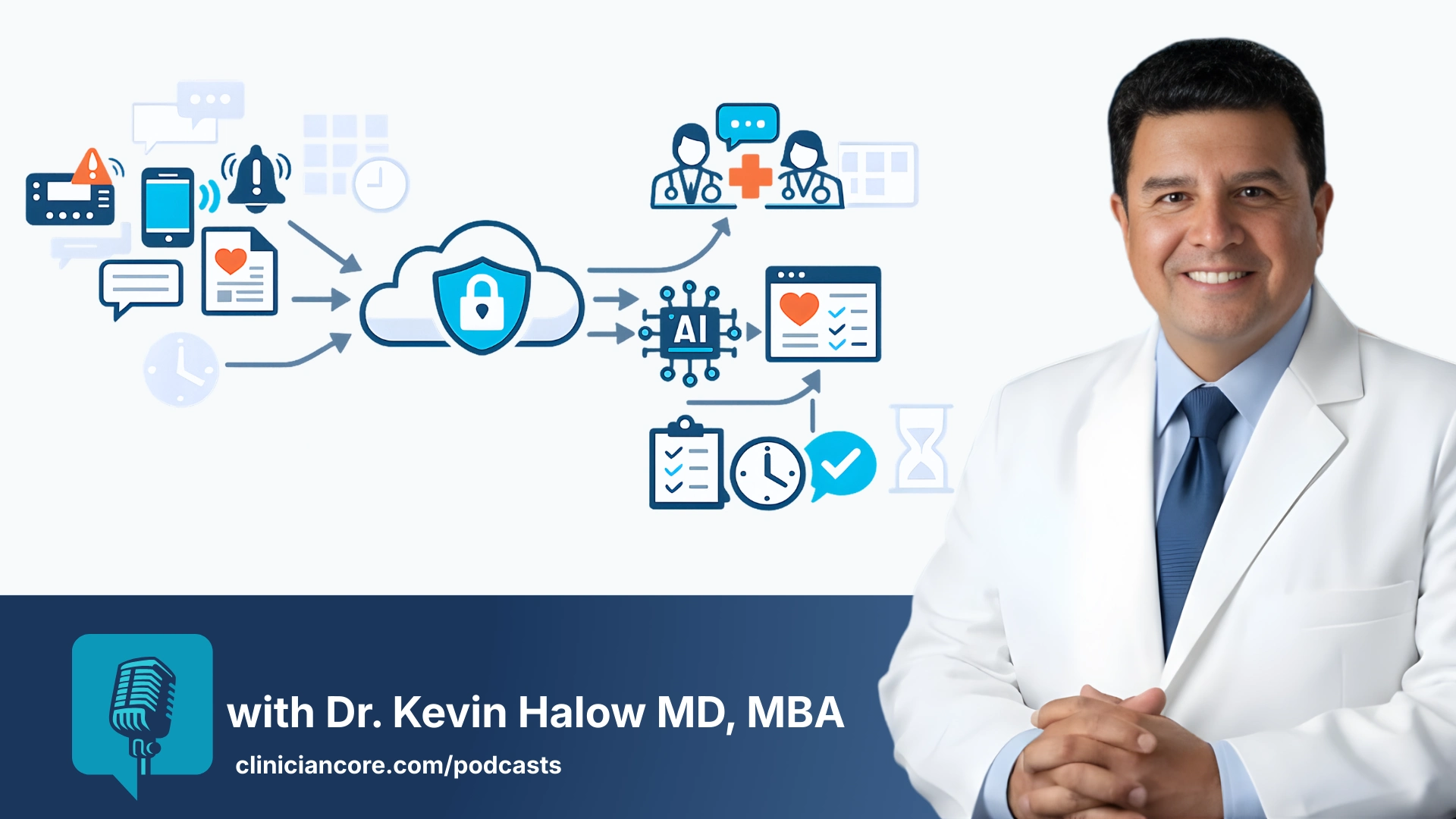
Welcome to the Connected Practice, another series in our clinician core podcasts. I’m your host, Dr. Kevin Hallow, co-founder and chief Medical Officer of Clinician Core. In today’s episode, we’re gonna pull back the curtain on the technological architecture that is currently reshaping how we practice medicine.
When we talk about the clinician core platform, we’re not just talking about a single tool, we are talking about a comprehensive ecosystem built on four Accenture pillars, HCC for healthcare collaboration, the doc lounge for the physician community, and HCX for the healthcare information exchange. And our primary focus today, HCO, the healthcare organization feature in our previous discussions.
We’ve touched on the immense pressure facing modern clinicians. We are operating in an era where medical knowledge is doubling every few months. Yet our communication infrastructure remains remarkably stagnant. We have advanced robotic surgical suites, but we still struggle to coordinate a simple patient room change without a flurry of legacy alerts and clunky notification tools.
This disconnect is the primary source of the friction. That leads to systemic physician burnout. To solve this, we designed the clinician core platform to be a private physician-centric unified network for the medical professional. While HCC allows us to collaborate across different health systems, HCX provides a space for innovation and trend analysis, and the Dock Lounge provides a private virtual space for physicians to reengage.
HCO is the foundation that manages the internal life of your medical organization. It’s the HIPAA compliant cloud-based engine that streamlines every interaction within your own four walls. Today I want to share five specific examples of how the HCO feature of clinician Core is helping physicians, clinicians, and healthcare professionals to reclaim their time and.
To regain the joy of practicing medicine.
One of the most powerful tools within the clinician core HCO suite is the ability to use non-linear video for internal coordination. Think about the traditional surgical or procedural handoff. It’s almost always a synchronous event.
You have to find the receiving physician, clinician, or nurse, and you both must be physically present and mentally available at the exact same moment. If you miss that window, you’re left playing phone tag or relying on a sterile text or voicemail that provides zero clinical context within the HCO environment.
I can now record a brief HIPAA compliant encrypted non-linear video immediately after I step out of the surgical suite and procedure room. I can use the camera to show the specific dressing placement, discuss a unique anatomic variation I encountered, or give precise instructions for postoperative care.
Because this is a core part of the clinician core platform, that video is instantly available to the entire internal team. The recovery staff can watch the video the moment the patient arrives, even if I’ve already started my next case. This is the definition of efficiency. We are moving from a world of, Hey, did you get my text to a world of, I’ve already seen the update.
This asynchronous flow powered by HCO ensures that the clinical intent is never lost In translation, it creates a visual record that is far more effective than a legacy broadcast, a confusing text, or a scribbled note on a chart.
We also need to talk about the psychological toll of the constant pings we receive all day long. We have become a profession of people who are perpetually interrupted. In many organizations, the intercom or the noisy group page is a constant background.
Hum. Every alert is treated. As equally urgent, which leads to the dangerous phenomenon of alarm fatigue. When everything is an emergency, eventually nothing feels like one. The clinician core HCO feature addresses this through intelligent AI triage when an administrative staff member or a medical assistant enters an update into the system, whether it is an urgent lab result or a question about a patient in the lobby.
AI does not just blast it to everyone. It analyzes the urgency of the message and cross cross references it with the roles and schedules of the clinical team. If I’m in the middle of a complex patient encounter, the clinician core AI knows to divert that internal alert to a lead nurse or a designated triage partner, it filters the noise.
This means that when my device actually alerts me, I know it’s a high priority matter that specifically requires my expertise. This intelligent routing is how we protect the sanctity of the healthcare professionals valuable time. We are using HCO to silence the unmanaged alerts and restore the focus that medicine requires.
I.
I often ask my colleagues, when was the last time their morning huddle actually started on time? Usually the answer is never, someone is always caught on a call or they’re busy responding to a notification on a legacy device.
Physical huddles are great in theory, but in a fast-paced clinic or hospital setting. They’re often the first thing to be sacrificed. Clinician core HCO provides a better way by digitizing the huddle into a continuous real time thread. Instead of a single 10 minute meeting, the entire internal team is connected through a secure group thread that lives within the clinician core app.
I can see exactly where we are on the schedule. At any given moment, my staff can update me on room availability or patient preparation without ever having to leave their station. This level of intra-organizational coordination creates a single unified organism. It stops the shouting of names down the hallway and the redundant internal messages that clutter our day.
The result is an organization that is quieter, more professional, and significantly more efficient. By utilizing HCO as the central hub for team coordination, we are ensuring that everyone is on the same page without needing a physical meeting to make it happen. This is how we optimize practice effectiveness and improve the patient experience simultaneously.
Now, there are times when even an internal organization needs a more focused space for discussion. Perhaps. I have a complex case that requires a detailed review with my partner who specializes in a different area of our practice.
I do not want that discussion happening in the general organization feed where it can get buried under. Administrative updates or transient notifications. The HCO feature allows us to create private invitation-only case rooms. Within these encrypted spaces, we can share high resolution diagnostic images, review detailed patient histories, and engage in a high level clinical debate.
This is the digital equivalent of leaning over a light box in the old days, but with all the security and documentation of a modern cloud platform. Unlike a hallway chat that is quickly forgotten, these interactions with the clinician core create a clear decision trail. We can reference our reasoning days later.
This fosters a culture of deep internal collaboration and shared learning. It allows us to leverage the collective intelligence of our group practice in a way that is structured, secure, and incredibly efficient. We’re moving away from the unreliable legacy hardware and towards a truly collaborative internal environment.
Finally, I wanna address the hidden work of clinical life. Every physician knows the feeling of being in a flow state with patients only be interrupted by a question about the staff schedule or a facility issue.
These administrative tasks are necessary for a healthy practice, but they should not compete for the same mental space as clinical decision making. Through the clinician core HCO feature, we are finally able to separate these two streams of information. Clinical alerts and patient updates are prioritized in one channel while administrative and organizational management tasks are organized into another.
This allows the clinician to batch their work. I can focus on my clinical alert alerts in real time and then address the administrative backlog during my designated organizational block. This prevents the constant interruption of unmanaged alerts that characterizes the traditional organizational environment.
By centralizing all internal organization tasks within a single HIPAA compliant home, we eliminate the need to check multiple apps or look for lost notes from an old notification tool clinician. Core HCO gives us the structure. We need to manage our time effectively ensuring that when we are with patients, we are fully present and focused on them alone.
I’d like to take a moment to summarize what we’ve discussed. When we look at the clinician core platform, we must see it as a comprehensive solution. While HCC, the DOC Lounge and HCX all play vital roles in the life of moderate physician, HCO is the foundation for your daily internal success.
It is the feature that brings order to the chaos of a busy medical organization. It’s time for us to move beyond the legacy systems that have held our practices back for decades. By adopting the HCO feature of clinician core, we are not just adding another app to our phones. We are implementing a clinical operating system that respects our time, protects our focus, and elevates the standard of care that we provide to our patients.
If you’re ready to see our clinician core platform and its HCO feature can transform your internal organization, I encourage you to visit clinician core.com today. There you can find resources, how to integrate HCO into your daily routine, and explore the other pillars of our ecosystem like healthcare collaboration, healthcare exchange, and the doc lounge.
Let’s start communicating at the speed of modern medicine. I’m Dr. Kevin Hallow, co-founder and chief Medical Officer of Clinician Core. This has been the Connected Practice, another part in our series of Clinician core podcasts. Thanks for listening.