Healthcare organizations face increasing communication fragmentation across messaging tools, pagers, and email systems. Unified clinical communication platforms reduce cognitive load, improve patient safety, and restore physician workflow efficiency.
Video, voice, and text clinical communication, when fragmented across disconnected systems is one of the most measurable drivers of physician burnout, medical error, and lost revenue in modern healthcare.
Walk through the workflow of a typical physician on any given morning. A pager alert, a text from a nurse, a secure message in the EHR inbox, an email from a specialist, a voice message from the on-call resident — each arriving through a separate system, each demanding a separate response. None of them talk to each other. Welcome to the fragmented communication landscape that the majority of American physicians navigate every single day.
This is not a minor inconvenience. Fragmentation of clinical communication is a measurable driver of physician burnout, medical error, and lost revenue. When video, voice, and text exist in disconnected silos rather than as integrated modalities within a unified clinical communication platform, the entire system suffers — physicians most of all.
In 2026, the question is no longer whether healthcare needs to consolidate its communication infrastructure. The question is how quickly organizations will act.
ClinicianCore was built to answer that question with a purpose-built solution for physicians. For the organizational and human cost of fragmented communication, see our deep dive on physician burnout reduction strategies.
Key Takeaways
| Strategic Domain | Key Insight | Why It Matters |
| Communication Infrastructure | A governed clinical communication platform integrates video, voice, and text within a secure environment. | Reduces modality fragmentation and preserves conversational context. |
| Financial Impact | Physicians receive an average of 243 in-basket messages per week — nearly half generated by EHR algorithms alone (Health Affairs, 2019). | Message volume is a direct predictor of burnout risk and intent to reduce clinical hours. |
| Burnout Reduction | Nearly 75% of physicians with burnout directly blame fragmented EHR and communication systems (Infer Science, 2025). | Communication infrastructure is a clinical workforce retention strategy. |
| Voice AI Efficiency | AI-powered voice-to-text tools improved efficiency, patient interaction, and reduced administrative burden across every study that measured these outcomes (EBioMedicine, Aug 2025). | Voice is not supplemental — it is structurally necessary for complete clinical communication. |
| Multimodal Accuracy | Combining text, voice, and video improves clinical emotion detection by 12.6% over text-only approaches (NLP-AI4Health, 2025). | Modality integration improves clinical decision quality, not just convenience. |
| Market Adoption | By 2025, approximately 25% of U.S. healthcare organizations are deploying multimodal AI communication agents (Deloitte, cited 2025). | Platform consolidation is now a strategic priority, not a future-state concept. |
The Scale of the Problem: Communication Fragmentation by the Numbers
The communication infrastructure that most healthcare organizations rely on was not designed for how physicians actually work. It was assembled over decades — pagers in the 1980s, EHRs in the 2000s, secure messaging in the 2010s — each layer added without replacing the last. The result is a system of remarkable inefficiency.
A Health Affairs study analyzing EHR use at a large multispecialty practice found that physicians receive an average of 243 in-basket messages per week. Of those, 114 were generated by the EHR system itself — far outnumbering the 53 messages received from colleagues and 30 from patients. Physicians receiving above-average message volumes faced a 40% higher probability of burnout and a 38% higher probability of planning to reduce their clinical hours.
The picture becomes more alarming when fragmented communication channels compound an already overwhelmed inbox. Nearly 75% of physicians with burnout symptoms directly blame EHR and communication system dysfunction — and 59% believe these systems need a complete overhaul. Meanwhile, nearly 70% of physicians in a survey of two Midwestern hospitals reported difficulty finding critical patient information due to the volume and fragmentation of data across their systems. The hidden cost of physician turnover, averaging $500,000 to $1 million per physician is directly linked to this structural dysfunction.
The problem is not that physicians are using too many communication tools. The problem is that those tools do not work together — and that dysfunction has a clinical and human cost.
– Dr. Kevin D. Halow MD, MBA FACS
ClinicianCore eliminates multi-system chaos by centralizing all physician communication — pages, texts, consult requests, and care team messages — into a single, secure, HIPAA-compliant unified clinical communication platform. The HealthCare Organization (HCO) module delivers intelligent message prioritization, ensuring urgent items surface immediately while non-urgent messages queue without interrupting active patient care. Explore how HCO serves Core Clinical Leadership.
(Co-founder and Chief Medical Officer)
Why Video, Voice, and Text Clinical Communication Must Work as One System
For routine task delegation and asynchronous updates, secure text messaging has proven its value. A PubMed study implementing EHR-based text paging at a 591-bed urban hospital found educational interruptions dropped from 64% to 16% and patient care interruptions fell from 68% to 12%, with 92% of residents preferring the text-based system. Over three months, the system saved 72.5 hours in message transmission time alone.
But the clinical scenarios that matter most — urgent consults, complex case discussions, and emotionally charged patient conversations — cannot be adequately supported by text. Tone, urgency, and non-verbal context are lost entirely. A typed message reading ‘patient deteriorating’ carries a fraction of the clinical weight of a 30-second voice call or a one-minute video consult with the admitting team.
Research from the Journal of Medical Internet Research confirms this gap: multimodal systems that combine text, audio, and visual data consistently outperform single-modality approaches for clinical decision support, diagnostic accuracy, and patient-provider interaction quality. The same principle applies directly to physician collaboration. Complex, high-stakes clinical decisions require more than text. For a detailed look at the financial cost of this fragmentation, see The High Cost of Fragmented Clinical Communication in Modern Healthcare.
– Dr. Kevin D. Halow MD, MBA FACS
ClinicianCore eliminates multi-system chaos by centralizing all physician communication — pages, texts, consult requests, and care team messages — into a single, secure, HIPAA-compliant unified clinical communication platform. The HealthCare Organization (HCO) module delivers intelligent message prioritization, ensuring urgent items surface immediately while non-urgent messages queue without interrupting active patient care. Explore how HCO serves Core Clinical Leadership.
(Co-founder and Chief Medical Officer)
The Voice Modality: Speed, Nuance, and Clinical Power in Physician Collaboration
Voice communication in clinical settings has undergone a profound transformation in 2025. A systematic review published in EBioMedicine (August 2025) — analyzing data from 524 healthcare professionals, 616 patients, and 1,069 clinical consultations found that AI-powered voice-to-text technology improved effectiveness, practice efficiency, and patient-provider interaction quality across every study that measured those outcomes. Faster documentation, reduced administrative burden, and more engaged clinical conversations were consistent findings.
Beyond documentation, voice carries clinical information that text fundamentally cannot. Vocal tone signals urgency, emotional state, and confidence in a diagnosis — all of which matter when a hospitalist is consulting a cardiologist at 2 AM. Research on multimodal emotion recognition in clinical settings, presented at NLP-AI4Health 2025, found that combining voice with other modalities achieved 86.8% accuracy in detecting patient emotional states a 12.6% improvement over text-only approaches. What holds for patient interactions applies equally to physician collaboration: voice conveys the clinical urgency that text strips away.
– Neeraj Jain, CEO (ClinicianCore)
ClinicianCore integrates secure, real-time voice communication directly into the physician workflow — no separate app, no unsecured phone call, no compliance risk. Physicians initiate an encrypted voice consult from within the same unified clinical communication platform used for text updates and care team coordination, maintaining a complete, timestamped communication record. Voice messages can also be left asynchronously for colleagues across time zones or shifts — all fully HIPAA-compliant.
The Video Modality: Visual Diagnosis and Physician Collaboration Across Distance
Video communication in healthcare has moved far beyond pandemic-era telehealth. In 2025, researchers at the University of Pennsylvania’s AI-4-AI Lab unveiled Observer the first multimodal medical dataset combining video, audio, and clinical EHR data from real primary care settings. The project was built on a foundational clinical insight: so much of what shapes visit outcomes has been invisible to researchers because the tools to capture non-verbal, environmental, and behavioral context did not exist. Now they do.
For physician collaboration, video unlocks capabilities that text and voice cannot provide. A dermatologist reviewing a wound presentation, a vascular surgeon assessing post-operative swelling, a neurologist evaluating gait each of these clinical questions can be resolved with a 60-second video consult between physicians that would otherwise require a patient transfer, a scheduled appointment, or a text description that lacks the essential visual context.
Multimodal AMIE research published in May 2025 (arXiv) demonstrated that systems integrating text, voice, and video for clinical consultations outperformed primary care physicians on 7 of 9 evaluation axes when handling multimodal diagnostic data. The implication for physician collaboration is direct: when clinicians can share visual clinical data within a secure communication environment, diagnostic accuracy improves and specialist consultation becomes faster and more precise.
– Neeraj Jain, CEO (ClinicianCore)
ClinicianCore enables encrypted, HIPAA-compliant video consultations between physicians within the same unified clinical communication platform used for text and voice. The HealthCare Collaboration (HCC) module allows specialists to conduct visual assessments across sites without scheduling delays. Cross-specialty case reviews happen in real time, not across a chain of text messages. Every interaction is logged within the platform’s audit trail for compliance and continuity of care. Learn how this supports Care Delivery Partners — from radiologists to surgical tea
Practice Efficiency, Physician Well-Being, and the Communication Infrastructure Connection
The relationship between communication infrastructure and physician well-being is not indirect. The athenahealth 2025 Physician Sentiment Survey found that 95% of physicians said getting the right clinical data at the right time is critically important and 73% identified relevant patient information surfaced in context as the most critical factor in simplifying care. When communication is fragmented across modalities and systems, those two things become structurally impossible. Healthcare technology investments that fail to integrate communication are, in effect, investments that stop short of the problem. For a full operational analysis of this cost, see The High Cost of Fragmented Clinical Communication in Modern Healthcare.
The financial stakes are equally concrete. Replacing a single physician costs between $500,000 and $1 million, and fragmented communication is consistently identified as one of the top organizational drivers of physician attrition — a reality explored in depth in The Hidden $1M Cost of Physician Turnover. Practices using AI-assisted documentation tools already report completing notes 25% faster — a direct practice efficiency gain from improving one layer of the communication stack. Integrate that across a full video, voice, and text environment and the efficiency opportunity becomes transformative.
How Video, Voice, and Text Clinical Communication Reduces Physician Burnout
The evidence is consistent: video, voice, and text clinical communication integrated into one platform directly reduces the administrative burden that drives physician attrition.
The right healthcare technology infrastructure does not just support care it actively protects the physicians who deliver it. For a strategy-level analysis of how organizational design can reduce burnout, see Evidence Based Organizational Strategies for Physician Burnout Reduction.
When physicians can communicate with precision — using the right modality for the clinical moment, within a single secure environment, without platform switching — they reclaim the cognitive headspace that fragmentation steals. That recovery of mental clarity is not a soft benefit. It is the precondition for safe, high-quality, sustainable clinical care.
– Dr. Kevin D. Halow MD, MBA FACS
Every design decision in ClinicianCore’s clinical communication platform is oriented around physician time and cognitive load. The HealthCare Organization (HCO) module uses AI-triaged smart routing so non-urgent communication does not interrupt active care. The D.O.C. (Doctor’s Opinion Count) Virtual Lounge provides a private, physician-only sanctuary for peer connection — addressing the isolation dimension of burnout that technology alone often ignores. The HealthCare Xchange (HCX) connects physicians to industry innovation in a stealth-mode environment. Together, these modules form a communication infrastructure that restores physician well-being rather than depleting it. See how ClinicianCore serves physicians and administrators through Core Clinical Leadership solutions.
(Co-founder and Chief Medical Officer)
The Path Forward: Unified Clinical Communication as Core Healthcare Infrastructure
The evidence in 2026 converges on a single conclusion: the healthcare industry’s communication infrastructure is clinically inadequate and the solution is not more tools, it is better integration. Video, voice, and text are not competing modalities. They are complementary layers of a unified clinical communication system, each suited to different clinical moments, each essential for complete physician collaboration. For a deeper exploration of how AI is reshaping this landscape, see How Healthcare AI and Innovation are Transforming Clinical Collaboration and Care Delivery.
Organizations that treat unified clinical communication as a clinical priority — not an IT afterthought — will measurably outperform those that continue stacking disconnected systems. They will retain physicians longer, reduce burnout-driven attrition, deliver faster and more accurate clinical decisions, and build the collegial physician culture that fragmentation systematically destroys.
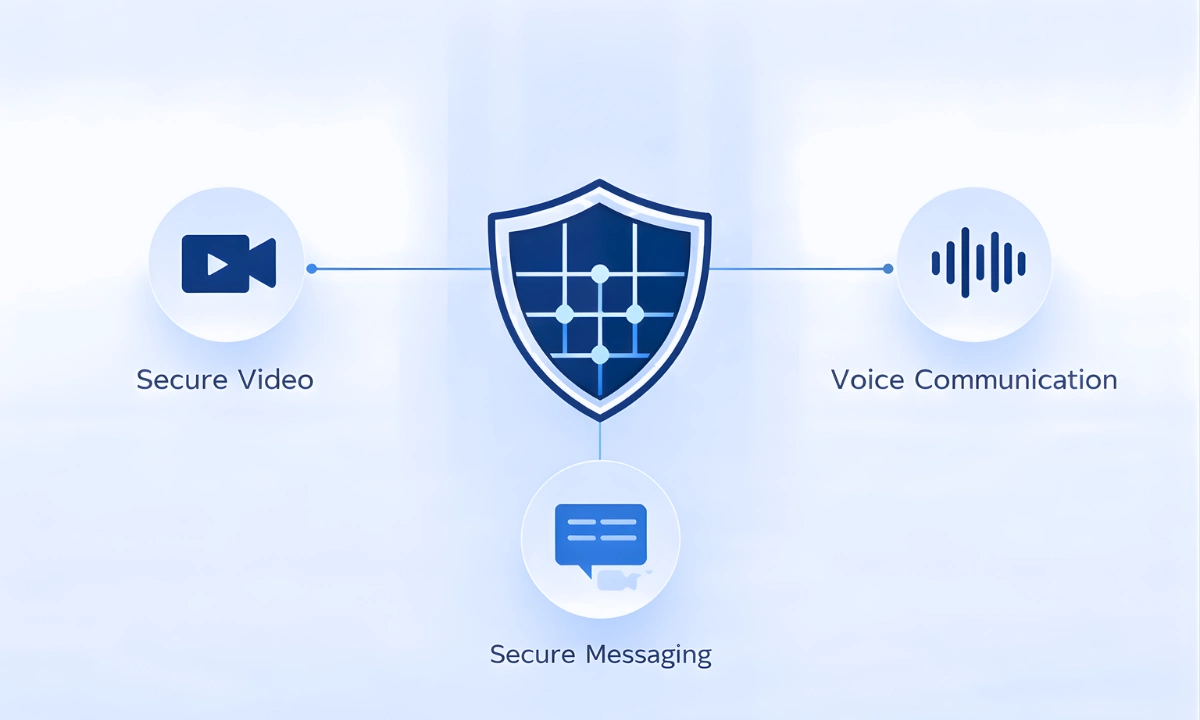
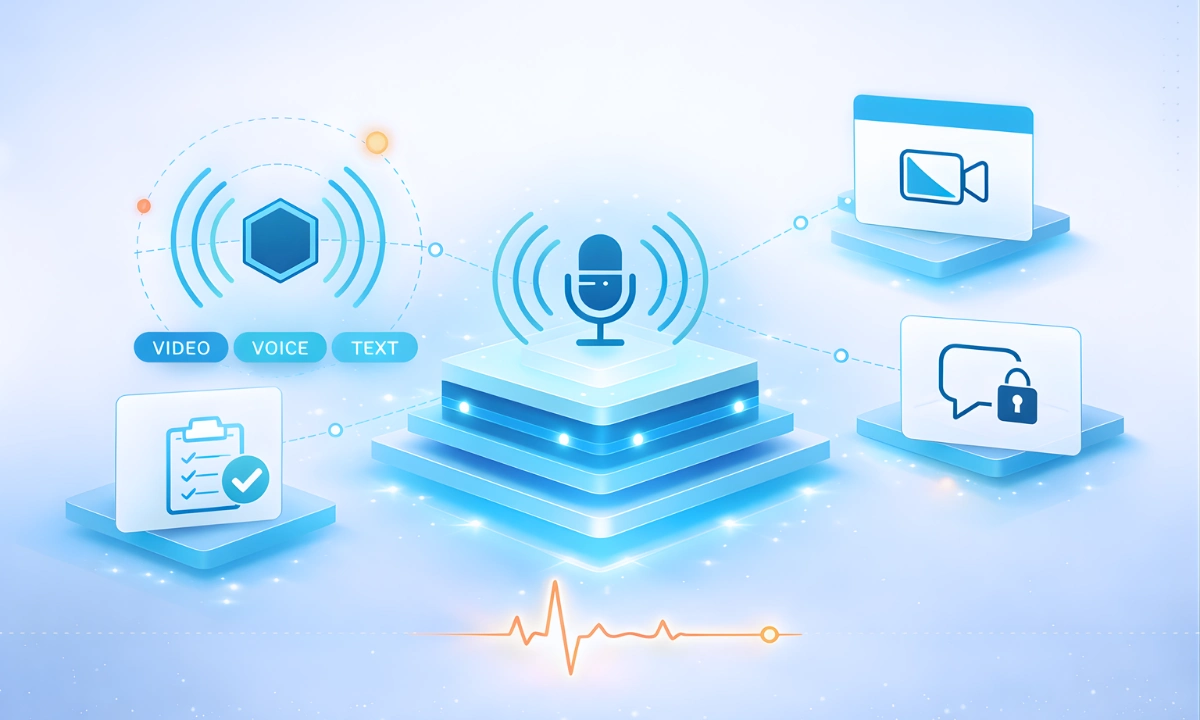
ClinicianCore’s video, voice, and text clinical communication platform brings all three modalities together in one HIPAA-compliant environment built exclusively for physicians.
It is not a messaging app. It is not a telehealth bolt-on. It is the communication infrastructure that medicine has needed — finally built the right way, for the right people. Learn more about how physician collaboration tools and practice efficiency solutions power the ClinicianCore platform.
The communication trinity is not a product feature. It is a clinical necessity. And in 2026, there is no longer a credible reason to delay building it. Explore the full ClinicianCore platform or calculate your organization’s ROI with the ClinicianCore Impact Estimator.
Frequently Asked Questions
What is a unified clinical communication platform and why does it matter in 2026?
A unified clinical communication platform integrates secure text, voice, and video into one HIPAA-compliant environment built for physician workflows. It matters because the average physician receives 243 in-basket messages weekly across fragmented systems and nearly 75% of burned-out physicians directly blame that dysfunction. ClinicianCore consolidates every modality in one physician-only platform, restoring the clarity fragmentation steals.
When should physicians use video versus voice versus text for clinical communication?
Text handles routine, asynchronous updates. Voice is best for urgent consultations where tone and nuance matter. Video supports visual diagnostic scenarios where seeing the patient directly improves decision quality. ClinicianCore enables all three within a single interaction through the HealthCare Collaboration (HCC) module, no platform switching, no compliance risk.
How does unified clinical communication reduce physician burnout?
Unified communication reduces physician burnout by eliminating the cognitive overload of context-switching between disconnected systems. A Health Affairs study linked above-average EHR message volumes to a 40% higher burnout probability. When all communication pages, texts, consults, and peer connection exists in one platform, attention focuses on care rather than system management.
Are video and voice clinical communications required to be HIPAA-compliant?
Yes. Any physician-to-physician consultation involving protected health information must meet HIPAA Security and Privacy Rules, including end-to-end encryption, access controls, audit logging, and a signed BAA. Most consumer video and messaging platforms do not qualify. ClinicianCore’s unified clinical communication platform is built to full HIPAA compliance across all three modalities.
How does multimodal clinical communication compare across countries — is the U.S. behind?
Yes. The Commonwealth Fund’s 2025 survey of 10 countries found U.S. physicians reported the highest administrative burden and lowest scores for team-based communication support. Countries like the Netherlands and Australia with unified health communication systems, show measurably lower burnout rates. The technology gap is not technical; it is organizational. Adopting a unified clinical communication platform is the fastest path to closing it.
How does unified clinical communication reduce physician burnout as a system-level outcome?
Unified clinical communication addresses burnout at the systems level by eliminating alert fragmentation, unpaid curbside consult work, and the isolation that fractured digital environments create. The D.O.C. (Doctor’s Opinion Count) Virtual Lounge provides a physician-only peer community within the same platform, addressing the professional isolation dimension that task-management tools miss entirely.
How does ClinicianCore’s approach differ from platforms like TigerConnect?
ClinicianCore is physician-centric, not technology-imposed. While secure messaging platforms focus on message delivery, ClinicianCore builds the full communication infrastructure — video, voice, secure text, peer community, and revenue capture for interprofessional consults within a single HIPAA-compliant ecosystem. The HealthCare Collaboration (HCC) module uniquely captures documented consult workflows that support CPT billing codes 99446–99452, converting communication that was previously uncompensated into auditable revenue.
What is the best clinical communication platform for small practices?
The best clinical communication platform for small and independent practices is one that eliminates tool sprawl without requiring enterprise IT infrastructure. Small practices need HIPAA-compliant video, voice, and secure text in a single environment not three separate subscriptions. ClinicianCore is built physician-first, meaning it scales from solo and small group practices to large health systems without changing the core workflow. The HealthCare Collaboration (HCC) module supports CPT billing codes 99446–99452, which is particularly valuable for small practices where every uncompensated consult directly affects revenue. Unlike enterprise-only platforms, ClinicianCore does not require a dedicated IT team to deploy or maintain.
References & Citations
1. Shanafelt TD et al. (Health Affairs, 2019). Physicians’ Well-Being Linked to In-Basket Messages Generated by Algorithms in Electronic Health Records.
2. Alboksmaty A et al. (EBioMedicine, August 2025). The Impact of Using AI-Powered Voice-to-Text Technology for Clinical Documentation on Quality of Care.
3. Infer Science (2025). How EHR Inefficiencies Cause Physician Burnout.
4. Tebra (2025). Primary Care Under Pressure: What 2025 Burnout Data Reveals.
5. athenahealth / The Harris Poll (2025). Insights from the 2025 Physician Sentiment Survey.
6. Lapointe R et al. (PubMed, 2018). An Innovative Approach to Improve Communication and Reduce Physician Stress and Burnout via EHR-Based Text Paging.
7. Channe V (NLP-AI4Health, 2025). Enhancing Patient-Centric Healthcare Communication Through Multimodal Emotion Recognition.
8. University of Pennsylvania / EurekAlert (2025). Observer: New Multimodal Medical Dataset Linking Video, Audio, and Clinical EHR Data.
9. Google DeepMind / arXiv (May 2025). Multimodal AMIE: Advancing Conversational Diagnostic AI with Video, Voice, and Text Integration.
10. AlSaad R et al. (Journal of Medical Internet Research, 2024). Multimodal Large Language Models in Health Care: Applications, Challenges, and Future Outlook.
11. Commonwealth Fund (November 2025). Causes and Impacts of Burnout Among Primary Care Physicians in 10 Countries.