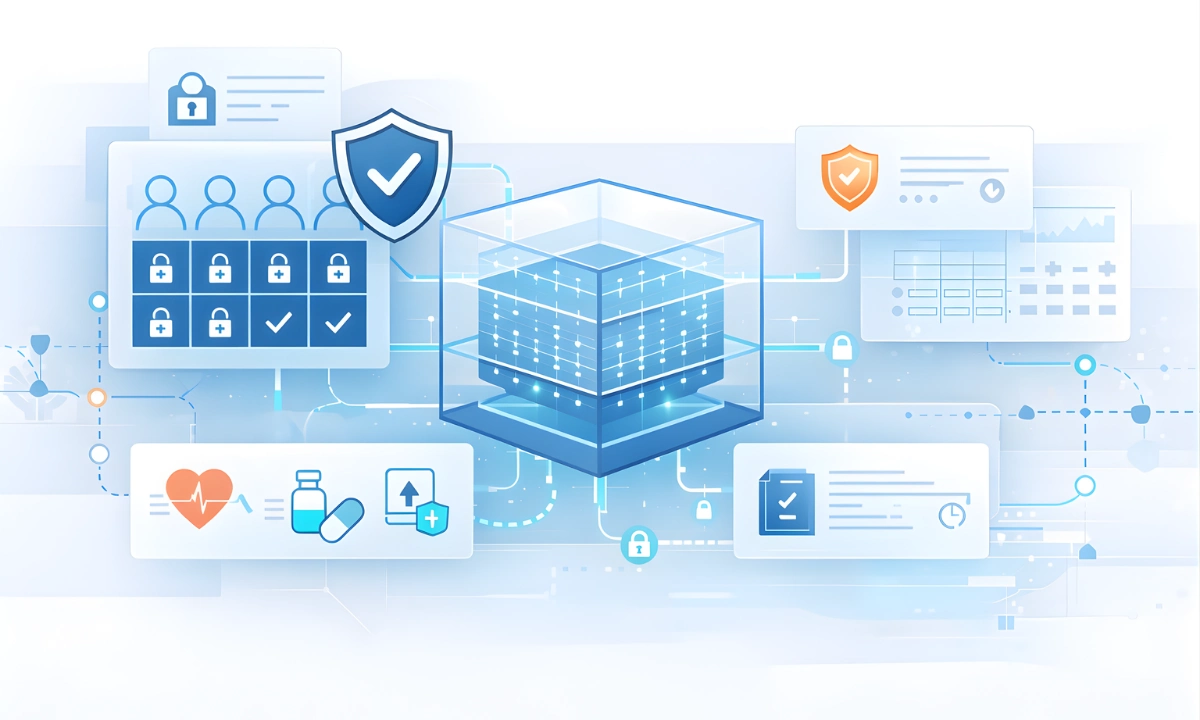
Healthcare AI privacy is the institutional framework of technical and legal safeguards designed to protect Protected Health Information (PHI) within artificial intelligence ecosystems.
For United States healthcare systems, this requires strict adherence to the HIPAA Privacy Rule and alignment with evolving HHS guidance on responsible AI use in healthcare settings.
As organizations transition toward more advanced healthcare AI and innovation, the Office for Civil Rights (OCR) has signaled increased attention to emerging AI-related privacy risks, including unapproved or unsanctioned AI usage within clinical environments.
CMS guidance increasingly emphasizes documentation, auditability, and governance safeguards for AI-enabled workflows.
These measures specifically mitigate the risk of unauthorized data re-identification during interoperability exchanges. Organizations must rigorously distinguish between enterprise AI platforms, which provide a comprehensive Business Associate Agreement (BAA), and consumer-grade tools that may lack enterprise contractual safeguards and institutional data governance controls.
In summary, healthcare AI privacy requires enterprise governance, contractual safeguards such as BAAs, encrypted or isolated deployments, and strict data usage controls to prevent model-level exposure of Protected Health Information.
Key Takeaways
- Healthcare AI privacy requires contractual safeguards, not just encryption.
- Enterprise AI platforms must provide BAAs and no-training guarantees.
- Consumer AI tools lack institutional governance controls.
- Prompt-level logging and USCDI v3 interoperability are becoming regulatory expectations.
- Clinician-only environments reduce PHI surface exposure.
What is Healthcare AI Privacy?
Healthcare AI privacy ensures that artificial intelligence systems processing clinical data comply with HIPAA regulations, maintain data sovereignty, and prevent model-level data leakage. Enterprise deployments typically require BAAs, encrypted or isolated environments, and clearly defined data usage limitations to support HIPAA compliance under U.S. healthcare law.
Enterprise Healthcare AI Evaluation Framework (2026)
The 2026 landscape for healthcare AI compliance is defined by a shift toward USCDI v3 (United States Core Data for Interoperability) standards. Hospital IT leaders are increasingly prioritizing clinical workflow automation that evaluates models not just on clinical accuracy, but on their native support for FHIR-based APIs and federal interoperability standards.
| Evaluation Area | What Enterprise Buyers Should Require |
| Business Associate Agreement | Explicit HIPAA liability transfer and no-training clause |
| Data Isolation | Encrypted silo or on-prem deployment |
| Model Training Policy | Written guarantee excluding PHI from foundation model training |
| Auditability | Prompt-level logging retained ≥ 6 years |
| Interoperability | FHIR and USCDI v3 support |
| Access Controls | Role-Based Access Control (RBAC) |
| Governance | Alignment with NIST AI RMF 1.0 |
OpenAI ChatGPT Health (Consumer Health Experience)
OpenAI introduced ChatGPT Health as a dedicated health space within the ChatGPT platform that lets users securely connect electronic medical records and wellness applications so AI responses are more contextually relevant to their personal health data. According to OpenAI, this environment uses isolated, encrypted spaces to protect sensitive health information, and health-related conversations and connected files are not used to train foundation models or flow back into general ChatGPT interactions.
ChatGPT Health is designed to support understanding of health information and help users prepare for clinician conversations, not to replace clinical care, and its optional medical record integrations are currently available only in the United States.
Enterprise AI vs Consumer AI in Healthcare
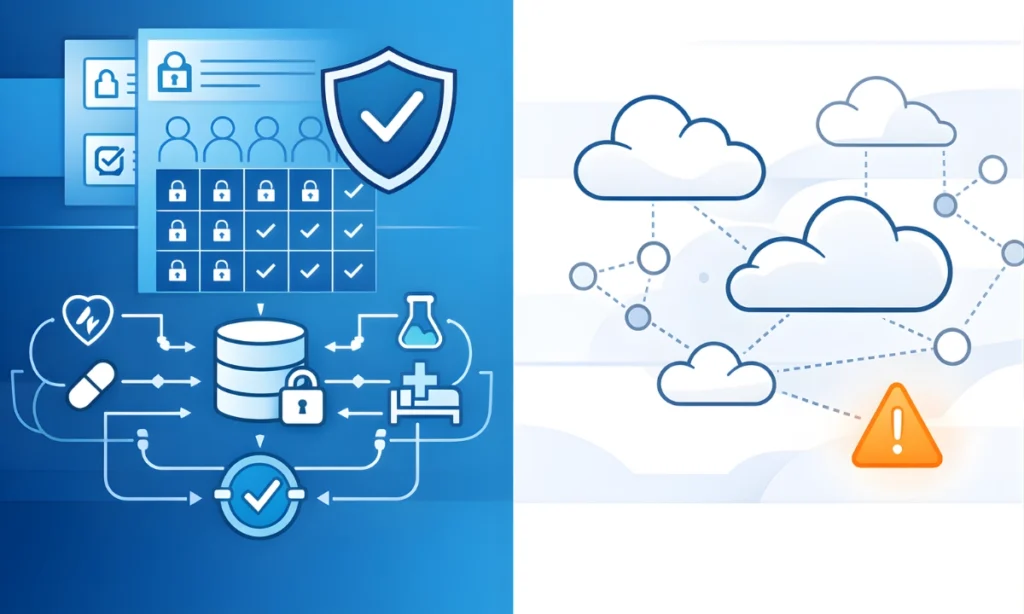
While consumer AI tools may offer isolated health experiences, enterprise AI deployments operate within regulated institutional environments governed by contractual safeguards and compliance controls.
| Category | Enterprise AI Platform | Consumer AI Tool |
| HIPAA Coverage | Covered under BAA | Typically not covered |
| Data Usage | Contractually restricted | May follow platform terms |
| Deployment | Isolated or on-prem | Public cloud environment |
| Audit Logging | Required | Often limited |
| Governance | CIO/Compliance oversight | Individual user discretion |
AI in Healthcare Data Privacy: Institutional Vulnerabilities & Risk Exposure
When U.S. healthcare systems deploy LLM-powered tools, the primary risk shift occurs from simple data breaches to complex re-identification vulnerabilities that challenge traditional OCR de-identification protocols.
The Re-identification Fallacy (The Mosaic Effect)
Standard de-identification often fails when faced with sophisticated AI. Even if the 18 HIPAA identifiers are removed, an LLM processing rare biomarkers or specific surgery dates can often re-identify individuals through “mosaic” Linkage Attacks.
This may create material privacy risks under the HIPAA Privacy Rule if re-identification leads to unauthorized disclosure of Protected Health Information (PHI).
Human Oversight and Regulatory Exposure
Unless a HIPAA-compliant healthcare automation software platform is utilized, sensitive clinical inputs may be reviewed by third-party human contractors for model verification (RLHF).
Healthcare organizations should carefully evaluate whether AI vendor review processes introduce additional access to PHI and ensure that any such access is governed by appropriate contractual and compliance safeguards.
Medical LLM Privacy Risks: Data Persistence & HIPAA Compliance Challenges
A fundamental challenge for the CMIO is that LLMs absorb information into their mathematical weights. This creates a persistent conflict with HIPAA requirements for data lifecycle management and the “right to erasure.”
- Training Leakage Risk: If an enterprise does not secure a “no training” guarantee, rare clinical cases can influence the model’s weights. This creates a risk of “model disgorgement,” where PHI is leaked in future outputs across different user sessions.
- Audit Lineage Requirements: The CMS AI Playbook v4 now requires hospitals to maintain auditable data lineage for every prompt and model interaction for up to six years, mirroring traditional medical record retention mandates.
Interoperability and Agentic Risks in Enterprise AI
As healthcare organizations adopt TEFCA (Trusted Exchange Framework and Common Agreement) for seamless data sharing, AI agents are gaining “agentic” power to act on clinical data across disparate systems.
- Indirect Prompt Injection: Security leaders must guard against attackers using hidden instructions in external records to trick a hospital’s AI into exporting PHI or sensitive metadata.
- Metadata Mapping: AI access to enterprise calendars creates a map of facility utilization. This metadata, when combined with patient traffic patterns, is increasingly viewed by the OCR as high-risk identifiable information that requires robust ai data security healthcare protocols.
The Regulatory Foundation: HIPAA and AI in Healthcare
The distinction between a “Covered Entity” and a technology provider is the cornerstone of healthcare AI governance in 2026.
Business Associate Agreements (BAAs) and Derivative Works
A BAA is the primary legal shield for a U.S. hospital. It ensures the AI vendor assumes liability for data protection.
A robust AI BAA should clearly define data ownership, model training restrictions, and downstream use limitations. Some governance experts have raised questions about how derivative model artifacts should be treated when trained on PHI, making contractual clarity increasingly important for risk mitigation.
CMS AI Playbook v4 Compliance
Federal healthcare oversight bodies increasingly emphasize documentation, auditability, and governance safeguards when AI is incorporated into care delivery workflows. Maintaining structured logging and oversight mechanisms may help organizations demonstrate compliance during regulatory review.
Procurement Standards: Identifying a HIPAA Compliant AI Platform
For hospital leadership evaluating healthcare AI vendors, governance architecture should weigh equally with clinical performance metrics.
When evaluating AI in healthcare data privacy, ClinicianCore leadership recommend moving toward secure healthcare process automation that follows the NIST AI Risk Management Framework (AI RMF 1.0):
- Differential Privacy: Adds mathematical “noise” to clinical datasets to prevent pinpointing specific patient identities, aligning with NIST “Measure” functions.
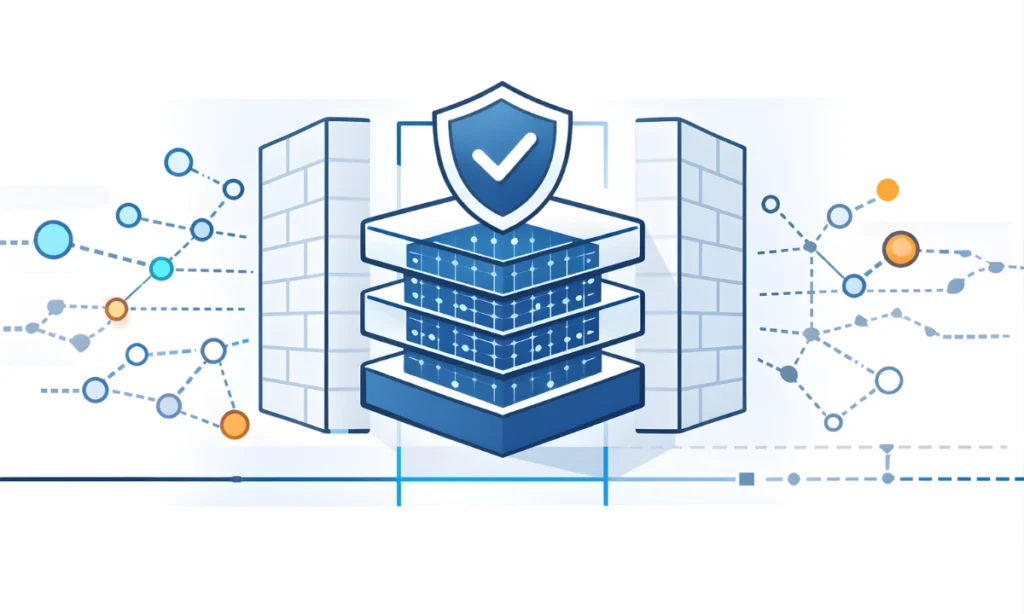
- Federated Learning: The model learns within the hospital firewall, leaving the raw PHI behind—a gold standard for data sovereignty.
- Zero-Knowledge Architectures: Data is encrypted such that even the AI provider cannot access plaintext inputs, supporting advanced implementations of HIPAA Security Rule safeguards.
As healthcare organizations expand AI-powered clinical workflow automation, privacy governance must extend beyond data encryption to communication architecture. Clinician-only AI environments reduce surface exposure by eliminating patient-facing access points and ensuring PHI remains within institutional boundaries.
ClinicianCore supports healthcare organizations in implementing clinician-only AI environments aligned with HIPAA governance and NIST AI RMF frameworks.
Conclusion: Advancing Toward Secure Clinical Collaboration
The shift from experimental AI to enterprise-wide adoption requires a fundamental transition in how health systems perceive data boundaries. As the OCR and HHS refine oversight for medical LLMs, the priority for hospital leadership must move beyond simple encryption toward the establishment of clinician-only environments. These gated ecosystems ensure that AI serves as a secure extension of the care team, rather than a point of vulnerability.
Strategic healthcare AI governance is no longer just a defensive compliance measure; it is a prerequisite for high-performance medicine. By deploying platforms that prioritize data sovereignty, where clinical intelligence is refined without the data ever entering the public domain; health systems can safely bridge the gap between innovation and the HIPAA Privacy Rule.
Frequently Asked Questions
Is healthcare AI HIPAA compliant?
Healthcare AI deployments typically require a Business Associate Agreement (BAA) and appropriate administrative, technical, and physical safeguards to support HIPAA compliance.
Can AI models remember patient data?
Yes, AI models can “remember” data through training leakage. If PHI is included in a training set, it becomes part of the model’s mathematical weights. Hospitals must ensure their AI partners utilize “no-training” silos to prevent permanent data persistence within the model’s architecture.
What is a Business Associate Agreement (BAA) in AI?
A BAA in AI is a legal contract between a healthcare provider and an AI vendor that establishes HIPAA liability. It mandates specific administrative and technical safeguards for PHI and should explicitly prohibit the use of clinical inputs for improving public models.
Are consumer AI tools safe for clinical use?
Consumer AI tools are generally not designed for regulated clinical workflows and may lack the contractual, governance, and audit safeguards required in healthcare environments.
How can hospitals securely deploy LLMs?
Hospitals securely deploy LLMs by utilizing enterprise-grade, sandboxed environments that integrate with EHRs via interoperability standards like FHIR. Security protocols must include Role-Based Access Controls (RBAC), prompt-level audit trails, and federated learning to ensure patient data stays within the institutional firewall.