End-to-end encryption in healthcare is the technical foundation of every genuinely HIPAA-compliant communication platform yet it remains one of the most misrepresented terms in healthcare technology. This guide explains exactly what end-to-end encryption means, how it differs from weaker alternatives, why it is required for HIPAA-compliant collaboration, and what administrators should demand from every vendor claiming compliance.
For the full framework of HIPAA requirements a communication platform must meet, see our guide: What Makes a Communication Platform Truly HIPAA Compliant?
Key Takeaways
- End-to-end encryption (E2EE) ensures that only the sender and intended recipient can read a message not the platform provider, not the server, and not an interceptor on the network.
- Transport-layer encryption (TLS alone) is not end-to-end encryption. Many platforms use TLS in transit but decrypt data on their servers, making message content accessible to the vendor.
- In December 2024, HHS proposed mandatory ePHI encryption at rest and in transit via the HIPAA Security Rule NPRM. Platforms enforcing E2EE today are already ahead of this regulatory curve.
- Every patient-related message sent through a non-E2EE application including consumer apps like WhatsApp, iMessage, and standard SMS constitutes a reportable HIPAA breach.
- ClinicianCore enforces end-to-end encryption across all four platform modules (HCO, HCC, HCX, D.O.C.), covering messaging, voice, video, and file transfers by architecture not configuration.
- In 2024, OCR completed 22 enforcement actions totaling over $9.4 million. Inadequate technical safeguards including failed transmission security were among the top cited findings (HHS OCR, 2024).
What End-to-End Encryption Actually Means
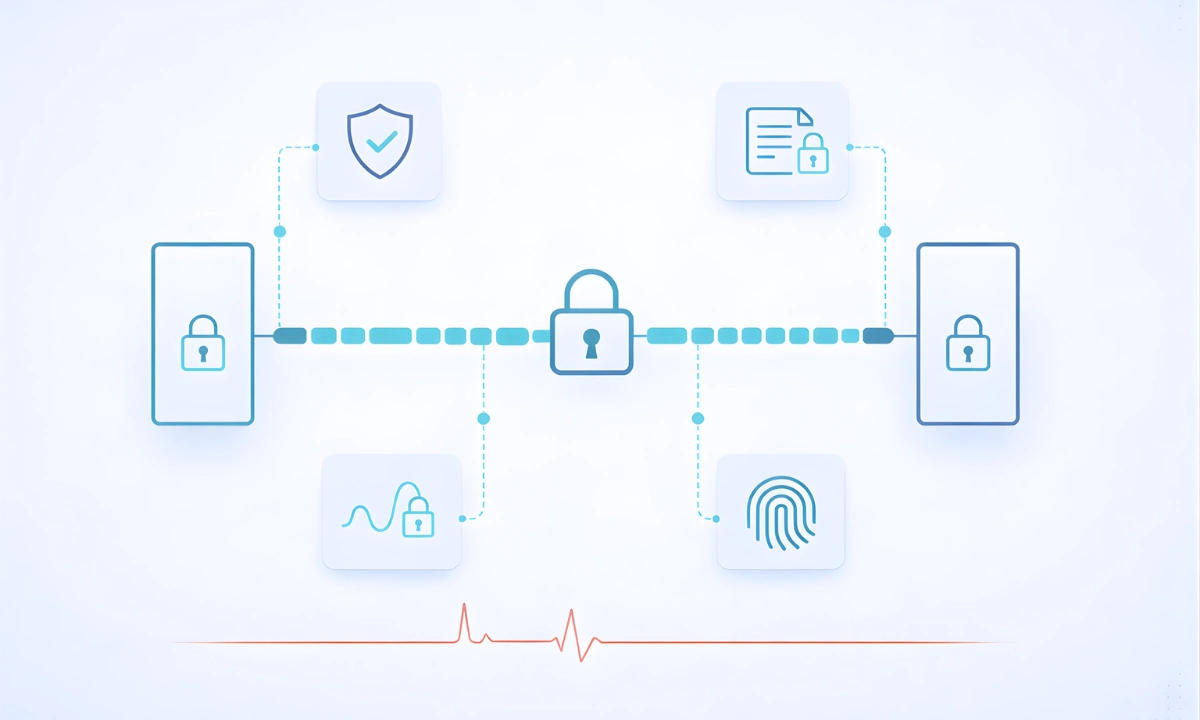
End-to-end encryption (E2EE) is a method of data protection in which a message is encrypted on the sender’s device and can only be decrypted by the intended recipient’s device. No intermediary including the platform provider, the server infrastructure, or any party monitoring the network can access the message content.
The phrase “end-to-end” describes the two endpoints of the communication: the sender and the receiver. Everything between those endpoints sees only encrypted data ciphertext that is mathematically indecipherable without the recipient’s private decryption key.
The critical test for any vendor claim: Can your platform’s administrators or technical staff access the content of messages transmitted through the system? If the answer is yes, that is not end-to-end encryption.
How E2EE Works: The Non-Technical Version
Think of end-to-end encryption as a locked box. The sender puts a message inside and locks it with the recipient’s specific key. Only the recipient holds the matching key to open it. The platform that delivers the box never has access to a key it simply transports a sealed container it cannot open.
In technical terms, most E2EE implementations use asymmetric cryptography: each user has a public key (shared openly, used to encrypt messages to them) and a private key (stored only on their device, used to decrypt messages). Messages encrypted with a recipient’s public key can only be decrypted with their corresponding private key.
End-to-End Encryption vs. Transport-Layer Encryption: The Critical Difference
This distinction is where most vendor claims break down and where most administrators are misled. The terms are not interchangeable, and understanding the difference is essential for HIPAA compliance evaluation.
Transport-layer encryption (TLS) protects data as it travels between a user’s device and the platform’s server. Once the data arrives at the server, it is decrypted. The platform provider can then read, store, analyze, or expose that content either deliberately or as the result of a breach. This is how most consumer messaging applications work, and it is why they are categorically incompatible with HIPAA requirements for electronic Protected Health Information (ePHI).
A platform that encrypts data in transit but decrypts it on their servers has not encrypted the content from end to end. It has encrypted the delivery route and left the package accessible at the destination.
Why End-to-End Encryption in Healthcare is a HIPAA Technical Safeguard Requirement
The HIPAA Security Rule specifies four categories of required Technical Safeguards for any system handling ePHI. End-to-end encryption directly addresses two of them:
- Transmission Security: Covered entities must implement technical security measures to guard against unauthorized access to ePHI transmitted over electronic communications networks. The Security Rule specifically identifies encryption as an addressable implementation specification meaning that if a covered entity determines encryption is a reasonable and appropriate safeguard, it must be implemented. In a clinical communication platform handling patient data, this determination is not discretionary.
- Integrity Controls: Systems must protect ePHI from unauthorized alteration or destruction. E2EE ensures that only authorized recipients can modify or view message content.
- Access Controls: The minimum necessary principle requires limiting ePHI access to what users need to perform their job. A platform that decrypts content server-side creates an inherent access control vulnerability the vendor’s infrastructure becomes a single point of potential unauthorized access.
For organizations deploying AI-assisted clinical tools, the same principles apply to HIPAA-compliant multi-tenant healthcare AI systems.
The December 2024 HHS Security Rule NPRM: What Is Coming
In December 2024, HHS published a Notice of Proposed Rulemaking (NPRM) to update the HIPAA Security Rule its first major update since 2013. The proposed rule would eliminate the addressable/required distinction for encryption, making ePHI encryption at rest and in transit a mandatory standard rather than an implementation specification subject to organizational risk analysis.
Platforms that already enforce E2EE by architecture are positioned ahead of this change. Platforms relying on transport-layer encryption only will face remediation requirements upon the rule’s finalization (HHS, December 2024).
How ClinicianCore Delivers End-to-End Encryption
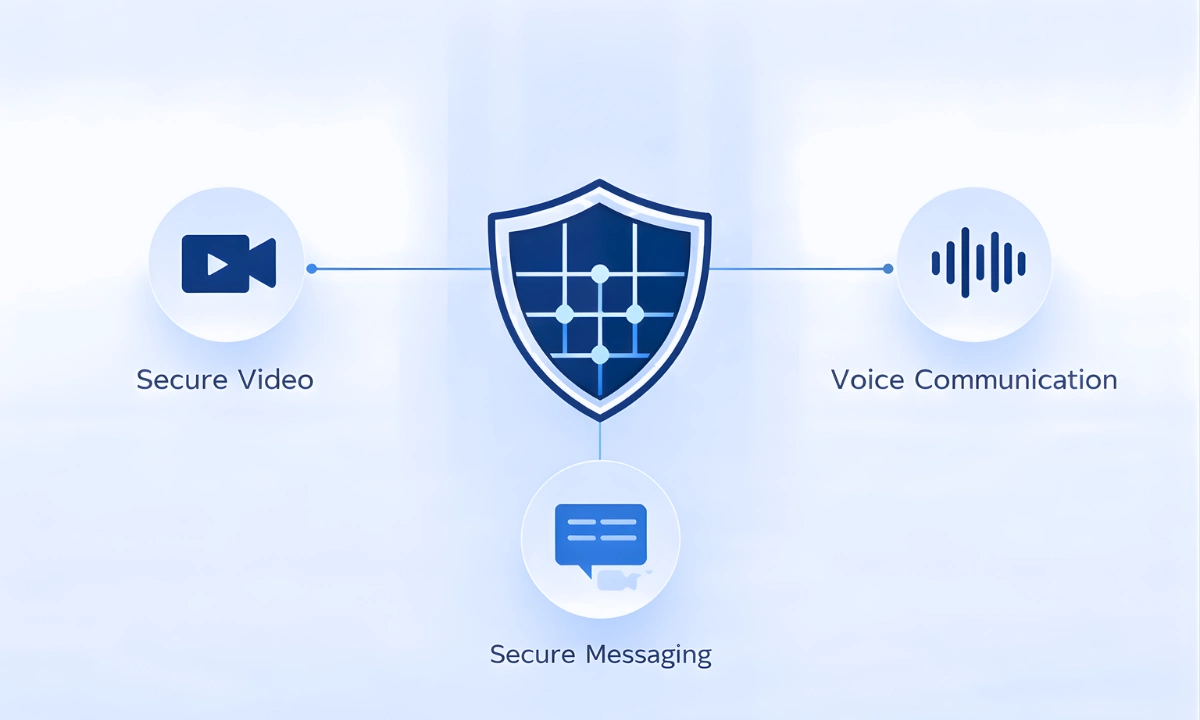
ClinicianCore enforces E2EE across all four platform modules HCO, HCC, HCX, and D.O.C. — covering every communication channel: secure messaging, voice calls, video sessions, and file transfers.
Encryption at rest uses AES-256. Encryption in transit uses TLS 1.2 or higher. Neither ClinicianCore’s administrators nor its technical staff can access the content of messages or calls transmitted through the system this is a structural guarantee, not a policy choice.
A fully executed Business Associate Agreement (BAA) is provided to every customer before any ePHI is handled. Review the full security architecture on the Security & Compliance features page .
The Shadow IT Problem: Consumer Apps Are Not End-to-End Encrypted for ePHI
The most pervasive encryption failure in healthcare is not a technical vulnerability in a clinical system it is the routine use of consumer messaging applications by clinical staff. Physicians, nurses, and care coordinators communicate via SMS, WhatsApp, and iMessage because those applications are fast, familiar, and installed on devices they already carry.
These applications present two compounding compliance failures:
- No Business Associate Agreement: Consumer messaging providers do not offer BAAs. Any use of these platforms for patient-related communication constitutes a per se HIPAA violation, regardless of the technical features of the application.
- No true end-to-end encryption for ePHI purposes: While some consumer applications advertise E2EE for their core messaging function, none provide the complete compliance infrastructure required for ePHI including tamper-evident audit trails, role-based access controls, configurable data retention, and breach notification obligations in a signed BAA.
- No audit trail: Consumer applications do not maintain the tamper-evident logs of message activity required by the HIPAA Security Rule. In an OCR investigation, this absence is itself a violation independent of whether a breach occurred.
These behaviors create hidden data exposure across healthcare organizations
In 2024, OCR’s Security Risk Analysis Initiative cited inadequate activity review and access monitoring as top findings across enforcement actions. The financial exposure is direct: in February 2024, Montefiore Medical Center paid $4.75 million after an employee was able to steal and sell patient data a consequence of inadequate access controls that shadow IT behavior consistently undermines (HHS OCR, 2024).
The compliance goal is not to prohibit communication. It is to provide a HIPAA-compliant collaboration platform that is more convenient than the consumer apps clinicians are already using. Adoption follows usability.
Evaluating Vendor Encryption Claims: The Questions That Matter
HIPAA compliance marketing is pervasive, and encryption claims are among the most commonly misrepresented. Administrators should approach vendor encryption assessments with a structured set of questions and accept only documented evidence, not verbal assurances.
On End-to-End Encryption Architecture
- Is the encryption end-to-end, or transport-layer (TLS) only? Can your platform’s administrators or technical staff access the content of messages and calls?
- Where are encryption keys managed? Are they held by the vendor, or by the end-user devices?
- What encryption standards are used for data at rest and in transit? (AES-256 at rest; TLS 1.2 or higher in transit are current minimums.)
- Are voice calls and video sessions encrypted with the same standard as text messages? Many platforms secure text but not media streams.
- Are attached files and documents encrypted end-to-end, or only during transmission?
On Third-Party Validation
- Has your encryption implementation been independently audited? Can you provide the most recent SOC 2 Type II audit report?
- Do you hold HITRUST CSF certification? This is the most comprehensive healthcare-specific compliance framework and requires a validated assessment by an authorized external assessor.
- Can you provide results from your most recent penetration test?
- What is the date range of your current certifications? There is a significant difference between a completed SOC 2 Type II audit and a readiness assessment that has not yet resulted in a formal report.
On Legal and Contractual Commitments
- Will you sign a BAA before any ePHI is transmitted through your system? Any vendor unwilling to sign a BAA should be immediately disqualified.
- What are your contractual breach notification timelines specified in the BAA?
- Does your BAA specifically address encryption architecture and your obligations in the event of a key management failure?
How ClinicianCore Addresses Vendor Evaluation
ClinicianCore provides a fully executed Business Associate Agreement to every customer before any handling of ePHI begins. The BAA specifies breach notification timelines and contractual obligations in plain terms.
The platform’s encryption architecture is documented and available for review by compliance officers and CIOs conducting vendor assessments. Security certifications and audit documentation are available upon request.
Encryption Is Necessary But Not Sufficient for HIPAA Compliant Collaboration
End-to-end encryption addresses transmission security and integrity controls. It does not, on its own, satisfy the full framework of HIPAA requirements for a clinical communication platform. Administrators evaluating vendors for HIPAA-compliant collaboration should confirm all seven non-negotiable requirements are met:
- End-to-end encryption for all channels (messaging, voice, video, file transfer)
- Comprehensive, tamper-evident audit trails logged for a minimum of six years and exportable for OCR audit purposes
- Role-based access controls (RBAC) enforcing the minimum necessary standard at organizational, departmental, and individual user levels
- Automatic session timeouts and centrally managed remote wipe capability for mobile devices
- A signed Business Associate Agreement (BAA) provided before any ePHI is handled
- Configurable data retention policies with secure deletion not manual user deletion
- Documented breach response protocols with contractual notification obligations in the BAA
A platform that enforces E2EE but lacks tamper-evident audit trails still exposes the organization to enforcement risk. A platform with strong audit logging but no signed BAA constitutes a per se HIPAA violation regardless of technical security. For a complete analysis of all seven requirements, see What Makes a Communication Platform Truly HIPAA Compliant?
Is Your Clinical Communication Platform Truly HIPAA Compliant?
See how ClinicianCore delivers all seven requirements — with a signed BAA from day one.
For Compliance Officers & CIOs
Use our Security Architecture documentation to answer vendor assessment questionnaires and demonstrate due diligence to your board.
→ View Security & Compliance FeaturesQuantify Your Compliance ROI
A single Tier 4 HIPAA violation can exceed $2.1M per violation category. Use our Impact Estimator to model the risk cost vs. the cost of a compliant platform.
→ Use the ClinicianCore Impact EstimatorFrequently Asked Questions
What is end-to-end encryption and why does it matter for healthcare?
End-to-end encryption (E2EE) means that a message is encrypted on the sender’s device and can only be decrypted by the intended recipient’s device. No intermediary including the platform provider can access the content. In healthcare, this matters because any system handling electronic Protected Health Information (ePHI) must protect that data against unauthorized access throughout its lifecycle. Platforms that encrypt data only in transit but decrypt it on their servers create a technical vulnerability that conflicts with the HIPAA Security Rule’s transmission security and minimum necessary requirements. For clinical communication platforms, E2EE is the baseline safeguard not an optional feature.
Is transport-layer encryption (TLS) the same as end-to-end encryption?
No. Transport-layer encryption protects data as it travels between a user’s device and the platform’s server. Once the data arrives at the server, it is decrypted. The platform provider can then read and access message content. End-to-end encryption ensures that data is encrypted on the sender’s device and can only be decrypted by the recipient’s device the platform’s server never has access to readable content. For ePHI, the distinction is critical: TLS alone does not prevent the vendor from accessing patient communications. A genuinely HIPAA-compliant clinical communication platform must enforce E2EE, not just TLS.
Are WhatsApp and iMessage end-to-end encrypted and therefore HIPAA compliant?
No. While WhatsApp and iMessage advertise end-to-end encryption for their messaging function, neither application is HIPAA compliant for clinical use. Neither provides a Business Associate Agreement a legal requirement before any vendor can handle ePHI on behalf of a covered entity. Neither maintains tamper-evident audit trails, enforces role-based access controls, or provides configurable data retention meeting HIPAA’s six-year minimum. Any patient-related communication transmitted through a consumer application constitutes a reportable HIPAA breach, regardless of that application’s encryption features. The encryption claim does not compensate for the absence of a BAA and the missing compliance infrastructure.
How does ClinicianCore implement end-to-end encryption across its platform?
ClinicianCore enforces end-to-end encryption across all four platform modules HCO (Healthcare Organization), HCC (Healthcare Collaboration), HCX (Healthcare Xchange), and D.O.C. (Doctor’s Opinion Count). This covers every communication channel: secure messaging, voice calls, video sessions, and file transfers. Encryption at rest uses AES-256; encryption in transit uses TLS 1.2 or higher. ClinicianCore’s administrators and technical staff cannot access the content of messages or calls transmitted through the system. This is an architectural guarantee, not a configurable setting. A fully executed BAA is provided to every customer before any ePHI is handled.
What should administrators ask a vendor to verify their encryption claims?
Administrators should request: (1) confirmation of whether encryption is end-to-end or transport-layer only specifically asking whether platform staff can access message content; (2) the encryption standards used at rest and in transit (AES-256 and TLS 1.2+ are current minimums); (3) whether voice, video, and file transfers are encrypted with the same standard as text messages; (4) the most recent SOC 2 Type II audit report with a clearly dated audit period; (5) HITRUST CSF certification documentation if available; (6) penetration test summaries; and (7) a signed BAA template. Verbal assurances and marketing claims are not sufficient documentation of independent audits with specific date ranges is the evidentiary standard.
Sources
HHS Office for Civil Rights (2024–2025). Resolution Agreements and Civil Money Penalties 2024–2025. U.S. Department of Health & Human Services. https://www.hhs.gov/hipaa/for-professionals/compliance-enforcement/agreements/index.html
https://www.ecfr.gov/current/title-45/subtitle-A/subchapter-C/part-160
https://www.hhs.gov/hipaa/for-professionals/compliance-enforcement/agreements/index.html
https://www.ecfr.gov/current/title-45/subtitle-A/subchapter-E/part-164
HHS (December 2024). HIPAA Security Rule Notice of Proposed Rulemaking (NPRM). Federal Register. U.S. Department of Health & Human Services.
HHS (January 28, 2026). HIPAA Civil Monetary Penalty Inflation Adjustments. Federal Register. U.S. Department of Health & Human Services.
NIST Special Publication 800-66 Rev. 2. Implementing the Health Insurance Portability and Accountability Act (HIPAA) Security Rule. National Institute of Standards and Technology.
HIPAA Security Rule, 45 CFR Parts 160 and 164. U.S. Department of Health & Human Services.
Feldesman LLP (May 2025). OCR Risk Analysis Initiative Summary. Retrieved from https://www.feldesman.com/
Shook Hardy & Bacon (March 2025). OCR Enforcement Analysis. Healthcare Compliance Report.
HITECH Act Enforcement Interim Final Rule. U.S. Department of Health & Human Services. 45 CFR Parts 160 and 164.