
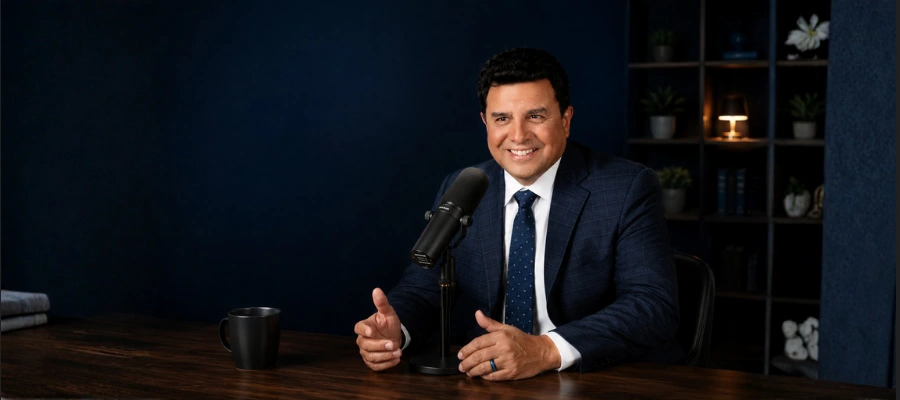
Welcome everyone. This is our second webinar. The topic of today’s webinar is the importance of the Doctor’s Lounge. We are looking to reclaim the private space for peer support and decision-making in modern medicine. We will explore further the root cause why emotional exhaustion and stress are arriving in modern practice. And I’m sure every one of them can give a lot of stories about what’s the root cause here, and why this keeps happening. I think in ’24, 45% of the physicians in our country were facing one way or another, physician burnout. So every second doctor right now is feeling that. We’ll explore the root cause, and then we’ll see how it impacts… how administrative burden for these doctors and loss of private space erode the resilience. And finally, the solution. How trusted community connection restores balance and meaning.

I appreciate everybody coming. I appreciate the panelists being here. I just want to give everyone kind of, like, this 36,000-foot view of the project. So, this project really started with a very simple question, and the question is: How do you get a physician to go to a meeting? Because they won’t go. And over the years, what we found is all the reasons that they gave for physicians not going to meetings aren’t really true. Like, physicians do care, they do want to be involved, they do want to have a say. They just don’t have time. And the problem is, that the physicians can’t leave their time universe, they can’t leave patient care to go to a meeting. Because they’re busy.

What we found over the years—this is our 7th year—is that the dissatisfaction, the frustration, physicians quitting, the burnout at 45%, physician suicide rate at 15%, it all seems to tie back to this idea that physicians are not engaged. They’re increasingly disengaged, they’re increasingly isolated. So, in order to attack this problem, what do we have to do? We have to bring the physicians back, we have to re-engage them, but in order to do that, we have to communicate with them. We have to bring the meeting to them.

ClinicianCore is a unified communication platform, it’s completely private, it’s HIPAA compliant, it’s invite-only, everything’s automatically deleted after 30 days. Instantly. It’s as secure as we can get it.

Section 1: The Identity Crisis (Physician vs. Provider)

So, our webinar today has four sections, and we’re going to start with our first section. This section talks about this idea of the identity crisis and the provider debate. You know, we’ve seen this change from physician to provider, right? Like, in this administrative context, the EHR context. So, how is this… to any of the panelists, how has this affected you morally? Are you a provider? Do you feel like a provider?

No, I don’t feel like a provider, but I get it, I get… everybody looks at me as a provider.

I think that we need a collective term for people providing the care to the patients, but the whole generalization and including people with far different training than our own… I feel sometimes as if it’s part and parcel with scope creep and people with less training sort of assuming… attorneys that are out of their scope because they’re now in a group, in a collective term with us. I do feel sometimes, like, I’ve been stripped of a lot of expertise in a couple of board certifications with the evolution of that term. That said, we need something collective, and you know, we’ve done it to ourselves a little bit by bringing everybody else in and allowing them to do more and more of the things that we did with the best of intentions, trying to lighten our load of some of the more mundane things. I just think we’ve fallen a little bit victim to unintended consequences.

Yeah, no, I agree. I mean, I think there’s definitely a need to have a title for everyone that provides… I work closely with APRNs and PAs, and sometimes they make calls that they don’t necessarily have the scope to make, but they’re put in that position by the whole medical complex. You know, we’re short-staffed across the nation, especially here in Northern Nevada. And you have this huge patient population that needs to be seen, and we kind of hand off a lot of that responsibility over. But at the same time, you’re handing over your title as the physician as well.

In my experience, especially the first interaction with any person in healthcare has been some sort of not a physician, but everybody else. So the idea regarding when they see us is that we are all the same. Sometimes you just really have to nail down and sit down with them, and tell them the gravity of the situation. People are not mentioning their scope, so I think that should be done. At least when people are entering the room. Even as an MD in internal medicine, I do say that… if it’s outside my scope of practice, I do refer to the right people.

It takes 12 to 18 years to train a physician. Do you feel like this idea that says that, okay, I can go to… I can train half or a third, and that’s okay. Do you feel like that takes away from your autonomy as a physician? Does it take away from your title?

I do think the training is very limited. On the other end, at least in our field, how we practice inpatient hospital medicine, I think the training people come in with is very reflexive training. Which diminishes what I do when people say, “oh yeah, you know, this is this, so you just do this.” It doesn’t really work like that. It took a lot of years of training to understand the nitty-gritty of the entire thing.

Do you feel like this shift to providers is a method to try and make you interchangeable with everyone else?

I feel like that has been the direction things have been going for a number of years. The overall direction has been to turn this into cogs that are easily replaceable, with less appreciation for what our expertise, training, and experience make us into. And so, that term is particularly offensive to me every time I hear it. I don’t feel interchangeable, but I get this idea of plug and play. Recent events in the surgery department at the hospital, it seems like the administration thinks that, “oh, this surgeon’s not working out, let’s remove this surgeon and put another surgeon in, and they’re going to be equal.” And as we all know, that’s not the case.

So, should we as a community of physicians say no? We’re done. We’re gonna push back against this. We’re not okay with being called providers anymore. Is that something we should do?

I think it has to come with an answer. Saying that we should not be called providers, I completely agree, because we are not providers. We are doctors. We train for this. To call us providers with everyone who has not done this… I don’t think it’s right. Most times, it’s demeaning.

I think the one thing that marks me as a physician is my name badge. We have big blue lettering that says “PHYSICIAN” on it. I think it’s almost to the point where it’s gotten so taken away from us, it may be a pretty uphill battle. But I do think that working towards that is not something we shouldn’t do.

Section 2: The Doctor’s Lounge

Next section, we’re talking a little bit about the concept of a physician lounge versus an actual physician lounge versus this cyber lounge, the Doc Lounge. So, when you think about the doctor’s lounge, right, it’s like this area where you get down there, maybe you have lunch, maybe get a cup of coffee. How do you feel about taking that lounge and putting that lounge into a virtual space? Would you feel comfortable?

I don’t know about comfortable right off the bat, I’m sure I would become comfortable with it. I feel like it’s probably inevitable, given the way things have evolved in the hospital space. As somebody that’s old enough to clearly remember the hospital lounge and having gotten a ton of work done, as well as finding out about the lives of my colleagues and building relationships over the years, I very much miss that concept. But I would say that almost anything that gets close to it or tries to approximate it, it would be valuable.

So for you, the lounge is… it’s not just work, it’s personal. Like, it’s a way to catch up with people, check in with people, see what’s happening.

Yeah, you know, I mean, facial expressions, body language, and finding out something that’s not medical about somebody’s life, and making some connection on those levels 100% improves your interaction on a clinical level.

I would use the doctor’s lounge… I use the doctor’s lounge primarily when I’m rounding in the hospital, but even when I’m in the clinic… it’s nice to have some connection with a different physician, the primary care physician, where it’s not strictly just an iMessage text message.

Primary care physicians don’t round in the hospitals anymore. So there’s a large group of physicians that can’t use the physical doctor’s lounge. It used to be this personal connection that I think, as we sub-specialized ourselves to death, you really don’t see anymore.

I don’t know how many times I’ve had a conversation with a primary care doctor where I’ll say I read an echo or a stress test and it’s abnormal. And I pick up the phone and call them. To hear them on the other end, how much they appreciate just that phone call. That’s that disconnect that is no longer there.

I have a great story. You know, I know who reads my pathology reports. I have never met that person. Same thing for my ENT surgeons or my orthopedic surgeons. But once you start talking to them on the phone, or once you see them, and you kind of connect to them, there’s so many layers… it makes you a better physician, and a better human.

When we started designing this app, we said that we should make video as a center of the lounge. It proves your point. When we have so seamlessly, instead of you call, make a video call. And video is becoming seamless.

There’s so many patients where just not one specialty is needed, and if you can get two people… without having multiple layers of reaching the voice answering service, and this and that, which takes eternity most of the times. If somebody can be given a common time, it becomes so much easier.

One is the video doctor, a second is the non-linear, where you can send a message now. And then you can reply on your own time, right? Because we all know how busy you guys are.

Section 3: Safety and Security

So, this kind of leads into our next segue. When you’re in that doctor’s lounge, do you feel safe and secure? Do you feel safe that it’s okay to speak your mind?

For me, the word that comes to mind is organic. It seems like the doctor’s lounge is organic. I’ve been here long enough to remember the old days at the old hospital when all the primary care doctors came in from the community, and it was just safe and organic and you felt comfortable talking about any and everything.

One of the problems we had with the first iterations of this project was that it was sponsored by the hospital. And there were a lot of people that felt like there was Big Brother watching them. Do you feel like you’re being watched?

There’s always a confidence that you have to be a little careful with your wording. I do feel if it’s a common place for all the physicians, and not just for our hospital… if we are thinking about it as a community space, I think it will be easier if it’s owned by the community, as compared to an organization.

What would make you feel comfortable and secure in the virtual lounge to be able to say whatever you want to say?

No screenshots. This has to be a mechanism where people cannot screenshot the screen, because if you’re going to talk about not just patients, about life, or what you went through emotionally… things can be hard. If people have to be a little more comfortable regarding what they felt and how they felt, it has to be completely secure on that end that somebody would not be able to take advantage.

I think the big thing is for everyone in the actual space to know that they have freedom to say whatever they want. Obviously, having administration involvement… I would definitely not want them within that community or space. Because I do think that sometimes, you know, even in meetings that we go to, sometimes we bite our tongue a little bit and don’t say exactly what we feel.

I’m a little bit paranoid about it, but I do think moving on into the current age… I think that screenshot suggestion would be invaluable, because that’s what gets people out in the larger world of social media and all. It’s not the moment, it’s the screenshot that gets posted all over the internet.

When I was in training, we used to have a room… where the residents would meet, and we called it the BS Lounge. And that’s exactly what it was. We would be able to go in there and just unload. If you’re having a hard day, just to be able to unload to someone that has an idea of what you’re talking about, that changes the course of the day for yourself. Instead of this isolation where you’re just sitting in front of computers. I think that kind of space also helps with burnout.

Section 4: Professional Isolationism and Burnout

We’re going to talk a little bit about this concept of professional isolationism. On any given day, you get hounded with some kind of notification… text, overhead page, code, phone calls constantly. But yet, despite the fact that you have all these ways to be reachable, physicians still feel like: “some days I just want to crawl under a rock.” Do you feel like that?

Absolutely, yes. Especially when you’re holding the phone. It can be like 5 calls from the floor, 5 calls from the ER, anesthesia calling… every call is important, but there’s a lot of stimulation. I believe text and having a common place where people… like a group, where we have admissions… if I can strategize and make sure which call has to be returned first without going here and there, I think that would be the most ideal. But yeah, it is very overwhelming when you are getting a lot of pings.

How does it make you feel? Like, we talk about the concept of burnout… how does all this make you feel on any given day?

I don’t want to talk to anyone, I don’t want to call my parents… I just want to crash in my bed. You know, it takes a toll on your next day, too. The problem is, I think when we are all trained, most of us have been trained that never show your anger. But because you’re trying to be so nice everywhere, when you go home, sometimes that niceness completely fizzles off. So you take the emotion home.

I completely agree. There’s days you’ll see 20, 25, 30 patients in the clinic, and then you sit down to work on some notes, and there’s 30 phone calls to respond to. And you’re just like… I don’t even know how to try to even catch up. You feel cornered. And then talking about not taking the work home… it’s hard to come home and speak to a spouse about your day in medicine. They just don’t understand the complexities.

Raise your hand if in the last year you felt burnout.

(Group indicates roughly 50% felt burnout)

We talk about burnout, and we say as physicians we’re just supposed to be tough and deal with it. Do you think the role of having this peer connection… can help stop burnout?

Absolutely. Not to disclose anything from my work as Vice Chief of Staff, but you know, you talk about burnout, you talk about suicide. You also need to talk about the amount of substance abuse that is out there amongst physicians as well. And you know, we self-medicate. Because we’re told: “You don’t say anything.” And so, when you don’t have that “BS lounge” environment where you can go and say whatever you want, what are you supposed to do?

I completely agree. I think talking about it helps. Just even just talking about… running things with each other. Sometimes it’s good that your peer is saying, “hey, you know, this was not personal, it happens.” And sometimes it really helps you to let go of things which you are taking extra personally.

Section 5: HCX (Healthcare Exchange)

One last question. So we brought on this idea of an HCX. Which is a healthcare exchange. But in our exchange, it is a non-compliant space where you could connect with vendors, you could connect with each other, you can discuss these higher-level topics… whether it’s a new medication, a new cardiac device. But you can then take that conversation into a doctor’s lounge and have… like, we all know what it’s like to talk to a rep. They’re selling you everything. But then we can take that conversation into a specialty section in the Doc Lounge and say, “okay, now, what do y’all think about this?” Would you use the HCX?

I mean, God, yes. When I had a private practice, I eventually barred the reps from coming in. But you still need to know about these new things, the new medications, new techniques. Just to have the “Reddit of medicine” to go and ask about it… I mean, that seems like more of an apple pie to me.

Oh yeah, absolutely. I mean, I think it’d be a good way to even get evidence in regards to any research on new medications that are out without having to wait for them to bring you lunch.

It kind of exists already with a couple online groups for robotic surgery. It’s just a cool way to post your videos, and like, “oh, that’s how that guy does it, oh, here’s how you use this new mesh or new suture.” It’s a real quick and easy way just to pop it up on your phone.

We have actually looked at the discrete way… so you can communicate with them. And they will just provide a profile. And that, too, those profiles will also be specialty specific. And we control that so that it’s not… we are not allowing them to communicate, because that defeats the whole purpose.

Conclusion

Alright, well, I’m going to wrap it up, because our hour’s up, but I want to thank all of you. You guys are all really busy, I get it. So, I just want to thank you all for coming on. A lot of great insight, a lot of great validation, a lot of stuff we haven’t thought about.

Yeah, I mean, this conversation actually proved that when physicians come together, narrative changes. That’s what I see. It feels like there is a purpose of this kind of discussion. And I think it motivates us to provide this app so that, like one of you said, even if we can add 5%, make your life easier… that itself is a win.

Thank you all very much for coming, I appreciate it.

Enjoy the rest of your day.